
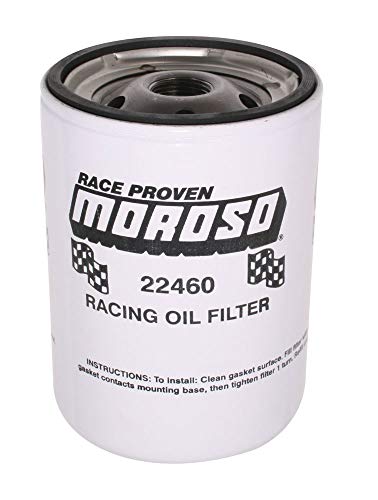
Correct Fitment: Thread and Sealing Surface Matter
Your distributor feed identifies:
Fit Type: Vehicle Specific
That’s too broad to be useful.
The 22460 should be treated as:
Application-specific / filter-interface specific
Moroso identifies it primarily for SBC, BBC, Chevrolet and other compatible applications using the proper 13/16″-16 filter interface.
Compatibility depends on more than seeing 13/16″-16 threads.
Before ordering, verify:
- Filter thread
- Gasket diameter
- Filter mounting surface
- Filter bypass arrangement
- Available filter height
- Header clearance
- Chassis clearance
- Oil-pan clearance
- Required filter specification
Similar threads do not automatically make two oil filters interchangeable.
As the My Pro Street Oil Pressure Warning Light Guide points out, the wrong or restricted filter can affect oil delivery. A filter that screws onto the engine is not automatically the correct filter.
5-1/4-Inch Long Design
Moroso specifies the 22460 at:
5-1/4 inches tall
That makes physical clearance one of the first things to check.
A longer filter may interfere with:
- Headers
- Exhaust pipes
- Chassis crossmembers
- Steering components
- Engine mounts
- Oil pans
- Suspension components
- Belly pans
- Race-car chassis tubing
Measure before ordering if the vehicle has a tightly packaged engine bay.
A filter with excellent flow characteristics isn’t particularly useful if the header occupies the same physical space.
13/16″-16 UNF Thread
The Moroso 22460 uses:
13/16″-16 UNF
spin-on filter threads.
This is a traditional Chevrolet-style filter configuration used on numerous applications.
Moroso specifically categorizes the 22460 as:
SBC / BBC / Chevy
while also describing it as suitable for Chevrolet and other compatible applications.
That makes it especially relevant for:
- Small Block Chevy engines
- Big Block Chevy engines
- Traditional Chevrolet performance builds
- Compatible aftermarket blocks
- Compatible remote oil-filter mounts
Always verify the specific filter mounting arrangement.
27-Micron Filtration Rating
One of the most important specifications for the Moroso 22460 is its:
27-micron rating
Moroso chose that specification deliberately.
According to Moroso, its engineers determined that extremely fine racing filters can create excessive restriction and pressure drop. Moroso’s racing-filter strategy therefore balances particle filtration with the need to maintain oil flow under severe operating conditions.
The company rates its racing filters at 27 microns.
This is not simply a marketing contest over which filter advertises the smallest micron number.
Oil filtration is a balance between:
Filtration efficiency
and
Oil-flow restriction
particularly in racing applications.
Maximum Initial Restriction: 2.5 PSI
Moroso states that its 27-micron racing-filter design produces a:
Maximum initial restriction of 2.5 psi
when tested according to SAE J806.
That specification matters because pressure drop across the filter reduces the pressure available downstream of the restriction.
Moroso’s stated objective is:
- Less pressure drop
- More oil flow
- Reduced bypass operation
- Effective filtration under racing conditions
That makes the 22460 fundamentally different from choosing an ordinary replacement filter solely because it happens to fit the threads.
Why Oil-Filter Restriction Matters
The oil pump has to push lubricant through the filter before that oil can continue through much of the engine’s lubrication circuit.
A filter that becomes excessively restrictive can create a larger pressure differential across the filter media.
Depending on the engine and filter system, excessive restriction can cause the bypass valve to open.
When bypass occurs, some or all of the oil may travel around the filter media rather than through it.
Moroso specifically designed its racing filters to minimize this situation under severe operating conditions.
Bypass Is a Safety Strategy, Not a Filtration Feature
Oil-filter bypass exists because an engine generally needs unfiltered oil more urgently than it needs no oil at all.
If a filter becomes too restrictive, bypass operation can preserve oil flow.
That’s preferable to starving bearings.
But it also means oil isn’t receiving normal filtration while bypass is occurring.
This is why Moroso emphasizes balancing filtration with restriction rather than simply advertising the smallest possible micron rating.
Oil Pressure Is Not the Same as Oil Flow
A pressure gauge doesn’t tell the entire lubrication story.
Oil pressure represents resistance to flow within the system.
The engine ultimately needs sufficient oil flow at appropriate pressure to maintain protective oil films at:
- Main bearings
- Rod bearings
- Cam bearings
- Valvetrain components
- Distributor drive where applicable
- Turbocharger bearings where equipped
An extremely restrictive component can change the pressure relationship without improving lubrication.
The goal is a complete oiling system that delivers the correct oil volume and pressure throughout the engine.
Why Racing Engines Need Reliable Oil Flow
Racing conditions can expose an oiling system to:
- High RPM
- Sustained load
- High oil temperature
- Increased pump volume
- Higher bearing loads
- Rapid acceleration
- Hard braking
- Cornering forces
- Extended full-throttle operation
The oil filter becomes part of that system.
A racing filter therefore has to do more than keep ordinary street-engine contamination out of the bearings.
It needs to maintain useful flow under demanding conditions.
Heavy-Duty Filter Construction
Moroso’s racing-filter design incorporates features intended for severe operating conditions.
According to Moroso’s racing-filter documentation, the design includes:
- Extra-thick housing
- Reinforced backplate
- Roll-formed threads
- Pleated filter element
- Metal end caps
- Anti-drainback valve
- Buna-N gasket
Each addresses a different requirement of a racing lubrication system.
Extra-Thick Housing
Moroso uses a heavier filter housing designed to withstand elevated pressure and pressure surges.
That’s especially important on racing engines that may use:
- High-volume oil pumps
- High-pressure pumps
- Cold high-viscosity oil
- External oiling components
- Accumulators
Cold-start pressure can be considerably higher than hot-idle pressure because cold oil has greater viscosity.
The filter housing needs sufficient structural margin for those conditions.
Reinforced Backplate
Moroso’s racing-filter design also uses an extra-thick backplate.
The backplate forms the structural interface between the filter and engine or filter mount.
It has to support:
- Filter gasket
- Oil passages
- Threaded mounting connection
- Internal pressure
A performance filter is therefore more than filter media inside a painted can.
Its housing and mounting structure matter too.
Anti-Drainback Valve
Moroso incorporates an:
Anti-drainback valve
designed to help retain oil in the filter after engine shutdown.
Whether an anti-drainback valve is critical depends partly on filter orientation and engine design.
On installations where oil could otherwise drain from the filter, retaining oil can help reduce the time required to refill the filter after startup.
That can be especially useful on engines that sit between events.
Metal End Caps
Moroso’s racing-filter documentation specifies:
Non-porous metal end caps
The purpose is to prevent oil from bypassing the filter element through the ends of the media.
Again, filtration performance depends on the entire internal construction—not simply the micron number printed on the box.
Buna-N Gasket
Moroso specifies a:
Buna-N sealing gasket
and describes it as compatible with racing fuels and lubricants.
The gasket is the seal between the oil filter and mounting surface.
Before installing the filter:
- Remove the old filter.
- Verify the old gasket came off with it.
- Clean the mounting surface.
- Inspect for damage.
- Lubricate the new gasket with clean engine oil where specified.
- Install according to Moroso and engine-manufacturer instructions.
Never Double-Gasket an Oil Filter
When removing the old filter, always verify its gasket isn’t stuck to the engine.
If the old gasket remains and a new filter is installed over it, the engine now has two gaskets stacked together.
That can create a severe oil leak as soon as pressure rises.
A double-gasketed oil filter can dump engine oil remarkably quickly.
It’s one of the simplest mistakes capable of turning an otherwise routine oil change into an engine-damage investigation.
Burst-Pressure Specification Needs a Caveat
Your distributor data lists:
300 psi maximum burst capability
Moroso’s current individual product page also lists the 22460 at:
300 psi maximum
However, Moroso’s current racing oil-filter chart lists the 22460 at:
350 psi maximum
Because Moroso’s own current documents conflict, the safest Pro Street Online specification is:
Burst Strength: 300 psi maximum according to Moroso’s current individual 22460 product listing
Do not advertise the filter as guaranteed for 350 psi unless Moroso confirms which specification supersedes the other.
Don’t Confuse Burst Pressure With Operating Oil Pressure
A 300 psi maximum burst rating does not mean the engine should run at 300 psi oil pressure.
Burst strength is a structural limit specification.
Normal operating pressure should follow the engine builder’s or engine manufacturer’s specification.
Excessive oil pressure can still:
- Damage seals
- Stress filter components
- Increase pump drive load
- Waste power
- Create oil-control problems
A high burst rating provides structural margin.
It isn’t an oil-pressure target.
Moroso 22460 Cross-Reference
Moroso’s current filter chart provides the following cross-reference for the 22460:
FRAM: PH13, TG13, HP4
Purolator: L30040
Motorcraft: FL12
WIX: 51061
AC: PF35
GM: 6438384, 6437946, 6435679
K&N: HP-3002
Hastings: LF24, LF224
STP: S-029
Cross-reference information helps identify the general filter family.
It should not replace verification of:
- Thread
- Gasket
- Filter height
- Bypass design
- Required flow
- Application specifications
22459 vs 22460 vs 22461
Moroso offers three particularly useful Chevy-style racing-filter lengths.
Moroso 22459
Thread: 13/16″-16 UNF
Height: 4-9/32 inches
Design: Short
Best where chassis or header clearance limits filter height.
Moroso 22460
Thread: 13/16″-16 UNF
Height: 5-1/4 inches
Design: Long
A useful middle-size option where additional filter length fits.
Moroso 22461
Thread: 13/16″-16 UNF
Height: 8 inches
Design: Extra long
Moroso describes this as approximately a two-quart-capacity filter for applications with sufficient space.
The 22460 sits neatly between the compact 22459 and enormous 22461.
Don’t Substitute 22462 Just Because It Has the Same Thread
This is particularly important for Pro Street customers building LS engines.
Moroso lists:
22462 — Early GM LS, 1997–2006
with:
13/16″-16 UNF threads
and:
3-1/2-inch height
The fact that 22460 and 22462 share a nominal thread does not mean they should automatically be interchanged.
Moroso engineered the 22462 specifically for early LS applications.
Your Ultimate GM LS Engine Guide explains how quickly GM engine architecture and component compatibility changed across LS generations.
Order the filter designed for the actual engine and filter mount.
Later LS Engines Use a Different Filter Family
Moroso lists:
22463
for many:
2007-up GM LS applications
using:
22 mm-1.5 threads
The 22463 is also listed for various Ford modular and import applications.
Again, this reinforces why the 22460 shouldn’t be sold simply as a generic “Chevy filter.”
Traditional SBC/BBC applications and modern LS engines do not all use the same filter configuration.
Check Filter Clearance Before Ordering
Because the 22460 is 5-1/4 inches tall, check clearance before installation.
This is particularly important with:
- Long-tube headers
- Engine swaps
- Custom crossmembers
- Dry-sump conversions
- Road-race oil pans
- Low ride-height cars
- Engine setback
- Custom steering systems
If clearance is limited, the shorter 22459 may be more appropriate.
If there is abundant room and additional capacity is desired, investigate the 22461.
Remote Oil Filter Applications
The 22460 can also work with compatible Chevrolet-style remote oil-filter mounts.
Moroso’s instructions for its 23750 and 23760 Chevy-style remote filter mounts specifically identify the 22460 as the long/truck-size filter option.
That creates a useful combination for vehicles where the engine’s original filter location has become difficult to access because of:
- Engine swap
- Headers
- Chassis design
- Oil cooler plumbing
- Racing oil system
- Custom suspension
Remote mounting can improve service access while also making additional oil-system plumbing easier.
Moroso 23691 Oil Cooler Sandwich Adapter
Moroso also lists the 22460 as an option for its:
23691 Oil Filter Adapter
The 23691 is designed for compatible SBC and BBC Mark IV / aftermarket blocks with a deep oil-filter pocket and provides -10AN ports for plumbing a remote oil cooler.
That makes the 22460 a natural cross-sell for traditional Chevy engines using an external oil cooler.
Oil Coolers Need Correct Plumbing
Adding a remote cooler creates additional:
- Hose length
- Fittings
- Connections
- Potential restrictions
- Leak points
Use appropriately sized oil lines and fittings.
Route them away from:
- Exhaust heat
- Sharp edges
- Moving suspension
- Steering components
- Driveshafts
- Belts
After installation, verify oil pressure and inspect every connection for leakage.
Verify Oil Pressure After Oiling-System Changes
Any significant change to a racing lubrication system should be followed by pressure verification.
This includes changing:
- Oil pump
- Filter type
- Filter location
- Oil cooler
- Remote filter mount
- Accumulator
- Oil-line size
- Oil viscosity
Your Oil Pressure Warning Light Is On Guide explains why actual oil pressure should be measured rather than assuming the dashboard warning circuit tells the entire story.
If pressure is questionable, use a mechanical gauge and compare readings with the engine manufacturer’s or builder’s specification.
Low Oil Pressure Can Destroy an Engine Quickly
Engine bearings depend on a pressurized oil film to keep loaded metal surfaces separated.
Insufficient oil pressure can damage:
- Main bearings
- Rod bearings
- Cam bearings
- Valvetrain
- Timing components
- Turbochargers
The My Pro Street LS1 Cam Bearing Damage Guide demonstrates how even internal bearing damage can contribute to reduced oil pressure.
The filter is only one component in the lubrication system.
Oil pressure problems still need complete diagnosis.
Oil Level and Oil Pressure Are Different
An engine can have a full oil pan and still suffer from low oil pressure.
Potential causes include:
- Worn oil pump
- Pickup restriction
- Pickup leakage
- Excessive bearing clearance
- Internal oil leakage
- Wrong oil viscosity
- Aerated oil
- Filter problems
- Pressure-relief valve failure
Likewise, an engine can show pressure on a gauge while still having oil-control problems under braking or cornering.
A racing lubrication system needs both adequate oil supply and appropriate pressure.
Pre-Fill When Appropriate
Depending on filter orientation and engine manufacturer’s recommendations, pre-filling the oil filter before installation may reduce the amount of time needed to fill the filter during initial startup.
This isn’t practical on every installation.
A horizontally mounted filter filled to the brim tends to convert installation into an oil-pouring contest.
Follow the engine builder’s recommended priming procedure.
Prime Freshly Built Engines Properly
A new or rebuilt performance engine should not rely on the starter motor alone to eventually figure out lubrication.
Follow the engine builder’s priming procedure before initial startup.
The objective is to establish oil supply through the engine before placing bearings and valvetrain components under combustion load.
This is especially important after:
- Fresh engine assembly
- Oil-pump replacement
- Major oil-system changes
- Remote filter installation
- Oil-cooler installation
- Long-term storage
Inspect the Used Filter
On a racing engine, the used oil filter is also a diagnostic tool.
After an appropriate service interval, inspect the oil and filter for evidence of:
- Bearing material
- Ferrous debris
- Aluminum
- Excessive sealant
- Carbon
- Coolant contamination
- Unusual debris
Dedicated filter-cutting tools allow the canister to be opened without producing the same amount of metal contamination as hacking through it with an abrasive wheel.
If the engine is telling you something through the filter media, try not to add your own grinding debris to the conversation.
Package Information
Your distributor data lists:
Package Height: 8.64 cm / approximately 3.40 inches
Package Length: 14.48 cm / approximately 5.70 inches
Package Width: 9.91 cm / approximately 3.90 inches
Package Weight: 453.6 grams / approximately 1.0 lb
These are package/shipping measurements.
The important physical product dimension supplied by Moroso is:
Filter Height: 5-1/4 inches
Moroso 22460 Specifications
Part Number: 22460
Product: Racing Oil Filter
Application: SBC, BBC, Chevrolet and other compatible applications
Thread: 13/16″-16 UNF
Design: Long
Filter Height: 5-1/4 inches
Filtration Rating: 27 microns
Maximum Initial Restriction: 2.5 psi under Moroso’s SAE J806 testing
Burst Strength: 300 psi maximum according to Moroso’s current individual product page
Filter Type: Spin-on racing oil filter
Anti-Drainback Valve: Yes, according to Moroso racing-filter documentation
Gasket: Buna-N
End Caps: Metal
Fitment: Application / filter-interface specific
Package Weight: Approximately 1.0 lb according to distributor data
Who Should Buy the Moroso 22460?
The 22460 is a strong choice for a compatible:
- Small Block Chevy
- Big Block Chevy
- Traditional Chevrolet performance engine
- Street/strip build
- Drag car
- Road-race car
- Circle-track car
- High-performance street car
- Compatible remote-filter system
It’s especially attractive where the vehicle has room for the 5-1/4-inch filter and the builder wants Moroso’s racing-oriented filtration and low-restriction design.
Who Should Choose Another Moroso Filter?
Consider the:
22459 when space is limited.
Consider the:
22461 when there is room for an extra-long Chevy filter and the application calls for it.
Consider the:
22462 for compatible 1997–2006 early GM LS applications.
Consider the:
22463 for compatible later GM LS/LT and other 22 mm applications.
Consider the:
22470 for compatible Ford, Chrysler and import 3/4″-16 applications.
Choose according to the engine and oil-filter interface rather than whichever filter has the largest can.
Final Verdict
The Moroso 22460 Racing Oil Filter is a long-format, 5-1/4-inch Chevy-style filter designed for compatible 13/16″-16 UNF applications.
Its biggest technical selling point isn’t simply that the housing is larger.
Moroso designed its racing-filter line around a 27-micron filtration rating and reports a maximum initial restriction of only 2.5 psi under SAE J806 testing, balancing filtration with the oil-flow demands of racing engines.
Combined with the heavy-duty housing, reinforced backplate, metal end caps and anti-drainback design, that makes the 22460 a much more purposeful choice for a compatible performance oiling system than grabbing whatever white filter happens to screw onto the block.
Just verify the thread, sealing surface and 5-1/4-inch clearance first.
The header doesn’t care what the cross-reference chart says.





There are no reviews yet.