
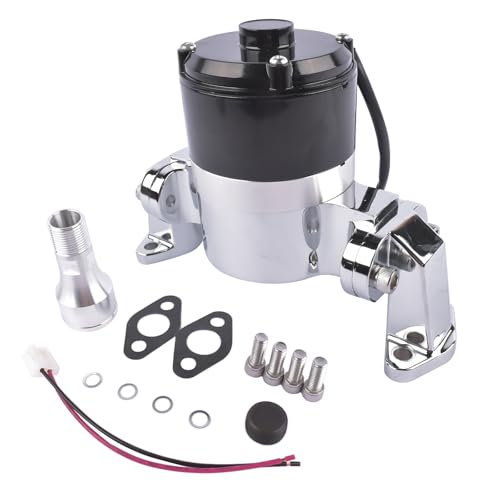
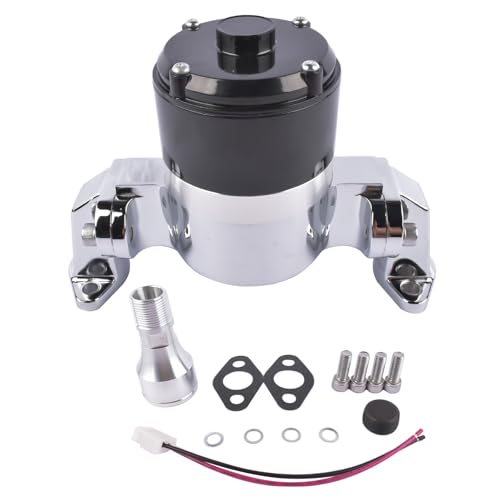
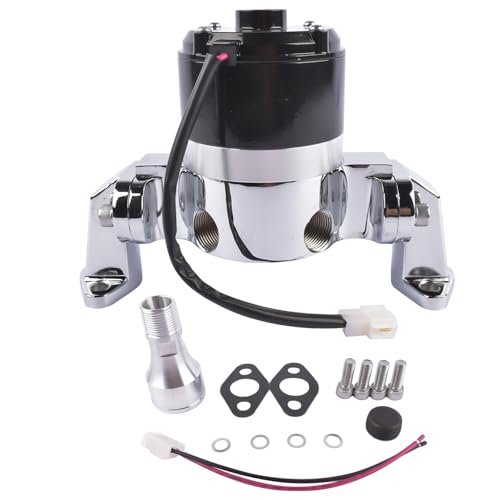
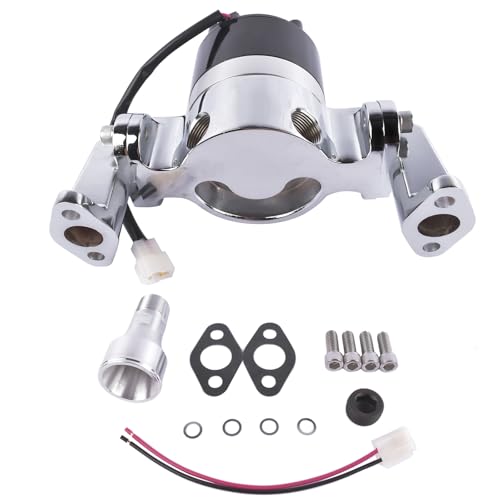
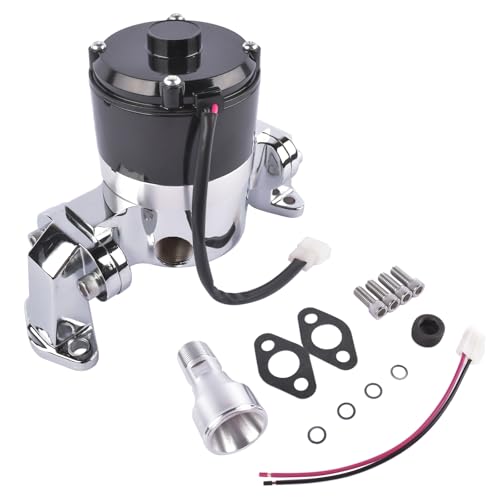
Product Specifications
- Reference number: 8010C
- Product type: Electric engine water pump
- Engine family: Traditional Gen I small-block Chevrolet
- Material: Aluminum
- Finish: Chrome
- Operating voltage: 12 volts
- Rated flow: 35 GPM
- Current draw: Approximately 5.5 amps, according to seller specifications
- Inlet hose size: 1.75 inches
- Overall depth without backing plate: Approximately 6.8 inches
- Inlet position: Left or right, depending on assembly configuration
- Mounting hardware: Listed as included
- Gaskets: Listed as included
Confirm the package contents before installation because generic 8010C pumps are sold by several aftermarket brands and suppliers.
Why Use an Electric Water Pump?
A mechanical water pump spins whenever the engine runs, and its speed rises with engine RPM. An electric pump operates independently of engine speed.
Potential benefits include:
- Consistent coolant flow at idle
- Reduced accessory drag
- Cleaner front-engine packaging
- Continued coolant circulation after shutdown
- Easier cooldown between drag-strip passes
- Removal of the water-pump pulley
- More flexibility with custom accessory drives
Electric pumps are particularly popular on:
- Drag cars
- Street-and-strip builds
- Race engines
- Show cars
- Custom accessory-drive installations
- Vehicles with electric radiator fans
- Engines requiring post-shutdown cooling
A 35 GPM rating does not guarantee that the complete cooling system can manage the engine’s heat. Radiator capacity, airflow, thermostat operation, coolant routing and electrical reliability still matter.
Is This Electric Pump Suitable for Street Driving?
It can be used in a street-driven vehicle when the pump is rated for continuous operation and the electrical system is designed correctly. However, an electric pump creates different failure considerations from a conventional mechanical pump.
A street installation should include:
- Properly sized wiring
- Dedicated fuse or circuit breaker
- Suitable relay
- Reliable ignition-switched control
- Adequate alternator capacity
- Strong electrical grounds
- Temperature gauge or warning system
- Manual override when appropriate
- Electric radiator fan
- Correct thermostat or restrictor
- Emergency shutdown planning
A wiring failure can stop coolant circulation immediately. A chrome housing looks terrific, but it remains a poor substitute for a fuse and relay installed by someone who has met electricity before.
Electrical Installation Requirements
Do not route full pump current through a small dashboard switch. Use the switch or ignition circuit to control a relay, then supply the pump through properly sized wiring.
A typical circuit includes:
- Battery or protected power distribution point
- Correctly rated fuse
- Heavy-duty relay
- Electric water pump
- Clean chassis or battery ground
- Ignition-switched relay trigger
- Optional manual override
- Optional temperature controller
Mount the fuse close to the power source. Protect wiring from headers, exhaust pipes, sharp sheet metal and rotating accessories.
The exact fuse size and wire gauge must follow the pump manufacturer’s documentation. Do not size the circuit solely around a generic marketplace claim.
Mechanical Installation Notes
General installation includes:
- Letting the engine cool completely.
- Disconnecting the battery.
- Draining the coolant.
- Removing the mechanical fan when fitted.
- Removing the drive belt and mechanical water pump.
- Cleaning the block’s gasket surfaces.
- Confirming coolant passage and bypass compatibility.
- Installing the supplied gaskets and pump.
- Connecting the 1.75-inch radiator hose.
- Wiring the pump through a fuse and relay.
- Refilling the cooling system.
- Bleeding trapped air.
- Checking for leaks.
- Verifying pump direction and coolant circulation.
- Monitoring temperature during the first complete heat cycle.
Never open a hot cooling system. Pressurized coolant can cause severe burns.
Our guide on how to flush a car cooling system explains proper draining, filling and air-removal practices.
Accessory Drive and Fan Considerations
Removing the mechanical water pump also removes its pulley. That may change belt routing for the alternator, power steering pump and air-conditioning compressor.
Before ordering, determine:
- Whether the vehicle uses V-belts or a serpentine belt
- How each accessory will remain driven
- Whether new brackets or pulleys are required
- Whether the mechanical fan must be replaced
- Whether an electric fan and controller are installed
- Whether the pump clears the radiator and chassis
- Whether the lower radiator hose matches the inlet
This is not necessarily a ten-minute bolt-on conversion. The pump may fit the block while the rest of the accessory system files a formal complaint.
Thermostat and Bypass Requirements
A functioning thermostat helps control warm-up and regulates coolant flow through the radiator. Some small-block combinations also require attention to the internal or external coolant bypass.
Incorrect bypass configuration can cause:
- Localized hot spots
- Slow thermostat response
- Poor circulation while the thermostat is closed
- Temperature spikes
- Incomplete system bleeding
Follow the engine builder’s or pump manufacturer’s instructions. Do not automatically remove the thermostat because race cars on the internet allegedly do it.
Our guide comparing a bad thermostat versus a bad water pump explains how each component affects circulation and temperature.
Will an Electric Water Pump Add Horsepower?
Removing the mechanical pump reduces parasitic accessory drag. Some manufacturers advertise small power gains, but the actual change depends on engine speed, mechanical-pump design and electrical load.
The alternator still supplies energy to the electric motor, so the gain is not free power generated from the chrome finish. The practical advantages are consistent flow, packaging flexibility and after-shutdown operation.
Common Installation Problems
Watch for:
- Pump wired backward
- Insufficient wire gauge
- Missing relay
- Fuse installed too far from the battery
- Weak ground connection
- Hose contacting the belt or fan
- Incorrect coolant bypass arrangement
- Thermostat removed unnecessarily
- Air trapped in the cylinder heads
- Mechanical fan retained without a drive solution
- Alternator belt no longer aligned
- Pump left running with a discharged battery
- Steam-hole requirements ignored on a 400 SBC
If coolant loss is present after installation, use our guide on how to find a coolant leak before assuming the pump itself has failed.
Frequently Asked Questions
Is the flow rate 3 GPM or 35 GPM?
The listed specification is 35 GPM at 12 volts. “3 GPM” in the title is a typographical error.
What engines does the 8010C pump fit?
It is designed for traditional Gen I small-block Chevrolet engines ranging from approximately 262 to 400 cubic inches, including popular 283, 305, 307, 327, 350 and 383 combinations.
Does it fit an LS engine?
No. GM LS engines use a different block, mounting pattern and cooling configuration.
Does it fit a big-block Chevy?
No. Big-block Chevrolet engines require a BBC-specific electric pump.
Does it fit an LT1?
It should not be used on a 1992–1997 Gen II LT1 or LT4, which uses a different reverse-flow cooling arrangement. An older Gen I engine carrying an “LT-1” designation requires configuration-specific verification.
Can it be used on a 400 small-block?
The mounting pattern may fit, but the engine must retain correct steam-hole provisions and coolant routing. Verify the complete build with the block, cylinder-head and gasket manufacturers.
Does it replace the mechanical fan?
Installing the electric pump normally removes the water-pump pulley used to drive a mechanical fan. An electric radiator fan and suitable controller may be required.
Does it need a relay?
Yes. A properly rated relay, fuse, wiring and ground should be used.
Can the pump run after the engine shuts off?
Yes, if the electrical controls are wired for post-shutdown operation. Avoid running it long enough to discharge the battery.
Is 8010C a Chevrolet OE number?
No. It is an aftermarket product reference used for this chrome 35 GPM SBC electric-pump configuration.
Is this best for racing or street use?
It is especially useful for racing and street-and-strip builds. Street use requires reliable continuous-duty operation and a properly engineered electrical system.
For comparison, review PROFORM’s electric water-pump overview and the specifications for a similar 35 GPM SBC electric water pump from JEGS.







There are no reviews yet.