

Mounts at the Factory Spin-On Oil Filter Pad
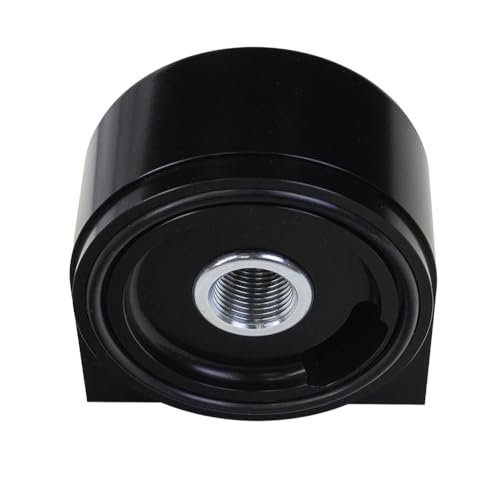
The Moroso 23682 installs where the engine’s conventional spin-on oil filter would normally mount.
Once installed, engine oil is redirected through the adapter and into the remote lubrication circuit.
A basic remote-filter system becomes:
ENGINE OIL FILTER PAD → MOROSO 23682 → -10AN SUPPLY LINE → REMOTE FILTER → -10AN RETURN LINE → MOROSO 23682 → ENGINE
The actual inlet and outlet must be connected according to Moroso’s port markings and the direction of oil flow through the remote filter system.
Don’t assume that two identical-looking -10AN ports are interchangeable.
Oil filters are designed around a specific direction of flow.
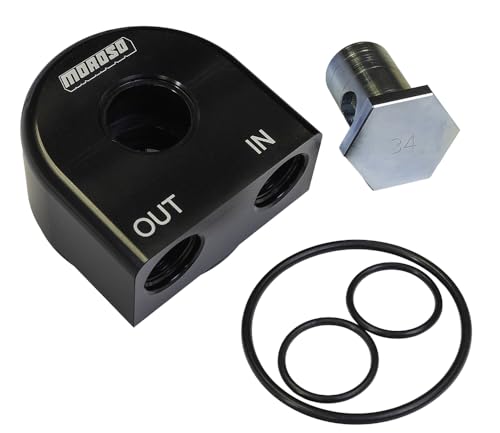
Clearly Marked -10AN Inlet and Outlet Ports
Moroso equips the 23682 with two -10AN ports.
The adapter identifies the oil inlet and outlet to simplify plumbing.
That’s important when building a remote filtration system because oil needs to travel through the filter in the correct direction.
The -10AN connection size is also well suited to performance lubrication systems where adequate oil volume and minimal unnecessary restriction are priorities.
A remote oil-filter system should never be built around hose and fittings selected simply because they were already sitting in the toolbox.
The oiling system deserves slightly more planning than that.
Billet Aluminum Construction
The Moroso 23682 is manufactured from billet aluminum.
Billet construction provides a strong, accurately machined housing while keeping weight relatively low.
That’s particularly useful at the engine block, where the adapter must:
- Seal against engine oil pressure
- Support attached AN plumbing
- Maintain accurate port geometry
- Survive engine vibration
- Handle repeated heat cycles
The machined construction also gives the adapter a compact profile compared with more elaborate cast or fabricated remote-filter assemblies.
Black Anodized Finish
Moroso finishes the 23682 in black anodizing.
Beyond providing a clean performance appearance, anodizing helps protect the aluminum surface.
The black finish also integrates naturally into modern performance engine bays using:
- Black AN fittings
- Braided hose
- Black valve covers
- Powder-coated accessories
- Fabricated aluminum components
It’s a small detail, but an oil system built with properly routed matching components tends to look considerably more intentional than one assembled from six generations of leftover fittings.
3/4″-16 Filter Stem
Moroso specifies the 23682 with a 3/4″-16 stem.
That dimension is critical when determining engine compatibility.
The adapter isn’t selected by vehicle make and model alone.
You need to verify:
- Engine oil-filter pad configuration
- Spin-on filter mounting design
- Filter stem thread
- Available physical clearance
Moroso associates the adapter with applications using compatible Ford-style oil-filter architecture, but the actual thread and sealing arrangement should always be verified before installation.
This becomes especially important on engine-swapped vehicles where the engine, chassis and original vehicle application no longer match.
O-Rings Included
Moroso supplies the necessary O-rings with the 23682.
Those O-rings seal the adapter against the engine’s oil-filter mounting surface.
Always inspect the sealing surfaces before installation.
They should be:
- Clean
- Smooth
- Free from old gasket material
- Free from deep scratches
- Free from debris
A remote oil-filter system operates under full engine oil pressure.
A small sealing problem at the adapter can therefore become a very large oil leak surprisingly quickly.
Why Relocate an Oil Filter?
Remote oil filters are common on performance and racing vehicles for several reasons.
The original filter may become difficult or impossible to access after installing:
- Long-tube headers
- Engine-swap mounts
- Turbo manifolds
- Larger oil pans
- Racing suspension
- Steering conversions
Moving the filter can provide easier service access while also creating opportunities to integrate other lubrication components.
A properly designed remote system can make oil changes easier and improve packaging without compromising oil flow.
Excellent for Engine Swaps
Engine swaps are one of the strongest applications for the Moroso 23682.
An engine may have excellent oil-filter access in its original chassis.
Put the same engine into another vehicle and suddenly the filter occupies the same physical space as the:
- Frame rail
- Steering rack
- Crossmember
- Header collector
- Engine mount
Physics generally refuses to let both components win.
A low-profile 90-degree remote adapter allows the filter itself to be moved somewhere accessible while leaving only the adapter and hoses at the original mounting point.
Makes Adding an Oil Cooler Easier
Once the oil system has been converted to external -10AN plumbing, incorporating an engine oil cooler becomes considerably easier.
A typical system may be arranged as:
ENGINE → ADAPTER → OIL FILTER → OIL COOLER → ENGINE
The exact arrangement depends on the engine, filter mount, thermostat strategy and cooler configuration.
For street-driven vehicles, a thermostatically controlled oil cooler may be desirable because engine oil needs to reach proper operating temperature.
More cooling isn’t always better.
Oil that’s perpetually too cold isn’t operating under ideal conditions either.
Makes Adding an Oil Accumulator Easier
The Moroso 23682 can also simplify integration of an oil accumulator.
An accumulator stores pressurized engine oil and can discharge it when system oil pressure falls.
That’s useful in applications where the pickup can momentarily become uncovered during:
- Hard acceleration
- Heavy braking
- High-G cornering
- Other transient oil-control events
Moroso’s 23900 3-quart oil accumulator is designed around this concept, providing a reserve of pressurized oil that can feed the engine when oil pressure drops.
A remote-filter circuit provides a convenient location for plumbing an accumulator into the pressure side of the lubrication system.
Useful With the Moroso 23900 Accumulator
The 23682 and Moroso 23900 can naturally become part of the same performance oiling system.
The 23900 provides three quarts of pressurized oil capacity and uses a 1/2-inch NPT oil connection.
Appropriate AN adapters and plumbing can connect the accumulator into a compatible remote oil circuit.
That creates a system where the remote filter handles filtration while the accumulator provides an additional pressure reserve.
The components solve different problems.
A remote adapter improves plumbing and filter placement.
An accumulator helps protect against temporary pressure loss.
Remote Filters Can Improve Service Access
One overlooked benefit of remote filtration is simply making the oil filter easier to reach.
A remote filter mount can be positioned where the filter can be removed without:
- Reaching between hot headers
- Removing suspension parts
- Dumping oil onto the crossmember
- Inventing entirely new combinations of profanity
That’s particularly useful on race cars where oil and filter inspections happen frequently.
The filter can also be positioned vertically in many installations, reducing the mess during servicing.
Filter Orientation Matters
When selecting the remote filter location, consider how the filter will be serviced.
Ideally, position it where:
- The filter is accessible
- Hoses aren’t sharply bent
- Exhaust heat is minimized
- The filter is protected from road debris
- Oil can be drained cleanly
- Fittings can be inspected
Avoid mounting the filter where a minor off-track excursion or road obstacle can strike it.
The entire engine’s oil supply passes through this system.
Protect it accordingly.
Keep -10AN Hose Runs Efficient
Remote oil systems inevitably add hose length compared with a block-mounted filter.
That makes hose routing important.
Use smooth routing with:
- Proper -10AN hose
- Quality fittings
- Gradual bends
- Adequate heat protection
- Secure supports
Avoid:
- Kinked hose
- Excessively tight 90-degree hose bends
- Unnecessary adapters
- Undersized fittings
- Routing directly against headers
- Unsupported heavy hose
Every unnecessary restriction increases pressure drop.
The objective is to relocate the filter without strangling the oil supply on the way there.
Pressure Drop Matters
Any external oil-system component can introduce some restriction.
That includes:
- Hose
- AN fittings
- Oil filter
- Cooler
- Thermostat
- Accumulator plumbing
A well-designed system minimizes unnecessary pressure loss while still providing the desired filtration and cooling.
After installing a remote-filter system, verify actual oil pressure under operating conditions.
Check:
- Cold-start pressure
- Hot idle
- Cruise
- Elevated RPM
- Full-load operation where practical
Compare the results with the engine builder’s intended pressure range.
Use a Quality Remote Filter Mount
The engine adapter is only half of a remote oil-filter conversion.
You’ll also need an appropriate remote filter mount.
The mount should provide:
- Correct filter thread
- Adequate port size
- Proper flow direction
- Secure mounting
- Compatible oil-filter capacity
Moroso offers remote filter mounts designed around performance AN plumbing, allowing the system to be assembled from compatible components rather than mixing unrelated fittings and adapters.
Choosing the Oil Filter
The remote filter should be selected according to the filter mount rather than the filter that originally screwed onto the engine.
That’s an important distinction.
Once the engine uses a remote filter adapter, the engine-side filter thread no longer necessarily determines the actual replacement filter.
The 23682’s 3/4″-16 stem determines how the adapter interfaces with the engine, while the remote filter mount determines which spin-on filter is installed elsewhere in the system.
That flexibility is one of the advantages of remote filtration.
Don’t Confuse Engine-Side and Filter-Side Threads
This is an easy source of ecommerce confusion.
The Moroso 23682’s 3/4″-16 specification refers to its engine-side mounting configuration.
It does not mean the adapter itself holds a Ford oil filter remotely.
The remote oil filter attaches to a separate remote filter mount.
The system therefore consists of at least:
- Engine-side adapter
- Oil lines
- Remote filter mount
- Oil filter
Optional coolers, thermostats and accumulators can then be incorporated as needed.
Prime the Remote Oil System
Adding external hoses and a remote filter increases the total volume of the lubrication system.
Before starting a newly assembled engine, fill and prime the system appropriately.
Depending on the engine and installation, that may include:
- Pre-filling the filter
- Filling external lines where practical
- Priming the engine oil pump
- Pre-lubricating the engine
- Cranking without ignition/fuel where appropriate
- Confirming oil pressure before startup
A completely dry remote filter and several feet of empty -10AN hose represent volume the oil pump needs to fill before normal pressure reaches every part of the engine.
Plan accordingly.
Recheck Oil Level After Initial Startup
A remote filter, hoses, cooler and accumulator can substantially increase total system oil capacity.
After the system has filled:
- Shut the engine off.
- Allow oil to stabilize according to the engine’s normal checking procedure.
- Check the oil level.
- Add oil as necessary.
Don’t assume the original factory oil capacity remains correct after adding several external oil-system components.
System capacity and oil-pan operating level are related but different considerations.
Inspect for Leaks Under Pressure
After initial startup, inspect every connection.
Pay particular attention to:
- Engine adapter O-rings
- -10AN fittings
- Hose ends
- Remote filter mount
- Filter gasket
- Cooler fittings
- Accumulator connections
Check again after the engine reaches operating temperature.
Aluminum components, fittings and hoses all experience thermal expansion.
A connection that remains dry during cold priming should still be inspected hot.
Useful for Racing Applications
Remote filtration is particularly common in:
- Drag racing
- Road racing
- Circle track
- Pro Touring
- Pro Street
- Engine swaps
- Kit cars
- Custom chassis builds
Race cars frequently have more complicated oil systems and tighter packaging than factory vehicles.
The Moroso 23682 gives builders a compact way to begin moving the filtration system away from the block.
Moroso 23682 Specifications
Part Number: 23682
Product: 90-Degree Remote Oil Filter Adapter
Material: Billet aluminum
Finish: Black anodized
Engine-Side Thread: 3/4″-16
Oil Ports: Two -10AN
Port Identification: Inlet and outlet marked
Configuration: 90 degree
Mounting Location: Engine spin-on oil-filter pad
O-Rings: Included
Application: Remote oil filtration and external oil-system plumbing
Fitment: Universal/application-specific according to engine filter-pad configuration
Listed Package Weight: Approximately 1.6 lb
Not Simply Vehicle-Specific
The supplied marketplace data describes the Moroso 23682 as vehicle specific.
That’s not the best way to merchandise it.
Compatibility depends primarily on:
- Engine oil-filter mounting pad
- 3/4″-16 mounting configuration
- Sealing surface
- Physical clearance
- External oil-system design
A better ecommerce description is:
Fitment Type: Universal / application-specific
Engine-Side Thread: 3/4″-16
Oil Connections: -10AN inlet and outlet
Application: Engines with compatible spin-on oil-filter mounting pads requiring remote filtration
This gives an engine-swap customer useful information instead of forcing a racing plumbing component into an unreliable year/make/model lookup.
Who Should Buy the Moroso 23682?
The Moroso 23682 is ideal for performance builds where the factory oil filter location is inaccessible or where the lubrication system needs external components.
Strong applications include:
- Engine swaps
- Race cars
- Pro Street builds
- Pro Touring cars
- Vehicles with header interference
- Remote oil-filter systems
- Engine oil-cooler installations
- Oil-accumulator systems
- Custom chassis builds
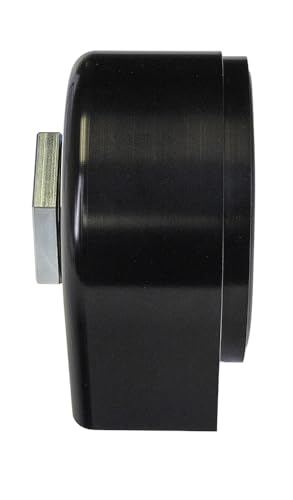
The 90-degree configuration is especially useful where there isn’t enough room for straight-out AN fittings at the original oil-filter pad.
Final Verdict
The Moroso 23682 90-Degree Remote Oil Filter Adapter provides a compact, high-quality foundation for relocating a compatible engine’s oil filter.
Its billet-aluminum construction, black anodized finish, 3/4″-16 mounting configuration and dual -10AN ports make it particularly useful for performance vehicles where space around the original filter location is limited.
More importantly, converting the engine to external -10AN plumbing makes it considerably easier to incorporate a remote filter, oil cooler or oil accumulator into the lubrication system.
Just remember that remote filtration isn’t simply about finding somewhere else to put the filter.
Hose size, flow direction, pressure drop, heat protection and oil-system capacity all matter.
Because relocating your oil filter six feet away is impressive.
Relocating the oil pressure along with it is less desirable.



There are no reviews yet.