

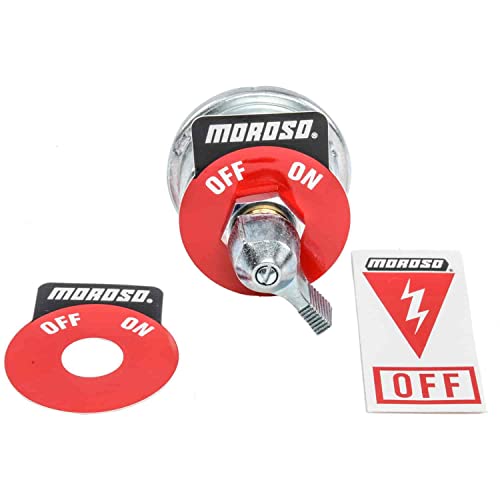
Designed for Alternator-Equipped Applications
One major distinction between the 74101 and Moroso’s basic 74100 switch is alternator use.
Moroso describes the 74101 as a heavy-duty battery disconnect for street/race vehicles with alternators and multiple-battery applications.
That’s important because an alternator-equipped race car requires more thought than simply putting a switch between the battery and starter.
Once the engine is running, the alternator can become an electrical power source.
A properly engineered master-disconnect system therefore needs to account for alternator output as well as the battery.
Battery Disconnect vs Complete Alternator Shutdown
This distinction matters.
Opening the battery circuit does not automatically guarantee that a running alternator can no longer power the vehicle.
Depending on how the electrical system is wired, the alternator may continue supplying:
- Ignition
- Fuel pump
- ECU
- Instruments
- Other circuits
For competition vehicles, the required result is generally much more important than simply having a switch with an OFF label.
The vehicle needs to respond according to the applicable sanctioning body’s rules.
Moroso 74107 Alternator Shutdown Relay
Moroso offers the 74107 Alternator Shutdown Relay as a supporting component for its battery-disconnect systems.
That gives builders a way to incorporate alternator shutdown into an appropriate racing electrical system.
If the goal is a competition master cutoff that shuts down a running engine, design and test the complete system accordingly.
Do not assume that interrupting one battery cable automatically accomplishes everything.
Test the Switch With the Engine Running
After wiring a racing master disconnect, test its actual operation.
With the vehicle safely stationary:
- Start the engine.
- Operate the master disconnect according to the installation design.
- Verify that the engine shuts down.
- Verify that intended vehicle electrical power is removed.
If the engine keeps running, the system isn’t providing the intended complete shutdown.
Fix the wiring before taking the car to technical inspection—or discovering the problem when someone actually needs the switch.
Twist-Style Operation
The Moroso 74101 uses a twist-style non-slip handle.
A quick turn provides a clear manual ON/OFF function.
That straightforward mechanical operation is valuable in motorsports because the switch needs to be understandable and accessible under pressure.
No menus.
No Bluetooth.
No firmware update.
Turn the switch.
Drag Racing Mounting
Moroso states that for drag-racing vehicles, the battery disconnect should be mounted at the rear panel of the vehicle for easy accessibility.
This is particularly relevant when the battery has been relocated to the trunk.
The goal is to provide an externally accessible master electrical control point.
Always check the current rulebook for the organization and class in which the vehicle competes.
Rules can specify switch location, identification, operation and electrical behavior.
Oval-Track and Road-Racing Mounting
For oval-track and road-racing applications, Moroso recommends positioning the switch so it can be easily reached by either:
- The driver
- Service personnel outside the vehicle
Again, final placement should follow the applicable sanctioning-body rules.
Accessibility is a safety function.
A master switch that requires opening the trunk, removing a panel and finding a 10mm socket has missed the point.
Street-Car Installation
Moroso also identifies the 74101 for street applications.
In that situation, the switch can provide convenient battery isolation for:
- Storage
- Electrical service
- Project-car work
- Show vehicles
- Occasional-use vehicles
Moroso also notes that a concealed switch can serve as an additional theft deterrent.
It shouldn’t replace a proper immobilizer or alarm system, but electrically disabling the vehicle creates another obstacle.
Remote Operation With Moroso 74105
The Moroso 74101 is compatible with the Moroso 74105 Push/Pull Battery Disconnect Mounting Kit.
Moroso’s 74105 allows compatible disconnect switches—including the 74101—to be mounted near a roll-cage tube and operated by an external T-handle through the rear body panel.
The kit includes:
- Weld-on mounting hardware
- Swing-arm linkage
- 18-inch aluminum actuator tube
- Bushings
- Fasteners
- Installation hardware
This is particularly useful on drag cars where the electrical switch itself needs to remain securely mounted inside the vehicle while an external control remains accessible.
External Push/Pull Operation
With a remote kit, the driver or safety worker doesn’t need direct access to the switch body.
The external handle operates the disconnect mechanically.
This can make packaging much easier in vehicles with:
- Trunk-mounted batteries
- Fuel cells
- Roll cages
- Rear electronics panels
- Limited rear-panel depth
The switch and linkage still need to be installed according to Moroso’s instructions and the relevant racing rules.
Two 3/8-Inch Studs Included
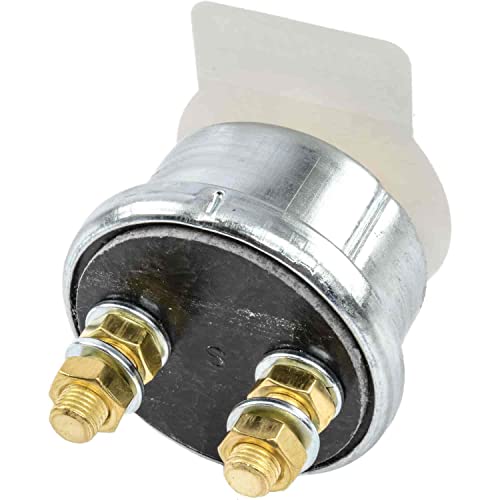
Moroso supplies the 74101 with two 3/8-inch studs for the primary electrical connections.
High-current battery connections need to be assembled correctly.
Use appropriate:
- Battery cable
- Cable terminals
- Crimping or termination methods
- Insulation
- Routing
- Circuit protection
Loose high-current connections create resistance.
Resistance creates heat.
Heat and battery cables are not a particularly desirable racing partnership.
Terminal Boots Available
Moroso offers the 74110 Battery Disconnect Terminal Boots in black and red.
Terminal protection is worth considering because the disconnect’s main studs may remain connected directly to the battery circuit.
An accidentally grounded tool or metal component can create an extremely high-current short circuit.
Cover exposed positive connections wherever practical.
Battery Cable Size Matters
The disconnect is only one part of the high-current circuit.
Battery cable needs to be sized appropriately for:
- Cable length
- Starter current
- Battery location
- System voltage
- Engine compression
- Electrical load
This becomes especially important when relocating a battery from the engine compartment to the trunk.
Longer cable means more resistance.
More resistance means more voltage drop.
Use properly sized cable and high-quality terminations.
Voltage Drop Matters
A starter can draw substantial current.
Even relatively small resistance in a long battery cable or poor terminal connection can create a significant voltage drop under load.
Symptoms include:
- Slow cranking
- Starter clicking
- Low voltage at the starter
- Hot terminals
- Hard starting
- ECU voltage problems during cranking
After installing a master disconnect, perform a voltage-drop test under load.
Don’t assume a connection is good simply because it looks shiny.
Battery Relocation Applications
The 74101 is a natural companion for trunk-mounted battery systems.
A typical race-car layout might include:
TRUNK-MOUNTED BATTERY
↓
MOROSO 74101 MASTER DISCONNECT
↓
MAIN BATTERY CABLE
↓
STARTER / VEHICLE POWER DISTRIBUTION
with the alternator circuit integrated according to the required shutdown design.
Moroso’s battery-relocation hardware also includes sealed battery boxes and cable kits for appropriate applications.
Multiple-Battery Applications
Moroso specifically lists the 74101 for multiple-battery applications.
That makes it useful for vehicles where more than one battery contributes to the main electrical system.
The complete circuit still needs to be engineered so operating the master disconnect produces the intended electrical isolation.
Simply having two batteries upstream or downstream of a switch without understanding the current paths can leave portions of the system energized.
Moroso 74101 vs 74100
Moroso’s 74100 and 74101 look similar but have important differences.
Moroso 74100
Rating: 125 amps at 6–36V DC
Service: Limited-service
Typical Application: Drag racing without alternators
Moroso 74101
Rating: 175 amps at 6–36V DC
Service: Heavy-duty
Typical Application: Street/race vehicles with alternators and multiple-battery systems
For an alternator-equipped performance vehicle, the 74101 is the more appropriate of these two switches.
Moroso 74101 vs 74102
For more demanding electrical systems, Moroso offers the 74102 Super-Duty Battery Disconnect Switch.
Moroso rates the 74102 at:
300 amps continuous
2,000 amps intermittent
It also uses additional terminals that can support more advanced electrical isolation arrangements.
The 74102 makes more sense where starter draw or total electrical demand exceeds what the 74101 is intended to handle.
Moroso 74101 vs 74106
Moroso also offers the 74106 Heavy-Duty Push On/Off Battery Disconnect.
The 74106 is rated:
250 amps
6–24V DC
The major operational difference is control style.
74101
Twist ON/OFF handle.
74106
Push-style operation.
Both are intended for heavier electrical applications than the limited-service 74100.
Moroso 74101 vs 74108
The Moroso 74108 Battery and Alternator Disconnect Switch is especially important for modern racing electrical systems.
The 74108 is a four-pole switch designed to disconnect the battery and alternator feed simultaneously without requiring a separate relay.
Moroso rates it at:
125 amps continuous
750 amps intermittent
Up to 36V DC
If the build specifically requires integrated battery-and-alternator isolation, the 74108 may provide a cleaner architecture than a conventional two-terminal battery disconnect combined with additional shutdown hardware.
74101 vs 74104 Side-Post Disconnect
The Moroso 74104 product you added earlier serves a very different purpose.
Moroso 74104
Battery-terminal disconnect for compatible side-post batteries.
Rating: 100 amps
Voltage: 12/24V DC
Primarily useful for storage, charging isolation and basic battery disconnection.
Moroso 74101
Heavy-duty panel-mounted master disconnect.
Rating: 175 amps
Voltage: 6–36V DC
Designed for serious street, racing, RV and multiple-battery electrical systems.
These shouldn’t share identical ecommerce positioning.
The 74104 is a convenient battery-terminal disconnect.
The 74101 is a proper high-current master switch.
Don’t Use Battery Disconnection as an Alternator Test
Never use the old trick of disconnecting the battery while the engine is running to determine whether the alternator works.
Removing the battery from a live charging system can cause undesirable voltage behavior and potentially damage electronics.
Use a multimeter and proper charging-system diagnostics.
A racing master switch should only disconnect a running electrical system when the system has been intentionally wired to handle that function.
Package Dimensions
The supplied distributor information lists:
Package Height: 23.3 cm / approximately 9.17 inches
Package Length: 6.2 cm / approximately 2.44 inches
Package Width: 16.7 cm / approximately 6.57 inches
These are package dimensions, not switch dimensions.
Keep them in shipping attributes rather than presenting them as physical installed dimensions.
Moroso 74101 Specifications
Part Number: 74101
Product: Heavy-Duty Battery Disconnect Switch
Operation: Twist ON/OFF
Handle: Non-slip
Current Rating: 175 amps
Voltage Rating: 6–36V DC
Primary Terminals: Two 3/8-inch studs
Alternator Applications: Yes, when the complete electrical system is correctly configured
Multiple-Battery Applications: Yes
Remote Operation: Compatible with Moroso 74105 Push/Pull Kit
Optional Alternator Shutdown Relay: Moroso 74107
Optional Terminal Boots: Moroso 74110
Applications: Street, drag racing, oval track, road racing, RV and multiple-battery systems
Fitment: Universal / electrical-system specific
Who Should Buy the Moroso 74101?
The Moroso 74101 is a strong choice for builders needing a manually operated high-current battery disconnect for:
- Drag cars
- Oval-track cars
- Road-race cars
- Pro Street builds
- Hot rods
- Street/strip cars
- RV applications
- Multiple-battery systems
- Trunk-mounted battery systems
- Project cars with custom electrical systems
Its 175-amp rating and broad 6–36V operating range make it substantially more versatile than a basic battery-terminal disconnect.
Final Verdict
The Moroso 74101 Heavy-Duty Battery Disconnect Switch gives street and race builders a simple mechanical way to control a serious electrical system.
Its 175-amp, 6–36V DC rating makes it suitable for a broad range of alternator-equipped and multiple-battery applications, while the twist-style handle provides obvious manual operation. Moroso also supports remote operation through the 74105 push/pull kit and alternator shutdown through additional system components.
The critical part is installation.
A master switch is only as effective as the electrical architecture behind it.
If turning the big red switch to OFF still leaves the engine running, you haven’t invented a clever new type of kill switch.
You’ve invented an ON switch with confidence issues.






There are no reviews yet.