

Seal Conditioners Help Reduce Oil Leaks
One of MaxLife’s biggest advantages is its seal-conditioning technology.
Engine seals can gradually harden or shrink after years of exposure to heat and oil.
When that happens, small leaks and seepage can develop.
Valvoline MaxLife contains seal conditioners designed to help restore flexibility to aging seals, which can help:
- Reduce minor oil leaks
- Prevent some age-related seepage
- Reduce oil consumption
- Support proper lubrication
- Maintain oil levels between services
This doesn’t mean MaxLife can repair a physically torn seal or failed gasket.
If oil is pouring onto the driveway faster than you can pour it into the engine, you need a wrench—not a miracle bottle.
For ordinary age-related seal deterioration, however, high-mileage seal conditioners can provide a useful additional layer of protection.
Helps Reduce Oil Consumption
Oil consumption often becomes more noticeable as engines accumulate mileage.
Aging seals and normal internal wear can allow more lubricant to enter areas where it is eventually burned.
MaxLife is formulated to help minimize consumption associated with the normal aging process.
Keeping oil consumption under control helps maintain the correct lubricant level between services.
Owners of high-mileage engines should still check the dipstick regularly.
High-mileage oil helps manage the problem.
It doesn’t replace the dipstick.
20% Better Wear Protection
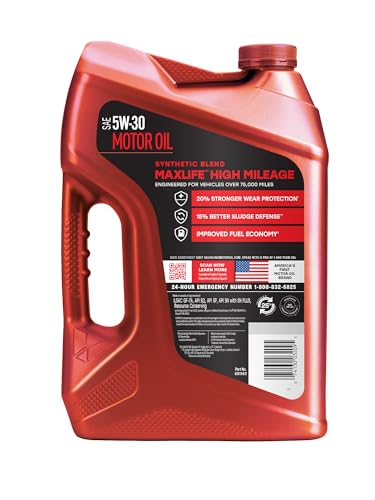
Valvoline states that MaxLife High Mileage provides 20% better wear protection than industry standards.
Wear protection becomes increasingly important as an engine accumulates mileage.
Critical components including bearings, camshafts, piston assemblies, timing components and valvetrain hardware depend on a stable lubricant film to prevent damaging metal-to-metal contact.
MaxLife’s additive package is engineered to provide additional protection against that wear while helping an older engine continue operating reliably.
15% Better Sludge Defense
Valvoline also states that MaxLife provides 15% better sludge defense than industry standards.
Sludge develops when heat, oxidation, moisture, combustion byproducts and deteriorating oil combine inside an engine.
Over time, contamination can restrict oil circulation and interfere with components relying on small lubrication passages.
MaxLife’s detergent package is designed to help control these contaminants and maintain cleaner internal surfaces.
For a deeper look at what causes sludge and what happens once contamination gets out of control, read our My Pro Street guide to Engine Oil Sludge Causes and How to Fix It.
Preventing sludge is substantially cheaper than discovering which bearing stops receiving oil first.
Extra Detergents Keep Aging Engines Cleaner
Higher-mileage engines have had considerably more time to accumulate contaminants than newer engines.
MaxLife includes extra detergents designed to fight:
- Deposits
- Sludge
- Friction-related contamination
- Corrosion
- Internal buildup
Keeping internal components cleaner supports proper lubrication and can help preserve engine performance as mileage accumulates.
That’s particularly valuable for vehicles you plan to keep rather than trade away the moment the odometer gains another digit.
Advanced Friction-Fighting Additives
Friction wastes energy and contributes to wear.
Valvoline MaxLife incorporates advanced friction-fighting additives designed to minimize internal resistance while maintaining engine protection.
Reducing unnecessary friction can help support:
- Engine efficiency
- Fuel economy
- Wear protection
- Smooth operation
- Long-term durability
Will MaxLife turn your 5,000-pound SUV into an economy car?
No.
The laws of physics remain annoyingly difficult to negotiate with.
But minimizing internal friction can help an engine operate as efficiently as its design allows.
Synthetic Blend Protection
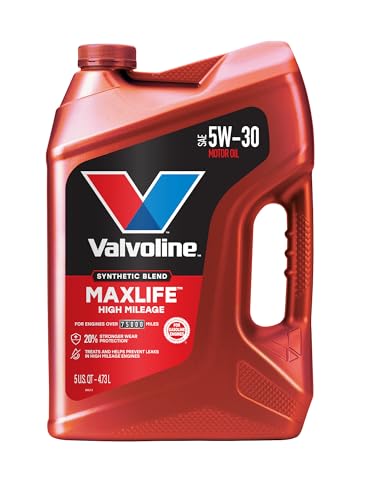
MaxLife High Mileage 5W-30 uses a synthetic-blend formulation.
Synthetic-blend oil combines synthetic and conventional base-oil technology with an additive package tailored to the intended application.
In MaxLife’s case, the formulation is built around high-mileage concerns such as:
seals + wear + deposits + sludge + oil consumption
That makes it an attractive choice for owners seeking purpose-built high-mileage protection without necessarily moving to a premium full-synthetic product.
API SQ Performance
Valvoline MaxLife High Mileage 5W-30 meets or exceeds API SQ requirements according to the supplied specifications.
It also meets or exceeds:
- API SP
- API SN with SN PLUS
- Applicable preceding API gasoline categories
API SQ addresses the lubrication requirements of modern gasoline engines, including important areas involving wear, deposits and engine cleanliness.
That allows MaxLife to combine high-mileage-specific protection with current-generation lubricant performance.
ILSAC GF-7A
MaxLife 5W-30 also meets or exceeds ILSAC GF-7A requirements.
GF-7A performance addresses several areas important to modern gasoline engines, including:
- Engine wear
- Deposit control
- Oxidation control
- Fuel economy
- Timing-chain protection
- Low-speed pre-ignition protection
- Engine cleanliness
This makes MaxLife useful for compatible newer vehicles that have already crossed into high-mileage territory.
Modern cars reach 75,000 miles too.
They don’t magically become 1994 Camrys when the odometer rolls over.
Ford WSS-M2C971-A1
According to the supplied product specifications, Valvoline MaxLife High Mileage 5W-30 meets Ford WSS-M2C971-A1.
This makes the oil relevant to compatible Ford-family applications requiring that specification and SAE 5W-30 viscosity.
Always verify the exact lubricant requirements for your vehicle’s year, model and engine.
Matching the viscosity alone isn’t enough.
Chrysler MS-13340
Valvoline MaxLife High Mileage 5W-30 also lists Chrysler MS-13340 among its additional specifications.
Owners of compatible Chrysler, Dodge, Jeep and Ram vehicles should compare this specification with the exact oil requirements established for their engine.
Use the required specification rather than assuming every 5W-30 is interchangeable.
Valvoline MaxLife High Mileage 5W-30 Specifications
Brand: Valvoline
Product Line: MaxLife High Mileage
Product Type: Synthetic Blend Motor Oil
SAE Viscosity: 5W-30
Container Size: 5 Quarts
Recommended Mileage: 75,000+ miles
API: SQ / SP / SN with SN PLUS and applicable preceding gasoline categories
ILSAC: GF-7A
Resource Conserving: Yes
Ford Specification: WSS-M2C971-A1
Chrysler Specification: MS-13340
Seal Conditioners: Yes
Wear Protection: 20% better than industry standards, per Valvoline
Sludge Defense: 15% better than industry standards, per Valvoline
Extra Detergents: Yes
Oil Leak Protection: Yes
Oil Consumption Protection: Yes
Friction-Fighting Additives: Yes
Primary Application: Compatible engines with 75,000 miles or more
Why Use 5W-30 in a High-Mileage Engine?
SAE 5W-30 remains one of the most widely used viscosity grades in passenger vehicles.
The 5W represents its low-temperature or winter viscosity classification.
The 30 represents its operating-temperature SAE viscosity grade.
If your higher-mileage engine was designed to continue using 5W-30, MaxLife allows you to gain high-mileage-focused protection without arbitrarily switching to a thicker viscosity.
That’s important.
High mileage does not automatically mean an engine should move from 5W-30 to 10W-40.
Always follow the viscosity recommendations appropriate for the specific engine and operating conditions.
Valvoline MaxLife vs Valvoline Restore & Protect
Both Valvoline products can make sense for an aging engine, but their primary missions are different.
Valvoline MaxLife High Mileage 5W-30 is focused on the needs of older engines, including:
- Aging seals
- Oil leaks
- Oil consumption
- Wear
- Sludge
- Friction
Valvoline Restore & Protect 5W-30, by comparison, is built around active piston-deposit removal and continued deposit prevention.
Choose MaxLife when age-related seal and high-mileage concerns are the priority.
Choose Restore & Protect when removing existing piston deposits is the primary objective.
That distinction also makes these products complementary options rather than two bottles fighting for exactly the same purpose.
Synthetic Blend MaxLife vs Full Synthetic High-Mileage Oil
Synthetic-blend and full-synthetic high-mileage oils can both provide strong protection when they meet the requirements of the engine.
MaxLife Synthetic Blend is particularly appealing to owners who want:
- Dedicated high-mileage additives
- Seal conditioning
- Leak protection
- Sludge control
- Modern API SQ performance
- A synthetic-blend formulation
A premium full synthetic may be preferable where the vehicle manufacturer requires it or where operating conditions demand additional temperature or extended-service performance.
The correct choice depends on the engine—not which bottle has the fanciest adjectives.
Can MaxLife Stop an Oil Leak?
MaxLife can help with certain minor age-related leaks caused by hardened or shrunken seals.
Its seal conditioners are designed to restore flexibility to those aging materials.
However, motor oil cannot repair:
- Torn seals
- Cracked gaskets
- Damaged oil pans
- Loose drain plugs
- Failed oil-filter housings
- Mechanical damage
If you’re losing a quart every hundred miles, diagnose the problem.
If you’ve got ordinary high-mileage seepage around aging seals, MaxLife’s conditioning technology is much more relevant.
Who Should Buy Valvoline MaxLife High Mileage 5W-30?
MaxLife is designed primarily for compatible engines with 75,000 miles or more, although Valvoline notes performance benefits for new and rebuilt engines as well.
It’s particularly attractive for:
- Vehicles with 75,000+ miles
- Higher-mileage daily drivers
- Older cars and SUVs
- High-mileage light trucks
- Engines experiencing minor seal seepage
- Vehicles consuming some oil between services
- Engines where sludge protection is important
- Owners concerned about internal deposits
- Compatible vehicles requiring API SQ
- Compatible vehicles requiring ILSAC GF-7A
- Applicable Ford engines
- Applicable Chrysler-family engines
- Owners planning to keep a vehicle well beyond 100,000 miles
Always confirm SAE 5W-30 and the required lubricant specifications for your exact application before ordering.
Give an Aging Engine the Oil It Actually Needs
A high-mileage engine doesn’t necessarily need rebuilding.
Sometimes it just needs maintenance designed around the fact that it isn’t new anymore.
Valvoline MaxLife High Mileage 5W-30 Synthetic Blend Motor Oil addresses the problems that become increasingly important after 75,000 miles.
Its combination of seal conditioners, extra detergents, friction-fighting additives, 20% better wear protection and 15% better sludge defense gives aging engines targeted protection without abandoning modern API SQ and GF-7A performance.
If your higher-mileage vehicle requires an appropriate SAE 5W-30 lubricant, grab a 5-quart jug of MaxLife and keep that odometer moving.
Six figures isn’t scary.
Running low on oil because nobody checked the dipstick is.






There are no reviews yet.