
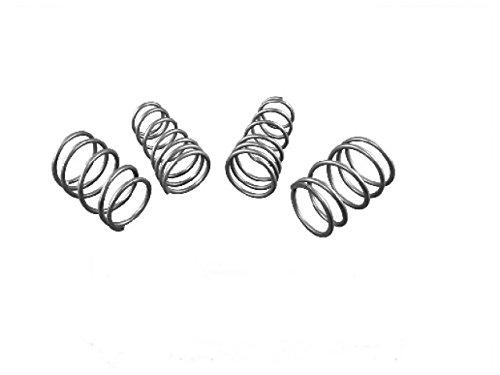
Why Lower a Subaru WRX or STI?
Lowering isn’t just about removing wheel gap.
Reducing vehicle ride height lowers the center of gravity.
During cornering, braking and acceleration, the vehicle’s mass creates forces that cause the body to move relative to the suspension.
A lower center of gravity can help reduce those movements.
Potential benefits include:
- Reduced body roll
- Reduced brake dive
- Improved transitional response
- More planted handling
- Improved appearance
- More responsive chassis behavior
The key is lowering the vehicle by a sensible amount.
More isn’t automatically better.
Eventually you’re not lowering the center of gravity anymore; you’re just introducing the oil pan to local infrastructure.
Lowering Springs vs. Stock Subaru Springs
Factory springs must satisfy a broad range of customers and operating conditions.
Subaru engineers have to account for:
- Rough roads
- Passenger comfort
- Cargo loads
- Snow
- Ground clearance
- Warranty requirements
- Noise and vibration
- Manufacturing tolerances
Performance lowering springs operate with a different set of priorities.
Whiteline can focus more heavily on:
Handling response
Reduced body movement
Lower ride height
Performance-oriented spring behavior
while still retaining enough compliance for street use.
Why Spring Rate Matters
Ride height is only part of spring design.
Spring rate determines how much force is required to compress the spring.
A properly engineered performance spring balances:
- Vehicle weight
- Suspension travel
- Damper characteristics
- Front-to-rear balance
- Intended ride height
Simply installing extremely stiff springs doesn’t guarantee better handling.
If the suspension can’t maintain tire contact over imperfect pavement, grip can actually decrease.
That’s why a balanced street suspension generally works better than a suspension designed entirely around winning arguments on an internet forum.
Progressive Spring Design
Performance lowering springs may use progressive-rate characteristics depending on application.
A progressive spring changes effective rate as it compresses.
This can allow relatively compliant behavior during normal driving while providing greater resistance as suspension load increases.
The goal is combining:
Street compliance
with
Performance body control.
That makes progressive-rate springs particularly attractive for dual-purpose street cars.
Lower Center of Gravity
One of the primary performance benefits of lowering is reducing the vehicle’s center-of-gravity height.
A lower center of gravity can reduce weight transfer leverage during cornering.
The result can be:
- Less body roll
- More immediate response
- Improved stability
- Better driver feedback
But lowering too far can introduce entirely new problems.
Suspension geometry still matters.
Suspension Travel Matters
Lowering reduces available suspension travel.
That’s unavoidable.
If the car is lowered excessively, the suspension may frequently contact the bump stops.
Once that happens, effective spring rate increases dramatically and tire contact can become less consistent.
That’s why moderate lowering generally works better for a street-driven WRX or STI than chasing the lowest possible stance.
Read Pro Street’s Complete Guide to Lowering Springs for a deeper explanation of ride height, spring rate, suspension travel and lowering geometry.
Can WSK-SUB007 Work With Factory Shocks?
Performance lowering springs are generally designed around compatible factory-style dampers, but damper condition matters enormously.
If your Subaru has substantial mileage, inspect the shocks and struts before installing new springs.
Watch for:
- Oil leakage
- Weak damping
- Damaged mounts
- Torn boots
- Excessive bounce
- Unusual noises
Installing new performance springs onto completely exhausted dampers isn’t a suspension upgrade.
It’s an archaeological project.
Lowering Springs and Performance Dampers
For higher-mileage vehicles or more aggressive performance builds, pairing lowering springs with appropriately matched dampers can provide better results.
Quality performance dampers can improve:
- Rebound control
- Compression control
- Transitional response
- Body movement
- Tire contact
The spring supports the vehicle.
The damper controls how quickly that spring moves.
Both matter.
Lowering Springs vs. Coilovers
Which option makes sense depends on the build.
Lowering Springs
Advantages include:
- Lower cost
- Simpler installation
- OEM-like packaging
- Predictable ride height
- Good street performance
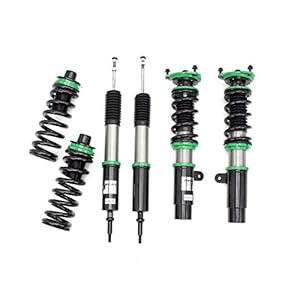
Coilovers
Potential advantages include:
- Adjustable ride height
- Greater spring-rate options
- Potential damping adjustment
- Corner-balancing capability
For most street-driven cars, a properly engineered spring-and-damper package can provide excellent performance without the additional complexity of coilovers.
What Happens to Alignment After Lowering?
Lowering changes suspension geometry.
Depending on the chassis, that can alter:
- Camber
- Toe
- Caster relationships
- Roll center
- Control-arm angles
Therefore, the vehicle should receive a professional alignment after lowering.
Don’t skip this step.
Poor toe settings can destroy an expensive set of tires surprisingly quickly.
Camber After Lowering
As suspension position changes, many vehicles naturally gain negative camber.
A modest amount can benefit cornering.
Too much can contribute to uneven tire wear and reduced straight-line tire contact.
For aggressive lowering, adjustable suspension components may be necessary to achieve desired alignment specifications.
Toe Is Particularly Important
Enthusiasts love discussing camber because it’s visible.
Toe isn’t nearly as exciting.
Unfortunately, toe can have an enormous effect on:
- Tire wear
- Straight-line stability
- Steering response
- Rolling resistance
After installing WSK-SUB007 springs, verify alignment rather than assuming everything remains where Subaru originally set it.
Pairing Springs With Whiteline Sway Bars
Lowering springs and sway bars affect different aspects of suspension behavior.
Springs
Influence:
- Ride height
- Vertical wheel movement
- Body movement
- Suspension travel
Sway Bars
Primarily influence:
- Roll stiffness
- Handling balance
- Left-to-right suspension interaction
Combining the two allows a more comprehensive chassis setup.
Don’t Forget the Bushings
Older WRX and STI models may already have worn suspension bushings.
Inspect:
- Control-arm bushings
- Sway-bar bushings
- End links
- Strut mounts
- Rear suspension links
Fresh performance springs won’t compensate for worn suspension joints allowing the wheels to wander around under load.
Street Performance
For a street-driven Subaru, the objective should be usable grip.
That means retaining enough suspension travel and compliance to keep the tires connected to imperfect pavement.
Pro Street’s Daily Driver Suspension Setup That Actually Works explains why making every component substantially stiffer isn’t necessarily the fastest solution on real roads.
Installation
Installing lowering springs requires safely disassembling loaded suspension components.
General installation includes:
- Safely raise and support the vehicle.
- Remove the appropriate strut or shock assemblies.
- Safely compress the factory springs where required.
- Remove the original springs.
- Inspect dampers, mounts and bump stops.
- Install the Whiteline springs in the correct orientation.
- Reassemble the suspension.
- Torque all hardware correctly.
- Settle the suspension.
- Verify ride height.
- Perform a professional alignment.
Spring compressors can store substantial energy.
If you don’t have the correct tools or experience, professional installation is strongly recommended.
Is Whiteline WSK-SUB007 Worth It?
For the correct Subaru application, the Whiteline WSK-SUB007 Performance Spring Kit provides a straightforward way to improve appearance and chassis behavior without immediately moving to a complete coilover suspension.
A properly matched lowering spring package can provide:
Lower ride height
Lower center of gravity
Reduced body movement
Sharper response
Improved appearance
Street-friendly performance
The important word is properly.
Suspension is a system. Springs, dampers, tires, alignment, sway bars and bushings all influence the final result.
Get those pieces working together and the Subaru becomes substantially more rewarding to drive.
Just lowering it until the exhaust develops an intimate relationship with every speed bump is considerably less sophisticated.
Shop Subaru suspension and performance components through Pro Street Online.





There are no reviews yet.