
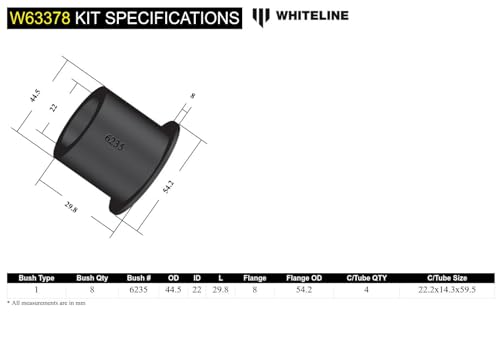
What Does Whiteline W63378 Include?
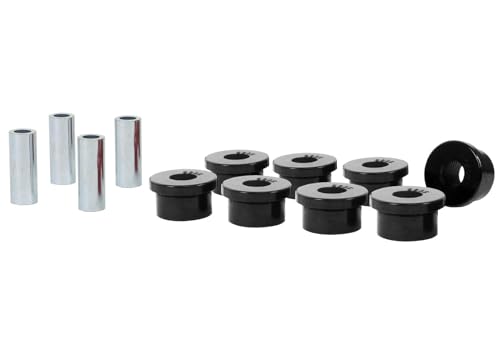
Whiteline specifies the W63378 kit as containing:
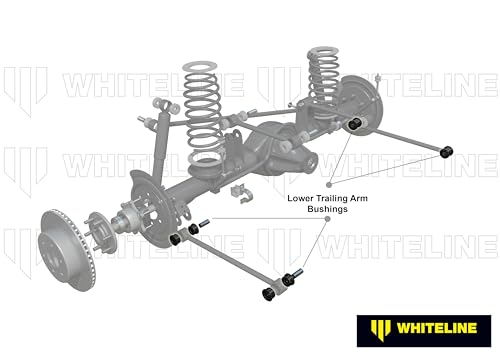
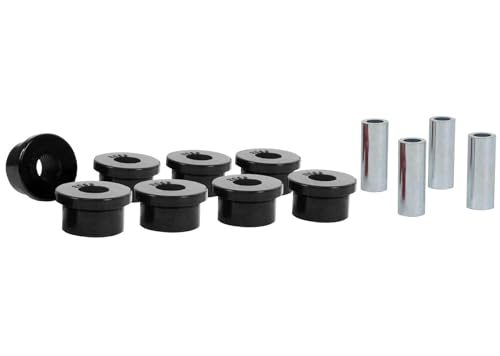
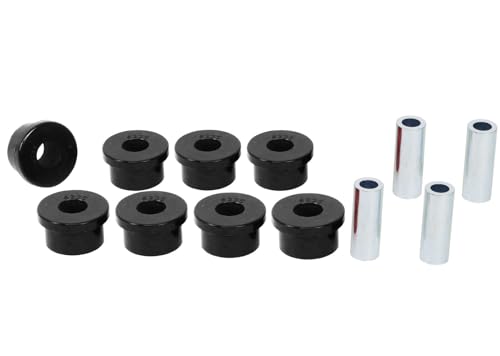
- 8 rear lower trailing-arm bushings
- 4 inner tubes/sleeves
- 1 complete kit required per vehicle
- Rear lower mounting position
- Approximately 3 hours installation time
- Wheel alignment recommended after installation
Whiteline also classifies installation as more involved than a basic bolt-on suspension job.
For current manufacturer specifications, see the Whiteline W63378 product page.
Why 3rd-Gen 4Runner Trailing Arm Bushings Matter
The third-generation 4Runner uses a solid rear axle located by suspension links.
The rear lower trailing arms help control the axle’s fore-and-aft movement as the suspension travels. Their bushings provide enough compliance for normal suspension articulation while preventing the axle from wandering around underneath the truck.
As those bushings deteriorate, the rear suspension can become less controlled.
Whiteline specifically identifies symptoms including uneven tire wear, unbalanced braking and less predictable rear-end behavior while cornering as potential indications of failed trailing-arm bushings.
Symptoms of Worn 4Runner Rear Trailing Arm Bushings
A worn bushing doesn’t always announce itself with one obvious symptom. More often, several smaller problems begin appearing together.
A third-gen 4Runner with deteriorated rear trailing-arm bushings may exhibit clunking from the rear suspension, vague handling, excessive axle movement, instability under braking, changes in handling when transitioning on and off the throttle, or visible cracking and separation in the original rubber.
Uneven tire wear can also develop when suspension movement prevents the axle and wheels from remaining as consistently located as intended.
For a deeper explanation of how worn suspension bushings affect vehicle behavior, see the Pro Street Suspension Bushing Guide.
Why Replace Rubber With Whiteline Bushings?
Factory rubber bushings are designed around several competing requirements.
Toyota engineers needed the original 4Runner bushings to provide:
Ride comfort + low noise + suspension articulation + durability + axle control
That compromise works extremely well for a factory SUV.
But rubber deteriorates.
Heat, age, contamination, compression and thousands of suspension cycles eventually reduce its ability to maintain its original shape.
Whiteline uses its synthetic elastomer material to reduce unwanted suspension deflection while maintaining enough compliance for suspension movement. The company emphasizes elasticity, memory and durability as core characteristics of W63378.
Better Rear Axle Control
Under acceleration, torque travels through the drivetrain into the rear differential and axle assembly.
The suspension links must control the reaction forces created by that torque.
With badly deteriorated bushings, some movement can occur before the suspension links fully control the axle.
Replacing those bushings can make the rear suspension feel more connected during acceleration and braking.
The goal isn’t to make the rear suspension rigid.
It’s to make the axle move according to the suspension geometry rather than according to however much movement 25-year-old rubber happens to permit.
Better Braking Stability
Trailing-arm bushings also matter when the truck slows down.
Braking places longitudinal loads through the suspension links. Excessive bushing deformation can allow unwanted movement as those forces reverse direction.
Whiteline specifically identifies unbalanced braking as one potential symptom associated with worn trailing-arm bushings.
Restoring proper bushing control can therefore improve how consistently the rear suspension behaves under braking.
Better Cornering Stability
Nobody bought a third-gen 4Runner because they were chasing Nürburgring lap records.
That doesn’t mean suspension precision is irrelevant.
During cornering, the rear suspension has to manage lateral and longitudinal loads while maintaining predictable axle positioning.
Reducing excessive bushing movement can make the rear of the vehicle feel more stable and consistent.
That’s especially valuable on a tall SUV with a relatively high center of gravity.
W63378 for High-Mileage 4Runners
Age alone makes this kit relevant.
A 1996 4Runner is now three decades old. Even the newest 2002 examples are well beyond the age where original suspension rubber deserves automatic trust.
Mileage isn’t the only consideration.
Rubber deteriorates from:
- Age
- Heat
- Ozone exposure
- Oil contamination
- Weather
- Repeated compression
- Off-road use
- Towing loads
A relatively low-mileage 4Runner can therefore still have deteriorated suspension bushings.
W63378 for Lifted Toyota 4Runners
Lifted 4Runners deserve additional attention because suspension modifications can change the angles and loads experienced by the rear links.
W63378 can improve the connection between the trailing arms and their mounting points, but it should not be treated as a suspension geometry correction kit.
If a substantial lift has changed rear axle geometry, additional components may be required to properly correct the suspension.
Bushings control movement.
They don’t magically relocate suspension pickup points.
Physics remains stubbornly unwilling to accept Amazon product descriptions as engineering documentation.
W63378 for Off-Road Builds
A firmer and more durable bushing can also make sense on a 4Runner that regularly sees dirt, rocks, trails and uneven terrain.
Off-road driving repeatedly loads the suspension through large articulation angles.
That makes bushing condition particularly important.
Whiteline describes its black synthetic elastomer bushings as having high load-bearing capability and resistance to abrasion, oil, grease, ozone and weathering—characteristics particularly relevant to 4WD and towing applications.
Polyurethane vs. Factory Rubber
There are advantages and disadvantages to both materials.
Factory rubber generally provides better isolation from vibration and road noise.
Performance synthetic elastomer/polyurethane generally provides greater resistance to deformation and deterioration.
For a completely stock luxury-oriented daily driver, fresh OEM rubber may be preferable.
For a 4Runner being restored, modified, used off-road or driven with performance in mind, Whiteline’s firmer material can provide a useful balance between suspension control and normal articulation.
You can learn more about choosing suspension bushings in the Pro Street Polyurethane Bushing Buying Guide.
Inspect the Upper Trailing Arm Bushings Too
W63378 addresses the rear lower trailing arms.
That distinction matters because the 4Runner’s rear suspension uses additional links.
Whiteline also offers separate upper trailing-arm bushings, so if you’re refreshing a high-mileage truck, inspect the complete rear suspension rather than automatically assuming the lower bushings are the only worn components. Whiteline’s catalog, for example, lists W63379 separately as the rear upper trailing-arm bushing kit.
While you’re underneath the truck, inspect the rear shocks, coil springs, sway-bar links, sway-bar bushings, upper trailing-arm bushings, lower trailing-arm bushings, Panhard/track-bar bushings and mounting hardware.
Replacing one destroyed piece of rubber while carefully preserving the seven destroyed pieces next to it is technically a repair. Just not an especially ambitious one.
Installation
Whiteline estimates approximately three hours for W63378 installation and describes it as a relatively difficult installation for someone without suspension experience.
The basic process involves supporting the vehicle and rear axle, removing the affected trailing arms, removing the original bushings, cleaning and inspecting the housings, installing the new bushings and sleeves, reinstalling the arms and correctly tightening the suspension hardware.
Because suspension-link fasteners can influence bushing position and preload, follow the appropriate Toyota and Whiteline installation procedures rather than simply attacking everything with an impact gun.
Whiteline also recommends a wheel alignment after installation.
Should You Replace All the Rear Bushings at Once?
On a high-mileage 4Runner, it’s worth considering.
If one set of original rubber bushings has deteriorated after 20-plus years, the surrounding bushings have experienced essentially the same age and environmental conditions.
A complete inspection can reveal whether it makes sense to refresh multiple suspension pivots while the truck is already apart.
Pro Street’s Suspension Bushing Upgrade Guide discusses why replacing related worn suspension components together can restore more consistent geometry and chassis behavior.
Is Whiteline W63378 Worth It for a Toyota 4Runner?
For a 1996–2002 Toyota 4Runner with worn rear lower trailing-arm bushings, Whiteline W63378 offers a performance-oriented alternative to replacing deteriorated rubber with another conventional factory-style bushing.
The kit includes eight bushings and four tubes and is designed specifically for the rear lower trailing-arm mounting system.
The biggest potential improvements aren’t flashy.
You’re looking for better axle control, more predictable braking, more consistent cornering behavior and less unwanted suspension movement.
On a 20- to 30-year-old 4Runner, simply getting the rear axle to behave the way Toyota originally intended can feel like a surprisingly substantial suspension upgrade.
Browse additional automotive suspension, chassis and replacement components at Pro Street Online.





There are no reviews yet.