
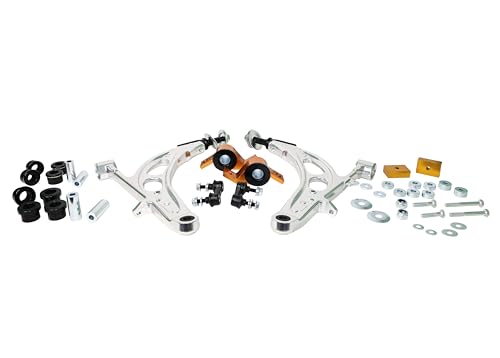

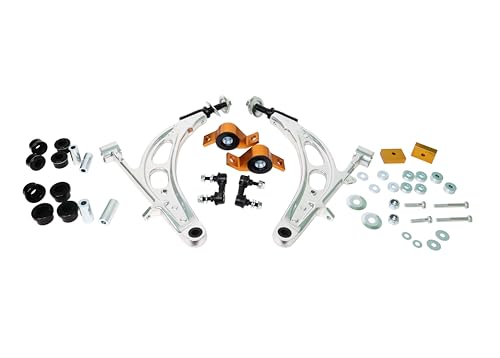
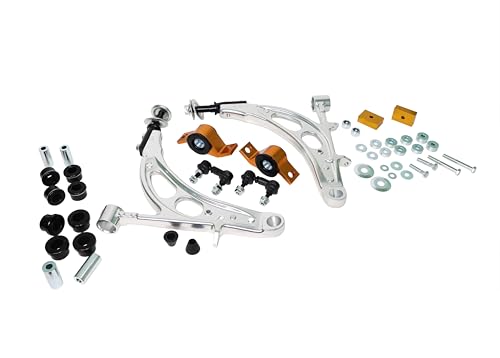
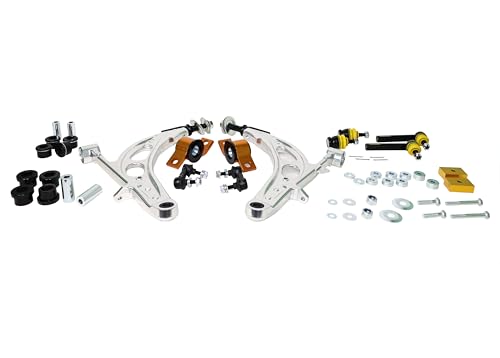
What Does the Front Lower Control Arm Do?
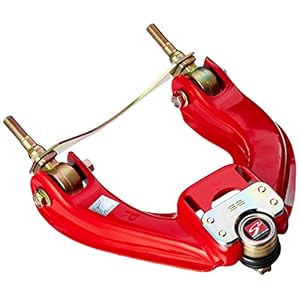
The front lower control arm connects the wheel hub assembly to the chassis while allowing the suspension to travel vertically.
It plays a major role in maintaining:
- Wheel position
- Camber geometry
- Caster geometry
- Steering response
- Braking stability
- Suspension articulation
The control arm has to move with the suspension while simultaneously resisting substantial cornering and braking forces.
Why Replace the Complete Control Arm?
On an older Subaru, replacing individual bushings isn’t always the most efficient solution.
The original control arm itself may have experienced:
- Corrosion
- Impact damage
- Distortion
- Damaged mounting points
- Decades of stress
A complete control arm assembly provides an opportunity to refresh a larger portion of the front suspension at once.
Improved Steering Precision
The lower control arms directly influence front-wheel positioning.
Any unwanted movement can make steering feel vague or delayed.
When the driver turns the steering wheel, the suspension should respond immediately and predictably.
Excessive compliance or worn mounting components can introduce movement before the tire reacts.
Fresh control arms help restore a more direct connection between the chassis and front suspension.
Better Braking Stability
Hard braking generates significant longitudinal loads through the front suspension.
Those forces travel from the tire through the hub and into the lower control arm.
Worn or damaged control arms and bushings can allow unwanted movement under braking.
Symptoms may include:
- Vehicle wandering
- Steering corrections during braking
- Front-end instability
- Clunking
- Changes in steering feel
Restoring proper control-arm location helps maintain more consistent suspension geometry.
Ideal for Older Subaru Impreza Models
Early Subaru Impreza platforms have become increasingly popular as restoration and performance projects.
That includes:
- GC-generation Impreza
- GM/GF Impreza
- GD/GG Impreza
- WRX
- WRX STI
Many of these vehicles are now well over 20 years old.
Even if mileage is relatively low, suspension bushings and chassis components deteriorate with age.
Subaru Forester Applications
The KTA289 also supports select first- and second-generation Forester applications.
These vehicles share significant suspension architecture with contemporary Impreza platforms.
Performance-oriented Forester builds can particularly benefit from refreshed front suspension components when combined with:
- Lowering springs
- Coilovers
- Performance sway bars
- Wider wheels
- Performance tires
KTA289 for Lowered Subarus
Lowering changes the operating angle of the front control arms.
That makes the condition and geometry of those arms increasingly important.
KTA289 can complement suspension upgrades such as:
- Lowering springs
- Coilovers
- Roll-center correction kits
- Sway bars
- Adjustable end links
- Performance alignment
For aggressively lowered vehicles, roll-center and bump-steer correction should also be considered.
Control Arms and Roll Center
The angle of the lower control arms contributes to determining the front suspension’s roll-center geometry.
When a Subaru is lowered substantially, the control arms may move away from their intended operating angle.
That’s why simply installing very short springs isn’t necessarily a complete suspension solution.
Ride height, control-arm position and steering geometry all need to work together.
Performance Street Driving
For a street-driven Impreza, WRX or Forester, fresh lower control arms can improve:
- Steering response
- Front-end stability
- Braking confidence
- Cornering consistency
- Suspension predictability
You don’t need a track car to appreciate a front suspension that isn’t negotiating with itself every time you turn the wheel.
Autocross
Autocross repeatedly loads the front suspension through:
- Hard braking
- Tight corners
- Slaloms
- Rapid transitions
- Acceleration
Reducing unwanted control-arm movement helps make those transitions more predictable.
Track Applications
Track driving places even greater loads on front suspension components.
A properly refreshed front suspension helps performance upgrades work as intended.
KTA289 can be combined with:
- Coilovers
- Performance dampers
- Sway bars
- Performance tires
- Chassis bracing
- Geometry correction
- Performance alignment
The goal is creating a complete suspension system rather than simply installing isolated parts.
Inspect the Ball Joints
Whenever replacing front control arms, inspect the ball joints carefully.
Look for:
- Torn boots
- Excessive movement
- Corrosion
- Binding
- Damaged studs
A worn ball joint can create many of the same symptoms associated with worn control arm bushings.
If you’re rebuilding a 20-year-old Subaru front suspension, replacing obviously deteriorated components while everything is apart can save substantial labor later.
Inspect the Control Arm Mounting Points
Older Subarus can also experience corrosion around suspension components.
Inspect:
- Front mounting points
- Rear control arm mounts
- Subframe
- Crossmember
- Fasteners
- Welded chassis brackets
Don’t install beautiful new suspension components onto structurally compromised mounting points.
Installation
General installation involves:
- Safely raise and support the vehicle.
- Remove the front wheels.
- Inspect the existing suspension.
- Disconnect the sway-bar end links as required.
- Disconnect the lower ball joint.
- Remove the control-arm mounting hardware.
- Remove the original lower control arms.
- Inspect chassis mounting points.
- Install the KTA289 control arms.
- Reconnect suspension components.
- Verify ball-joint and bushing positioning.
- Torque mounting hardware according to specifications.
- Set the suspension at normal operating ride height where required.
- Perform a complete four-wheel alignment.
- Road-test.
- Reinspect mounting hardware.
Always follow Whiteline’s supplied instructions and Subaru factory torque specifications.
Alignment Is Required
Replacing front lower control arms can affect wheel alignment.
A professional alignment should be performed after installation.
Check:
- Front camber
- Caster
- Toe
- Rear alignment
- Thrust angle
- Steering-wheel centering
If the vehicle is lowered, tell the alignment technician how the car is used.
A daily-driven WRX and an autocross WRX don’t necessarily need identical alignment settings.
Is Whiteline KTA289 Worth It?
The Whiteline KTA289 Front Lower Control Arm Kit provides a comprehensive way to refresh the front suspension on compatible Subaru Impreza and Forester models.
It’s particularly attractive for older vehicles where factory suspension components have accumulated years of:
- Wear
- Corrosion
- Bushing deterioration
- Road damage
- Performance abuse
For restoration, street performance or motorsport applications, replacing the complete lower control arm assemblies can help restore steering precision and suspension consistency while providing a solid foundation for additional handling upgrades.
And on a 1990s Subaru, “the factory suspension is probably still fine” is becoming an increasingly optimistic sentence.





There are no reviews yet.