
Why Does the Subaru WRX Need Adjustable Rear Control Arms?
The factory rear suspension is designed around the WRX’s original ride height and alignment specifications.
Install lowering springs or coilovers and that geometry changes.
As ride height decreases, rear camber can become increasingly negative. Depending on how far the car is lowered, the factory adjustment range may no longer be sufficient to bring the alignment back where you want it.
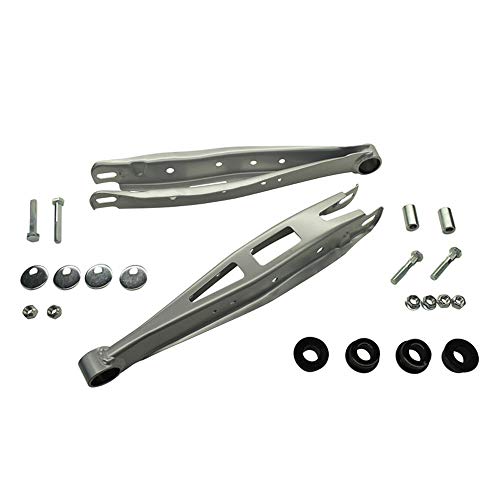
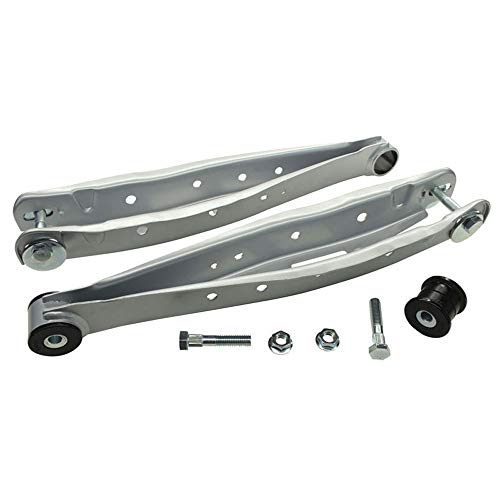
The KTA216A provides additional adjustment through the rear lower control arms.
That allows the suspension to be aligned around the vehicle’s actual ride height, rather than simply accepting whatever alignment lowering created.
What Does Rear Camber Do?
Camber describes the angle of the wheel when viewed from the front or rear of the vehicle.
When the top of the tire leans inward, that’s negative camber.
A moderate amount of negative camber can improve cornering grip because the tire maintains a better contact patch as the suspension loads during a corner.
Too much negative camber can contribute to:
- Inner-edge tire wear
- Reduced straight-line tire contact
- Reduced braking performance
- Poor tire utilization
- Difficult alignment
The correct amount depends on whether the WRX is a daily driver, autocross car, track car or something in between.
KTA216A for Lowered Subaru WRX Models
Lowering is one of the most common modifications made to the VA-generation WRX.
The typical sequence goes something like this:
Install coilovers.
Lower car.
Admire car.
Get alignment.
Discover rear camber is nowhere near where you wanted it.
That’s where adjustable suspension components become useful.
The KTA216A allows the rear alignment to be fine-tuned after the vehicle’s final ride height has been established.
Cam-Bolt Adjustment
Whiteline designed the KTA216A around a cam-bolt adjustment system.
This allows alignment changes to be made on the vehicle without repeatedly removing the control arms.
For an alignment technician, that means adjustments can be made while monitoring actual alignment measurements.
That’s considerably more useful than installing a fixed-length arm and hoping the resulting geometry happens to be correct.
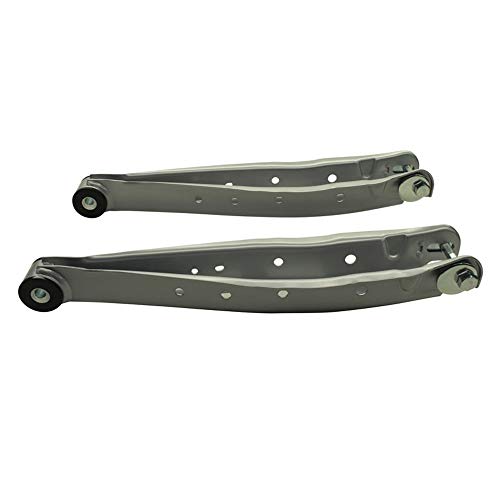
Lightweight Stamped-Steel Construction
Each complete KTA216A control arm weighs approximately 1.72 kg or 3.8 pounds.
Whiteline uses a stamped-steel design that provides the strength necessary for suspension loads without unnecessarily adding weight.
The objective isn’t simply to create a heavier component than the factory arm.
It’s to provide additional alignment capability while maintaining proper suspension strength and geometry.
KTA216A on the 2015 Subaru WRX
The 2015 Subaru WRX introduced the VA-generation chassis to the U.S. market.
Many of these cars are now running:
- Coilovers
- Lowering springs
- Wider wheels
- Larger sway bars
- Performance tires
Once ride height changes, rear alignment should always be checked.
KTA216A provides additional correction capability when the desired alignment can’t be achieved through the factory setup.
KTA216A on the 2016 Subaru WRX
The same principle applies to the 2016 WRX and WRX STI.
If the vehicle remains at stock ride height and the factory alignment range is sufficient, adjustable lower control arms may not be necessary.
Once the car is lowered, however, additional adjustment becomes considerably more useful.
KTA216A on the 2017 Subaru WRX
The 2017 WRX and STI are also compatible with KTA216A.
For street-driven cars, the objective is generally to balance:
Handling + stability + tire life
You don’t necessarily want maximum negative camber.
You want the correct camber for how the vehicle is actually being used.
KTA216A on the 2018 Subaru WRX
The 2018 Subaru WRX and STI complete the primary fitment range for this particular KTA216A application.
This includes cars equipped with factory suspension as well as vehicles modified with aftermarket springs or coilovers, provided the rest of the suspension configuration remains compatible.
Better Tire Wear
Tire wear is one of the strongest practical reasons to correct rear alignment after lowering a WRX.
Excessive negative camber can accelerate wear along the inner shoulder of the tire.
Incorrect toe makes the situation even worse.
A tire that’s simultaneously running excessive camber and incorrect toe can disappear impressively quickly.
Which is entertaining right up until you remember what four good performance tires cost.
Properly adjusting the rear suspension helps keep more of the tire working effectively.
Better Rear Tire Contact
Alignment isn’t only about tire longevity.
It’s also about maintaining an appropriate tire contact patch.
The rear tires need to generate grip during:
- Cornering
- Braking
- Acceleration
- High-speed transitions
Proper camber helps the tire maintain effective contact with the pavement as suspension loads change.
KTA216A gives the alignment technician more control over that relationship.
KTA216A With Lowering Springs
Lowering springs generally provide a moderate reduction in ride height.
Depending on the spring and resulting ride height, the factory rear alignment may still fall within an acceptable range.
If it doesn’t, KTA216A can provide the additional correction needed.
The important thing is to measure the alignment after lowering rather than assuming adjustable arms are automatically required.
KTA216A With Coilovers
Coilovers provide a much larger range of ride-height adjustment.
That also means they can create much larger changes in suspension geometry.
A proper installation sequence should generally be:
Install coilovers
→ Set final ride height
→ Allow suspension to settle
→ Corner balance if required
→ Install/adjust rear control arms
→ Perform four-wheel alignment
→ Road test
Don’t align the car and then decide to lower it another inch the following weekend.
You’ll simply be purchasing the same alignment twice.
Street Alignment
For a street-driven WRX or STI, alignment should prioritize predictable handling and reasonable tire life.
Extreme negative camber isn’t necessary for most daily-driven cars.
KTA216A allows the suspension to be adjusted toward a more appropriate street setup even after lowering has changed the factory geometry.
Autocross Applications
Autocross places heavy emphasis on transitional grip.
Cars rapidly move through:
- Slaloms
- Sweepers
- Tight corners
- Braking zones
- Direction changes
Rear camber can be tuned around the tire and suspension setup to improve grip and vehicle balance.
Adjustable lower control arms provide the flexibility necessary to experiment with those settings.
Track Applications
Track cars can benefit even more from precise alignment control.
Rear camber works together with:
- Front camber
- Toe
- Tire pressure
- Spring rates
- Dampers
- Sway bars
- Ride height
There isn’t one magical alignment setting that works for every WRX.
KTA216A simply provides additional mechanical range so the alignment can be tailored to the vehicle.
KTA216A and Wider Wheels
Wider wheels and performance tires are common WRX upgrades.
Alignment becomes even more important as tire width and grip increase.
The goal shouldn’t be using excessive negative camber merely to make oversized wheels fit underneath the fenders.
Suspension geometry should be selected for handling first.
Wheel fitment should work around that geometry.
Not the other way around.
Installation
Installing KTA216A requires removing the original rear lower control arms.
General installation includes:
- Safely raise and support the WRX.
- Remove the rear wheels.
- Inspect the existing rear suspension.
- Record the existing control-arm position.
- Remove the factory rear lower control arms.
- Compare the factory components with the KTA216A arms.
- Install the Whiteline control arms.
- Install and position the adjustment hardware.
- Verify suspension and wheel clearance.
- Torque mounting hardware according to specifications.
- Set the vehicle at normal operating ride height.
- Perform a complete four-wheel alignment.
- Tighten adjustment hardware.
- Road-test the vehicle.
- Recheck all fasteners.
Always follow the supplied Whiteline installation instructions and Subaru service specifications.
Alignment Is Required
Installing adjustable lower control arms directly affects wheel alignment.
A professional four-wheel alignment should therefore be considered part of the installation.
Have the technician check:
- Rear camber
- Rear toe
- Front camber
- Front toe
- Thrust angle
- Steering-wheel position
Do not simply install the arms and continue driving because the wheels “look straight.”
Your eyeballs are not a Hunter alignment rack.
Inspect the Rest of the Rear Suspension
While installing KTA216A, inspect:
- Rear wheel bearings
- Sway-bar links
- Sway-bar bushings
- Upper suspension links
- Toe links
- CV boots
- Rear shocks or coilovers
- Subframe bushings
- Brake hoses
- Mounting hardware
Suspension components operate as a system.
A new adjustable control arm won’t fix a destroyed wheel bearing or worn sway-bar link.
Stock WRX vs. Modified WRX
For a completely stock-height WRX with a proper factory alignment, KTA216A may provide little practical benefit.
For a lowered WRX where factory alignment adjustment has become insufficient, the situation changes considerably.
That’s the important distinction.
KTA216A isn’t something every WRX automatically needs.
It’s a geometry and alignment solution for cars that need additional rear adjustment.
Is Whiteline KTA216A Worth It?
The Whiteline KTA216A Adjustable Rear Lower Control Arm Kit provides additional rear alignment control for 2015–2018 Subaru WRX and WRX STI models.
Its lightweight stamped-steel construction and cam-bolt adjustment allow rear suspension geometry to be fine-tuned after lowering or other suspension modifications.
For a stock-height WRX, that additional adjustment may not be necessary.
For a lowered WRX or STI struggling to achieve the desired rear alignment, KTA216A provides the adjustment range needed to get the suspension back where it belongs.
Because lowering a car is easy.
Getting the suspension geometry right afterward is where the actual work starts.



There are no reviews yet.