
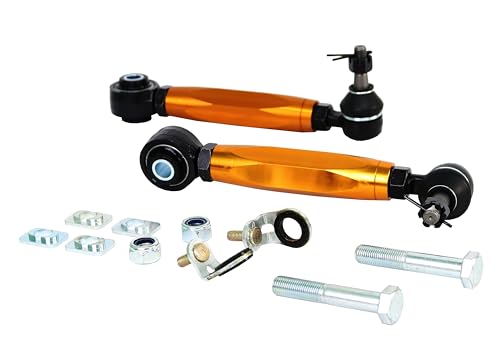
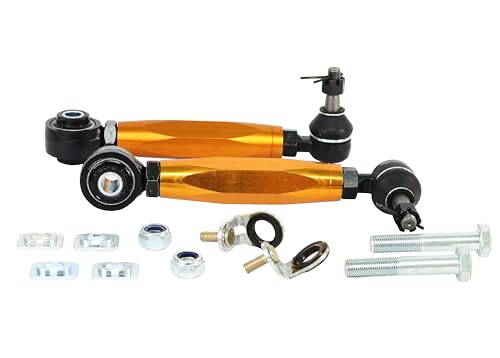
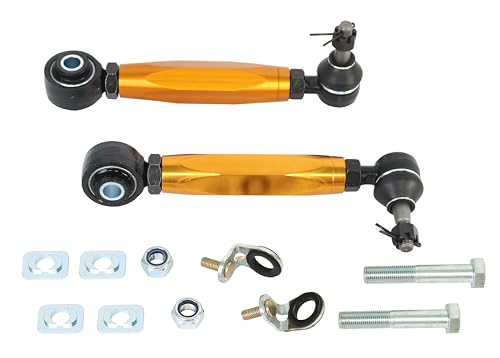
What Does KTA147B Do?
KTA147B provides additional adjustment of the rear toe angle.
Toe describes the direction the wheels point when viewed from above.
If the fronts of the tires point toward each other:
Toe-in
If they point away from each other:
Toe-out
Even relatively small changes in rear toe can dramatically affect handling and tire wear.
Why Lowering the BRZ/FR-S/86 Creates Alignment Problems
The rear suspension geometry changes as ride height decreases.
Lowering can introduce additional negative camber and alter toe.
The problem becomes more noticeable when adjustable rear camber components are installed.
You correct camber.
Then toe moves.
You correct toe.
Then discover you’ve reached the limits of the factory eccentric.
Congratulations. You’ve unlocked the suspension-alignment side quest.
KTA147B provides additional adjustment range to address that problem.
Why Rear Toe Matters
Incorrect rear toe can cause:
- Rapid tire wear
- Straight-line instability
- Wandering
- Nervous highway behavior
- Poor corner entry
- Reduced rear grip
- Unpredictable transitions
Toe can destroy tires surprisingly quickly.
In many cases, excessive toe is actually more destructive to tire life than negative camber.
Factory Toe Lockout Washers
One important feature of KTA147B is the inclusion of factory toe adjustment lockout washers.
Instead of continuing to rely on the factory eccentric adjustment, the eccentric is effectively locked into a fixed position.
Fine adjustment is then performed using the adjustable control arm.
This can help prevent the alignment from shifting under hard suspension loads.
Why Lock Out the Factory Eccentric?
Factory eccentric bolts are inexpensive and convenient for production vehicles.
They’re not necessarily ideal for heavily modified suspension.
Under high loads, eccentric adjusters can potentially move if they aren’t properly secured.
KTA147B moves the adjustment function into the arm itself.
The basic concept becomes:
Factory eccentric → Locked
Adjustable toe arm → Alignment adjustment
That’s a much more controlled approach for a performance suspension.
KTA147B With Coilovers
This is one of the strongest applications for KTA147B.
A proper setup sequence should generally be:
Install coilovers
→ Set final ride height
→ Corner balance if required
→ Set rear camber
→ Adjust rear toe
→ Perform complete alignment
→ Road or track test
Changing ride height after alignment will change suspension geometry again.
So establish the ride height first.
KTA147B With Lowering Springs
Lowering springs usually produce a less aggressive drop than coilovers, but rear geometry still changes.
Depending on the amount of lowering and desired camber setting, factory toe adjustment may become insufficient.
KTA147B provides additional adjustment range for these vehicles as well.
Better Tire Wear
For street-driven BRZ, FR-S and 86 models, this may be one of the biggest practical benefits.
A lowered car can look perfectly normal while running excessive rear toe.
Then 5,000 miles later:
Outside of tire: looks fantastic.
Inside of tire: has achieved racing-slick status.
Proper toe adjustment can dramatically improve tire life.
Street Performance
A street car typically benefits from relatively conservative rear toe settings that prioritize:
- Stability
- Predictability
- Tire life
- Straight-line tracking
KTA147B allows the alignment technician to establish those settings even when other suspension modifications have pushed the geometry outside the factory adjustment range.
Autocross
Autocross drivers may use rear toe strategically to influence rotation and transitional behavior.
Small changes can alter how quickly the rear responds during:
- Turn-in
- Slaloms
- Trail braking
- Rapid transitions
Adjustable toe arms make those changes easier to control and repeat.
Track Use
For track cars, rear alignment becomes part of the overall chassis setup.
Rear toe works together with:
- Camber
- Tire pressure
- Spring rates
- Sway bars
- Dampers
- Ride height
KTA147B gives the alignment technician additional control over one of those variables.
Installation
General installation involves:
- Safely raise and support the vehicle.
- Remove the rear wheels.
- Locate the factory rear toe links.
- Record the existing alignment/arm length as a starting point.
- Remove the factory arms.
- Install the KTA147B adjustable arms.
- Install the supplied eccentric lockout hardware.
- Set approximate initial arm length.
- Torque mounting hardware appropriately.
- Set the vehicle at operating ride height.
- Perform a complete four-wheel alignment.
- Tighten adjustment hardware.
- Road-test.
- Recheck all hardware.
Alignment Is Required
Unlike sway-bar bushings or end links, KTA147B directly controls wheel alignment.
A professional alignment is therefore mandatory after installation.
Check:
- Rear toe
- Rear camber
- Front toe
- Front camber
- Thrust angle
- Steering-wheel centering
Do not attempt to set rear toe by looking down the side of the car.
Human eyeballs remain disappointingly uncalibrated.
Is Whiteline KTA147B Worth It?
For a lowered 2013–2020 Subaru BRZ, 2013–2016 Scion FR-S or 2017–2020 Toyota 86, the Whiteline KTA147B provides a more precise method of adjusting rear toe after suspension modifications.
The adjustable arms allow additional toe correction while the supplied lockout washers eliminate reliance on the factory eccentric adjustment.
That’s particularly useful for cars equipped with:
- Coilovers
- Lowering springs
- Adjustable rear camber arms
- Aggressive wheel and tire packages
- Autocross setups
- Track suspension
It’s not simply another shiny suspension arm.
It’s a tool for getting the rear alignment back where you actually want it.





There are no reviews yet.