
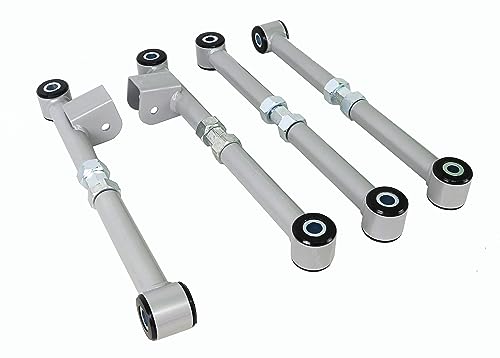
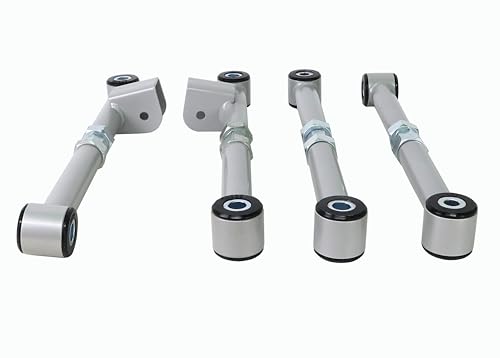
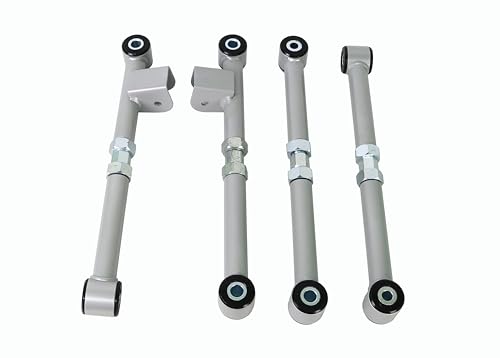
What Is Whiteline KTA108?
The KTA108 is a complete adjustable rear suspension arm package.
The kit uses:
- 4 complete adjustable rear arms
- Performance low-compliance bushings
- Turnbuckle-style adjustment
- Left/right-hand threaded adjustment
- On-car alignment capability
Unlike Whiteline’s more economical KTA107 solution, KTA108 replaces four complete arms rather than combining adjustable front arms with replacement bushings for the remaining factory components.
What Can KTA108 Adjust?
The purpose of KTA108 is to provide greater control over:
Rear Camber
Rear Toe
Rear Track
These alignment parameters become particularly important once the vehicle has been lowered.
Why Lowering a Subaru Changes Rear Alignment
Lowering springs and coilovers change where the suspension operates within its normal travel.
That changes suspension geometry.
Depending on ride height, the rear wheels can develop excessive negative camber and unwanted toe changes.
You may end up with something like:
Install coilovers
→ Lower car
→ Looks fantastic
→ Rear alignment is now somewhere in another ZIP code
Adjustable control arms provide the alignment technician with additional range to bring those settings back under control.
Rear Camber Adjustment
Camber describes the inward or outward tilt of the wheel when viewed from the front or rear.
Negative camber means the top of the wheel leans inward.
Some negative camber can improve cornering performance because it helps maintain tire contact as the suspension loads during cornering.
Too much negative camber can cause:
- Reduced straight-line tire contact
- Accelerated inner tire wear
- Reduced braking effectiveness
- Poor tire utilization
KTA108 allows rear alignment to be adjusted around the actual vehicle setup.
Rear Toe Adjustment
Toe describes whether the wheels point slightly inward or outward when viewed from above.
Small changes in rear toe can significantly influence stability.
Incorrect rear toe can contribute to:
- Rapid tire wear
- Rear instability
- Wandering
- Poor straight-line tracking
- Unpredictable corner entry
For a performance Subaru, rear toe is often every bit as important as camber.
Why Adjustable Arms Are Better for Lowered Cars
The factory suspension was designed around factory ride height.
Once the vehicle is substantially lowered, the original adjustment range may no longer be sufficient.
KTA108 gives the alignment technician more mechanical range to establish appropriate settings.
That’s particularly valuable with:
- Lowering springs
- Coilovers
- Aggressive wheel fitment
- Performance tires
- Autocross setups
- Track alignment
Turnbuckle Adjustment
One of KTA108’s most useful features is its left/right-hand threaded turnbuckle design.
Instead of removing one end of an arm every time an adjustment is required, the effective arm length can be changed while installed.
Rotate the adjustment section one direction:
Arm gets longer
Rotate it the other:
Arm gets shorter
That makes precise alignment considerably easier.
Low-Compliance Bushings
Whiteline also uses performance bushings in the KTA108 arms.
Factory rubber bushings provide excellent noise and vibration isolation, but they can deform under suspension loads.
Reducing that compliance helps the suspension maintain its intended geometry more consistently.
That can produce a more direct connection between:
Chassis → Control Arm → Hub → Tire
The goal isn’t simply making everything harder.
It’s controlling movement in the directions where movement isn’t desirable.
More Predictable Dynamic Alignment
Static alignment is what the alignment rack measures while the vehicle is stationary.
Dynamic alignment is what happens when the suspension is actually loaded.
During cornering, braking and acceleration, bushings deform and suspension arms move through their arcs.
Low-compliance bushings can reduce unintended geometry changes under those loads.
That’s one reason upgraded control arms can make a performance car feel more predictable even when the alignment numbers themselves aren’t dramatically different.
KTA108 for the 2002–2007 Subaru WRX
The GD-generation WRX remains an extremely popular platform for suspension modification.
Common upgrades include:
- Coilovers
- Lowering springs
- Larger sway bars
- Adjustable sway-bar links
- Wider wheels
- Performance tires
- Chassis bracing
Once ride height and tire grip increase substantially, rear alignment becomes increasingly important.
KTA108 gives the WRX more adjustment capability to support those modifications.
KTA108 for the 2004–2007 STI
The STI starts with a more performance-oriented suspension, but modified ride height can still push alignment outside the desired range.
Track-oriented STI builds can particularly benefit from adjustable rear arms because alignment can be optimized around:
- Tire compound
- Ride height
- Spring rate
- Sway-bar stiffness
- Track conditions
- Driver preference
That flexibility is much more useful than simply accepting whatever geometry Subaru’s original eccentric adjustment can provide.
Street Alignment
A street-driven WRX generally needs a compromise between:
Handling
Stability
Tire wear
Ride quality
Aggressive negative camber might look fantastic in a parking lot, but excessive camber and toe can destroy an expensive set of tires surprisingly quickly.
For a daily driver, use KTA108’s adjustment range to create a sensible alignment rather than seeing how much negative camber physically fits.
For additional suspension information, visit My Pro Street.
Track Alignment
Track cars can take advantage of more aggressive alignment.
Additional negative camber can help maintain the tire contact patch under heavy lateral load, while carefully selected rear toe can influence stability and rotation.
KTA108 allows those settings to be adjusted around the vehicle’s actual suspension and tire package.
KTA108 With Coilovers
This is probably the strongest application for adjustable rear arms.
A proper suspension setup would generally follow:
Install coilovers
→ Set ride height
→ Corner balance if required
→ Adjust rear control arms
→ Set camber and toe
→ Perform complete alignment
→ Road/track test
Changing the control-arm length before finalizing ride height can result in doing the alignment twice.
Alignment shops enjoy that arrangement considerably more than customers do.
Tire Wear
One of the biggest practical benefits of additional alignment adjustment is tire life.
A lowered Subaru with excessive negative camber combined with incorrect toe can destroy the inner shoulders of the rear tires.
Toe is particularly destructive.
Being able to independently bring alignment settings into an appropriate range can potentially save considerably more money in tires than the suspension components initially cost.
Installation
KTA108 installation involves replacing four rear suspension arms.
General installation includes:
- Safely raise and support the vehicle.
- Remove the rear wheels.
- Inspect the existing suspension.
- Measure or record the original arm lengths.
- Remove the factory arms.
- Set the KTA108 arms to reasonable initial lengths.
- Install the replacement arms.
- Verify suspension clearance.
- Torque mounting hardware appropriately.
- Set the vehicle at operating ride height.
- Perform a complete four-wheel alignment.
- Tighten adjustment locking hardware.
- Road-test the vehicle.
- Recheck all fasteners.
Alignment Is Mandatory
Unlike replacing sway-bar links, installing adjustable control arms directly changes suspension geometry.
A professional wheel alignment should therefore be considered part of the installation.
Have the technician check:
- Rear camber
- Rear toe
- Front camber
- Front toe
- Thrust angle
- Steering-wheel position
Don’t install adjustable arms and then drive around for three weeks waiting for an alignment appointment.
Your tires will conduct the alignment themselves.
Their preferred method involves removing rubber.
Inspect These Components at the Same Time
While installing KTA108, inspect:
- Rear wheel bearings
- CV boots
- Rear struts or coilovers
- Sway-bar links
- Sway-bar bushings
- Remaining suspension bushings
- Rear subframe mounts
- Brake hoses
- Axle seals
On a 2002–2007 Subaru, age is becoming just as important as mileage.
Who Should Buy Whiteline KTA108?
KTA108 makes the most sense for Subaru owners who:
Have lowered their WRX or STI
Need additional rear camber adjustment
Need additional rear toe adjustment
Run coilovers
Autocross or track their Subaru
Want more precise rear suspension geometry
Want lower-compliance rear suspension arms
For a completely stock Impreza at factory ride height, these arms may be unnecessary.
For a modified WRX or STI struggling to achieve proper rear alignment, they’re considerably easier to justify.
Is Whiteline KTA108 Worth It?
The Whiteline KTA108 Adjustable Rear Control Arm Kit addresses one of the most important consequences of modifying suspension height: alignment geometry.
Its four adjustable arms provide greater control over rear camber, toe and track while performance bushings reduce unwanted compliance.
For a lowered 2002–2007 Subaru Impreza WRX or 2004–2007 STI, that means you can actually align the suspension around the car you’ve built rather than trying to force modified geometry into the factory adjustment range.
That’s the difference between simply lowering a car and actually setting up its suspension.
Browse performance suspension and chassis components through Pro Street Online.





There are no reviews yet.