

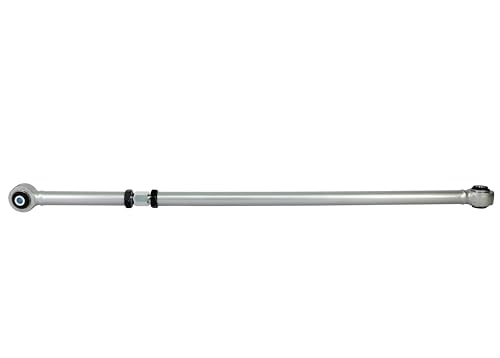
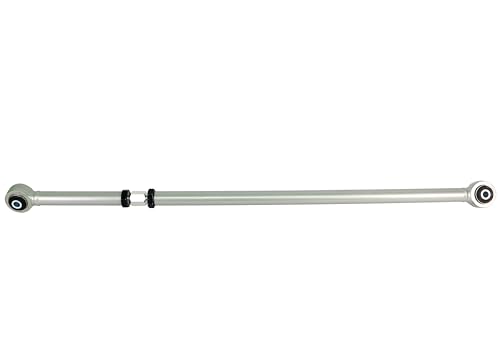
Why Changing Ride Height Moves the Rear Axle
The factory Panhard rod has a fixed length designed around the vehicle’s original ride height.
Lower the vehicle and the suspension now sits at a different point in the Panhard rod’s travel arc.
The result can be an axle that no longer sits perfectly centered beneath the vehicle.
One rear wheel may appear farther outward while the opposite wheel sits farther inward.
The same problem can occur when substantially raising certain vehicles.
Why Use an Adjustable Panhard Rod?
An adjustable rod allows its effective length to be changed.
That means you can physically reposition the axle underneath the chassis.
The process is essentially:
Change ride height
→ Rear axle shifts laterally
→ Adjust KPR068 length
→ Recenter rear axle
It’s one of those suspension modifications that doesn’t sound particularly exciting until you realize your rear axle is sitting noticeably closer to one quarter panel than the other.
Heavy-Duty DOM Steel Construction
Whiteline constructs the KPR068 from heavy-duty DOM steel tubing.
DOM—or Drawn Over Mandrel—tubing is commonly used for performance suspension components because it provides consistent dimensions and good structural strength.
That’s particularly important for a Panhard rod because it continuously handles lateral suspension loads.
Forged Ends
Whiteline also uses forged ends for additional strength.
During cornering, lateral tire forces are transmitted through the axle and into the Panhard rod.
That makes the mounting ends critical structural points.
The KPR068 is designed as a performance replacement capable of handling those suspension loads while providing the adjustment unavailable from a fixed factory rod.
Whiteline Giiro Bushings
The KPR068 uses Whiteline’s Giiro bushing technology.
These bushings are designed to provide controlled articulation while minimizing maintenance requirements.
Whiteline emphasizes grease-free operation, meaning owners don’t need to periodically lubricate the bushings like some conventional polyurethane suspension components.
That’s useful on a street-driven performance vehicle where nobody particularly enjoys crawling underneath the car every few months armed with a grease gun.
Better Axle Centering
Axle centering is the primary reason to install KPR068.
An incorrectly positioned rear axle can affect:
- Wheel-to-fender clearance
- Tire clearance
- Suspension geometry
- Vehicle appearance
- Handling consistency
- Left-to-right suspension behavior
This becomes particularly important with wider wheels and tires where available fender clearance may already be limited.
KPR068 With Lowering Springs
Lowering springs change the static operating position of the rear suspension.
Even a moderate drop can alter the Panhard rod angle enough to shift the axle laterally.
An adjustable Panhard rod allows that change to be corrected after the springs are installed.
A proper sequence is:
Install springs
→ Settle suspension
→ Measure axle position
→ Adjust KPR068
→ Verify wheel clearance
KPR068 With Coilovers
Vehicles equipped with adjustable-height suspension can benefit even more.
Every time ride height changes significantly, rear axle position should be checked.
Set your final ride height first.
Then adjust the Panhard rod.
Otherwise, you’re essentially correcting geometry for a suspension height you’re about to change again.
KPR068 on Raised Vehicles
The same geometric principle applies when the vehicle is raised.
Increasing ride height moves the axle along the opposite portion of the Panhard rod’s arc.
Therefore, lifted vehicles using compatible Panhard-style rear suspension may also require lateral axle correction.
Better Wheel Fitment
An off-center axle can become especially obvious after installing wider wheels.
You might find:
Driver side: plenty of clearance.
Passenger side: tire attempting to become emotionally involved with the quarter panel.
Before blaming the wheel offset, measure rear axle position.
If the axle isn’t centered, wheel fitment isn’t the underlying problem.
Performance Handling
Keeping the rear axle properly positioned helps maintain more symmetrical suspension behavior.
During cornering, the rear suspension experiences significant lateral loading.
A properly configured Panhard rod helps keep the axle laterally controlled relative to the chassis.
That’s important for:
- Performance street driving
- Autocross
- Track use
- Drag racing
- Aggressive wheel and tire setups
Drag Racing Applications
A Panhard rod is particularly important on high-powered live-axle vehicles.
Hard launches transmit substantial forces through the rear suspension.
Maintaining predictable axle position can complement other upgrades such as:
- Rear control arms
- Differential bushings
- Performance shocks
- Springs
- Limited-slip differential upgrades
- Wider rear tires
KPR068 doesn’t create traction by itself, but it helps ensure the rear axle remains properly located.
Does KPR068 Reduce Body Roll?
No.
That’s the job of components such as:
- Springs
- Sway bars
- Dampers
The Panhard rod controls lateral axle position.
It’s important not to confuse those functions when building a suspension package.
Installation
General installation involves:
- Park the vehicle on a level surface.
- Safely raise and support the vehicle as required.
- Support the rear axle.
- Measure existing axle position.
- Remove the factory Panhard rod.
- Set the KPR068 to approximately the factory rod length.
- Install the Whiteline rod.
- Lower/load the suspension to normal ride height.
- Measure wheel or axle position relative to the chassis.
- Adjust rod length until the axle is centered.
- Tighten adjustment hardware.
- Torque mounting bolts correctly.
- Check tire and suspension clearance.
- Road-test the vehicle.
- Recheck all mounting hardware.
Always follow the Whiteline installation instructions and factory torque specifications for the specific vehicle.
How to Center the Rear Axle
Don’t simply look at the tires and declare the axle centered.
Measure from repeatable chassis or body reference points on both sides.
You want the rear axle positioned equally relative to the vehicle centerline.
After adjustment, verify that both tires have appropriate clearance throughout suspension travel.
Does KPR068 Require an Alignment?
Installing a Panhard rod doesn’t directly adjust conventional:
- Camber
- Caster
- Toe
However, because KPR068 is generally installed after a ride-height change, a complete alignment is still highly recommended.
Lowering or raising the vehicle can alter other suspension geometry even if the Panhard rod itself doesn’t directly control those alignment angles.
When Do You Need KPR068?
An adjustable Panhard rod makes the most sense when:
The vehicle has been lowered
The vehicle has been raised
The rear axle is visibly off-center
Wider wheels have reduced fender clearance
The factory Panhard rod is damaged
You’re building a performance-oriented live-axle suspension
The critical factor is axle position.
If the rear axle is already correctly centered at the desired ride height, don’t adjust things simply because adjustment exists.
Is Whiteline KPR068 Worth It?
The Whiteline KPR068 Adjustable Panhard Rod solves a very specific suspension geometry problem: lateral axle displacement caused by changes in ride height.
Its heavy-duty DOM steel construction, forged ends, adjustable length and maintenance-friendly Giiro bushings make it suitable for performance-oriented street and motorsport applications.
If lowering or raising your vehicle has shifted the rear axle toward one side, an adjustable Panhard rod allows you to put it back where the engineers originally intended:
in the middle.
A revolutionary concept, apparently.





There are no reviews yet.