
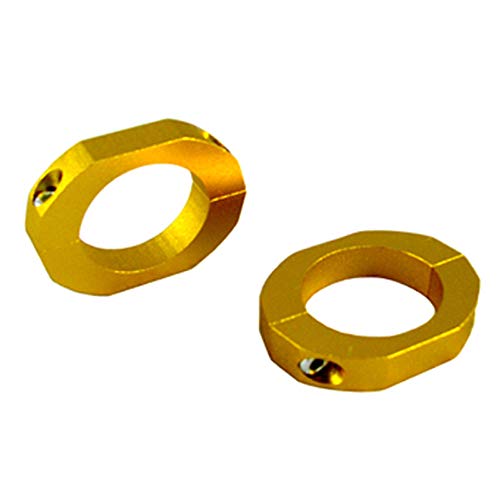
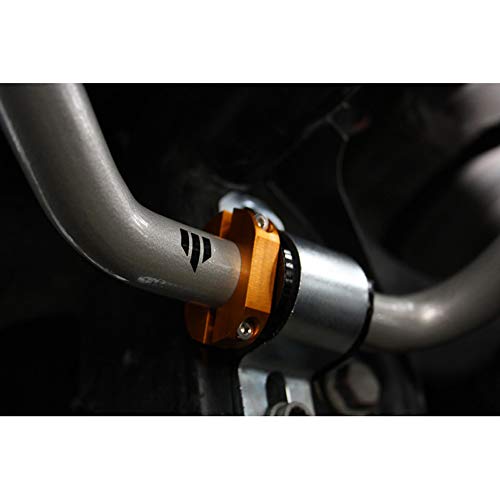
What Does Whiteline KLL122 Do?
A sway bar is supposed to rotate within its chassis-mounted bushings as the suspension moves.
What you don’t want is the entire bar sliding sideways.
Under aggressive cornering loads, a sway bar can potentially shift laterally through its mounting bushings.
That can reduce consistency and, in some installations, cause the sway bar to contact nearby:
- Chassis components
- Control arms
- Steering components
- Exhaust components
- Suspension hardware
KLL122 limits that unwanted lateral movement.
How Sway Bar Lateral Locks Work
The installation is straightforward.
One lock is installed immediately beside each chassis-mounted sway-bar bushing.
The resulting arrangement looks roughly like:
LOCK | BUSHING — SWAY BAR — BUSHING | LOCK
The sway bar can still rotate normally inside its mounting bushings.
However, the lateral locks prevent the entire bar from sliding significantly left or right.
Why Does a Sway Bar Move Sideways?
During cornering, suspension loads aren’t perfectly isolated to one axis.
As the suspension compresses, extends and articulates, the sway bar and end links can experience forces that encourage lateral movement.
This can become more noticeable with:
- Larger aftermarket sway bars
- Stiffer suspension
- Performance end links
- Sticky tires
- Track driving
- Autocross
- Aggressive street driving
The more grip the vehicle generates, the greater the forces transmitted through suspension components.
Factory vs. Aftermarket Sway Bars
KLL122 can potentially be used with either.
Factory sway bars
The locks can help control unwanted lateral movement while retaining the original stabilizer bar.
Aftermarket sway bars
This is arguably the more interesting application.
Performance sway bars are often larger and stiffer than factory bars.
That means they can experience greater forces during hard cornering.
Adding lateral locks helps keep the bar positioned correctly relative to its chassis mounts.
Why 22mm Matters
KLL122 is specifically sized around a 22mm sway bar.
That’s approximately:
0.866 inches
Do not assume a sway bar is 22mm based on vehicle model alone.
Different trim levels can use different bar diameters.
Manufacturers may also change sway-bar diameter during a production run.
And if the vehicle already has an aftermarket sway bar, the original factory specification becomes irrelevant.
How to Measure Your Sway Bar
The best method is using a digital or vernier caliper.
Measure the sway bar on a straight, clean section near the mounting bushing.
You’re looking for approximately:
22.0 mm
Don’t measure over:
- Paint buildup
- Rust scale
- Dirt
- Grease
- Bushings
And definitely don’t measure circumference with a tape measure and declare victory unless you’re prepared to do the conversion accurately.
Installation
One major advantage of KLL122 is that the sway bar generally doesn’t need to be removed.
Basic installation involves:
- Safely raise the vehicle if additional access is required.
- Locate the sway-bar chassis mounting bushings.
- Clean the sway bar beside each mounting bushing.
- Position one lateral lock immediately beside each bushing.
- Verify clearance around surrounding components.
- Tighten the locking hardware evenly.
- Check that the sway bar can still rotate normally.
- Verify that the bar cannot move excessively side-to-side.
- Road-test the vehicle.
- Recheck the hardware.
It’s considerably easier than replacing the entire sway bar.
Does KLL122 Require an Alignment?
Normally, no.
Installing lateral sway-bar locks doesn’t directly change:
- Camber
- Caster
- Toe
Therefore, a wheel alignment isn’t generally required.
Does KLL122 Increase Sway Bar Stiffness?
No.
It doesn’t change the diameter, wall thickness or material of the sway bar.
Instead, it helps the existing bar remain correctly positioned.
Think of it as improving sway-bar location, not increasing sway-bar spring rate.
Can KLL122 Reduce Suspension Noise?
Potentially, if the noise is being caused by the sway bar shifting sideways and contacting surrounding components.
However, it won’t fix noises caused by:
- Worn end links
- Destroyed sway-bar bushings
- Loose brackets
- Ball joints
- Control-arm bushings
- Strut mounts
Diagnose the problem before throwing suspension parts at it.
Your UPS driver shouldn’t be your diagnostic technician.
Great Supporting Modification
KLL122 makes particular sense when combined with:
22mm performance sway bar
Performance sway-bar bushings
Heavy-duty end links
Lowering springs
Coilovers
Performance tires
It’s a small supporting component that helps keep the stabilizer system operating consistently.
Street Cars
For a normal street car with a properly located factory sway bar, lateral locks may not produce a dramatic difference.
But on a modified vehicle with a 22mm performance bar, they’re inexpensive insurance against unwanted bar movement.
Autocross
Autocross repeatedly loads and unloads the suspension through rapid directional changes.
That makes consistent sway-bar positioning particularly useful.
Slaloms and fast transitions can generate substantial alternating loads through the stabilizer system.
Preventing lateral movement keeps one more suspension variable under control.
Track Use
Track cars running high-grip tires can generate dramatically greater cornering forces than ordinary street vehicles.
A lateral lock kit is therefore a small but logical supporting modification for a properly developed suspension.
It won’t magically drop seconds from a lap time.
It simply ensures the sway bar stays where it’s supposed to be.
Sometimes suspension tuning is surprisingly glamorous.
Sometimes it’s two little aluminum collars.
Is Whiteline KLL122 Worth It?
If you’re running a 22mm factory or aftermarket sway bar that doesn’t already incorporate an effective lateral locating system, the Whiteline KLL122 provides a simple way to limit side-to-side stabilizer-bar movement.
It’s especially useful for vehicles with:
- Aftermarket sway bars
- Performance suspension
- High-grip tires
- Autocross setups
- Track-oriented builds
Just remember the critical fitment requirement:





There are no reviews yet.