
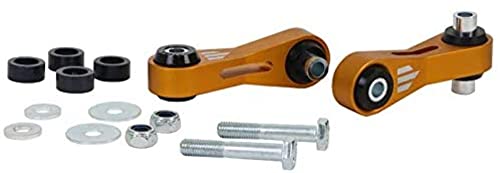


What Is Whiteline KLC231?
Part Number: KLC231
Position: Rear
Product Type: Sway bar/stabilizer bar end-link kit
Quantity: Pair
Application: Vehicle-specific Subaru rear suspension
Purpose: Improve sway-bar connection and reduce unwanted compliance
Recommended With: Factory or aftermarket rear sway bars
Despite some marketplace descriptions referring broadly to bushings or suspension links, KLC231 is a rear sway-bar end-link kit.
That’s how I’d categorize it on ProStreetOnline.
Why Sway Bar End Links Matter
The sway bar doesn’t connect itself directly to the wheel.
Instead, suspension movement is transferred through the end link:
Suspension → End Link → Sway Bar → Opposite Suspension
When the vehicle corners, one side of the suspension compresses relative to the other. The sway bar twists and resists that movement.
That adds roll stiffness.
But if the end link connecting everything together flexes excessively, has worn joints or develops play, the sway bar can’t respond as precisely.
What Happens When Factory End Links Wear?
Common symptoms of worn sway-bar links include:
- Clunking over bumps
- Rear suspension knocking
- Rattling
- Excessive joint movement
- Torn joint boots
- Reduced sway-bar response
- Less predictable transitional handling
On an older Impreza or WRX, mileage and corrosion can make factory end-link condition particularly important.
If you’re installing a new sway bar anyway, it’s an excellent time to inspect them.
KLC231 With an Aftermarket Rear Sway Bar
This is where upgraded end links become especially valuable.
A larger performance sway bar can generate significantly greater loads than the original bar.
Those loads travel directly through the end links.
Using stronger links can help create a more positive connection between the suspension and upgraded sway bar.
That means the bar can do the job you paid for it to do.
Will KLC231 Reduce Body Roll?
Not directly in the same way that installing a larger sway bar will.
The sway bar itself determines most of the change in roll stiffness.
KLC231 improves the connection between the suspension and sway bar.
Think of it this way:
Performance sway bar = changes roll stiffness
Performance end links = transmit suspension movement to that sway bar
They’re complementary components.
Rear Sway Bars and Subaru Understeer
Many factory AWD vehicles are intentionally configured with predictable understeer.
A stiffer rear sway bar can shift the chassis toward a more neutral handling balance by increasing rear roll stiffness.
Potential benefits can include:
- Reduced understeer
- Improved rotation
- Sharper transitional response
- Reduced body roll
KLC231 can help ensure that upgraded rear bar responds consistently.
KLC231 on the Subaru WRX
The 2008–2014 Impreza WRX and 2015–2016 WRX are obvious candidates for this upgrade.
These cars respond well to balanced suspension modifications, particularly when combining:
- Quality dampers or coilovers
- Performance springs
- Rear sway bar
- Upgraded end links
- Proper alignment
- Performance tires
A properly developed suspension can improve the WRX considerably without simply making everything painfully stiff.
Browse additional suspension and handling information through My Pro Street.
KLC231 on the WRX STI
The STI already has a more performance-oriented suspension than a conventional Impreza, but that doesn’t make its factory end links immortal.
Track use, aggressive driving and stiffer aftermarket sway bars can increase loads through the links.
For an STI equipped with a performance rear sway bar, stronger links make sense as a supporting modification.
KLC231 on the Impreza
You don’t need a turbocharger to benefit from better suspension response.
A naturally aspirated Impreza equipped with upgraded suspension can also benefit from properly functioning rear sway-bar links.
For a street car, though, avoid falling into the trap of assuming maximum stiffness automatically equals maximum handling.
Tires still need to remain connected to pavement.
Minor technicality, apparently.
KLC231 and Lowered Suspension
Lowering changes the static position of the suspension.
Depending on the vehicle and component design, that can affect:
- End-link operating angle
- Sway-bar position
- Suspension travel
- Roll-center geometry
- Component clearance
That’s why sway-bar links should be inspected whenever substantial ride-height changes are made.
For more information on how lowering affects the entire suspension system, browse Pro Street’s suspension guides at My Pro Street.
What Is Sway Bar Preload?
Sway-bar preload occurs when the stabilizer bar is being twisted even though the vehicle is sitting stationary at normal ride height.
This can occur after:
- Lowering
- Coilover installation
- Corner balancing
- Ride-height changes
- Incorrect link installation
Adjustable end links are commonly used to eliminate this condition.
However, don’t automatically describe every performance end-link application as providing a large adjustment range unless the exact KLC231 specification supports it.
For your product page, I’d emphasize heavy-duty replacement/performance end-link construction and improved sway-bar operation rather than inventing adjustment specifications.
Inspect the Sway Bar Bushings
End links aren’t the only components that wear.
The sway bar is also mounted to the chassis through bushings.
Inspect them for:
- Cracking
- Excessive clearance
- Deformation
- Contamination
- Bar movement
Worn mounting bushings can create noise and reduce stabilizer-bar effectiveness.
Check the Mounting Points
A larger rear sway bar can transmit substantially greater forces into the chassis mounting locations.
While installing KLC231, inspect:
- End-link mounting tabs
- Sway-bar brackets
- Chassis mounting points
- Fasteners
- Sway-bar bushings
Corrosion is especially important on older Subarus that have spent years in snow and road salt.
Street Performance
For a street-driven Impreza or WRX, upgraded end links are best viewed as a supporting suspension modification.
They become particularly worthwhile when:
The original links are worn
or
You’ve installed a performance sway bar.
If the entire suspension is factory and functioning perfectly, upgraded end links alone aren’t going to transform the vehicle.
There are limits to what two small pieces of metal can accomplish despite what product descriptions occasionally imply.
Autocross
Autocross puts significant emphasis on transitional handling.
Cars repeatedly change direction through:
- Slaloms
- Tight corners
- Sweepers
- Rapid transitions
A responsive rear sway-bar system can play an important role in chassis rotation and balance.
Strong end links help maintain a direct connection between the suspension and bar during those rapid transitions.
Track Use
On track, consistency becomes even more important.
Suspension components experience repeated high lateral loads.
KLC231 makes particular sense when combined with:
- Performance rear sway bar
- Coilovers
- Performance alignment
- Sticky tires
- Chassis reinforcement
The objective is predictable suspension behavior lap after lap.
Installation
General installation involves:
- Safely raise and support the vehicle.
- Remove the rear wheels if additional access is required.
- Locate the rear sway-bar end links.
- Inspect the sway bar and mounting bushings.
- Remove the original links.
- Compare the replacement components with the originals.
- Install the KLC231 links.
- Verify proper joint orientation.
- Check suspension and exhaust clearance.
- Torque all fasteners correctly.
- Load the suspension and reinspect the links.
- Road-test carefully.
Always follow Whiteline and Subaru torque procedures for the specific application.
Does KLC231 Require an Alignment?
Replacing sway-bar end links by themselves normally does not change:
- Camber
- Caster
- Toe
Therefore an alignment generally isn’t required solely because the end links were replaced.
However, if you’re installing KLC231 alongside:
- Coilovers
- Lowering springs
- Control arms
- Camber components
then an alignment may absolutely be necessary.
Who Should Buy Whiteline KLC231?
KLC231 makes the most sense for compatible Subaru owners who:
Have worn factory rear end links
Have upgraded the rear sway bar
Autocross or track their Subaru
Want a stronger sway-bar connection
Are performing a complete suspension refresh
Want more consistent rear suspension response
It’s particularly relevant to modified WRX and STI builds where rear sway-bar stiffness has already been increased.
Is Whiteline KLC231 Worth It?
For compatible Subaru Impreza, WRX, STI and XV Crosstrek applications, the Whiteline KLC231 Rear Sway Bar Link Kit provides an upgraded connection between the rear suspension and stabilizer bar.
It’s not designed to replace the sway bar itself.
Instead, it helps the sway bar operate through a stronger and more precise connection.
That’s especially useful when you’re already running an aftermarket rear sway bar and asking the end links to handle greater loads than Subaru originally intended.
In suspension tuning, the small supporting components often determine whether the expensive parts actually work properly.
Annoying, but physics has never been particularly respectful of marketing budgets.
Shop suspension, sway-bar and chassis components through Pro Street Online.






There are no reviews yet.