

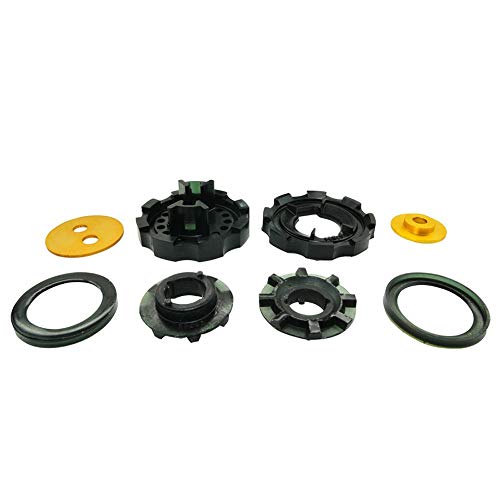
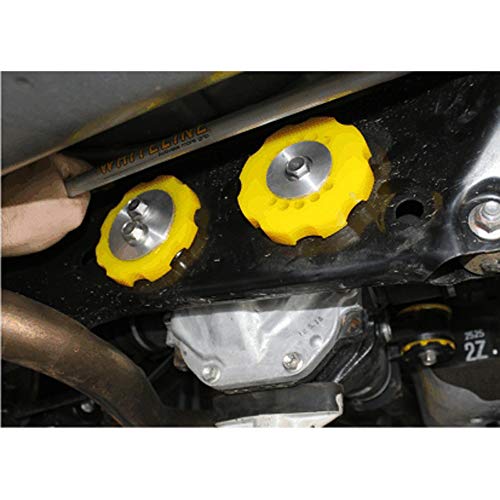
Whiteline’s own current catalog explicitly covers the first-generation BRZ ZC6, second-generation BRZ ZD8 and Toyota ZN6 platform. U.S. specialty fitment catalogs additionally list KDT925 for the second-generation Toyota GR86 and current BRZ.
For ProStreetOnline, I would catalog the U.S. applications individually as:
2013–2020 Scion FR-S
2013–2026 Subaru BRZ
2017–2020 Toyota 86
2022–2026 Toyota GR86
That captures the current U.S. model naming rather than using the overseas “GT86” designation everywhere.
Whiteline KDT925 Specifications
Part Number: KDT925
Position: Rear differential
Type: Differential mount bushing inserts
Material: Polyurethane / synthetic elastomer
Color: Black
Durometer: 85
Kit Contents: 6 insert bushings, 2 washers
Typical Installation Time: Approximately 1.5 hours
Complete Replacement Bushings: No — inserts work with the original bushings.
That last specification matters.
This isn’t a traditional press-out-the-rubber-and-replace-everything polyurethane bushing kit.
The inserts are designed to fill voids in the existing factory differential bushings.
Why Does the Differential Move?
When engine torque reaches the rear differential, the differential housing reacts against that torque.
Factory rubber mounts allow controlled movement to reduce:
- Noise
- Vibration
- Harshness
- Drivetrain shock
That’s perfectly reasonable for a production car.
The problem is that soft rubber can also allow the differential housing to move before all of the drivetrain’s force is transmitted through the axles.
With age and aggressive driving, that movement can become more noticeable.
What Does KDT925 Actually Do?
Whiteline’s polyurethane inserts fill open sections of the original rubber mounts.
That reduces how far the factory bushings can deform under load.
Instead of:
Torque applied → rubber compresses → differential moves → drivetrain loads
you get a more controlled transition:
Torque applied → reduced mount movement → drivetrain loads
Whiteline says the result can improve gearshift response while reducing initial torque loss through unwanted differential movement.
Better Differential Control During Acceleration
Hard acceleration places significant load through the BRZ/FR-S/86 drivetrain.
Power travels through the:
Transmission → Driveshaft → Differential → Axles → Rear Wheels
Movement anywhere in that chain can influence how immediate the car feels when the throttle is applied.
KDT925 doesn’t create horsepower.
Instead, it reduces compliance at one important mounting point.
That’s a meaningful distinction because “adds horsepower” would be considerably more exciting marketing—and considerably less true.
Improved Shift Feel
Differential movement can also influence how the drivetrain reacts during gear changes.
During a shift, torque through the drivetrain changes rapidly.
Reducing movement at the differential mounts can make those transitions feel more immediate and controlled.
Whiteline specifically identifies improved gear shifting as one of the benefits of KDT925.
Maintaining Pinion Angle
The differential’s input flange connects to the driveshaft.
As the differential housing moves within soft mounts, its orientation can change slightly under load.
Whiteline designed its differential bushing solution to help maintain more consistent pinion geometry under acceleration and deceleration.
This becomes increasingly relevant on cars subjected to:
- Hard launches
- Aggressive shifting
- Autocross
- Track driving
- Increased engine output
- Sticky performance tires
The more force the drivetrain has to manage, the more obvious compliance can become.
KDT925 on a Modified BRZ
The BRZ is one of the most modified modern Japanese sports cars, making KDT925 particularly relevant.
Common modifications include:
- Headers
- ECU tuning
- Superchargers
- Turbo kits
- Performance clutches
- Lightweight flywheels
- Coilovers
- Performance tires
Increasing power and grip can place additional loads through drivetrain mounts.
A differential bushing insert kit helps control one of those mounting points without requiring complete differential-bushing replacement.
KDT925 on the Scion FR-S
Mechanically, the Scion FR-S shares its underlying ZN6 platform with the first-generation Toyota 86 and ZC6 Subaru BRZ.
That makes the 2013–2020 FR-S one of the core applications for KDT925. Fitment catalogs identify the FR-S ZN6 directly.
It’s particularly appealing for older FR-S examples where the original differential bushings have already accumulated years of drivetrain loading.
KDT925 on the Toyota 86
The U.S.-market Toyota 86 replaced the Scion FR-S after Toyota discontinued the Scion brand.
Underneath, it remained part of the same basic first-generation ZN6 platform.
For Pro Street’s U.S. catalog, use:
2017–2020 Toyota 86
rather than simply labeling the vehicle Toyota GT86.
What About the GR86?
The second-generation Toyota GR86 and Subaru BRZ use the newer platform, but KDT925 continues to appear in current second-generation fitment catalogs.
Current specialty fitment data lists KDT925 through recent GR86 and BRZ model years.
Because Whiteline’s regional catalogs aren’t perfectly synchronized on U.S. model naming, I’d still verify the specific production year when adding future model years beyond 2026.
Polyurethane vs. Factory Rubber
Factory rubber is designed around a compromise.
It needs to:
- Control drivetrain movement
- Absorb vibration
- Reduce noise
- Survive environmental exposure
- Maintain comfortable NVH levels
Polyurethane inserts prioritize movement control more heavily.
Whiteline lists KDT925 at 85 durometer, making it considerably firmer than the compliant voided factory mounting arrangement.
Will Differential Inserts Increase NVH?
They can.
Reducing rubber compliance creates a more direct mechanical connection between the drivetrain and chassis.
That can potentially transmit additional:
- Gear noise
- Vibration
- Drivetrain harshness
into the cabin.
The advantage of an insert-style design is that the original rubber mounts remain in place, providing some isolation.
That’s different from replacing the factory mounts entirely with solid or extremely rigid mounts.
Why Inserts Make Sense for Street Cars
The KDT925 design represents an interesting middle ground.
You’re retaining the factory mount while reducing its available movement.
That makes the kit appealing for cars that serve double duty as:
Daily driver + weekend performance car
rather than building a drivetrain mounted directly to the chassis with all the refinement of a commercial washing machine full of sockets.
Inspect the Factory Bushings First
Because KDT925 works with the existing bushings, inspect them before installation.
Look for:
- Torn rubber
- Separation
- Severe cracking
- Oil contamination
- Damaged mounting hardware
- Excessive differential movement
An insert shouldn’t be treated as a magical repair for a completely destroyed factory mount.
Installation
Whiteline estimates approximately 1.5 hours for installation and provides six inserts and two washers with the kit.
General installation involves accessing the rear differential mounting points, supporting the differential, loosening the appropriate hardware and fitting the polyurethane inserts into the factory bushing voids.
Whiteline’s installation documentation specifies lubrication of the insert contact surfaces and correct engagement with the locating features of the OEM bushings.
Correct torque procedures should always be followed.
What Else Should You Inspect?
While working around the rear differential, inspect:
- Differential seals
- Differential fluid condition
- Driveshaft joints
- Axle/CV boots
- Rear subframe bushings
- Differential mounting hardware
- Exhaust clearance
- Rear suspension bushings
A twenty-minute inspection while everything is accessible can prevent another afternoon underneath the car.
KDT925 for Turbo and Supercharged BRZ Builds
Forced induction makes differential control increasingly relevant.
Adding significant torque means the drivetrain mounts must resist greater forces.
KDT925 doesn’t strengthen gears, axles or the differential itself.
What it does is reduce unwanted movement between the differential assembly and its mounting structure.
For higher-powered cars, drivetrain-mount upgrades should be viewed as part of the complete system rather than an isolated horsepower modification.
Explore additional forced-induction information through Pro Street’s automotive technical guides.
Who Should Buy Whiteline KDT925?
KDT925 makes the most sense for BRZ, FR-S, 86 and GR86 owners who want:
Reduced differential movement
More immediate drivetrain response
Improved shift feel
Better control under hard acceleration
A firmer drivetrain without solid differential mounts
A relatively straightforward supporting modification
It’s particularly relevant for performance street, autocross and track builds.
Is Whiteline KDT925 Worth It?
For a compatible BRZ, FR-S, Toyota 86 or GR86, the Whiteline KDT925 Differential Mount Bushing Insert Kit addresses a component that doesn’t receive nearly as much attention as coilovers, exhausts or power modifications.
By filling voids in the original differential bushings, KDT925 reduces movement while retaining the basic factory mounting arrangement.
That can provide a more immediate connection between throttle input and what happens at the rear wheels—without replacing the entire differential mounting system.
It’s the sort of modification most people will never see.
Which, naturally, means it’s often more useful than half the modifications people can see.
Shop suspension, chassis and drivetrain upgrades through Pro Street Online.
Whiteline’s specifications for the kit are available from the clean KDT925 manufacturer page.








There are no reviews yet.