
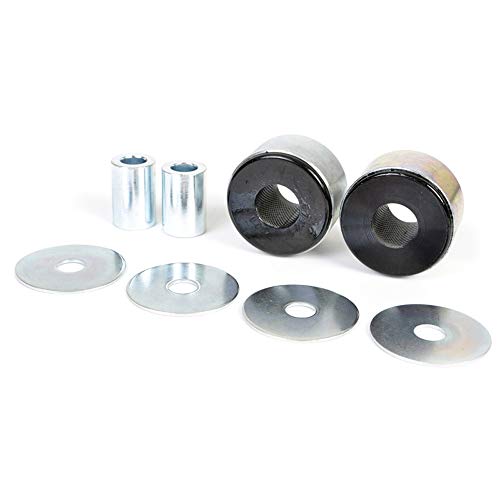
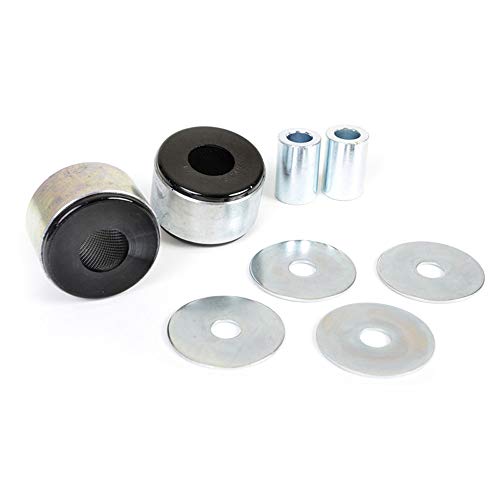
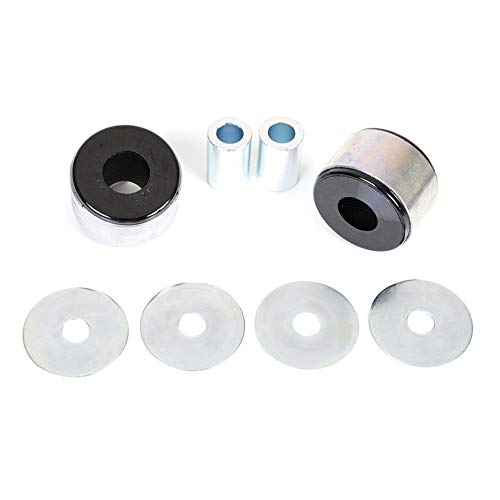
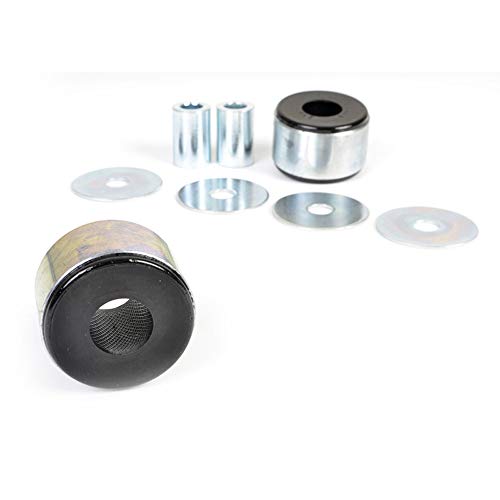
Mounted in the Differential Cradle
The KDT906 is specifically a rear differential cradle mounting bushing.
Rather than being a suspension control-arm bushing, it works directly with the mounting structure supporting the rear differential.
That distinction is important when cataloging the part.
Part Number: KDT906
Position: Rear
Component: Differential Mount
Mounting Location: Differential cradle
Product Type: Performance differential bushing
Why Differential Movement Matters
When the engine produces torque, that force travels through the drivetrain:
Engine → Transmission → Driveshaft → Differential → Axles → Wheels
The differential housing experiences an opposing reaction force.
Soft mounting bushings allow some of that force to initially move the differential instead of immediately transferring torque through the axles.
Reducing that movement can create a more direct drivetrain response.
Improved Power Transfer
Whiteline describes its differential bushing solutions as helping reduce initial torque loss while improving power transfer to the wheels.
That doesn’t mean KDT906 adds horsepower.
Your dyno chart isn’t going to suddenly discover another 25 horsepower because you installed a bushing.
Instead, the objective is reducing unnecessary drivetrain movement between the engine producing torque and the tires receiving it.
More Positive Gear Changes
Differential movement can also become noticeable during shifting.
As drivetrain load changes between:
Acceleration → Shift → Acceleration
the differential mounts repeatedly load and unload.
Reducing excessive movement can make those transitions feel more controlled and immediate.
This can be particularly noticeable on manual-transmission vehicles driven aggressively.
Helps Maintain Driveline Angles
Another important function of differential mounting bushings is maintaining the intended position of the differential.
Excessive movement can alter the relationship between the:
- Driveshaft
- Differential input
- Axles
- Chassis
Whiteline specifically emphasizes maintaining appropriate pinion angles as one benefit of its differential bushing upgrades.
Can KDT906 Reduce Wheel Hop?
It may help when differential movement is contributing to wheel hop.
Wheel hop can involve several components, including:
- Differential mounts
- Subframe bushings
- Control-arm bushings
- Tires
- Dampers
- Springs
- Suspension geometry
Reducing differential movement removes one potential source of driveline oscillation.
However, KDT906 shouldn’t automatically be treated as a universal wheel-hop cure.
Street Performance
On a performance-oriented street car, upgraded differential bushings can make the drivetrain feel more connected.
The difference is often most noticeable during:
- Hard acceleration
- Rapid throttle changes
- Manual gear changes
- Launches
- Engine braking
Drivers looking for a more direct drivetrain response may appreciate the reduced compliance.
Potential NVH Increase
There is a tradeoff.
Factory differential bushings are intentionally soft because they isolate drivetrain vibration from the passenger compartment.
Reducing that compliance can potentially increase:
- Gear noise
- Differential whine
- Vibration
- Drivetrain harshness
That’s normal with many performance drivetrain bushings.
You’re replacing isolation with control.
Physics continues refusing to provide both for free.
Great Supporting Modification for Higher-Power Builds
Differential bushings become increasingly relevant as vehicle output increases.
Modified vehicles may place considerably greater loads through the drivetrain than the factory mounts were designed around.
KDT906 can therefore complement upgrades such as:
- ECU tuning
- Turbo upgrades
- Supercharger upgrades
- Performance exhaust systems
- Clutch upgrades
- Transmission modifications
- Limited-slip differential upgrades
- Performance tires
The more traction the vehicle generates, the more force the drivetrain mounts have to control.
Inspect the Factory Mounts First
Before installing KDT906, inspect the existing differential mounting system.
Look for:
- Cracked rubber
- Separated bushings
- Excessive differential movement
- Torn mounting material
- Loose fasteners
- Corrosion
- Damaged cradle mounting points
If the original mounts are badly deteriorated, replacing or reinforcing them can produce a particularly noticeable improvement.
Installation
Installation difficulty depends heavily on the vehicle and differential cradle design.
A general procedure may involve:
- Safely raise and support the vehicle.
- Support the rear differential.
- Remove components obstructing access.
- Loosen or remove the appropriate differential mounting hardware.
- Access the cradle-mounted differential bushings.
- Remove or modify the factory bushing arrangement as required by the Whiteline kit.
- Install the KDT906 components.
- Reposition the differential.
- Torque mounting hardware to specification.
- Check driveshaft and axle clearance.
- Road-test the vehicle.
- Reinspect mounting hardware.
Always follow the Whiteline instructions and factory service procedures for the specific vehicle.
Does KDT906 Require an Alignment?
Normally, replacing differential mounting bushings doesn’t directly alter:
- Camber
- Caster
- Toe
Therefore, a wheel alignment generally isn’t required solely because the differential bushings were replaced.
If the rear subframe or suspension arms have to be loosened or repositioned during installation, checking alignment afterward is sensible.
Who Should Buy Whiteline KDT906?
The KDT906 makes the most sense for drivers experiencing excessive differential movement or building a more performance-oriented drivetrain.
It’s particularly relevant for vehicles with:
Higher-than-stock power
Performance tires
Aggressive launches
Manual transmission upgrades
Track or autocross use
Deteriorated factory differential mounts
For a completely stock luxury-oriented daily driver, the potential increase in drivetrain NVH should be considered before upgrading.
Is Whiteline KDT906 Worth It?
The Whiteline KDT906 Rear Differential Mount Bushing addresses something that’s easy to overlook when modifying a performance car: the differential itself has to be held securely enough to transfer all that additional torque.
Reducing differential movement can improve drivetrain response, help maintain driveline geometry and provide a more direct connection between throttle input and the rear wheels.
It’s not a horsepower modification.
It’s a modification that helps the horsepower you already paid for stop wasting its time moving the differential around.





There are no reviews yet.