
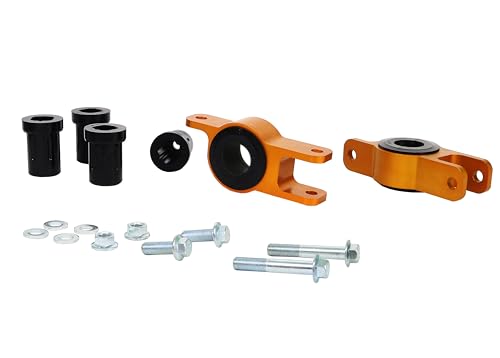
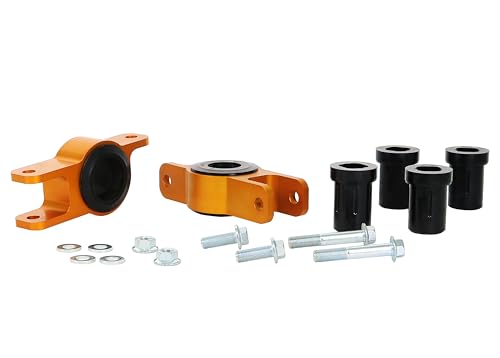
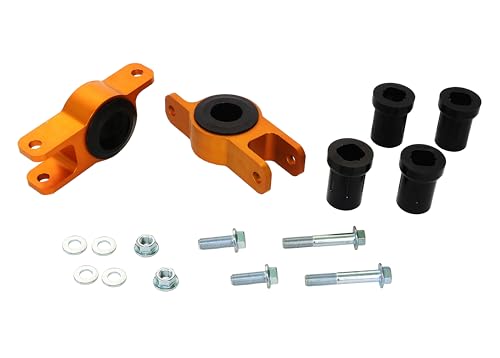
What Is an Anti-Lift Kit?
Despite the name, an anti-lift kit isn’t simply designed to make the front of the vehicle stop physically rising.
The objective is changing suspension geometry so the front suspension behaves differently when acceleration transfers weight toward the rear.
On a powerful front-wheel-drive car, weight transfer can reduce the load available at the driven front tires just when you’re asking them to transmit substantial torque.
Whiteline’s altered control-arm geometry is intended to improve the suspension’s response under these conditions.
The result can be better:
Traction.
Steering feel.
Turn-in response.
Corner-exit stability.
It’s suspension geometry doing the work instead of another giant wing apparently being asked to solve everything.
Increased Caster and Why It Matters
One of the major advantages of the KCA467 is its ability to alter caster.
Caster describes the forward or rearward inclination of the steering axis when viewed from the side of the vehicle.
Increasing positive caster can improve:
- Straight-line stability
- Steering self-centering
- Dynamic camber during steering
- Turn-in response
- Tire contact during cornering
When the steering wheel is turned, caster contributes to changes in wheel camber.
That can help the outside front tire maintain a more favorable orientation relative to the pavement during a corner.
For a performance-oriented Accord or Civic, that’s valuable because maintaining front-tire grip directly influences how readily the car rotates.
Reducing Understeer
Understeer occurs when the front tires lose cornering grip before the rear tires, causing the vehicle to push toward the outside of a turn.
Most production front-wheel-drive vehicles are deliberately engineered with relatively safe, predictable understeer characteristics.
That’s great when manufacturers are designing a car for millions of drivers.
It’s less exciting when you’re trying to make your Civic respond sharply on a canyon road or track.
The Whiteline KCA467 addresses front-end behavior through geometry rather than simply increasing suspension stiffness.
That distinction matters.
Sharper Turn-In Response
Factory rubber suspension bushings need to isolate noise and vibration.
That means they’re intentionally compliant.
During aggressive steering, braking and acceleration, that compliance allows suspension mounting points to move slightly under load.
Low-compliance performance bushings reduce some of that movement.
The result can be a more immediate relationship between:
Steering input → suspension movement → tire response.
That’s why upgraded control-arm bushings can make a car feel considerably more responsive even though they don’t add horsepower or change spring rates.
Synthetic Elastomer Bushings
Whiteline uses low-compliance synthetic elastomer bushings engineered for performance applications.
According to Whiteline, the material formulation provides resistance against:
- Oil
- Grease
- Ozone
- Weather exposure
- General environmental deterioration
This is particularly important for suspension bushings because they’re continuously exposed to water, dirt, temperature changes and road contamination.
Internal Grease Reservoirs
The KCA467 bushings incorporate internal grease reservoirs designed to provide ongoing lubrication.
Proper lubrication helps manage friction between the bushing and associated suspension hardware.
The kit also includes extreme-pressure molybdenum-disulphide-based grease for installation and extended service life.
Use the supplied lubricant as directed rather than grabbing whatever mysterious tube has been rolling around the bottom of the toolbox since 2009.
Anodized Alloy Construction
Whiteline pairs its performance bushings with alloy mounting components.
The anodized finish provides a protective surface intended to resist:
- Corrosion
- Oxidation
- Surface wear
- Environmental exposure
Protective coatings on the associated metal hardware further improve resistance against corrosion.
That’s particularly useful for suspension components living underneath the vehicle where glamorous working conditions include water, road grime, heat and whatever DOT decided to spread across the highway.
KCA467 vs. Standard Replacement Bushings
A conventional replacement control-arm bushing attempts to restore factory suspension behavior.
The Whiteline KCA467 changes it.
That’s an important distinction for shoppers.
Factory-Style Replacement Bushing
Designed primarily to:
- Restore original ride quality
- Replace cracked rubber
- Reduce unwanted suspension movement
- Maintain factory geometry
Whiteline KCA467
Designed to:
- Reduce bushing compliance
- Increase caster
- Modify front suspension geometry
- Improve turn-in
- Improve traction
- Increase directional stability
- Reduce understeer
If the goal is simply returning a commuter to factory condition, an OE-style bushing may make more sense.
If the goal is improving handling, the KCA467 becomes considerably more interesting.
Does the KCA467 Make the Ride Harsher?
Potentially, somewhat.
Reducing suspension-bushing compliance can transmit more road texture and vibration into the chassis compared with soft factory rubber.
That’s the tradeoff.
More compliance generally provides greater isolation.
Less compliance generally provides more precise suspension control.
For a performance street car, many enthusiasts consider the improvement in steering response worthwhile.
But describing a performance bushing as having absolutely no NVH tradeoff would be marketing fiction.
Alignment After Installing KCA467
A professional alignment is strongly recommended after installing components designed specifically to alter suspension geometry.
That’s especially true because caster is part of the reason you’re buying this kit in the first place.
After installation, check:
- Caster
- Camber
- Toe
- Steering-wheel centering
- Left-to-right alignment differences
Don’t spend money deliberately changing suspension geometry and then skip the alignment.
That’s like installing a turbo and deciding the ECU will “figure something out.”
Pairing KCA467 With Other Suspension Upgrades
The KCA467 can become part of a larger handling package.
Logical complementary upgrades include:
- Performance tires
- Lowering springs
- Performance dampers
- Coilovers
- Sway bars
- Rear suspension bushings
- Adjustable alignment components
The key is building a balanced suspension rather than randomly replacing every component with the stiffest version available.
Pro Street’s Complete Guide to Lowering Springs explains how spring changes affect handling, ride height and suspension behavior.
If you’re building a street car rather than a dedicated track car, Pro Street’s Daily Driver Suspension Setup That Actually Works is also useful when choosing components that improve handling without making every pothole feel personally insulting.
Installation
Whiteline designed the KCA467 with installer accessibility in mind and includes detailed installation instructions.
The supplied package includes the appropriate mounting components, bushings and lubricant.
General installation considerations include:
- Safely support the vehicle.
- Remove the appropriate front control-arm mounting components.
- Inspect surrounding suspension components.
- Install the Whiteline mounts and bushings according to the supplied orientation.
- Lubricate components according to Whiteline’s instructions.
- Torque suspension fasteners to specification.
- Perform a professional alignment.
Suspension fastener torque and bushing orientation matter.
This isn’t the place for the classic impact-gun torque specification of “three ugga-duggas should do it.”
Who Should Buy the Whiteline KCA467?
This kit makes the most sense for drivers who want their Accord or Civic to feel more responsive without turning it into a dedicated race car.
It’s particularly relevant for:
Performance street builds where steering feel and traction matter.
Autocross cars where front-end response can dramatically affect vehicle placement.
Track-day builds where controlling alignment and tire contact becomes increasingly important.
Modified turbo Hondas where additional torque makes front-wheel traction more difficult.
Suspension refreshes where the factory bushings are already being replaced and an upgrade makes more sense than returning to stock.
Is the Whiteline KCA467 Worth It?
For the correct Honda application, the Whiteline KCA467 Anti-Lift Front Control Arm Bushing Kit offers something many suspension modifications don’t:
It changes geometry rather than simply increasing stiffness.
The combination of increased caster, reduced bushing compliance and revised front control-arm geometry is intended to improve turn-in, traction and directional stability while reducing understeer.
That makes the KCA467 particularly appealing for enthusiasts who want their Honda to respond more precisely without immediately jumping to an extreme track suspension setup.
For a properly matched Civic or Accord, it’s the kind of modification you feel every time you turn the steering wheel rather than the kind you install because it looks impressive in an engine-bay photo.
Shop Honda suspension, chassis and performance components through Pro Street Online.





There are no reviews yet.