
What Vehicles Fit Whiteline KCA313-BJ?
Published U.S.-market fitment data shows a very broad range of Subaru applications. Exact trim and suspension configuration should still be verified before ordering.
| Years | Make | Model |
|---|---|---|
| 2005–2006 | Saab | 9-2X |
| 2000–2018 | Subaru | Forester |
| 1993–2017 | Subaru | Impreza |
| 2002–2021 | Subaru | WRX |
| 2002–2021 | Subaru | WRX STI |
| 2000–2019 | Subaru | Legacy |
| 2000–2019 | Subaru | Outback |
| 2013–2015 | Subaru | XV Crosstrek |
The underlying Whiteline KCA313 family also covers numerous earlier and international Subaru chassis, including GC/GF, GD/GG, GR/GV, VA, SF, SG, SH, SJ, BL/BP and BM/BR applications.
Pro Street Fitment Recommendation
For your catalog, I would not use the marketplace title’s blanket “1993–2021 XV Crosstrek, Impreza, XV, Forester, WRX STI, Outback, WRX, Legacy, 9-2X” as though every model exists across that entire year range.
Instead, assign individual vehicle ranges.
That avoids accidentally creating exciting new vehicles like the 1993 Crosstrek, roughly two decades before Subaru got around to building one.
What Is Roll Center?
The roll center is a geometric point determined by the suspension layout.
Together with the vehicle’s center of gravity, it influences how the body reacts to lateral forces during cornering.
The vertical distance between the:
Center of Gravity
and
Roll Center
creates what’s commonly described as a roll moment.
That relationship influences how strongly the vehicle wants to roll during cornering.
What Happens to Roll Center When You Lower a Subaru?
Lowering changes control-arm angles.
On a MacPherson-strut suspension, those geometry changes can move the front roll center downward.
In some cases, the roll center can drop proportionally more than the vehicle’s center of gravity.
That’s important.
You lowered the car expecting less roll, but the altered suspension geometry may increase the leverage acting on the chassis.
This is why lower isn’t automatically better.
How Does KCA313-BJ Correct Roll Center?
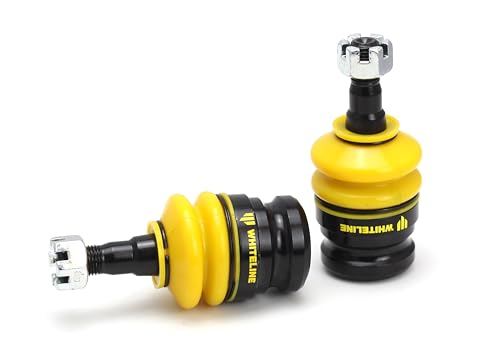
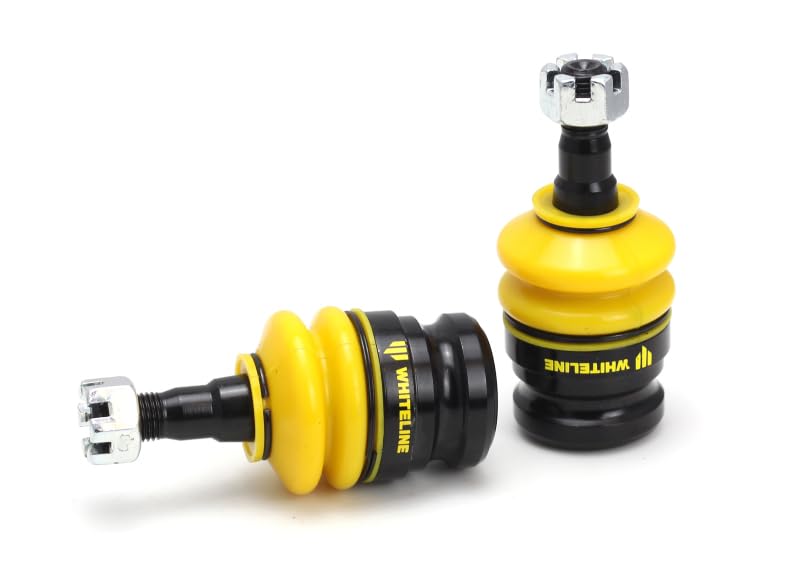
Whiteline uses specially engineered ball joints to change the relationship between the control arm and steering knuckle.
The extended geometry helps reposition the front control arm closer to a more favorable operating angle.
The objective is raising the effective front roll center after the vehicle has been lowered.
Whiteline says raising the front roll center increases front roll resistance and reduces compression of the outside front suspension during cornering.
That can improve:
- Tire contact
- Front-end grip
- Cornering response
- Weight distribution
- Suspension geometry
Why Tire Contact Matters
The suspension’s primary job isn’t making the car sit lower.
It’s keeping the tires properly connected to the road.
During aggressive cornering, the outside front tire carries substantial load.
If poor suspension geometry causes excessive body movement or unfavorable camber behavior, the tire may not use its available contact patch effectively.
Correcting geometry can help the suspension maintain more favorable tire positioning.
And tires actually touching pavement remain annoyingly important to going fast.
KCA313-BJ vs. Lowering Springs
These components perform completely different jobs.
Lowering Springs
Change:
- Ride height
- Spring rate
- Center-of-gravity height
- Suspension travel
KCA313-BJ
Changes:
- Front suspension geometry
- Control-arm operating angle
- Roll-center relationship
That’s why roll-center correction becomes particularly relevant after lowering.
For more information about the geometry changes caused by lowering, read Pro Street’s Complete Guide to Lowering Springs.
KCA313-BJ vs. Full KCA313 Kit
This distinction matters when building the product listing.
Whiteline KCA313-BJ
Ball-joint service/correction kit.
Primarily addresses the ball-joint side of the geometry correction.
Whiteline KCA313
Complete roll-center and bump-steer correction package.
Whiteline lists the full KCA313 as containing:
2 ball joints + 2 tie-rod components.
If someone needs the complete correction package after substantially lowering a Subaru, the full KCA313 deserves consideration.
What Is Bump Steer?
Bump steer occurs when suspension movement causes the wheels to change steering angle without corresponding steering-wheel input.
As the suspension compresses and rebounds, the relationship between:
- Control arms
- Steering rack
- Tie rods
- Steering knuckles
changes.
If those components move through incompatible arcs, toe changes as the suspension travels.
The driver can experience this as the car steering slightly when encountering bumps or suspension compression.
Why Lowered Subarus Can Experience Bump Steer
Lowering changes the static position of both the suspension and steering components.
The control arms and tie rods may no longer operate at their original angles.
That’s why the full KCA313 kit addresses both roll-center and bump-steer geometry using ball joints and tie-rod components.
KCA313-BJ should therefore be understood specifically as the ball-joint component/service solution rather than incorrectly representing it as the entire KCA313 system.
Is Roll Center Correction Necessary on Every Lowered Subaru?
No.
A modestly lowered street car may still operate acceptably without additional geometry correction.
The more aggressively ride height changes, however, the more important suspension geometry becomes.
KCA313-BJ becomes particularly relevant for:
Significantly lowered cars
Performance street builds
Autocross vehicles
Track cars
Vehicles where front suspension geometry has moved substantially from stock
The correct solution depends on actual ride height and suspension configuration.
KCA313-BJ With Coilovers
This is where roll-center correction becomes especially interesting.
Coilovers can allow substantial reductions in ride height.
Unfortunately, adjustable ride height doesn’t mean automatically corrected geometry.
A well-developed Subaru suspension may therefore combine:
Coilovers
→ Roll-center correction
→ Bump-steer correction
→ Alignment
→ Corner balance
→ Track testing
rather than simply spinning the coilovers downward until the tires disappear into the fenders.
Alignment Is Required
Any time you’re replacing suspension ball joints or changing geometry, alignment should be considered part of the installation.
After installing roll-center correction components, verify:
- Camber
- Caster
- Toe
- Steering-wheel position
- Left-to-right alignment consistency
For track applications, alignment targets can then be optimized around tires and intended use.
Inspect the Rest of the Front Suspension
While installing the KCA313-BJ, inspect surrounding components.
Pay particular attention to:
- Lower control-arm bushings
- Tie-rod ends
- Wheel bearings
- Sway-bar links
- Sway-bar bushings
- Strut mounts
- Steering rack bushings
- CV boots
Geometry correction won’t compensate for worn components allowing the wheel to move unpredictably.
Street Performance
For a properly lowered street Subaru, geometry correction can help preserve the handling improvements you were trying to achieve by lowering the car in the first place.
A balanced street suspension should retain:
- Usable suspension travel
- Predictable steering
- Adequate compliance
- Proper alignment
- Favorable geometry
Pro Street’s Daily Driver Suspension Setup That Actually Works explains why geometry and suspension travel matter as much as spring stiffness.
Autocross and Track Benefits
Roll-center correction becomes increasingly useful as lateral acceleration increases.
Potential benefits include:
- Improved outside-front tire behavior
- More consistent camber control
- Reduced unwanted body movement
- Better front-end response
- More predictable cornering
For a track-oriented WRX or STI with substantial lowering, this is exactly the kind of modification that separates “lowered suspension” from an actually developed suspension system.
Installation Considerations
Replacing ball joints involves safety-critical suspension components.
General installation involves:
- Safely raise and support the vehicle.
- Remove the front wheels.
- Disconnect the appropriate suspension components.
- Remove the original lower ball joints.
- Inspect the control-arm and knuckle mounting areas.
- Install the Whiteline correction ball joints.
- Reassemble the suspension using correct hardware and torque procedures.
- Verify suspension and CV-axle clearance.
- Settle the suspension.
- Perform a professional alignment.
Because ball joints directly locate the front suspension, professional installation is recommended if you don’t have the appropriate tools and experience.
Who Should Buy Whiteline KCA313-BJ?
This kit makes the most sense for owners of compatible Subaru and Saab vehicles who:
Have lowered the vehicle
Use performance springs or coilovers
Need replacement KCA313 correction ball joints
Want to improve front suspension geometry
Autocross or track the vehicle
Are building a properly engineered handling package
It’s not simply another replacement ball joint.
Its value is in the altered geometry.
Is Whiteline KCA313-BJ Worth It?
For the correct lowered Subaru application, Whiteline KCA313-BJ addresses one of the less glamorous but more important consequences of lowering a vehicle:
geometry.
The kit’s extended ball-joint design can help restore a more favorable front roll-center relationship, improving how the suspension manages cornering loads and maintains tire contact.
It’s especially relevant for WRX and STI owners who have already invested in springs or coilovers and want the rest of the suspension geometry to cooperate.
Because lowering a Subaru and then ignoring its control-arm geometry is a little like installing a giant turbo and deciding fueling is probably just a suggestion.
Shop suspension and handling components through Pro Street Online.





There are no reviews yet.