
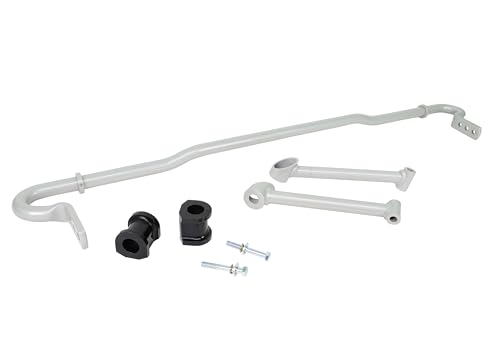
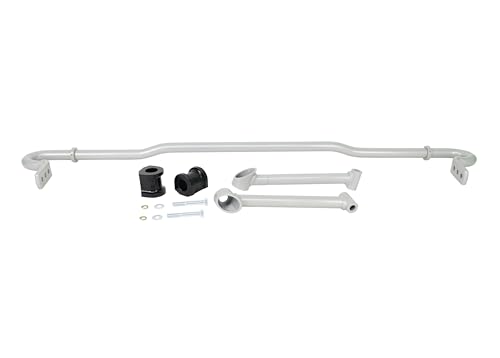
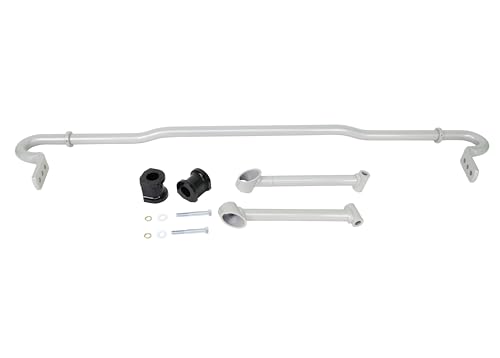
What Vehicles Fit Whiteline BSR49XXZ?
Published U.S. fitment data shows the BSR49XXZ covering several Subaru platforms. Because there are trim-specific differences, especially among Impreza/WRX/STI applications, I’d use the following as your catalog starting point rather than assigning one enormous blanket year range.
| Years | Make | Model |
|---|---|---|
| 2009–2018 | Subaru | Forester |
| 2008–2011 | Subaru | Impreza WRX STI |
| 2010–2019 | Subaru | Legacy |
| 2010–2019 | Subaru | Outback |
| 2012–2021 | Subaru | WRX |
| 2012 | Subaru | WRX STI |
Additional Impreza applications exist depending on chassis and factory sway-bar configuration, so those should be verified individually before loading them into Pro Street’s vehicle database.
Whiteline specifically lists the bar for vehicles equipped with an OEM rear sway bar.
Why Upgrade the Rear Sway Bar?
During cornering, weight transfers toward the outside tires and the body rolls relative to the suspension.
A sway bar connects the left and right sides of the suspension and resists this differential movement.
Increasing sway-bar stiffness can reduce:
- Body roll
- Delayed chassis response
- Excessive outside suspension compression
- Unwanted weight transfer characteristics
Unlike substantially increasing spring rates, a sway-bar upgrade primarily targets roll behavior.
That’s one reason sway bars are so effective on dual-purpose street cars.
Why a 24mm Rear Sway Bar Makes a Big Difference
Sway-bar stiffness doesn’t increase linearly with diameter.
Because torsional stiffness is strongly related to bar diameter, relatively small increases in diameter can create significant changes in roll resistance.
The BSR49XXZ’s 24mm solid construction therefore represents a serious performance upgrade rather than a cosmetic replacement.
Whiteline positions this particular bar as a Motorsport-oriented application.
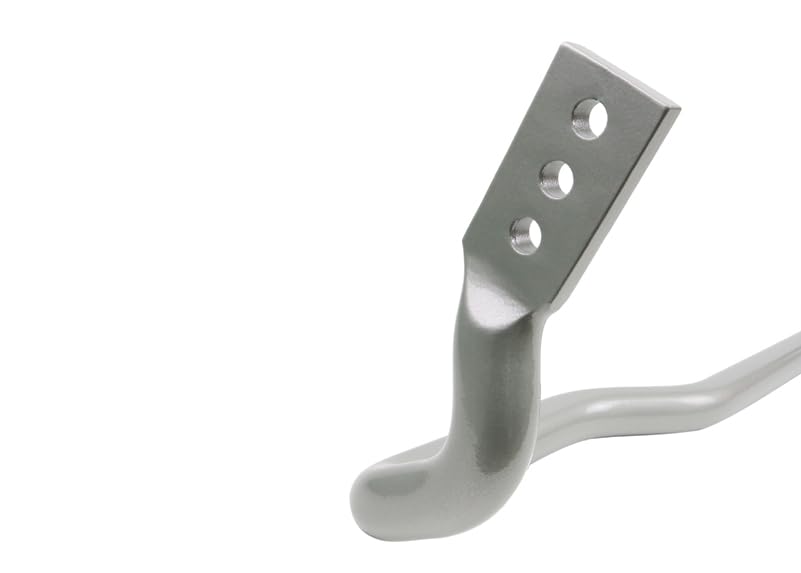
Three-Position Adjustability
One of the biggest advantages of BSR49XXZ is its three adjustment positions.
Changing the end-link mounting position changes the effective lever arm acting on the sway bar.
In simplified terms:
Longer effective arm = softer setting
Shorter effective arm = stiffer setting
This gives you the ability to change rear roll stiffness without replacing the entire bar.
That’s extremely useful when tuning around different:
- Tires
- Springs
- Dampers
- Alignment settings
- Driving environments
How a Rear Sway Bar Changes Subaru Handling
Many factory Subaru chassis are tuned toward predictable understeer.
That’s intentional. For the average driver, mild understeer is generally easier to manage than a rear end that’s enthusiastically attempting to become the front end.
Increasing rear roll stiffness can change that balance.
Depending on the rest of the suspension setup, a stiffer rear bar can:
- Reduce understeer
- Improve rotation
- Sharpen turn-in
- Reduce body roll
- Improve transitional response
The result can make the car feel substantially more responsive.
Adjustable Doesn’t Mean “Always Use Maximum”
The stiffest position isn’t automatically the fastest.
Vehicle balance depends on the entire setup.
That includes:
- Front sway bar
- Rear sway bar
- Springs
- Dampers
- Tires
- Alignment
- Differential behavior
- Road surface
A car with too much rear roll stiffness can become nervous or overly willing to rotate.
Start conservatively and evaluate the vehicle before moving to more aggressive settings.
Because “maximum” is a setting, not an engineering philosophy.
BSR49XXZ on the Subaru WRX
The WRX is an obvious candidate for rear sway-bar tuning.
Increasing rear roll stiffness can help reduce the factory tendency toward understeer and improve response during transitions.
This can be particularly useful for:
- Spirited street driving
- Autocross
- Track days
The adjustable design also means owners can experiment with chassis balance without changing springs.
BSR49XXZ on the Subaru Forester
A rear sway-bar upgrade can produce an especially noticeable difference on taller vehicles such as the Forester.
Its higher center of gravity creates more noticeable body movement during cornering than a lower performance sedan.
Increasing rear roll resistance can make the Forester feel considerably more controlled through:
- Highway transitions
- Sweeping corners
- On-ramps
- Mountain roads
That doesn’t magically turn your grocery-hauling Forester into a GT3 car, but Subaru owners have certainly attempted stranger things.
BSR49XXZ on the Subaru Outback
The same principle applies to the Outback.
Whiteline specifically lists BSR49XXZ for numerous 2010–2019 Outback configurations, including 2.5i and 3.6R variants.
For street-driven Outbacks, the adjustable bar gives owners the ability to improve body control without automatically moving to substantially stiffer springs.
BSR49XXZ on the Subaru Legacy
The Legacy can also benefit from additional rear roll stiffness.
On a street-performance build, reducing body movement while maintaining reasonable spring and damper compliance can create a responsive car without destroying ride quality.
That’s particularly attractive for daily-driven vehicles.
Sway Bars vs. Lowering Springs
These modifications aren’t interchangeable.
Lowering Springs
Primarily change:
- Ride height
- Spring rate
- Center of gravity
- Suspension travel
Sway Bars
Primarily change:
- Roll stiffness
- Front-to-rear handling balance
- Left-to-right suspension interaction
That’s why the two modifications often work well together.
Read Pro Street’s Complete Guide to Lowering Springs before deciding how aggressively to lower a street-driven Subaru.
Pairing BSR49XXZ With Lowering Springs
A lowered Subaru with a properly selected rear sway bar can provide a substantial improvement in chassis response.
But balance matters.
An effective street setup might include:
Moderate lowering springs
Quality dampers
24mm adjustable rear sway bar
Good tires
Proper alignment
The objective isn’t maximum stiffness.
It’s maximum usable grip.
Check Your End Links
An upgraded sway bar transfers greater loads through the end links.
That means worn factory links become particularly relevant.
Inspect them for:
- Ball-joint play
- Torn boots
- Corrosion
- Bent hardware
- Loose mounting points
Adjustable performance end links can also help eliminate unwanted sway-bar preload on lowered vehicles.
Check the Sway Bar Mounts
A 24mm performance sway bar can generate substantially more force at its chassis mounts than a softer factory bar.
That’s why the BSR49XXZ kit’s mounting hardware and bracing matter.
Whiteline includes support components rather than treating the bar as an isolated piece of steel.
Inspect the chassis mounting areas during installation.
Does BSR49XXZ Require an Alignment?
Whiteline states that a wheel alignment is not required solely for installation of BSR49XXZ.
The sway bar doesn’t directly change:
- Camber
- Caster
- Toe
However, if you’re simultaneously installing lowering springs, coilovers or alignment components, an alignment should absolutely be part of the job.
Street Driving
A properly configured sway-bar upgrade can be excellent for street performance because it improves body control without necessarily requiring dramatically stiffer springs.
For daily-driven vehicles, read Pro Street’s Daily Driver Suspension Setup That Actually Works for more information about balancing handling with suspension travel and ride quality.
Autocross
Autocross is where an adjustable rear sway bar becomes particularly useful.
Courses typically involve:
- Slaloms
- Rapid transitions
- Tight corners
- Heavy braking
- Quick direction changes
Being able to alter rear roll stiffness gives the driver another tool for tuning rotation and transitional response.
Track Driving
On track, sway-bar adjustment can help tune chassis balance around:
- Tire compound
- Alignment
- Spring rates
- Aero balance
- Track configuration
A vehicle pushing heavily through high-speed corners may respond differently to rear-bar adjustment than one already rotating aggressively.
Make one change at a time and document the result.
That’s called suspension tuning.
Changing five things simultaneously and declaring the car “way better” is called the internet.
Installation
General installation involves:
- Safely raise and support the vehicle.
- Remove the factory rear sway bar.
- Inspect the end links and mounting points.
- Install the supplied Whiteline bushings.
- Install the BSR49XXZ sway bar.
- Install the supplied braces and lateral locks.
- Select an initial adjustment position.
- Connect the end links.
- Torque all hardware correctly.
- Verify exhaust and suspension clearance.
- Load the suspension and inspect the installation.
- Road-test the vehicle carefully.
Whiteline rates installation at approximately one hour, although actual installation time depends on experience and vehicle condition.
Who Should Buy Whiteline BSR49XXZ?
This sway bar makes the most sense for Subaru owners looking for a serious rear roll-stiffness upgrade.
It’s particularly attractive for:
Performance street cars
Autocross builds
Track-day cars
Modified WRX/STI builds
Forester and Outback handling builds
Drivers who want adjustable chassis balance
Because BSR49XXZ is Whiteline’s 24mm Motorsport-oriented option, owners looking for a milder street upgrade should also consider whether a smaller bar better matches their suspension goals.
Is Whiteline BSR49XXZ Worth It?
For a compatible Subaru, the Whiteline BSR49XXZ 24mm Three-Position Adjustable Rear Sway Bar offers one of the most direct ways to alter chassis balance and reduce body roll.
Its combination of:
24mm solid construction
Three-position adjustability
Included mounting bushings
Included support bracing
Motorsport-oriented stiffness
makes it particularly appealing for enthusiasts who want more than a mild factory replacement.
And unlike another 50 horsepower, a sway bar might actually help you get around the corner you were accelerating toward.
Shop Subaru suspension and performance parts through Pro Street Online.





There are no reviews yet.