


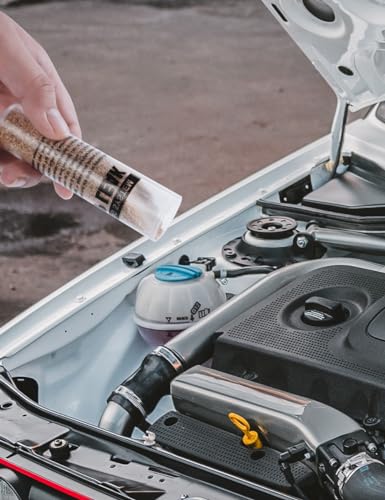
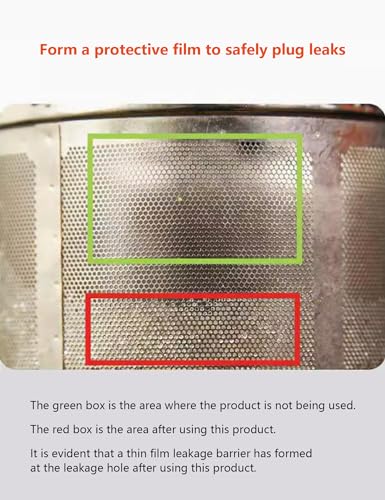
What Problems Can Radiator Stop Leak Actually Fix?
Stop-leak products work best when the opening they’re being asked to seal is extremely small.
Think seepage—not Niagara Falls.
A reasonable application might be a radiator that develops a tiny leak around an aging seam or a cooling-system component that slowly loses coolant while the engine is running.
Potential symptoms include:
- Coolant reservoir slowly dropping
- Small coolant spots after parking
- Dried coolant residue around the radiator
- Sweet coolant odor
- Minor radiator seepage
- Small heater-core leak
- Coolant loss without an obvious puddle
If you’re constantly adding coolant but can’t determine where it’s going, start with our How to Find a Coolant Leak You Can’t See guide.
Finding the source before adding sealant gives you a much better idea whether the product has a realistic chance of working.
Visbella Radiator Stop Leak for Radiator Leaks
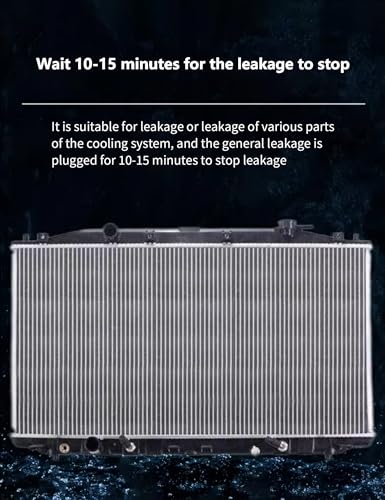
The radiator is probably the most obvious application for a product like this.
Radiators operate through constant cycles of:
cold → hot → pressurized → cool
Repeat that process thousands of times over many years and weak areas can eventually develop.
Leaks may occur around:
- Radiator seams
- Small core defects
- Aging joints
- Minor corrosion
- Small cracks
- Connections between radiator components
A tiny seep may be a reasonable candidate for radiator sealant.
A cracked plastic radiator tank that opens farther every time the cooling system becomes pressurized is not.
If the radiator has suffered substantial physical damage, replacement is the safer long-term solution.
Can Visbella Stop Leak Help a Heater Core Leak?
Visbella also lists heater-core applications, which deserve special attention.
The heater core is essentially a miniature radiator buried inside the vehicle’s HVAC system. Hot engine coolant flows through it, allowing the climate-control system to transfer that heat into the passenger compartment.
A leaking heater core can cause symptoms such as:
- Sweet smell inside the vehicle
- Windshield fogging
- Greasy film on the inside of the windshield
- Damp passenger-side carpet
- Gradual coolant loss
- Weak cabin heat
- Engine overheating if enough coolant is lost
Our Why Does My Car Smell Sweet? guide explains why a sweet odor can be one of the earliest clues that engine coolant is escaping.
Be Careful With Heater Cores
Heater cores contain narrow passages.
That means blindly adding excessive quantities of cooling-system sealant is particularly questionable when you’re dealing with one.
Follow the product instructions and don’t assume twice as much sealant equals twice as much repair.
Your heater core is not a Thanksgiving turkey. Stuffing it is not the objective.
What About Leaking Freeze Plugs?
Freeze plugs—also commonly called core plugs or expansion plugs—seal openings left during the engine block manufacturing process.
Over time, corrosion can cause these plugs to develop small leaks.
A minor seep may be temporarily reduced by an appropriate cooling-system sealant, which explains why freeze plugs are included among the applications marketed for the Visbella product.
But there is an important distinction between a seeping freeze plug and a severely corroded freeze plug.
If the plug has rusted substantially, sealant doesn’t restore its structural integrity.
The correct mechanical repair is replacement.
That’s especially important because a severely deteriorated freeze plug can suddenly begin leaking much faster.
Can Stop Leak Fix an Overheating Car?
Maybe—but only when the overheating is actually caused by coolant loss from a small leak.
Overheating has many possible causes.
These include:
- Low coolant
- Cooling-system leaks
- Failed radiator fan
- Stuck thermostat
- Failed water pump
- Restricted radiator
- Air trapped in the cooling system
- Collapsed radiator hose
- Incorrect coolant mixture
- Combustion gases entering the cooling system
If your vehicle overheats primarily while stopped or sitting in traffic, read Why Does My Engine Overheat at Idle? before assuming the radiator is leaking.
That symptom frequently points toward an airflow problem rather than a leak.
Likewise, Pro Street’s broader cooling-system diagnostic content can help determine whether you’re dealing with coolant loss, airflow, coolant circulation, pressure, or an internal engine problem.
Stop-leak doesn’t fix a dead radiator fan.
Sadly, we’ve yet to find a tube capable of repairing electrical circuits through positive thinking.
Should You Use Stop Leak on a Bad Water Pump?
A leaking water pump requires a little more caution.
Water pumps commonly begin leaking from the shaft seal or weep hole as the internal seal deteriorates.
You may notice:
- Dried coolant near the water pump
- Coolant dripping from the pump
- Coolant collecting near the crank pulley
- Bearing noise
- Pulley wobble
- Rising engine temperature
A sealant shouldn’t be viewed as a permanent repair for a mechanically failing water pump.
If the bearing is damaged or the pump impeller has failed, no cooling-system additive can repair it.
The same principle applies to the thermostat.
If you’re trying to determine which cooling-system component has failed, see our Thermostat or Water Pump? How to Tell Which One Failed guide.
Can Radiator Stop Leak Damage a Cooling System?
Any product specifically designed to seal small openings naturally raises this question:
What keeps it from sealing something you don’t want sealed?
That’s why stop-leak products should be used carefully.
Radiators and heater cores contain small passages, and cooling systems that already contain corrosion, scale, contaminated coolant, or previous sealing products can be more susceptible to restrictions.
We’ve covered this issue in detail in Can Radiator Stop-Leak Damage Your Cooling System?.
That guide is an important companion article for shoppers considering products like the Visbella Radiator Stop Leak Sealer Conditioner.
The takeaway is simple:
Use the correct quantity, use it for the correct problem, and don’t repeatedly pour stop-leak into a vehicle that’s telling you it needs an actual repair.
Inspect Your Coolant Before Using Stop Leak
Before adding any radiator sealing product, inspect the coolant itself.
Healthy coolant shouldn’t contain:
- Heavy rust
- Thick sediment
- Oil
- Sludge
- Large particles
- Previous excessive stop-leak deposits
If the cooling system is already heavily contaminated, adding more material isn’t the logical first move.
You may need a proper cooling-system service, flush, pressure test, or component replacement.
How to Find the Leak First
Start with the engine completely cold.
Never remove a radiator cap from a hot pressurized cooling system.
Inspect:
- Radiator core
- Radiator seams
- Radiator tanks
- Upper radiator hose
- Lower radiator hose
- Hose connections
- Thermostat housing
- Water pump
- Heater hoses
- Coolant reservoir
- Freeze-plug areas that are accessible
Look for dried coolant residue.
Depending on the coolant used, residue may appear:
- White
- Green
- Blue
- Pink
- Orange
- Yellow
If you can’t find the leak visually, a cooling-system pressure test is one of the best next diagnostic steps.
Pressure testing allows the system to be inspected for leakage without waiting for the engine to become extremely hot.
Visbella Stop Leak vs. Mechanical Repair
Here’s the easiest way to decide whether a product like Visbella makes sense.
Visbella Radiator Stop Leak May Make Sense For:
- Very small radiator leaks
- Minor cooling-system seepage
- Small heater-core leaks
- Minor freeze-plug seepage
- Gradual unexplained coolant loss
- Older high-mileage vehicles
- Temporary repairs while planning component replacement
- Situations where immediate mechanical repair isn’t practical
Repair or Replace the Component When:
- Coolant is pouring out
- A radiator tank is visibly cracked
- A hose has split
- A freeze plug is severely corroded
- The water pump bearing is failing
- The thermostat has mechanically failed
- The radiator is clogged
- The cooling system won’t hold pressure
- The engine repeatedly overheats
- Coolant is entering the cylinders
- A head gasket or cylinder head is suspected
This distinction is important because the product page should never imply that stop-leak can replace legitimate mechanical repairs.
That actually makes the product easier to sell to knowledgeable customers—not harder.
What If You See White Exhaust Smoke?
Coolant disappearing without an external leak deserves additional investigation.
Persistent white exhaust after the engine reaches operating temperature can potentially indicate coolant entering the combustion chamber.
Possible causes include:
- Head-gasket failure
- Cracked cylinder head
- Cracked engine block
- Certain intake-manifold gasket failures
Read White Smoke From Exhaust: Causes and Warning Signs before treating an unexplained internal coolant loss as a radiator leak.
A small radiator sealant isn’t the appropriate response to major internal engine damage.
Is Visbella Radiator Stop Leak Worth Buying?
For a vehicle with a small radiator, heater-core, freeze-plug, or cooling-system seep, Visbella Radiator Stop Leak Sealer Conditioner offers an inexpensive option before committing to more extensive repairs.
Its strongest use case isn’t catastrophic failure.
It’s the annoying little leak.
The radiator seam that stays slightly damp.
The coolant reservoir that keeps losing a small amount.
The older vehicle that isn’t worth tearing apart immediately.
The heater-core seep you’re trying to manage while preparing for the proper repair.
Used for those situations—and according to the manufacturer’s directions—a cooling-system sealer can be a useful addition to the automotive repair toolbox.
Just diagnose the problem first.
Because pouring stop-leak into every overheating engine is basically the automotive version of restarting the router and declaring yourself a network engineer.
Sometimes it works.
Sometimes you should probably figure out what actually broke.





There are no reviews yet.