

Key Features and Benefits
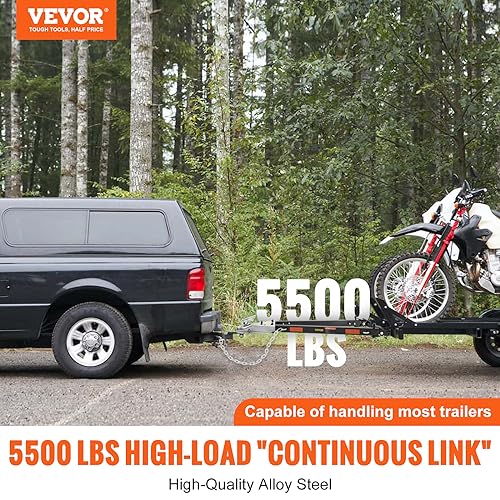
Advertised 5,500 lb Towing Capacity
The VEVOR tow bar is advertised with a maximum towing capacity of 5,500 pounds.
This rating describes the manufacturer’s stated towing capacity for the tow bar assembly.
Before use, verify that the towed vehicle’s actual weight is within the bar’s rating and that the tow vehicle, hitch ball, receiver, mounting brackets, and safety chains are also appropriately rated.
The maximum allowable towing weight is determined by the lowest-rated component.
The 5,500 lb rating should not be interpreted as proof that every vehicle weighing less than 5,500 pounds can be safely flat towed.
Heavy-Duty Alloy Steel Construction
The VEVOR tow bar is constructed from alloy steel for strength and structural rigidity.
Steel construction helps the assembly resist deformation under approved towing loads when correctly installed.
The product also features corrosion-resistant surface protection intended to reduce deterioration from moisture and normal outdoor exposure.
Key construction features include:
- Heavy-duty alloy steel tow bar assembly.
- Adjustable towing arms.
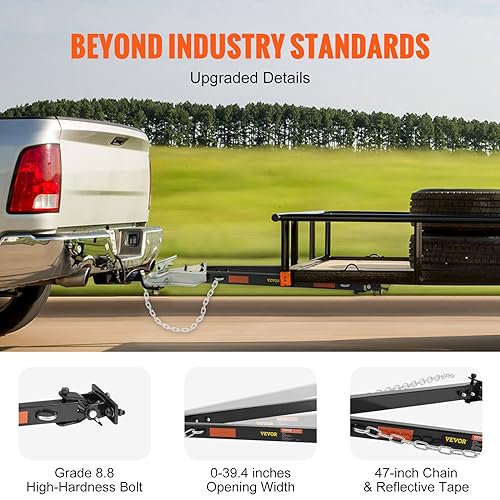
- Grade 8.8 mounting bolts.
- Protective black surface finish.
- Luminous visibility markings.
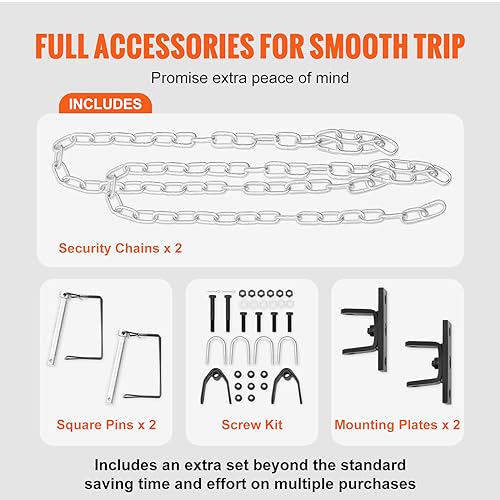
- Included safety chains.
Proper mounting and routine inspection are essential to maintaining safe operation.
Adjustable Width Up to 41 Inches
One of the primary features of the VEVOR vehicle tow bar is its adjustable mounting width.
The bar is advertised to accommodate attachment widths up to 41 inches.
This allows the mounting arms to be positioned for different compatible vehicle configurations.
However, adjustable width does not make the tow bar universally compatible with all vehicles.
The attachment points must be structurally suitable for flat towing, correctly spaced, and approved for the towing loads involved.
Never attach the tow bar to an ordinary bumper cover, unsupported sheet metal, suspension component, or unapproved recovery point.
Standard 2-Inch Trailer Ball Coupler
The tow bar uses a coupler designed for a standard 2-inch hitch ball.
This allows it to connect to a properly rated tow vehicle equipped with a compatible 2-inch ball mount.
Before towing, verify that:
- The hitch ball diameter matches the coupler.
- The hitch ball has a sufficient load rating.
- The ball mount and receiver are appropriately rated.
- The coupler is fully seated and latched.
- The required safety chains are correctly attached.
A 2-inch coupler must never be connected to an undersized or oversized hitch ball.
Safety Chains Included
The VEVOR tow bar is supplied with safety chains intended to provide a secondary connection between the tow vehicle and the towed vehicle.
Safety chains are an important part of a properly configured towing setup.
They must be attached to suitable structural connection points and routed according to the manufacturer’s instructions.
The supplied description does not identify the individual chain working load ratings, so these should be verified before towing.
Luminous Visibility Markings
The VEVOR tow bar features luminous markings intended to improve the visibility of the towing assembly in low-light conditions.
These markings can help make the bar more noticeable during setup and inspection.
They do not replace legally required vehicle lighting, brake lights, turn signals, reflectors, or other road-use safety equipment.
Grade 8.8 High-Strength Bolts
The tow bar includes fasteners described as Grade 8.8 metric bolts.
Property class 8.8 bolts are commonly used in structural automotive fastening applications.
Correct bolt diameter, engagement length, washers, mounting hardware, and installation torque are critical.
Use only the fasteners and attachment configuration approved for the exact tow bar.
Corrosion-Resistant Black Finish
The VEVOR tow bar features a black protective finish intended to help resist rust and environmental exposure.
This is useful for towing equipment that may be exposed to rain, road spray, and outdoor storage conditions.
Regular cleaning and inspection remain necessary, particularly around bolts, joints, mounting brackets, and areas where the finish becomes scratched.
VEVOR 5,500 lb Tow Bar Specifications
| Specification | Details |
|---|---|
| Brand | VEVOR |
| Product type | Adjustable vehicle tow bar |
| Advertised towing capacity | 5,500 lbs |
| Material | Heavy-duty alloy steel |
| Finish | Black, corrosion-resistant coating |
| Hitch ball compatibility | 2 inches |
| Maximum advertised adjustable width | 41 inches |
| Mounting fasteners | Metric property class 8.8 |
| Safety chains | Included |
| Visibility features | Luminous safety markings |
| Intended connection | Compatible vehicle tow-bar mounting points |
| Towing configuration | Subject to vehicle and equipment approval |
| Minimum adjustable width | Not specified |
| Chain working load rating | Not specified |
| Baseplate compatibility | Requires verification |
| Braking equipment | Not specified as included |
| Towed vehicle lighting | Not specified as included |
| Manufacturer part number | Not provided |
All specifications are based on the supplied product description. Verify the exact VEVOR model and installation manual before purchasing or towing.
What Is a Vehicle Tow Bar?
A vehicle tow bar connects a towed vehicle to a tow vehicle, allowing the towed vehicle to roll on its own wheels when the towing configuration permits it.
This is different from a conventional trailer hitch ball mount.
A ball mount supports a trailer coupler, while a vehicle tow bar connects to approved attachment points on the vehicle being towed.
Some vehicle tow bars are designed for flat towing, also called four-down towing, where all four wheels of the towed vehicle remain on the road.
Not every vehicle can be flat towed.
Automatic transmissions, all-wheel-drive systems, transfer cases, steering systems, and other components may be damaged if the vehicle is towed using an unapproved method.
Always consult the towed vehicle manufacturer’s recreational towing or flat-towing instructions.
VEVOR Adjustable Tow Bar vs. Tow Dolly vs. Car Trailer
| Feature | VEVOR Adjustable Tow Bar | Tow Dolly | Full Car Trailer |
|---|---|---|---|
| Vehicle wheels on road | Typically all four | Usually two | None |
| Separate trailer platform | No | Partial | Full |
| Adjustable vehicle attachment | Yes | Dolly-specific | Tie-down system |
| 2-inch hitch ball connection | Yes | Model dependent | Model dependent |
| Advertised towing capacity | 5,500 lbs | Varies | Varies |
| Vehicle drivetrain restrictions | Significant | Significant | Generally fewer rolling-drivetrain concerns |
| Storage requirements | Relatively compact | Larger | Largest |
| Towed vehicle braking considerations | Applicable | Applicable | Trailer braking requirements |
| Best application | Approved flat-towing configurations | Compatible vehicles | Broader vehicle transport applications |
The correct towing method depends on the vehicle’s drivetrain, weight, manufacturer instructions, and intended use.
Common Applications
Compatible Vehicle Flat Towing
The VEVOR tow bar may be suitable for approved flat-towing applications when used with the correct vehicle attachment system and supporting equipment.
Confirm the towed vehicle is specifically approved for four-down towing.
Farm and Property Equipment
Certain towable equipment may be suitable for movement using a compatible tow bar and properly engineered attachment points.
However, equipment that is safe to move on private property may not be legal or safe to tow on public roads.
Workshop and Fleet Applications
A tow bar may be useful in controlled environments where compatible vehicles need to be moved using approved procedures.
Do not use the bar for improvised recovery or pulling a disabled vehicle without confirming the application is permitted.
Recreational Towing
For compatible recreational towing configurations, an adjustable tow bar can provide a compact connection between the tow vehicle and towed vehicle.
Vehicle-specific baseplates, braking equipment, lighting, and steering requirements must be addressed separately.
How to Install the VEVOR Adjustable Tow Bar
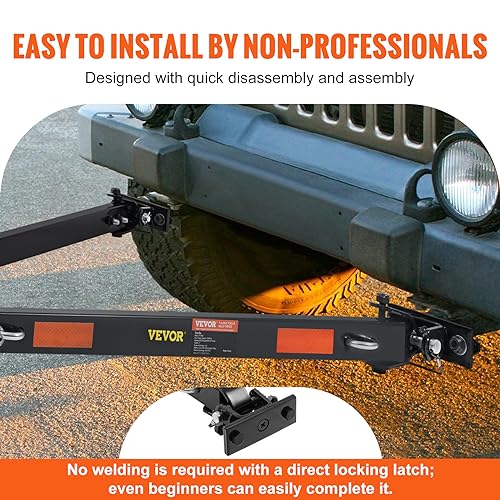
Installation depends on the vehicle and approved mounting hardware.
General Installation Overview
- Confirm the towed vehicle is approved for the intended towing method.
- Verify that the towed vehicle’s weight is within the complete towing system’s limits.
- Inspect the tow bar for damage, corrosion, or missing hardware.
- Identify approved structural tow-bar attachment points or compatible mounting brackets.
- Adjust the bar width to match the approved mounting configuration.
- Install the specified fasteners using the manufacturer’s required torque values.
- Connect the tow bar coupler to a properly rated 2-inch hitch ball.
- Secure the coupler latch and install any required retaining device.
- Attach the safety chains to approved connection points.
- Connect the required towing lights and supplemental braking equipment.
- Configure the towed vehicle’s steering, transmission, and drivetrain according to its manufacturer’s instructions.
- Perform a complete connection and safety inspection before moving.
Installation warning: Do not drill or modify vehicle structural components without an approved installation procedure. Universal mounting hardware is not a substitute for a vehicle-specific engineered attachment system.
Important Flat-Towing Safety Considerations
A tow bar’s weight rating is only one part of a safe towing setup.
Before towing, verify the following:
- Drivetrain compatibility: The vehicle manufacturer must approve the intended towing method.
- Transmission protection: Incorrect towing can damage transmissions, transfer cases, and driveline components.
- Steering configuration: Follow the manufacturer’s instructions for steering-wheel movement and ignition settings.
- Supplemental braking: A braking system may be required by law or the towing equipment manufacturer.
- Trailer lighting: Proper tail lights, brake lights, and turn signals are required for road use.
- Safety chains: Use correctly rated chains and approved attachment points.
- Tow bar alignment: Follow the manufacturer’s required tow-bar height and angle limits.
- Vehicle speed: Observe the most restrictive applicable towing speed.
- Backing restrictions: Many flat-towing setups should not be backed up while connected.
Never assume that an adjustable tow bar can safely tow every vehicle simply because the mounting width can be changed.
Frequently Asked Questions
What is the VEVOR tow bar’s maximum towing capacity?
The manufacturer advertises a maximum towing capacity of 5,500 pounds for the tow bar assembly.
Does this tow bar fit a 2-inch hitch ball?
Yes. It is advertised with a coupler designed for a standard 2-inch trailer hitch ball.
How wide can the tow bar be adjusted?
The manufacturer advertises an adjustable width of up to 41 inches.
Does the tow bar include safety chains?
Yes. Safety chains are included according to the supplied product description.
Can I tow any car under 5,500 pounds?
No. The vehicle must be approved for the towing method and equipped with compatible attachment points, lighting, and braking equipment.
Can I flat tow an automatic transmission vehicle?
Only if the vehicle manufacturer explicitly permits the specific flat-towing procedure. Many automatic transmission vehicles cannot be flat towed without damage.
Is this tow bar compatible with all SUVs and trucks?
No. Compatibility depends on vehicle weight, approved mounting points, drivetrain requirements, and the complete towing configuration.
What are the luminous strips for?
The markings are intended to improve tow bar visibility in low-light conditions. They do not replace required vehicle lighting.
Is the tow bar rust-resistant?
The product is advertised with a corrosion-resistant black protective finish.
Are the mounting bolts included?
The supplied description identifies Grade 8.8 bolts, but the complete mounting hardware inventory should be confirmed against the exact product package.
Can I reverse while flat towing?
Do not assume reversing is permitted. Many flat-towing systems prohibit backing while connected because of steering and tow bar geometry.
Can this tow bar be used for vehicle recovery?
It should not be treated as a kinetic recovery strap or winch recovery attachment. Use it only for applications approved by the manufacturer.
A Versatile Tow Bar for Compatible Vehicle Towing
The VEVOR Adjustable Tow Bar with 5,500 lb Towing Capacity combines heavy-duty alloy steel construction, a standard 2-inch ball coupler, an adjustable width of up to 41 inches, and included safety chains.
Its corrosion-resistant finish, Grade 8.8 fasteners, and luminous markings add practical features for approved towing applications.
For owners who need a compact vehicle towing connection rather than a full vehicle transport trailer, the VEVOR tow bar may provide a convenient solution when paired with compatible mounting hardware and properly configured vehicles.
Choose the VEVOR 5,500 lb Adjustable Tow Bar for a durable, adjustable towing connection designed for compatible vehicle and equipment transport applications.



There are no reviews yet.