
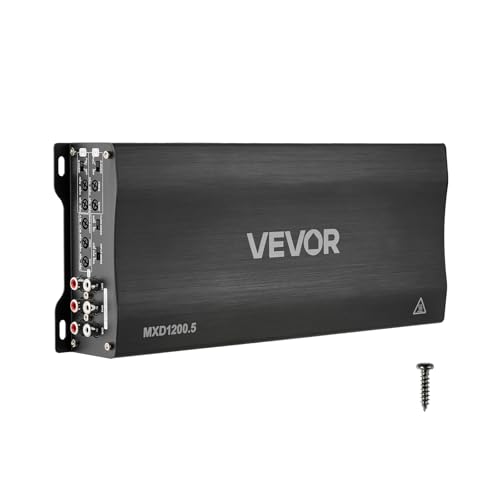




VEVOR 5-Channel Amplifier Power Output
VEVOR lists the amplifier with the following maximum output ratings:
Full-range channels at 4 ohms:
Up to 100W x 4
Full-range channels at 2 ohms:
Up to 200W x 4
Subwoofer channel at 4 ohms:
Up to 500W x 1
Subwoofer channel at 2 ohms:
Up to 1,000W x 1
These ratings make speaker impedance an important consideration when designing the system.
Because the supplied specifications describe these figures as maximum power, they should not automatically be treated as continuous RMS output ratings when matching speakers.
Four Full-Range Speaker Channels
The first four channels are intended to power the vehicle’s primary speakers.
A conventional installation could use:
- Channels 1 and 2 for front speakers
- Channels 3 and 4 for rear speakers
- Channel 5 for the subwoofer
This configuration works particularly well for vehicles receiving a complete speaker upgrade.
Instead of relying on the relatively limited amplification built into a factory or aftermarket radio, the external amplifier supplies dedicated power to each speaker channel.
Up to 100 Watts x 4 at 4 Ohms
VEVOR lists maximum output of up to 100 watts x 4 at 4 ohms.
Four-ohm speakers are extremely common in automotive audio, making this configuration suitable for many conventional component and coaxial speaker installations.
Before connecting speakers, check both their impedance and continuous RMS power-handling specifications.
Amplifier and speaker ratings aren’t useful unless they’re being compared using the same measurement standard.
Up to 200 Watts x 4 at 2 Ohms
At 2 ohms, VEVOR lists maximum output of up to 200 watts x 4.
Lower speaker impedance can allow an amplifier to deliver additional output, but it also increases electrical and thermal demand.
Never substitute a lower-impedance speaker simply because the wattage number gets bigger.
The complete system should be designed around:
- Speaker impedance
- Speaker RMS handling
- Amplifier capability
- Wiring configuration
- Electrical-system capacity
- Desired listening level
A correctly matched 4-ohm system can easily outperform a poorly configured lower-impedance installation.
Dedicated Subwoofer Channel
The fifth channel is dedicated to the subwoofer.
VEVOR lists maximum subwoofer output of:
- 500 watts x 1 at 4 ohms
- 1,000 watts x 1 at 2 ohms
Having a dedicated subwoofer channel means the amplifier can handle the complete audio system without requiring a separate monoblock amplifier in many installations.
This can be particularly useful in smaller vehicles where amplifier mounting space is limited.
Bridgeable Amplifier Design
The VEVOR amplifier also incorporates a bridgeable channel design.
Bridging combines amplifier channels to provide additional output for compatible speakers or subwoofer configurations.
This provides additional flexibility for custom installations where the standard five-channel configuration isn’t required.
However, bridging changes the electrical load seen by the amplifier.
Always confirm the manufacturer’s permitted bridged impedance and wiring arrangement before connecting speakers.
Match Your Subwoofer Impedance Correctly
Subwoofer impedance deserves particular attention because many aftermarket subwoofers use dual voice coils.
Depending on the voice-coil configuration and wiring arrangement, the same subwoofer may be capable of presenting dramatically different loads to an amplifier.
For example, parallel and series wiring produce different final impedances.
That means you should choose the subwoofer and amplifier as a system rather than buying both independently and hoping the wiring diagram performs a small miracle afterward.
Class D Amplifier Technology
The VEVOR five-channel amplifier uses Class D amplification.
Class D technology is popular in modern automotive amplifiers because it provides high efficiency relative to many traditional amplifier architectures.
Greater efficiency can help reduce:
- Electrical losses
- Heat generation
- Chassis size
- Power demand relative to output
These advantages become especially useful in a five-channel amplifier responsible for powering both full-range speakers and a subwoofer.
Full-Range Audio Capability
The amplifier is designed as a full-range Class D amplifier, allowing the primary channels to reproduce the frequency range required by conventional automotive speakers.
This makes the unit suitable for systems using:
- Component speakers
- Coaxial speakers
- Midrange drivers
- Compatible tweeter/crossover systems
- Subwoofers
Correct crossover configuration remains important, particularly when a system contains separate speakers optimized for different frequency ranges.
Why Crossovers Matter
A properly configured crossover prevents speakers from receiving frequencies they aren’t designed to reproduce.
For example, removing deep bass from smaller door speakers can reduce unnecessary cone excursion while allowing the dedicated subwoofer to handle low-frequency material.
This can improve system efficiency and reduce distortion.
Our guide to car audio system upgrades covers how speakers, amplifiers and subwoofers work together when building a complete aftermarket sound system.
Designed for Low-Distortion Audio
VEVOR describes the amplifier as using a low-distortion design intended to maintain cleaner reproduction at elevated listening levels.
Actual distortion depends on several factors beyond the amplifier itself, including:
- Input signal quality
- Gain configuration
- Speaker impedance
- Supply voltage
- Ground quality
- Speaker capability
- Output level
Even a capable amplifier can produce poor results when the gain is cranked into clipping.
Gain is there to match signal levels—not to unlock the mythical secret extra-wattage setting.
Aluminum Alloy Housing
The amplifier uses an aluminum-alloy enclosure designed to transfer heat away from the internal circuitry.
Heat management is particularly important in automotive applications because amplifiers are often installed in confined spaces.
Good mounting locations should provide sufficient ventilation around the amplifier.
Avoid burying it beneath insulation, carpeting or luggage where heat can accumulate.
Prevent Amplifier Overheating
If an amplifier repeatedly overheats or enters protection mode, don’t assume the amplifier itself is defective.
Common causes can include:
- Incorrect speaker impedance
- Poor ventilation
- Excessive gain
- Clipping
- Undersized power wiring
- Weak ground connections
- Low charging voltage
- Sustained high-output operation
Our guide explaining why car amplifiers overheat covers several of the electrical and installation problems that can cause an amplifier to run hotter than intended.
Built-In Fuse Protection
VEVOR equips the amplifier with built-in fuse protection to help protect the unit against excessive current conditions.
The amplifier’s internal fuse does not eliminate the need for a properly sized fuse near the vehicle battery.
The main power cable should be protected as close to the battery connection as practical.
That fuse primarily protects the vehicle and power cable if the wire shorts against the chassis.
Power Wiring Matters
An amplifier capable of powering an entire speaker system and subwoofer needs an appropriately designed electrical supply.
Installation should include:
- Properly sized power cable
- Correctly sized fuse
- Quality fuse holder
- Short, low-resistance ground connection
- Clean chassis grounding point
- Properly terminated cable ends
Undersized wiring creates voltage drop.
Voltage drop wastes power as heat and can prevent the amplifier from operating correctly under load.
Test Voltage at the Amplifier
A voltage reading at the battery doesn’t necessarily tell you what the amplifier is receiving.
Resistance in the power or ground circuit can cause voltage to fall significantly when the amplifier begins drawing substantial current.
Check voltage directly across the amplifier’s positive and ground terminals while the audio system is operating.
Our automotive voltage-drop testing guide explains why testing a circuit under load can uncover resistance that a basic continuity check may miss.
The same principles apply directly to high-current car audio installations.
Compatible with Standard 12V Automotive Systems
VEVOR designed this amplifier for use with standard 12V automotive electrical systems.
Potential applications include:
- Sedans
- Coupes
- Sports cars
- SUVs
- Pickup trucks
- Off-road vehicles
- Custom automotive builds
Actual compatibility depends on the vehicle’s electrical and audio system rather than simply the vehicle body style.
Modern vehicles equipped with factory amplified or digitally networked audio systems may require additional integration hardware.
A Cleaner Daily-Driver Audio Installation
The major advantage of a five-channel amplifier isn’t simply power.
It’s consolidation.
A complete system can potentially run:
Front speakers + rear speakers + subwoofer
from one amplifier.
That’s particularly attractive in a daily driver where owners may want substantially better sound without sacrificing half the trunk to an amplifier rack.
Choosing Speakers for the VEVOR 5-Channel Amp
Start with speaker impedance and RMS power handling.
Don’t select speakers solely according to the amplifier’s maximum output figures.
Look for speakers capable of operating efficiently within the amplifier’s usable continuous output range.
Other factors worth considering include:
- Sensitivity
- Frequency response
- Mounting depth
- Factory speaker dimensions
- Crossover requirements
- Vehicle acoustics
More wattage won’t fix speakers that don’t physically fit the doors. Apparently physics insists on being involved.
Choosing a Subwoofer
For the dedicated fifth channel, consider:
- Subwoofer RMS rating
- Voice-coil impedance
- Final wired impedance
- Enclosure type
- Available enclosure volume
- Desired output
A carefully matched subwoofer can make far better use of available amplifier power than simply choosing the largest woofer available.
Sealed vs Ported Subwoofer Enclosures
The enclosure has a major influence on how a subwoofer performs.
A sealed enclosure typically prioritizes compact packaging and controlled response, while a properly designed ported enclosure can provide greater output around its tuning range.
Neither design is universally superior.
Our sealed vs ported subwoofer comparison explains how enclosure design changes bass response, output and system behavior.
Key Features
- VEVOR five-channel car audio amplifier
- Full-range Class D architecture
- Four full-range speaker channels
- Dedicated subwoofer channel
- Bridgeable design
- Up to 100W x 4 maximum at 4 ohms
- Up to 200W x 4 maximum at 2 ohms
- Up to 500W x 1 maximum subwoofer output at 4 ohms
- Up to 1,000W x 1 maximum subwoofer output at 2 ohms
- Designed for speaker and subwoofer systems
- Low-distortion design
- Aluminum-alloy housing
- Heat-dissipating chassis
- Built-in fuse
- Designed for 12V automotive systems
- Suitable for cars, SUVs and trucks
- Compatible with off-road and performance vehicle installations
Complete Five-Channel Amplification from One Unit
The VEVOR 5-Channel Class D Car Audio Amplifier is designed for enthusiasts who want to power a complete speaker and subwoofer system without installing multiple amplifiers.
Its four full-range channels provide manufacturer-listed maximum output of up to 100 watts each at 4 ohms or 200 watts each at 2 ohms, while the dedicated fifth channel is rated for maximum output of up to 500 watts at 4 ohms or 1,000 watts at 2 ohms.
The bridgeable architecture adds installation flexibility, while Class D operation and an aluminum-alloy chassis address efficiency and heat management.
For a daily-driver audio upgrade, the biggest advantage may be simplicity: one amplifier can potentially handle the front speakers, rear speakers and subwoofer while keeping the installation cleaner and more compact.





There are no reviews yet.