
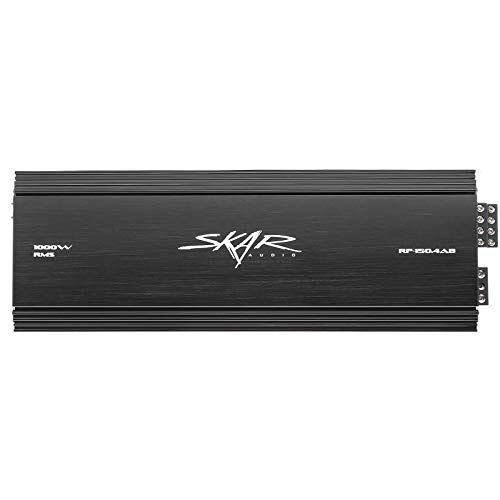


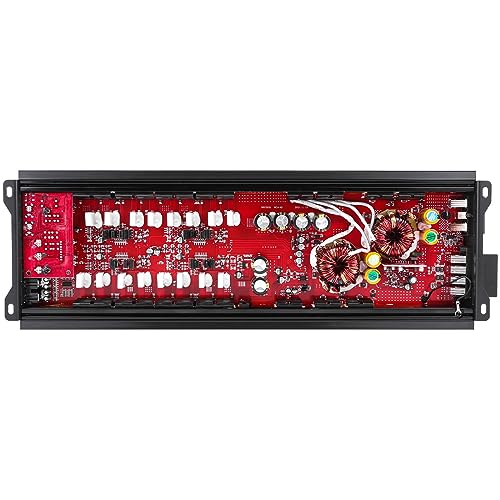

Built for a Complete Aftermarket Sound Stage
A powerful four-channel amplifier is an excellent foundation for an upgraded automotive sound stage.
A conventional configuration can use:
Channels 1–2: Front component speakers
Channels 3–4: Rear coaxial or component speakers
Alternatively, the amplifier can be incorporated into more specialized systems involving mids, drivers or actively configured components when the equipment and crossover arrangement are appropriate.
If you’re still deciding how to structure the system, our guide to the best car amplifier setup for bigger sound explains how four-channel, five-channel and multi-amplifier layouts differ and why RMS power and impedance should be matched before buying components.
250 Watts RMS x 4 at 2 Ohms
At a 2-ohm load, the RP-150.4AB is rated for an impressive 250 watts RMS per channel.
Across four channels, that’s up to 1,000 watts RMS of continuous full-range amplifier output.
This level of power opens the door to higher-output aftermarket speakers and custom sound-stage configurations that would overwhelm the internal amplifier found in most head units.
Before connecting 2-ohm speakers, verify that:
- Each speaker presents the intended impedance
- RMS power handling is appropriate
- Speaker wiring is correctly configured
- Power and ground wiring can support amplifier demand
- The vehicle charging system is healthy
More amplifier power can create greater clean output, but only when the rest of the system is designed to use it.
125 Watts RMS x 4 at 4 Ohms
At 4 ohms, the RP-150.4AB delivers 125 watts RMS x 4 channels.
For many street-driven systems, this may be the sweet spot.
A properly matched set of 4-ohm component or coaxial speakers can receive considerably more clean power than most factory radios provide while maintaining a straightforward speaker configuration.
When shopping for speakers, compare the amplifier’s RMS output with the speaker’s continuous RMS power handling rather than its largest advertised peak-power number.
Our car audio system guide covers speaker sensitivity, RMS matching, impedance and amplifier selection in more detail.
Class A/B Amplifier Architecture
The Skar Audio RP-150.4AB uses a Class A/B amplification design.
Class A/B amplifiers have long been popular for full-range automotive audio because they’re well suited to reproducing the entire audible frequency spectrum while maintaining strong sound quality.
The RP-150.4AB is designed for applications where the amplifier must reproduce vocals, instruments, midbass and higher frequencies rather than concentrating primarily on subwoofer duty.
For enthusiasts prioritizing a powerful front stage, the Class A/B architecture is one of the major distinctions between the RP-150.4AB and compact Class D alternatives.
Full 20 Hz to 20 kHz Frequency Response
Skar Audio specifies a 20 Hz–20,000 Hz frequency response for the RP-150.4AB.
That covers the generally accepted audible frequency spectrum and reflects the amplifier’s purpose as a full-range design.
This allows it to power a broad variety of compatible speakers rather than being limited to bass frequencies.
Actual system response will ultimately depend on the speakers, crossovers, installation, cabin acoustics and tuning.
105 dB Signal-to-Noise Ratio
The RP-150.4AB carries a stated 105 dB signal-to-noise ratio.
Signal-to-noise ratio describes the relationship between the desired audio signal and the amplifier’s background noise.
A strong signal-to-noise specification is especially relevant in a full-range amplifier because hiss and electrical noise are considerably more noticeable through midrange drivers and tweeters than through a subwoofer.
Clean signal routing and proper grounding remain important regardless of the amplifier specification.
High-Speed MOSFET Power Supply
The RP-150.4AB uses a high-speed MOSFET power supply to support its substantial output.
The amplifier’s power supply converts the vehicle’s electrical input into the internal voltages required by the amplifier circuitry.
This becomes increasingly important as power output rises.
An amplifier capable of producing up to 1,000 watts RMS across four channels requires a stable electrical supply, correctly sized wiring and low-resistance connections.
Adjustable High-Pass Filter
An onboard high-pass filter (HPF) allows unwanted low frequencies to be removed from speakers that aren’t designed to reproduce deep bass.
This is especially useful with:
- Component speakers
- Coaxial speakers
- Midrange drivers
- Smaller full-range speakers
High-pass filtering can reduce unnecessary cone excursion and allow the speakers to concentrate on the frequencies they’re designed to reproduce.
In systems using a dedicated subwoofer, the HPF can also help create a cleaner transition between the main speakers and bass system.
Adjustable Low-Pass Filter
The RP-150.4AB also provides an adjustable low-pass filter (LPF).
Low-pass filtering removes frequencies above the selected crossover range.
Combined with the amplifier’s other crossover controls, this gives installers considerably more flexibility when configuring custom systems.
Correct crossover setup is important not only for sound quality but also for reliability. Our guide to car amplifier overheating explains how incorrect speaker loads, gain settings, wiring and crossover configuration can increase amplifier workload and heat.
Adjustable Crossover Controls
The RP-150.4AB’s crossover controls allow the amplifier to be tailored to the connected speakers instead of simply sending the full audio spectrum everywhere.
This becomes especially useful when building:
- Component speaker systems
- Active front stages
- Midrange-heavy systems
- Custom speaker arrays
- Systems with separate subwoofer amplification
A properly configured crossover network allows each driver to concentrate on the frequencies it reproduces efficiently.
Sending 35 Hz to a door speaker that wants absolutely nothing to do with 35 Hz isn’t “full range.” It’s harassment.
Variable Gain Control
The amplifier includes adjustable gain controls for matching input sensitivity to the source unit.
Gain is not a volume control.
Its purpose is to match the amplifier input stage to the output voltage supplied by the head unit or processor.
Excessive gain can cause the amplifier to reach clipping earlier, increasing distortion and heat while placing additional stress on the speakers.
A powerful amplifier like the RP-150.4AB makes correct gain configuration particularly important.
Adjustable Bass EQ
Skar Audio also provides bass EQ adjustment for additional tonal control.
Bass EQ can emphasize lower-frequency output when the speaker system and installation benefit from it.
Use boost conservatively.
Additional EQ requires additional amplifier output at the boosted frequencies and can reduce available headroom if used aggressively.
Set gain and crossovers first, then make smaller EQ adjustments after the basic system is operating cleanly.
Four-Way Protection Circuitry
The RP-150.4AB incorporates four-way protection circuitry designed to help protect the amplifier when abnormal operating conditions occur.
Protection circuitry is particularly valuable in a high-output four-channel amplifier where incorrect impedance, wiring faults or electrical-system problems can create substantial current demand.
It should still be considered a backup rather than an installation strategy.
Correct wiring, speaker impedance, grounding, ventilation and gain configuration remain essential.
Large 4-Gauge Power and Ground Terminals
Skar Audio equips the RP-150.4AB with 4-gauge power and ground input terminals.
That’s an important feature given the amplifier’s output capability.
High amplifier power requires significant electrical current, and undersized wiring can create resistance and voltage loss.
Correctly sized cable helps:
- Reduce voltage drop
- Reduce unwanted heat
- Maintain amplifier output
- Improve electrical reliability
- Reduce the chance of protection-mode shutdown
Use quality power and ground cable appropriate for the installation length and amplifier requirements.
Power Wiring Matters at 1,000 Watts RMS
A four-channel amplifier capable of up to 1,000 watts RMS deserves more electrical planning than simply finding the nearest piece of red wire.
The installation should include:
- Properly sized power cable
- Matching ground cable
- Main fuse near the battery
- Quality fuse holder
- Secure battery connection
- Proper terminals
- Suitable speaker wiring
- Quality signal cables
Ground connections should be short and made to a suitable low-resistance point.
A bad ground can contribute to noise, unstable voltage, heat and amplifier protection problems.
Watch for Voltage Drop
Voltage loss through power and ground wiring can prevent an amplifier from reaching its intended performance.
Common causes include:
- Undersized power cable
- Loose battery terminals
- Poor ground connections
- Corrosion
- Weak fuse holders
- Damaged wiring
Measure voltage at the amplifier while the system is operating under load if electrical performance is questionable.
The amplifier can only work with the voltage that actually reaches its terminals. The number measured six feet away at the battery doesn’t magically teleport through a terrible ground connection.
Give a Class A/B Amplifier Room to Cool
Class A/B amplification can generate more heat than highly efficient modern Class D designs, particularly when operated at substantial output.
Installation location therefore deserves careful consideration.
Allow airflow around the amplifier and avoid:
- Covering the heat sink with carpet
- Burying the amplifier beneath cargo
- Mounting it in an unventilated enclosure
- Installing it near major heat sources
If an amplifier repeatedly enters thermal protection, don’t simply keep restarting it. The My Pro Street amplifier overheating guide covers airflow, impedance, voltage, gain and wiring problems that commonly cause excessive amplifier temperatures.
Match Speaker Impedance Before Installation
The RP-150.4AB produces different output depending on the connected speaker impedance.
That means speaker selection should happen before the wiring is finalized.
At the stated ratings:
4 ohms: 125W RMS per channel
2 ohms: 250W RMS per channel
A lower impedance asks the amplifier to deliver more current and power.
Never connect speaker loads below the amplifier’s supported configuration simply to chase more output.
That’s usually a remarkably efficient way to convert expensive car audio equipment into a protect-mode indicator.
Excellent for High-Power Component Speakers
The RP-150.4AB’s output makes it particularly interesting for higher-power component speaker systems.
A substantial front stage may use dedicated midbass drivers and tweeters with passive crossover networks, while more advanced installations may incorporate signal processing and active crossover configurations.
The amplifier’s available power and crossover controls provide flexibility for these types of builds.
Always follow the speaker manufacturer’s RMS, impedance and crossover requirements.
Can Power Front and Rear Speakers
For a more conventional street system, the RP-150.4AB can simply provide substantial power to four speakers.
This approach works well for:
- Performance coupes
- Sedans
- Trucks
- SUVs
- Custom street cars
- Show vehicles
Front speakers generally contribute the majority of the stereo image, so system tuning may favor the front stage rather than simply setting every channel to identical perceived output.
Pair It with a Dedicated Subwoofer Amplifier
Because the RP-150.4AB is designed as a powerful full-range four-channel amplifier, it can serve as the speaker amplifier in a multi-amplifier system.
A common high-output configuration would use:
- RP-150.4AB for front and rear speakers
- Dedicated monoblock amplifier for subwoofer duty
This allows each amplifier to concentrate on a specific job while providing greater tuning and upgrade flexibility.
As the My Pro Street amplifier setup guide explains, separate full-range and monoblock amplifiers can provide more tuning and expansion flexibility than an all-in-one configuration when you’re planning a larger system.
Key Features
- Skar Audio RP-150.4AB
- Full-range four-channel car amplifier
- Class A/B architecture
- High-speed MOSFET power supply
- 250W RMS x 4 at 2 ohms
- 125W RMS x 4 at 4 ohms
- Up to 1,000 watts RMS total at 2 ohms
- 20 Hz–20 kHz frequency response
- 105 dB signal-to-noise ratio
- Adjustable gain
- Adjustable high-pass filter
- Adjustable low-pass filter
- Adjustable crossover controls
- Bass EQ adjustment
- Four-way protection circuitry
- Large 4-gauge power terminals
- Large 4-gauge ground terminals
- Designed for aftermarket full-range speakers
- Suitable for component and coaxial systems
- Useful for high-output front and rear sound stages
Serious Four-Channel Power for an Upgraded Sound Stage
The Skar Audio RP-150.4AB 4-Channel Class A/B Amplifier is built for systems where ordinary head-unit power isn’t remotely enough.
With 125 watts RMS x 4 at 4 ohms, it can provide substantial clean power to many aftermarket component and coaxial systems. With compatible 2-ohm speakers, output increases to a formidable 250 watts RMS per channel, giving the amplifier up to 1,000 watts RMS of total full-range output.
A high-speed MOSFET power supply supports the amplifier’s electrical demands, while adjustable gain, HPF, LPF, crossover and bass EQ controls provide the tuning flexibility needed for more sophisticated sound stages. Four-way protection circuitry and 4-gauge power and ground connections round out a package designed for serious aftermarket audio.
For enthusiasts building a powerful front-and-rear speaker system—or pairing a dedicated full-range amplifier with a separate monoblock—the RP-150.4AB provides the kind of output that can make upgraded speakers finally perform like the expensive speakers you told everyone were “definitely necessary.”









There are no reviews yet.