
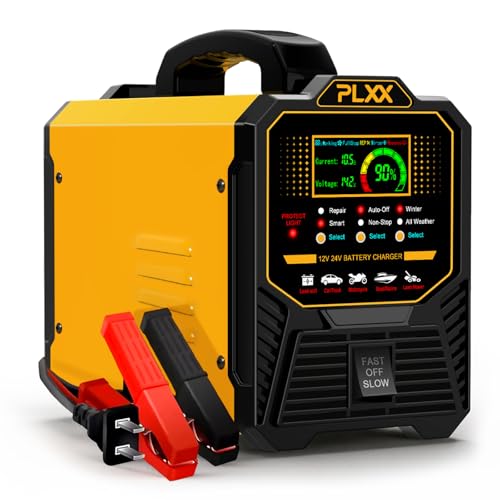

PLXX 12V/24V 0-15A Automatic Smart Battery Charger & Maintainer
The PLXX 12V/24V 0-15A Automatic Smart Battery Charger combines high-current charging, trickle maintenance, battery repair and cold-weather charging in one heavy-duty unit for automotive, marine and recreational batteries.
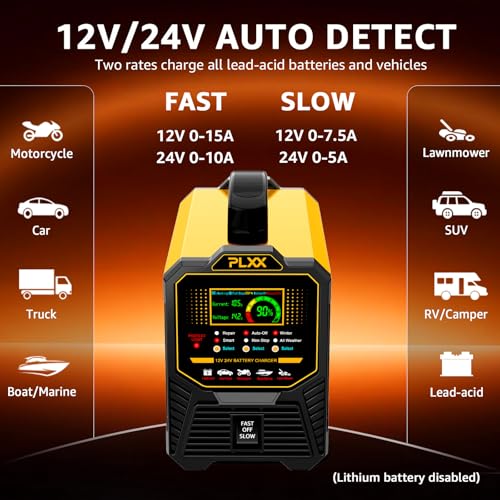
Designed for 4Ah to 300Ah lead-acid batteries, the PLXX charger automatically detects compatible 12V and 24V batteries and uses a seven-stage smart charging process to manage charging without constant supervision. Selectable FAST and SLOW modes make it suitable for everything from smaller motorcycle batteries to larger automotive, truck, RV and deep-cycle batteries.
Add an LCD display, automatic shutoff, Winter Mode, desulfation functionality and 12V power-supply capability, and the PLXX becomes considerably more versatile than a basic trickle charger.
0-15A Charging for 12V and 24V Batteries
The PLXX provides charging current up to 15 amps for compatible batteries and automatically detects 12V or 24V systems.
Its stated battery-capacity range extends from 4Ah to 300Ah, making it useful across a broad selection of vehicles and equipment.
Typical applications include:
-
Cars
-
Pickup trucks
-
Motorcycles
-
Boats
-
Marine equipment
-
RVs
-
Lawn mowers
-
Deep-cycle battery systems
-
Other equipment using compatible lead-acid batteries
Rather than buying one charger for the motorcycle, another for the truck and another mysterious box that lives beside the lawn mower, the PLXX is designed to cover a much broader range of battery sizes.
Seven-Stage Automatic Smart Charging
The PLXX uses a seven-stage smart charging process designed to adapt charging behavior as battery conditions change.
Automatic voltage detection determines whether a compatible 12V or 24V battery is connected, while the charging system manages the charging cycle without requiring continuous manual adjustment.
This makes the charger useful both for recovering discharged batteries and for routine battery maintenance.
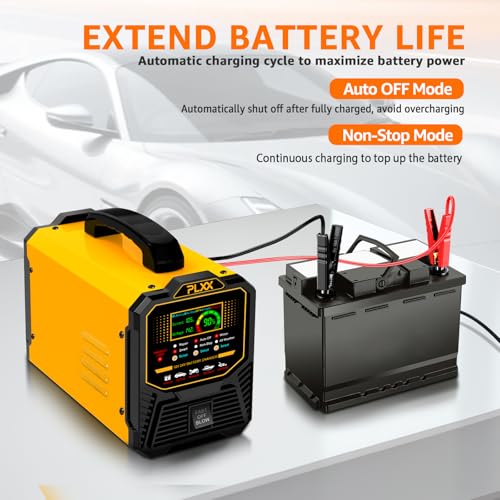
Once the battery reaches the appropriate charge level, automatic shutoff helps prevent overcharging.
Original price was: $125.95.$113.35Current price is: $113.35.
FAST and SLOW Charging Modes
The PLXX provides two primary charging-rate strategies for different battery sizes and applications.
FAST Mode is intended for larger compatible batteries when a higher charging rate is appropriate.
SLOW Mode provides lower-current charging for smaller batteries and trickle-maintenance applications.
Battery size, chemistry, condition and manufacturer specifications should always be considered when choosing a charging rate.
Throwing maximum amperage at every battery isn’t a charging strategy. It’s enthusiasm with jumper clamps.
AGM, Gel, Flooded and Deep-Cycle Compatibility
The PLXX supports several common lead-acid battery chemistries, including:
- AGM
- Gel
- Wet/Flooded
- EFB
- Calcium
- Maintenance-Free (MF)
- Deep-cycle batteries
This broad compatibility makes the charger particularly useful for garages containing several types of vehicles or equipment.
Always verify battery voltage and chemistry before charging. This model is specified for compatible lead-acid batteries and should not be assumed compatible with lithium-ion or LiFePO4 batteries.
Battery Repair and Desulfation Mode
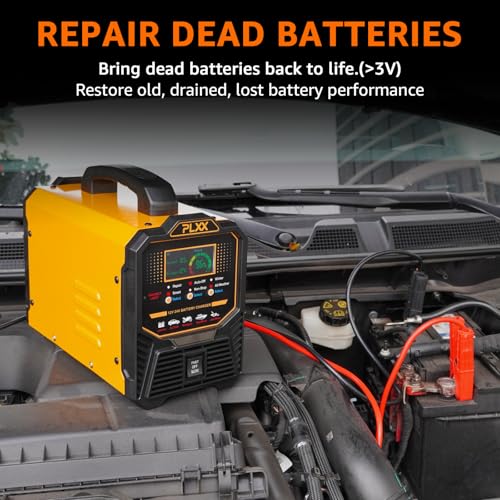
The PLXX incorporates a battery repair/desulfation function intended for certain weak, sulfated, stratified or long-idle lead-acid batteries.
The repair function can be used with compatible batteries retaining more than approximately 3 volts, according to the supplied specifications.
Sulfation can develop when a lead-acid battery remains discharged or partially discharged for extended periods. A repair charging strategy may help recover some performance when sulfation is reversible.
Battery repair does have limits.
A charger cannot reliably restore a battery with damaged plates, internal shorts, failed cells, severe capacity loss or physical damage. If a battery repeatedly fails after charging, replacement or further diagnosis may be required.
Automatic Shutoff After Charging
Automatic operation is one of the PLXX charger’s main advantages over traditional manual chargers.
Once the battery reaches full charge, the charger is designed to automatically shut off its primary charging cycle, helping reduce the risk of overcharging.
This makes the PLXX suitable for users who want a more plug-and-play approach instead of manually monitoring a timer and ammeter throughout the charging process.
For vehicles that spend significant time parked, maintenance charging can also help compensate for normal battery self-discharge.
Winter Mode for Cold-Weather Charging
Cold weather is particularly hard on automotive batteries.
Battery output falls as temperature drops, while a cold engine may simultaneously require additional cranking current.
The PLXX includes a dedicated Winter Mode designed to modify charging behavior for cold-weather conditions and help ensure the battery reaches an appropriate state of charge.
This can be particularly useful for:
- Vehicles stored outdoors
- Seasonal vehicles
- Trucks
- Motorcycles
- RVs
- Boats stored during winter
- Lawn and utility equipment
Winter Mode can’t reverse an aging or internally damaged battery, but keeping a healthy battery properly charged can improve cold-weather starting reliability.
LCD Battery and Charging Display
The integrated LCD display provides useful charging information without requiring users to interpret a collection of blinking mystery lights.
Displayed information includes:
- Battery voltage
- Charging current
- Charging percentage
- Charging status
This allows charging progress to be monitored at a glance and provides basic information about the connected battery.
Why Does a Charged Battery Still Fail to Start the Car?
A battery charger is useful for diagnosis because a properly charged battery eliminates one major variable from the starting system.
If the battery is charged but the vehicle still has electrical power and won’t start, the problem may involve battery connections, starter cables, grounds, relays, the starter motor or other electrical components.
Likewise, rapid clicking when trying to start the engine often points toward insufficient available voltage, but poor connections can produce nearly identical symptoms.
Charging the battery is therefore a starting point—not always the final diagnosis.
Check for Voltage Drop in Battery Cables
A battery cable can look perfectly normal while excessive resistance inside the cable or terminal prevents sufficient current from reaching the starter.
Because starter motors draw substantial current, even relatively small amounts of resistance can cause significant voltage loss.
Our guide to automotive voltage-drop testing explains how to check positive cables, starter connections and ground circuits while they’re under load.
If a fully charged battery still produces slow cranking or intermittent starting problems, voltage-drop testing can help locate electrical resistance before unnecessary parts are replaced.
When the Battery Keeps Going Dead
If you continually need the PLXX charger to get the same vehicle running, something else may be wrong.
A battery that repeatedly goes dead can result from an aging battery, parasitic electrical draw, poor connections or charging-system problems.
A smart charger can replenish the battery, but it can’t eliminate whatever caused the discharge.
If the battery loses charge while the engine is running, inspect the alternator and charging system as well. Our guide explaining why a battery warning light comes on covers several common charging-system faults that can prevent the alternator from properly replenishing the battery.
Heavy-Duty Copper-Coil Construction
The PLXX charger uses a pure-copper coil with a combination metal and ABS housing designed for repeated garage and workshop use.
The heavier construction distinguishes it from smaller maintenance-only chargers and supports its broader charging range.
Its design is intended for users maintaining multiple vehicles or larger battery systems where a compact fractional-amp maintainer may not provide enough charging capacity.
12V DC Power Supply Capability
In addition to battery charging, the PLXX can operate as a 12V DC power source for compatible applications.
This expands its usefulness around the workshop for suitable 12V electrical projects.
Always remain within the charger’s specified voltage and current limitations when using it as a power supply.
Electrolysis and Rust-Removal Applications
The charger’s DC output can also be used for certain electrolysis rust-removal projects, including restoration work involving suitable cast-iron and steel components.
Electrolysis uses direct electrical current through an electrolyte solution to help remove oxidation from ferrous metal parts.
This can be useful when restoring older automotive hardware and cast-iron components.
Electrolysis should only be performed using proper procedures in a well-ventilated area because the process can generate gases. Never use inappropriate metals, sealed containers or unsafe electrical connections.
Multiple Built-In Safety Protections
The PLXX incorporates several protection systems designed to reduce the risk of damage during charging.
Stated protection functions include:
- Reverse-polarity protection
- Short-circuit protection
- Overcharge protection
- Over-temperature protection
- Over-voltage protection
- Over-current protection
These systems add another layer of protection, but users should still confirm battery voltage and polarity before connecting the charger.
Never attempt to charge a battery that is frozen, cracked, leaking, severely swollen or otherwise physically damaged.
Three-Year Warranty
The PLXX charger is backed by a stated three-year warranty, adding additional coverage for owners planning to use the charger regularly around the garage or workshop.
Warranty terms and eligibility should be verified with the seller or manufacturer at the time of purchase.
Key Features
- Automatic 12V/24V battery detection
- Charging output up to 15A
- Supports 4Ah–300Ah batteries
- Seven-stage automatic smart charging
- FAST charging mode
- SLOW/trickle charging mode
- Automatic battery-maintenance functionality
- Automatic shutoff after charging
- Battery repair function
- Desulfation mode
- Designed to recover certain batteries above approximately 3V
- Winter charging mode
- LCD digital display
- Voltage display
- Charging-current display
- Charge-percentage display
- AGM battery compatibility
- Gel battery compatibility
- Wet/Flooded battery compatibility
- EFB battery compatibility
- Calcium battery compatibility
- MF battery compatibility
- Deep-cycle battery compatibility
- Pure-copper coil construction
- Metal and ABS housing
- 12V DC power-supply capability
- Suitable for certain electrolysis projects
- Reverse-polarity protection
- Short-circuit protection
- Overcharge protection
- Over-temperature protection
- Over-voltage protection
- Over-current protection
- Stated three-year warranty
One Smart Charger for the Garage, Truck, Boat and RV
The PLXX 12V/24V 0-15A Automatic Smart Battery Charger provides a useful combination of higher-current charging, automatic battery maintenance and recovery functions.
Its 4Ah–300Ah capacity range and support for several common lead-acid battery chemistries make it suitable for everything from motorcycles and lawn equipment to cars, trucks, boats and RVs.
Seven-stage automatic charging simplifies routine use, while FAST and SLOW modes provide additional control when moving between battery sizes. Battery repair, Winter Mode and DC power-supply capability further expand what the charger can do around a home garage or workshop.
Basically, it charges batteries, maintains them, attempts to rescue neglected ones and can even help remove rust through electrolysis. If it starts organizing the 10mm sockets, we may finally have achieved perfection.
Specification: PLXX 12V/24V 0-15A Automatic Smart Battery Charger & Maintainer
|
User Reviews
Be the first to review “PLXX 12V/24V 0-15A Automatic Smart Battery Charger & Maintainer”
You must be logged in to post a review.








There are no reviews yet.