



Pedal Commander for 2007–2021 Toyota Tundra: Sharper Throttle Response for Towing, Hauling, and Off-Road Driving
The second-generation Toyota Tundra earned its reputation by being dependable, powerful, and refreshingly straightforward.
It can tow a camper, haul building materials, carry an entire family, crawl down a trail, or spend 200,000 miles proving that maintenance records matter more than online arguments about truck brands.
What it does not always deliver is immediate accelerator response.
The 2007–2021 Toyota Tundra uses an electronic throttle-by-wire system rather than a traditional mechanical throttle cable. When the driver presses the accelerator, the pedal sends an electronic request to the engine-control system, which then decides how quickly the engine should respond.
That factory calibration is designed to balance smoothness, emissions, traction, transmission behavior, fuel economy, and driveline protection.
It can also make the pedal feel softer or more delayed than some Tundra owners prefer.
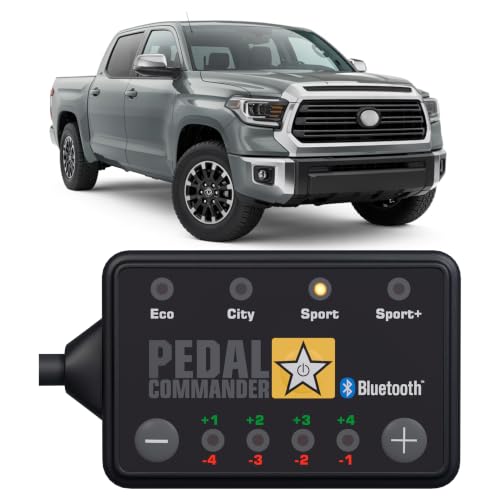
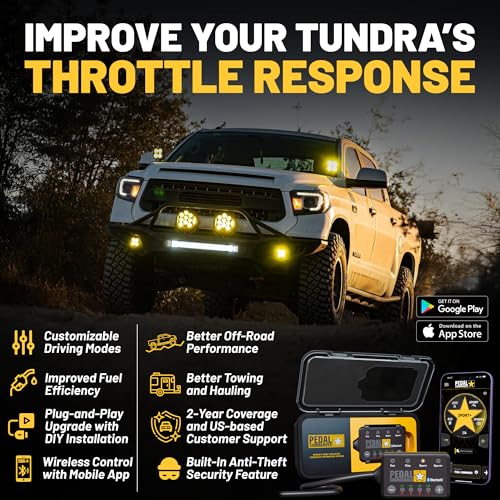
The Pedal Commander throttle response controller for the 2007–2021 Toyota Tundra is designed to change that relationship. It provides four driving modes, 36 sensitivity settings, app control, and a reversible plug-and-play installation.
It does not add horsepower.
It does not increase towing capacity.
It does not make a heavily loaded Tundra forget that the trailer still weighs several thousand pounds.
What it can do is make the truck feel more responsive when merging, passing, towing, hauling, or driving with larger tires and additional off-road equipment.
$299.99
What Is the Pedal Commander?
The Pedal Commander is an inline electronic throttle response controller.
It installs between the Tundra’s accelerator-pedal sensor and the factory wiring harness. Once connected, the device adjusts the electronic pedal signal according to the selected driving mode and sensitivity level.
The Pedal Commander changes:
- Accelerator-pedal sensitivity
- Partial-throttle response
- The relationship between pedal travel and throttle request
- How quickly the truck reacts to accelerator movement
- The perceived delay in the factory pedal calibration
It does not directly change:
- Peak horsepower
- Peak torque
- Fuel delivery
- Ignition timing
- Engine displacement
- Transmission gear ratios
- Axle gearing
- Towing ratings
- Payload ratings
The Tundra may feel stronger because less pedal movement can request more throttle.
That is not the same thing as increasing actual engine output.
The Pedal Commander should therefore be viewed as a drivability upgrade rather than a conventional power modification.
Compatible Toyota Tundra Models
According to the supplied product information, this Pedal Commander application is compatible with 2007–2021 Toyota Tundra models, including:
- SR5
- Limited
- Platinum
- 1794 Edition
- TRD Pro
- TRD Sport
- TRD Off-Road
The supplied compatibility information includes Tundra models equipped with:
- 4.0-liter engine
- 4.6-liter engine
- 4.7-liter engine
- 5.7-liter engine
Engine availability, trim names, pedal connectors, and electronic systems vary across the Tundra’s long production run.
Owners should verify the exact Pedal Commander part number using their truck’s:
- Model year
- Engine
- Trim
- Transmission
- Accelerator-pedal connector
- Market configuration
A 2007 work-spec Tundra and a 2021 TRD Pro may share the same basic generation, but ordering an electronic component based only on the tailgate badge is an efficient way to meet your retailer’s returns department.
Exact fitment should always be confirmed before purchase.
Why Does the Toyota Tundra Have Throttle Lag?
The Toyota Tundra uses electronic throttle control.
When the driver presses the accelerator, the pedal sends an electronic signal to the truck’s engine-control system. The computer then decides how quickly to open the throttle.
Toyota calibrates that response to balance:
- Smooth acceleration
- Emissions
- Fuel economy
- Traction control
- Transmission behavior
- Engine protection
- Driveline durability
- Towing stability
- Passenger comfort
That calibration can produce a softer initial response than some drivers expect, especially in a truck equipped with a large-displacement V8.
The hesitation may feel more noticeable when the Tundra is:
- Towing a trailer
- Carrying a heavy payload
- Climbing a grade
- Running larger tires
- Equipped with heavy bumpers
- Carrying overlanding equipment
- Merging into fast traffic
- Passing at highway speeds
You press the accelerator.
The Tundra receives the request.
It considers the engine, transmission, load, traction, trailer, tire size, and the camping equipment that somehow weighs twice as much as it did when you packed it.
Then it accelerates.
The Pedal Commander is designed to reduce that perceived delay by changing pedal sensitivity.
Four Driving Modes
The Pedal Commander offers four primary driving modes:
- Eco
- City
- Sport
- Sport+
Each mode changes how aggressively the Tundra responds to accelerator movement.
Eco Mode
Eco mode reduces throttle sensitivity.
It may be useful for:
- Daily commuting
- Wet or slippery roads
- Snow
- Heavy traffic
- Long highway trips
- Technical off-road driving
- Smooth towing
- Drivers who want more progressive pedal control
Eco mode does not reduce the engine’s maximum horsepower.
Instead, it requires more pedal travel to request the same throttle response.
That can help the driver apply power more gradually, which may be useful when towing, crawling over obstacles, or driving on low-traction surfaces.
Can Eco Mode Improve Fuel Economy?
Eco mode may encourage smoother acceleration, which can support more efficient driving habits.
It does not guarantee better fuel economy.
Actual mileage still depends on:
- Engine size
- Vehicle weight
- Tire pressure
- Tire size
- Trailer weight
- Driving speed
- Road grade
- Weather
- Driver behavior
Eco mode can make the pedal less sensitive.
It cannot convince a 5.7-liter V8 towing a travel trailer that gasoline has become optional.
City Mode
City mode provides a moderate increase in accelerator sensitivity.
It is intended for everyday driving situations such as:
- Commuting
- Stop-and-go traffic
- Urban driving
- Parking lots
- Highway merging
- Normal street use
For many Tundra owners, City mode may offer the best daily-driving balance.
The truck can feel more awake without becoming difficult to control at low speeds.
This may be especially helpful for Tundras running:
- Larger tires
- Heavier wheels
- Steel bumpers
- Winches
- Bed racks
- Toolboxes
- Overlanding equipment
City mode does not remove the added weight.
It can make the truck feel more responsive while carrying it.
Sport Mode
Sport mode delivers a stronger increase in throttle sensitivity.
It may improve the driving feel during:
- Highway merging
- Passing
- Climbing hills
- Towing
- Hauling
- Open-road acceleration
- Spirited street driving
- Sand or faster off-road terrain
Sport mode makes the engine react more aggressively to smaller accelerator inputs.
It does not create additional torque, but it can make the available torque feel easier to access.
For many owners, Sport mode may provide the most noticeable improvement without the extreme sensitivity of Sport+.
Sport+ Mode
Sport+ offers the most aggressive throttle response.
Small pedal movements can create a much stronger throttle request, making the Tundra react quickly during acceleration.
Sport+ may appeal to drivers who want:
- Maximum accelerator sensitivity
- Immediate street response
- Faster access to full throttle
- Aggressive highway acceleration
- A dramatic change from the stock pedal feel
This setting should be used carefully, especially:
- While towing
- On wet pavement
- In snow
- On loose dirt
- During rock crawling
- In heavy traffic
- In a powerful 5.7-liter Tundra
- On trucks with oversized tires
- On lifted trucks with altered handling
Maximum sensitivity is not automatically maximum performance.
A full-size pickup with V8 torque does not need the accelerator to behave like an on-off switch.
36 Adjustable Sensitivity Settings
The Pedal Commander offers nine sensitivity levels within each of its four driving modes.
That creates a total of 36 possible settings.
This allows the driver to fine-tune accelerator response rather than choosing only between the factory calibration and maximum sensitivity.
Possible examples include:
- Eco -3 for snow or technical trails
- Eco +1 for smoother towing
- City -1 for daily commuting
- City +3 for a Tundra with larger tires
- Sport -2 for highway driving
- Sport +2 for stronger passing response
- Sport+ at a lower level before trying the maximum setting
The ideal setting depends on:
- Engine
- Truck weight
- Tire diameter
- Tire weight
- Trailer weight
- Terrain
- Road conditions
- Weather
- Driver preference
A setting that feels ideal in an unloaded 4.6-liter Tundra may feel unnecessarily aggressive in a 5.7-liter truck towing a camper.
The ability to make small adjustments is one of the product’s strongest features.
Smartphone App Control
The Pedal Commander can be adjusted through a compatible smartphone application.
Depending on the product version and supported app features, the driver may be able to:
- Change driving modes
- Adjust sensitivity
- View the selected setting
- Store preferred configurations
- Control the device without reaching toward the footwell
App control is useful because the physical controller is normally mounted near the accelerator-pedal area.
Drivers should only make adjustments while parked or when it is otherwise safe.
The app makes changing settings convenient.
It does not make changing settings halfway through a highway passing maneuver a good idea.
Pedal Commander for the 4.0-Liter Tundra
According to the supplied compatibility information, the Pedal Commander supports applicable Tundra models equipped with the 4.0-liter engine.
A sharper throttle curve may make these trucks feel:
- More responsive from a stop
- More alert in traffic
- Quicker during highway merging
- Less hesitant during passing
- More engaging during everyday driving
The controller does not add horsepower or torque.
It changes how quickly the driver requests the engine’s available output.
Owners should verify exact model-year and engine compatibility before ordering.
Pedal Commander for the 4.6-Liter V8
The 4.6-liter V8 provides a balance between everyday drivability and traditional V8 performance.
The Pedal Commander may make a 4.6-liter Tundra feel:
- Quicker to react at partial throttle
- More responsive during merging
- Less soft when pulling away
- Stronger during normal passing
- More immediate with additional truck accessories
It will not create the output of the larger 5.7-liter engine.
It can, however, make the existing power feel easier to access during everyday use.
Pedal Commander for the 4.7-Liter V8
The 4.7-liter V8 appeared in earlier second-generation Tundra models.
On compatible applications, the Pedal Commander can sharpen accelerator response without performing a conventional ECU tune.
Potential improvements in driving feel may include:
- Reduced perceived pedal delay
- More immediate partial-throttle acceleration
- Sharper highway response
- Better pedal feel while carrying a load
The controller does not increase the engine’s maximum output.
It simply changes the pedal-response curve.
Exact fitment should be verified carefully because earlier model years may use different connectors or electronic configurations.
Pedal Commander for the 5.7-Liter V8
The 5.7-liter V8 is the engine most commonly associated with the second-generation Tundra’s towing and performance capability.
It already provides strong horsepower and torque.
The Pedal Commander can make that power feel more immediate by sharpening accelerator response.
Potential benefits include:
- More responsive highway merging
- Faster-feeling passing response
- Stronger partial-throttle acceleration
- Sharper response when towing
- More immediate pedal feel with larger tires
However, owners should increase sensitivity gradually.
The 5.7-liter V8 already has enough torque to create wheelspin or abrupt weight transfer under poor conditions.
A moderate City or Sport setting may be more useful than maximum Sport+.
The engine is not waiting for motivation.
It is waiting for traction.
Pedal Commander for Towing
The Toyota Tundra is frequently used to tow:
- Travel trailers
- Campers
- Boats
- Utility trailers
- Car trailers
- Equipment trailers
- Off-road trailers
A sharper pedal response may make the truck feel more confident during:
- Highway merging
- Passing
- Pulling away from a stop
- Climbing grades
- Maintaining speed under load
The Pedal Commander does not increase the Tundra’s official towing capacity.
It does not change:
- Frame strength
- Brake capacity
- Hitch rating
- Cooling-system capability
- Axle ratings
- Gross combined weight rating
- Payload limits
It only changes throttle response.
Best Pedal Commander Mode for Towing
City or a moderate Sport setting may provide the best balance for many drivers.
Sport+ may be too sensitive when towing because abrupt throttle requests can cause:
- Harsh acceleration
- Extra transmission shifting
- Trailer movement
- Reduced traction
- Increased fuel consumption
- Less comfortable load control
A smooth and predictable pedal is usually more useful than maximum sensitivity.
The trailer does not care how sporty the throttle feels.
It cares whether the truck remains stable.
Pedal Commander for Hauling
A loaded Tundra can feel slower to respond, particularly when carrying:
- Construction materials
- Tools
- Landscaping supplies
- Firewood
- Camping equipment
- Spare parts
- Work gear
The Pedal Commander cannot reduce payload weight or increase engine output.
It can make the truck feel more responsive by requesting more throttle with less pedal travel.
That may be useful while:
- Entering traffic
- Climbing hills
- Passing
- Driving with a full bed
- Operating a heavily accessorized work truck
A moderate setting is generally more practical than maximum sensitivity.
The goal is to improve response without making unsecured cargo learn about weight transfer.
Pedal Commander for TRD Pro and TRD Off-Road Models
TRD Pro and TRD Off-Road Tundra models are built for drivers who regularly leave paved roads.
The Pedal Commander’s adjustable modes can be useful because different terrain benefits from different pedal behavior.
Rock Crawling
Eco mode may offer smoother low-speed control.
A softer pedal can help reduce:
- Sudden wheelspin
- Abrupt vehicle movement
- Lurching over obstacles
- Unwanted throttle spikes
Sand
A moderate Sport setting may make it easier to maintain momentum.
Too much sensitivity can still make precise control more difficult.
Mud
The correct setting depends on traction, tire choice, and the need to maintain momentum.
Excessive sensitivity may cause unnecessary wheelspin.
Fire Roads and Open Trails
City or Sport mode may make the truck feel more responsive during elevation changes and changing speeds.
Snow and Ice
Eco mode can make power easier to apply gradually.
The Pedal Commander does not improve traction.
It simply changes how easily the driver can manage the traction already available.
Pedal Commander for Overlanding
Overlanding builds often add considerable weight through:
- Bed racks
- Rooftop tents
- Camp kitchens
- Recovery equipment
- Auxiliary fuel
- Water storage
- Steel bumpers
- Skid plates
- Larger tires
That extra equipment can make the Tundra feel less responsive.
The Pedal Commander may improve perceived acceleration by sharpening the pedal-response curve.
It will not compensate mechanically for:
- Added vehicle mass
- Increased aerodynamic drag
- Larger tire diameter
- Heavier wheels
- Incorrect axle gearing
However, it can make the truck feel more alert during highway travel, passing, and hill climbing.
The product may therefore be useful for drivers who want adjustable response without permanently changing the factory ECU calibration.
Pedal Commander With Larger Tires
Larger tires are a common Tundra modification.
They can improve:
- Ground clearance
- Off-road traction
- Tire durability
- Obstacle clearance
- Appearance
They can also increase rotational mass and effectively alter the truck’s gearing.
That may make acceleration feel softer, especially if axle ratios have not been changed to match the new tire diameter.
The Pedal Commander can improve perceived response by requesting throttle more aggressively.
It does not change:
- Axle ratios
- Tire weight
- Tire diameter
- Transmission gearing
- Engine output
- Vehicle mass
If a Tundra with oversized tires feels mechanically undergeared, proper axle gearing may still be the correct solution.
The Pedal Commander can make the pedal feel sharper.
It cannot renegotiate the laws of leverage.
Pedal Commander With Intakes and Exhaust Systems
A throttle controller can be used alongside many common Tundra modifications, including:
- Cold air intakes
- Performance air filters
- Cat-back exhaust systems
- Headers
- Performance mufflers
- Lift kits
- Larger wheels and tires
- Off-road accessories
These upgrades perform different jobs.
An intake or exhaust may change airflow and sound.
A lift kit changes suspension height and tire clearance.
The Pedal Commander changes accelerator sensitivity.
It does not increase the horsepower produced by another modification, but it may make the engine and exhaust react more immediately during acceleration.
It does not create more V8 sound.
It simply helps the driver request it sooner.
Fast Plug-and-Play Installation
The supplied product information describes an installation time of approximately 15 minutes.
The Pedal Commander connects at the Tundra’s accelerator-pedal harness.
A typical installation process includes:
- Park the Tundra securely.
- Turn off the engine.
- Keep the key or key fob away from the truck.
- Allow the electrical system to power down.
- Locate the accelerator-pedal connector.
- Disconnect the factory wiring harness.
- Connect the Pedal Commander inline.
- Mount the controller securely.
- Route all wiring away from the pedals.
- Pair the controller with the mobile app.
- Select a conservative initial setting.
- Test the system before normal driving.
The installation does not normally require:
- Cutting wires
- Soldering
- ECU flashing
- Drilling
- Engine disassembly
- Permanent dashboard modifications
All wiring must be secured away from:
- Accelerator-pedal movement
- Brake-pedal travel
- Parking-brake components
- Steering components
- Driver foot movement
A loose cable near the pedals is not an unfinished cosmetic detail.
It is a safety concern that must be corrected before driving.
Does the Pedal Commander Leave an ECU Footprint?
The Pedal Commander is designed to operate without performing a conventional ECU software flash.
It modifies the accelerator-pedal signal through an inline connection rather than rewriting the truck’s factory engine calibration.
That makes it different from a tuner that may change:
- Fuel maps
- Ignition timing
- Torque management
- Transmission operation
- Rev limits
- Internal throttle mapping
- Cooling-fan settings
The controller is also designed to be removable.
However, owners should not interpret a reversible installation as an unconditional warranty guarantee.
Warranty decisions can depend on:
- The failed component
- Whether the accessory contributed to the issue
- Dealer findings
- Manufacturer policies
- Applicable consumer-protection laws
The most accurate description is that the Pedal Commander does not perform a traditional ECU reflash and can be physically removed.
Does the Pedal Commander Add Horsepower?
No.
The Pedal Commander does not increase:
- Horsepower
- Torque
- Fuel flow
- Airflow capacity
- Engine displacement
- Towing capacity
- Payload capacity
- Axle strength
- Transmission capability
It changes accelerator sensitivity.
The Tundra may feel faster because a smaller pedal movement produces a larger throttle request.
At full throttle, however, the engine still has the same maximum output it had before installation.
That means any claims about guaranteed faster acceleration should be treated carefully.
Actual performance depends on:
- Engine output
- Truck weight
- Trailer weight
- Tire size
- Tire grip
- Transmission behavior
- Road grade
- Weather
- Driver input
The Pedal Commander can change the response.
It cannot unload the trailer.
Pedal Commander Versus an ECU Tune
A throttle response controller and an ECU tune are different modifications.
Pedal Commander
The Pedal Commander changes:
- Accelerator sensitivity
- Partial-throttle response
- Perceived pedal delay
It generally does not change:
- Fuel delivery
- Ignition timing
- Peak horsepower
- Peak torque
- Transmission calibration
- Rev limits
ECU Tune
An ECU tune may change:
- Fuel maps
- Ignition timing
- Torque management
- Transmission behavior
- Cooling-fan operation
- Throttle mapping
- Rev limits
A properly calibrated tune may create actual power gains.
The Pedal Commander is primarily a reversible drivability modification.
It is intended for owners who want a different accelerator feel without rewriting factory engine-management software.
Advantages
- Sharper accelerator response
- Eco, City, Sport, and Sport+ modes
- 36 sensitivity settings
- Smartphone app control
- Plug-and-play installation
- Fully reversible design
- No conventional ECU flash
- Useful for towing and hauling
- Adjustable for off-road terrain
- Can improve perceived response with larger tires
- Compatible with multiple Tundra engines when properly matched
- Works alongside many common intake, exhaust, and suspension upgrades
Disadvantages
- Does not add horsepower
- Does not increase torque
- Does not increase towing capacity
- Does not increase payload capacity
- Sport+ may be too sensitive while towing
- Aggressive modes may reduce low-speed off-road precision
- Does not correct improper axle gearing
- Exact model-year and engine fitment must be confirmed
- Some drivers may prefer the factory throttle calibration
- It does not replace an ECU or transmission tune
Is the Pedal Commander Worth It for a Toyota Tundra?
The Pedal Commander makes the most sense for a Tundra owner who:
- Dislikes the factory accelerator response
- Wants sharper highway merging
- Regularly tows or hauls
- Runs larger tires
- Drives a heavily accessorized truck
- Wants adjustable response for different terrain
- Prefers a reversible modification
- Does not want an ECU flash
- Values drivability more than dyno numbers
It makes less sense for someone expecting:
- Additional horsepower
- More torque
- Increased towing capacity
- Increased payload capacity
- Guaranteed fuel-economy gains
- A substitute for axle regearing
- A replacement for an engine tune
- Guaranteed faster zero-to-60 times
The Pedal Commander is best viewed as a throttle-response and drivability upgrade.
It changes how quickly the Tundra reacts to accelerator movement.
It does not change what the engine, transmission, frame, or brakes can safely handle.
Final Thoughts
The 2007–2021 Toyota Tundra became popular because it combined traditional truck capability with long-term durability.
It could tow, haul, commute, explore, and keep doing those jobs long after some owners stopped remembering when they last made a truck payment.
The Pedal Commander does not add power to that formula.
It focuses on one specific area: accelerator response.
Eco mode can soften the pedal for slippery roads, technical trails, or smooth towing. City mode can sharpen daily driving. Sport can improve highway merging and grade climbing, while Sport+ provides the most aggressive pedal mapping.
The 36 sensitivity settings allow the driver to fine-tune the response rather than choosing only between factory behavior and maximum aggression.
It will not add horsepower.
It will not increase towing capacity.
It will not correct axle gearing on a lifted Tundra wearing tires large enough to require a climbing permit.
What it can do is make the truck feel more immediate without a conventional ECU tune or permanent modification.
For owners frustrated by a soft factory pedal, that may be enough to make a proven truck feel more responsive and better suited to the way it is actually used.
Frequently Asked Questions
Does the Pedal Commander add horsepower to a Toyota Tundra?
No. It changes accelerator-pedal sensitivity but does not increase peak horsepower or torque.
Which Toyota Tundra models are compatible?
According to the supplied product information, it works with compatible 2007–2021 Tundra models, including SR5, Limited, Platinum, 1794 Edition, TRD Pro, TRD Sport, and TRD Off-Road trims.
Which Tundra engines are supported?
The supplied compatibility information includes applicable 4.0-liter, 4.6-liter, 4.7-liter, and 5.7-liter engines. Exact fitment should be verified before ordering.
Is the Pedal Commander useful for towing?
It can make the accelerator feel more responsive while merging, passing, or climbing grades. It does not increase the truck’s towing capacity.
Does it help when hauling a heavy load?
It may improve perceived throttle response, but it does not reduce vehicle weight or add engine power.
Is it useful with larger tires?
It can sharpen pedal response, but it does not correct the mechanical gearing changes caused by oversized tires.
Is the Pedal Commander good for off-road driving?
The adjustable modes can be useful off road. Eco may provide smoother control on technical terrain, while City or Sport may improve response on open trails.
How many settings does the Pedal Commander have?
It offers four driving modes with nine sensitivity levels in each mode, creating 36 settings.
Does it require an ECU tune?
No. It connects at the accelerator-pedal harness and does not perform a conventional ECU software flash.
How long does installation take?
The supplied product information estimates approximately 15 minutes, although access and connector difficulty may vary.
Can the Pedal Commander be removed?
Yes. The inline plug-and-play installation is designed to be reversible.
Which mode is best for towing?
City or a moderate Sport setting may offer the best balance between responsiveness and smooth control. The ideal setting depends on the trailer, terrain, and driver preference.
Specification: Pedal Commander for 2007–2021 Toyota Tundra: Sharper Throttle Response for Towing, Hauling, and Off-Road Driving
|
User Reviews
Be the first to review “Pedal Commander for 2007–2021 Toyota Tundra: Sharper Throttle Response for Towing, Hauling, and Off-Road Driving”
You must be logged in to post a review.



There are no reviews yet.