
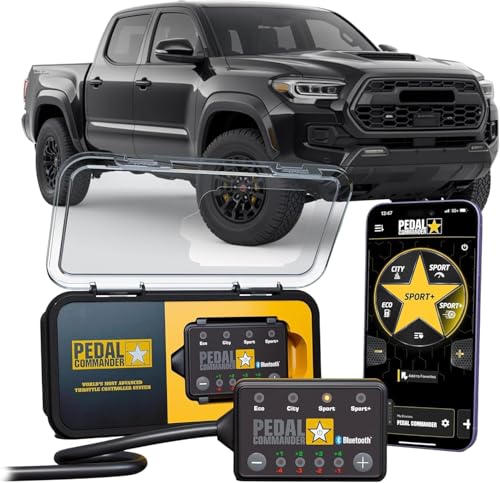


Pedal Commander for 2005–2023 Toyota Tacoma: Better Throttle Response for Lifted Trucks, Larger Tires, and Off-Road Driving
The 2005–2023 Toyota Tacoma earned its reputation by being durable, capable, and almost comically resistant to depreciation.
It also developed a reputation for something less flattering: an electronic accelerator that can feel disconnected from the driver’s right foot.
That complaint can become more noticeable after adding:
- Larger all-terrain or mud-terrain tires
- Heavier aftermarket wheels
- A suspension lift
- Steel bumpers
- Skid plates
- Rock sliders
- A winch
- Bed racks
- Rooftop tents
- Camping and recovery equipment
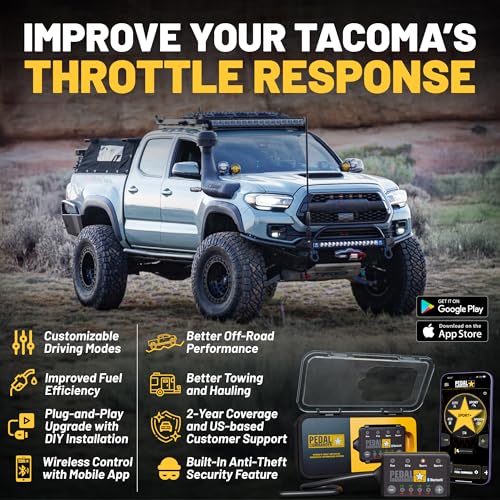
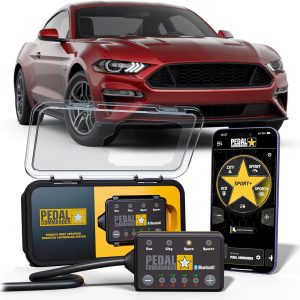
The Pedal Commander throttle response controller for the 2005–2023 Toyota Tacoma is designed to change how quickly the truck reacts to accelerator input.
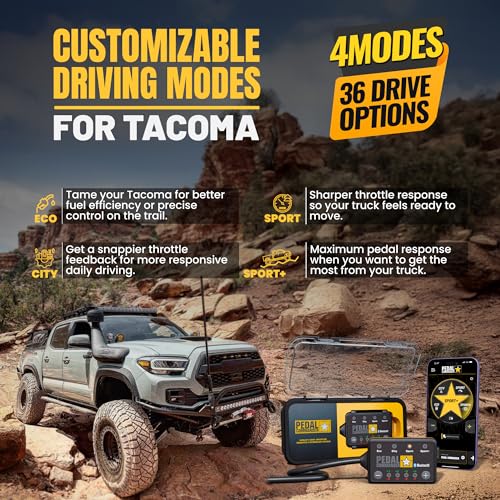
It connects inline with the accelerator-pedal sensor and provides four driving modes—Eco, City, Sport, and Sport+—with nine sensitivity levels in each mode. That creates 36 available throttle-response settings. Pedal Commander currently lists separate Tacoma fitments for second-generation 2005–2015 trucks with 2.7-liter and 4.0-liter engines and third-generation 2015–2023 trucks with 2.7-liter and 3.5-liter engines.
The controller also supports wireless app operation and an optional subscription-based Anti-Theft feature.
It does not add horsepower.
It does not increase torque.
It does not correct axle gearing.
It does not recover power supposedly “lost” to a lift kit or larger tires.
What it can do is make the Tacoma feel more responsive during daily driving, highway merging, towing, trail use, and operation with heavier aftermarket equipment.
$299.99
What Is the Pedal Commander?
The Pedal Commander is an inline electronic throttle-response controller.
A modern Tacoma uses an electronic drive-by-wire accelerator rather than a physical cable connecting the pedal directly to the throttle body. When the driver presses the accelerator, the pedal-position sensor sends a request to the truck’s control system.
The engine computer then decides how to respond based on factors such as:
- Pedal position
- Engine speed
- Transmission gear
- Vehicle speed
- Traction-control activity
- Engine temperature
- Emissions strategy
- Requested torque
- Stability-control intervention
The Pedal Commander installs between the accelerator pedal and its factory wiring harness. It modifies the pedal signal according to the selected mode and sensitivity level.
It changes:
- Accelerator sensitivity
- Partial-throttle response
- The pedal movement required to request acceleration
- The perceived hesitation after pressing the pedal
- How gradual or aggressive the accelerator feels
It does not directly change:
- Peak horsepower
- Peak torque
- Fuel-injection mapping
- Ignition timing
- Transmission shift programming
- Axle ratios
- Towing capacity
- Payload capacity
- Engine displacement
The Tacoma can feel faster because less pedal movement requests a stronger throttle response.
That is not the same as making more power.
Toyota Tacoma Compatibility
The supplied listing describes compatibility with 2005–2023 Toyota Tacoma models, including:
- SR
- SR5
- TRD Sport
- TRD Off-Road
- TRD Pro
- Limited
The listing also names:
- 2.7-liter four-cylinder
- 3.5-liter V6
- 4.0-liter V6
Those engines are correct for the two generations covered, but they were not offered during the same years.
Second-Generation Tacoma: 2005–2015
The second-generation Tacoma used:
- 2.7-liter four-cylinder
- 4.0-liter V6
Pedal Commander currently lists a dedicated second-generation Tacoma application covering 2005–2015 trucks with those engines.
Third-Generation Tacoma: 2016–2023
The third-generation Tacoma used:
- 2.7-liter four-cylinder
- 3.5-liter V6
Toyota’s official 2023 Tacoma documentation lists the 2.7-liter engine at 159 horsepower and 180 pound-feet of torque, while the 3.5-liter V6 produced 278 horsepower and 265 pound-feet.
Pedal Commander’s current fitment information also separates these trucks into a third-generation 2.7-liter and 3.5-liter application.
Important Model-Year Detail
Some fitment databases describe the third generation as beginning in 2015 because production or application dates can overlap. In the U.S. market, however, the redesigned third-generation Tacoma was introduced for the 2016 model year.
Buyers should order by:
- Exact model year
- Engine
- Pedal connector
- Drivetrain
- Transmission
- Market specification
- Pedal Commander part number
A 2005 Tacoma and a 2023 Tacoma may share a name and a talent for surviving abuse.
They do not share the same engine or electronic architecture.
Why Does the Tacoma Have Throttle Lag?
Toyota’s factory throttle calibration is designed to balance:
- Smooth acceleration
- Fuel economy
- Emissions compliance
- Traction
- Transmission behavior
- Driveline protection
- Low-speed control
- Passenger comfort
That balance can produce a softened initial accelerator response.
The delay may feel more noticeable when the Tacoma is:
- Starting from a stop
- Entering fast-moving traffic
- Passing at highway speed
- Climbing a grade
- Pulling a trailer
- Carrying camping equipment
- Running heavier tires
- Equipped with aftermarket armor
- Operating at higher elevation
You press the pedal.
The Tacoma consults the engine, transmission, traction system, road conditions, tire weight, camping load, and the collection of recovery equipment carried specifically because nobody trusts the other vehicles on the trail.
Then it responds.
The Pedal Commander changes the pedal curve so that the truck reacts more strongly to a smaller amount of accelerator movement.
Four Pedal Commander Driving Modes
Pedal Commander provides four modes:
- Eco
- City
- Sport
- Sport+
Each mode includes nine sensitivity settings for a total of 36 combinations.
Eco Mode
Eco mode softens accelerator response.
The driver must move the pedal farther to request the same level of acceleration, creating a smoother and more progressive feel.
Eco mode may be useful for:
- Rock crawling
- Technical trails
- Snow and ice
- Wet pavement
- Trailer backing
- Stop-and-go traffic
- Crowded campsites
- Low-speed parking
- Drivers who prefer gentle response
Eco mode does not reduce the engine’s maximum available output.
It changes how gradually that output is requested.
Can Eco Mode Improve Fuel Economy?
Eco mode may help drivers accelerate more smoothly and avoid unnecessary throttle inputs.
That could support better fuel economy, but it does not guarantee a measurable improvement.
Actual mileage still depends on:
- Engine
- Tire size
- Tire pressure
- Vehicle weight
- Roof racks
- Payload
- Trailer weight
- Road grade
- Wind
- Driving speed
- Driver behavior
Eco mode can calm the accelerator.
It cannot make a lifted Tacoma with 35-inch tires, a rooftop tent, traction boards, and six fuel cans suddenly become an efficiency vehicle.
City Mode
City mode provides a moderate increase in accelerator sensitivity.
It is suited to:
- Daily commuting
- Urban traffic
- Stop-and-go driving
- Highway merging
- General street use
- Light towing
- Trucks carrying permanent equipment
For many Tacoma owners, City mode may provide the best everyday balance.
It can make the truck feel more alert without producing the abrupt pedal behavior associated with aggressive Sport+ settings.
City mode may be particularly useful on Tacomas equipped with:
- Bed racks
- Camper shells
- Toolboxes
- Steel bumpers
- Winches
- Recovery equipment
- Larger all-terrain tires
- Skid plates
The controller cannot remove the weight.
It can make the truck feel less hesitant while moving it.
Sport Mode
Sport mode delivers a stronger increase in pedal sensitivity.
It may improve the driving feel during:
- Highway merging
- Passing
- Grade climbing
- Open-road driving
- Moderate towing
- Driving with larger tires
- Faster dirt-road travel
Sport mode requests a stronger response from less pedal movement.
It does not add horsepower or torque, but it can make the Tacoma’s existing output feel easier to access during partial-throttle driving.
For many drivers, a moderate Sport setting may deliver the most noticeable useful improvement.
Sport+ Mode
Sport+ provides the most aggressive accelerator response.
A small pedal movement can request a significantly stronger throttle response, making the Tacoma feel much sharper than stock.
Sport+ may appeal to drivers looking for:
- Maximum pedal sensitivity
- Immediate partial-throttle response
- Faster access to full throttle
- Aggressive unloaded street driving
- A dramatic change from the factory pedal map
Sport+ should be used carefully during:
- Technical off-road driving
- Rain or snow
- Loose gravel
- Mud
- Trailer maneuvering
- Low-speed parking
- Driving with unsecured cargo
The supplied listing says the controller can “make your engine roar.”
That is possible in the sense that an aggressive pedal curve may cause the engine to rev more quickly.
It does not increase engine output.
Sport+ is maximum sensitivity, not additional horsepower.
On a technical trail, the best throttle setting is often the one that prevents the truck from launching itself over the obstacle the driver intended to crawl across.
Understanding the 36 Settings
Each of the four modes offers nine adjustment levels.
That allows drivers to fine-tune pedal behavior rather than choosing only between factory response and maximum aggression.
Possible starting points include:
- Eco -4 for snow
- Eco -2 for rock crawling
- City -1 for commuting
- City +2 for a truck carrying permanent equipment
- Sport -2 for highway driving
- Sport +1 for stronger passing response
- A low Sport+ level before trying maximum sensitivity
The ideal setting depends on:
- Engine
- Transmission
- Tire size
- Axle ratio
- Vehicle weight
- Payload
- Trailer weight
- Terrain
- Weather
- Driver preference
A setting that feels appropriate in a 2.7-liter four-cylinder truck may feel unnecessarily sensitive in a lightly loaded 4.0-liter or 3.5-liter V6 Tacoma.
The correct setting is the one that remains predictable.
Not necessarily the one that causes the passenger to immediately ask what was changed.
Wireless Smartphone App Control
Supported Pedal Commander controllers can be adjusted through the company’s mobile app.
The app may allow the driver to:
- Change modes
- Adjust sensitivity
- View the active setting
- Access supported Anti-Theft features
- Control the module without reaching under the dashboard
Pedal Commander currently advertises wireless control and app-based Anti-Theft functionality for its Tacoma controller.
Settings should be changed while parked.
Being able to adjust throttle response from a phone is useful.
Trying to select Sport+ while approaching a rocky climb merely creates a second obstacle inside the cab.
Pedal Commander Anti-Theft Mode
The optional Anti-Theft feature is designed to disable normal accelerator response through the mobile app.
Pedal Commander currently advertises:
- A 14-day free trial
- $0.99 per month
- $9.99 per year
When activated, the feature restricts the accelerator signal so the vehicle cannot be driven normally.
Anti-Theft may provide an additional security layer when the Tacoma is parked at:
- Trailheads
- Hotels
- Campsites
- Worksites
- Airport parking
- Remote locations
- Long-term storage facilities
It should not be treated as a complete theft-prevention system.
It does not replace:
- The factory immobilizer
- Secure key storage
- An alarm
- GPS tracking
- Steering-wheel locks
- Physical parking barriers
- Secure gear storage
Disabling the accelerator may prevent someone from driving away normally.
It does not prevent towing, key theft, physical entry, or every electronic attack.
Pedal Commander for the 2.7-Liter Tacoma
The naturally aspirated 2.7-liter four-cylinder was offered in both second- and third-generation Tacomas.
In the 2023 Tacoma, Toyota rated the engine at 159 horsepower and 180 pound-feet of torque.
A Pedal Commander may make a 2.7-liter Tacoma feel:
- More responsive from a stop
- Sharper in city traffic
- Less hesitant during highway merging
- More immediate with a light load
- More alert at partial throttle
It does not add horsepower.
It does not give the four-cylinder the output of the V6.
It changes how quickly the driver requests the power already available.
That distinction is especially important on a loaded or lifted 2.7-liter truck. A more sensitive pedal can improve the driving feel, but it cannot overcome the engine’s actual output or the mechanical effects of heavier tires.
Pedal Commander for the 4.0-Liter V6 Tacoma
The 4.0-liter V6 powered second-generation Tacoma trucks from 2005 through 2015.
A compatible Pedal Commander may make the 4.0-liter Tacoma feel:
- More immediate at partial throttle
- Sharper while passing
- More responsive during highway entry
- Less softened while towing
- More alert with larger tires
The controller does not increase the 4.0-liter engine’s horsepower or torque.
It changes the accelerator curve.
The 4.0-liter already provides relatively strong low- and midrange response, so drivers should increase sensitivity gradually.
City or a moderate Sport setting may provide a better everyday result than maximum Sport+.
The 4.0 does not need to become more dramatic.
It merely needs the accelerator to communicate without placing every request on hold.
Pedal Commander for the 3.5-Liter V6 Tacoma
The 3.5-liter V6 powered third-generation Tacomas from 2016 through 2023.
Toyota rated the 2023 version at 278 horsepower and 265 pound-feet of torque.
A Pedal Commander may make the 3.5-liter Tacoma feel:
- More responsive at lower speeds
- Sharper during merging
- Quicker to react during passing
- Less hesitant while climbing grades
- More immediate with passengers or cargo
It does not change:
- Horsepower
- Torque
- Fuel mapping
- Ignition timing
- Transmission programming
- Variable valve timing
- Towing capacity
Third-generation Tacoma owners sometimes describe the 3.5-liter and automatic transmission combination as requiring substantial pedal input before the truck feels motivated.
The controller may reduce that sensation by requesting more throttle earlier in the pedal travel.
It does not rewrite the transmission or create additional low-rpm torque.
Does It Fix Third-Generation Tacoma Gear Hunting?
No.
The Pedal Commander changes accelerator sensitivity, not transmission programming.
A third-generation automatic Tacoma may still:
- Downshift on grades
- Hunt between gears
- Hold a lower gear
- Respond to load and road conditions
- Follow Toyota’s factory shift logic
A more aggressive pedal setting could even request stronger acceleration more frequently, potentially causing additional downshifts.
Owners specifically trying to change shift points or transmission behavior may need to investigate:
- Factory ECU updates
- Transmission tuning
- Regearing
- Tire-size correction
- Mechanical diagnosis
The Pedal Commander can make the accelerator feel more immediate.
It cannot turn the transmission into a different transmission.
Pedal Commander for the Tacoma SR and SR5
SR and SR5 Tacomas are commonly used as:
- Daily drivers
- Fleet vehicles
- Work trucks
- Light tow vehicles
- Weekend trail trucks
- Affordable modification platforms
A Pedal Commander may improve the perceived response during:
- City driving
- Highway entry
- Passing
- Light hauling
- Driving with larger tires
- Operating with a camper shell or bed rack
City mode may offer the best everyday balance for most SR and SR5 owners.
Sport may be useful for highway driving, while Eco can provide smoother control in poor weather or on slow trails.
Pedal Commander for the Tacoma TRD Sport
The TRD Sport is generally aimed more toward road use than technical trail driving.
A Pedal Commander may complement that character by making the truck feel:
- Sharper in city traffic
- More immediate while passing
- More responsive from a stop
- Less softened during highway driving
Sport mode may appeal to TRD Sport owners, but maximum Sport+ is not automatically the best setting.
A moderate increase often provides a more natural response without making parking-lot driving unnecessarily abrupt.
The TRD badge does not require every setting to be turned to maximum.
Toyota did not include a points system.
Pedal Commander for the Tacoma TRD Off-Road
The TRD Off-Road combines daily usability with features designed for trail driving.
Depending on the model year, those features may include:
- Locking rear differential
- Off-road suspension
- Terrain-management systems
- Crawl-control technology
- Skid plates
- All-terrain tires
A Pedal Commander can give the driver additional control over accelerator sensitivity.
Possible starting points include:
- Eco for rocks and technical terrain
- City for mixed street and trail use
- Mild Sport for open dirt roads
- Sport+ only where traction and space support aggressive response
For technical terrain, the ability to soften the accelerator may be more valuable than making it sharper.
Precision is usually more useful than drama when the truck is balanced against an obstacle and everyone outside is shouting different instructions.
Pedal Commander for the Tacoma TRD Pro
The TRD Pro is the most aggressively equipped off-road Tacoma trim in the 2005–2023 range.
A Pedal Commander may help owners tailor accelerator behavior for:
- Street driving
- High-speed dirt roads
- Slow rocky trails
- Sand
- Snow
- Mud
Eco mode may improve low-speed precision.
City or Sport may make the truck feel more alert on the road.
Sport+ may provide very aggressive response, but it should be used cautiously on loose surfaces.
The TRD Pro already has suspension, tires, and off-road equipment intended to improve capability.
The Pedal Commander does not add traction or suspension travel.
It only changes how quickly the driver requests engine response.
Pedal Commander for the Tacoma Limited
The Tacoma Limited emphasizes comfort and street use more than serious off-road driving.
A Pedal Commander may appeal to Limited owners wanting:
- Better daily response
- Sharper highway merging
- More immediate passing
- Improved pedal feel with passengers or cargo
- Adjustable sensitivity for poor weather
City mode may be the most practical everyday choice.
Sport may provide a stronger highway response.
The controller will not turn a Limited into a TRD Pro.
It may, however, make the accelerator feel as though it has finished reading the request before responding.
Pedal Commander for Lifted Tacomas
Lift kits are among the most common Tacoma modifications.
They can improve:
- Ground clearance
- Tire clearance
- Approach and departure angles
- Breakover clearance
- Off-road capability
- Appearance
A lift can also contribute to:
- Increased aerodynamic drag
- Higher center of gravity
- Additional suspension weight
- Alignment changes
- Reduced fuel economy
The Pedal Commander may make a lifted Tacoma feel more responsive.
It does not mechanically compensate for the lift.
It cannot:
- Lower the center of gravity
- Reduce aerodynamic drag
- Improve suspension geometry
- Correct alignment
- Increase engine output
- Increase payload capacity
It changes pedal response only.
Pedal Commander With Larger Tires
Oversized tires can make a Tacoma feel slower because they increase:
- Tire diameter
- Rotational mass
- Unsprung weight
- Effective gearing
- Rolling resistance
A Pedal Commander may improve the perceived response by requesting greater throttle from less pedal movement.
It does not correct:
- Effective axle ratio
- Tire weight
- Speedometer error
- Transmission behavior
- Actual acceleration loss
- Increased braking demand
If the truck feels genuinely undergeared, axle regearing may still be the correct solution.
The controller can sharpen the accelerator.
It cannot convince a 35-inch mud tire that it weighs the same as the original equipment tire.
Can It Restore Power Lost to Larger Tires?
No.
Larger tires can reduce acceleration because they alter effective gearing and increase rotational mass.
The Pedal Commander does not restore that mechanical loss.
It may make the truck feel more responsive because the driver reaches a greater throttle request sooner.
That is a change in pedal sensitivity, not recovered horsepower.
Owners should be suspicious of any claim suggesting that a throttle controller can reverse the mechanical effects of wheel diameter, tire weight, or incorrect gearing.
Physics has been presented with many marketing claims.
It remains unmoved.
Steel Bumpers, Winches, Sliders, and Skid Plates
Tacoma owners frequently install:
- Steel front bumpers
- Rear swing-out bumpers
- Winches
- Rock sliders
- Skid plates
- Bed racks
- Camper shells
- Rooftop tents
These modifications add weight.
A Pedal Commander may make the truck feel more responsive while carrying that equipment, but it cannot:
- Remove the added mass
- Increase payload capacity
- Strengthen the frame
- Improve braking
- Correct suspension sag
- Increase horsepower
- Reduce aerodynamic drag
Owners should continue to calculate payload carefully.
That includes:
- Passengers
- Cargo
- Accessories
- Camper weight
- Trailer tongue weight
- Fuel and water
- Recovery equipment
A sharper pedal does not make an overloaded truck safer.
It only makes the overloaded truck respond more quickly when the accelerator is pressed.
Pedal Commander for Towing
Tacoma owners may tow:
- Small travel trailers
- Boats
- Utility trailers
- Off-road campers
- Motorcycle trailers
- Lightweight car trailers
A sharper accelerator may improve the truck’s feel during:
- Highway merging
- Pulling away from a stop
- Grade climbing
- Rejoining traffic
- Passing
It does not increase the Tacoma’s tow rating.
Toyota listed a maximum towing capacity of up to 6,800 pounds for certain properly configured 2023 V6 Tacoma models, but actual capacity depends on the exact configuration.
The Pedal Commander does not change:
- Gross combined weight rating
- Hitch rating
- Axle ratings
- Brake capacity
- Cooling capacity
- Tire ratings
- Payload
- Trailer-sway limitations
Best Pedal Commander Setting for Towing
City or a moderate Sport setting may provide the best balance for many drivers.
Sport+ may be too sensitive because it can contribute to:
- Abrupt starts
- Trailer surging
- Unnecessary downshifts
- Cargo movement
- Reduced traction
- Less precise backing
- Greater fuel consumption
Smooth response matters more than maximum sensitivity.
The trailer does not care whether the accelerator feels exciting.
It cares whether the contents arrive in roughly the same arrangement in which they departed.
Pedal Commander for Off-Road Driving
Different terrain benefits from different accelerator behavior.
Rock Crawling
Eco mode can soften the pedal and improve low-speed precision.
That may reduce:
- Sudden wheelspin
- Lurching
- Abrupt weight transfer
- Unwanted throttle spikes
Dirt Roads
City or a mild Sport setting may provide quicker response while remaining manageable.
Mud
Excessive sensitivity can create unnecessary wheelspin.
A moderate setting may be more effective than maximum Sport+.
Sand
Stronger response may help preserve momentum, but abrupt throttle can still cause the truck to dig.
Snow and Ice
Eco mode may help the driver apply power more gradually.
The Pedal Commander does not create traction.
It changes how the driver requests the torque available at the tires.
Plug-and-Play Installation
The supplied listing describes a roughly 15-minute installation without cutting wires or making permanent changes.
A typical installation involves:
- Park the Tacoma securely.
- Turn off the engine.
- Remove the key or move the key fob away.
- Allow the electrical system to power down.
- Locate the accelerator-pedal connector.
- Disconnect the factory harness.
- Connect the Pedal Commander inline.
- Confirm that both connectors are fully seated.
- Secure the module and wiring.
- Keep the harness away from pedal travel.
- Pair the controller with the app.
- Begin with a conservative setting.
- Test operation before driving normally.
Installation generally does not require:
- Cutting wires
- Soldering
- Drilling
- ECU flashing
- Engine disassembly
- Permanent dashboard modifications
- Use of the OBD-II port
Pedal Commander describes its system as using an OEM-style harness connected directly to the accelerator pedal.
All wiring must remain clear of:
- Accelerator movement
- Brake-pedal travel
- Clutch-pedal travel on manual trucks
- Parking-brake components
- Steering hardware
- Driver footwear
A loose cable beside the pedals is not a minor installation issue.
It is a safety problem.
Manual-Transmission Tacoma Considerations
Some 2005–2023 Tacoma configurations were available with manual transmissions.
A throttle controller can change accelerator sensitivity, but it does not change:
- Clutch engagement
- Flywheel weight
- Gear ratios
- Synchronizer condition
- Rev-hang behavior
- Driver technique
An aggressive Sport+ setting may make smooth clutch engagement more difficult because a small pedal movement requests a stronger engine response.
Manual-transmission owners should begin with a conservative City or low Sport setting.
A sharper throttle can make rev matching feel more immediate.
It can also make every imperfect clutch release more visible to everyone in the parking lot.
Does the Pedal Commander Alter the ECU?
The Pedal Commander does not perform a conventional ECU software flash.
It changes the pedal signal received by the vehicle rather than rewriting the factory calibration. Pedal Commander describes the device as modifying accelerator input while leaving the ECU’s own programming and factory safety logic in place.
It does not normally change:
- Fuel maps
- Ignition timing
- Variable valve timing
- Transmission programming
- Emissions calibration
- Rev limits
- Engine-protection logic
The module is designed to be removable.
However, claims that it will always leave “no trace” or can never cause a diagnostic code should be treated carefully.
A fault could potentially occur because of:
- An incompletely seated connector
- Installation before the vehicle powers down
- Damaged wiring
- Corrosion
- Incorrect fitment
- Hardware failure
- Improper removal
The accurate claim is that the controller does not perform a conventional ECU reflash.
That is different from saying no electronic accessory could ever contribute to a fault.
Does Pedal Commander Preserve the Factory Warranty?
Pedal Commander states that its controller does not void the manufacturer’s warranty because it does not occupy the OBD-II port or rewrite the ECU.
Actual warranty decisions can be more nuanced.
A dealer or manufacturer may consider:
- Which component failed
- Whether the controller contributed
- Installation quality
- Diagnostic findings
- Other modifications
- Applicable consumer-protection laws
The reversible design and lack of an ECU flash may create fewer concerns than a conventional engine tune.
That does not guarantee approval of every future warranty claim.
The responsible description is that the controller does not rewrite Toyota’s factory engine software.
Does the Pedal Commander Add Horsepower?
No.
The Pedal Commander does not increase:
- Horsepower
- Torque
- Airflow
- Fuel delivery
- Compression
- Engine displacement
- Towing capacity
- Payload capacity
- Transmission strength
- Axle capacity
It changes accelerator sensitivity.
The Tacoma may feel quicker because less pedal travel requests a greater throttle response.
At wide-open throttle, the engine still produces the same maximum output.
That makes the Pedal Commander a throttle-response modification, not a power adder.
Will It Make the Tacoma Accelerate Faster?
A more aggressive pedal map may help the driver request full throttle sooner.
That does not guarantee a meaningful improvement in measured acceleration.
Actual performance still depends on:
- Engine output
- Transmission
- Truck weight
- Tire size
- Axle ratio
- Traction
- Payload
- Trailer weight
- Road grade
- Elevation
- Weather
The greatest difference is usually felt during partial-throttle operation.
That is where changing the pedal curve can make the Tacoma feel dramatically more immediate without changing its actual power.
Pedal Commander Versus an ECU Tune
A throttle controller and an ECU tune do different jobs.
Pedal Commander
The Pedal Commander changes:
- Accelerator sensitivity
- Partial-throttle response
- Perceived pedal delay
It generally does not change:
- Fuel mapping
- Ignition timing
- Peak horsepower
- Peak torque
- Transmission programming
- Rev limits
ECU Tune
A properly developed ECU tune may change:
- Fuel tables
- Ignition timing
- Torque management
- Throttle mapping
- Transmission behavior
- Rev limits
- Cooling-fan operation
A tune may produce measurable performance changes.
The Pedal Commander is primarily for owners who want adjustable accelerator feel without rewriting Toyota’s factory ECU software.
Pedal Commander Versus Regearing
Regearing changes the truck mechanically.
It can improve:
- Effective gearing
- Acceleration with larger tires
- Crawl ratio
- Transmission behavior
- Grade performance
- Towing feel
The Pedal Commander changes only the pedal signal.
It may make a modified Tacoma feel more responsive, but it cannot duplicate axle gears.
For a Tacoma running substantially larger tires, regearing may provide a more meaningful mechanical correction.
The two modifications address different problems:
- Pedal Commander: accelerator sensitivity
- Axle gears: mechanical leverage
One changes how quickly the driver asks for torque.
The other changes what the drivetrain can do with it.
Advantages
- Sharper accelerator response
- Eco, City, Sport, and Sport+ modes
- 36 sensitivity settings
- Wireless app control
- Optional Anti-Theft feature
- Plug-and-play installation
- No conventional ECU flash
- Does not occupy the OBD-II port
- Fully reversible
- Useful for highway merging
- Adjustable for trail conditions
- May improve perceived response with larger tires
- Can soften low-speed response for rock crawling
- Separate applications for second- and third-generation Tacomas
Disadvantages
- Does not add horsepower
- Does not increase torque
- Does not raise towing capacity
- Does not increase payload capacity
- Does not correct axle gearing
- Does not fix transmission shift programming
- Sport+ may be too aggressive off road
- Aggressive settings may complicate smooth clutch control
- Anti-Theft requires a subscription after the trial
- Exact model-year fitment must be verified
- Warranty approval cannot be universally guaranteed
- It cannot mechanically offset heavy tires or overland equipment
Is the Pedal Commander Worth It for a Toyota Tacoma?
The Pedal Commander may be worth considering for a Tacoma owner who:
- Dislikes the factory accelerator response
- Wants sharper highway merging
- Runs larger tires
- Drives a lifted truck
- Carries overland equipment
- Wants adjustable off-road pedal response
- Regularly tows or hauls
- Prefers a reversible modification
- Does not want an ECU tune
- Values driving feel more than dyno numbers
It makes less sense for someone expecting:
- Additional horsepower
- More torque
- Increased towing capacity
- Increased payload capacity
- A fix for gear hunting
- A substitute for axle regearing
- Guaranteed better fuel economy
- A cure for mechanical problems
- Guaranteed faster acceleration
The Pedal Commander is best understood as a throttle-response and drivability upgrade.
It changes how quickly the Tacoma reacts to the accelerator.
It does not change what the engine, transmission, brakes, suspension, tires, or axles can safely handle.
Final Verdict
The 2005–2023 Toyota Tacoma is one of the most commonly modified midsize trucks in America.
Owners lift them, regear them, add larger tires, install steel armor, bolt tents above the bed, carry enough recovery equipment to support a small expedition, and then wonder why the truck no longer feels as lively as it did on stock tires.
The Pedal Commander can make the Tacoma feel more responsive.
Eco mode can improve low-speed precision for rocks, snow, or trailer maneuvering. City mode may sharpen everyday drivability. Sport can improve highway response, while Sport+ provides the most aggressive pedal map.
Its 36 settings provide enough adjustment to suit different engines, tires, loads, and terrain.
It will not add horsepower.
It will not fix gear hunting.
It will not increase towing capacity.
It will not restore the mechanical acceleration lost when factory tires are replaced with rolling boulders.
What it can do is change how quickly the truck responds to the accelerator without a conventional ECU tune or permanent wiring modification.
For Tacoma owners frustrated by soft factory pedal response, that may be enough to make a familiar truck feel considerably more alert.
Frequently Asked Questions
Does Pedal Commander add horsepower to a Toyota Tacoma?
No. It changes accelerator sensitivity but does not increase peak horsepower or torque.
Which Toyota Tacoma years are compatible?
Pedal Commander currently lists separate applications for 2005–2015 second-generation trucks and 2015–2023 third-generation applications. Buyers should verify the exact model year, engine, and part number.
Does it work with the 2.7-liter Tacoma?
Yes, Pedal Commander lists compatible 2.7-liter applications for both second- and third-generation trucks.
Does it work with the 4.0-liter V6?
Pedal Commander lists the 4.0-liter V6 under its second-generation 2005–2015 Tacoma application.
Does it work with the 3.5-liter V6?
Pedal Commander lists the 3.5-liter V6 under its third-generation Tacoma application.
Can Pedal Commander help a Tacoma with larger tires?
It may improve perceived throttle response, but it does not correct effective gearing, tire weight, or the actual acceleration loss caused by oversized tires.
Does it fix third-generation Tacoma gear hunting?
No. The controller changes accelerator sensitivity, not transmission programming.
Is it useful for off-road driving?
Yes, adjustable response can be useful off road. Eco may improve technical low-speed control, while City or Sport may suit faster dirt-road driving.
Which mode is best for rock crawling?
Eco or a low City setting may provide more precise throttle control than Sport or Sport+.
Is Pedal Commander useful for towing?
It may make accelerator response feel more immediate during merging or grade climbing. It does not increase towing capacity.
Which mode is best for towing?
City or a moderate Sport setting is generally a better starting point than maximum Sport+.
Does it work with a manual-transmission Tacoma?
Fitment should be verified by exact model and part number. On a compatible manual truck, sensitivity should be increased gradually to preserve smooth clutch engagement.
Does it alter the ECU?
It does not perform a conventional ECU software flash. It modifies the accelerator-pedal signal rather than rewriting Toyota’s engine programming.
Does it use the OBD-II port?
No. Pedal Commander says the controller connects at the accelerator pedal and does not occupy the OBD-II port.
How long does installation take?
The supplied listing estimates approximately 15 minutes. Actual installation time may vary depending on access and model year.
How does Anti-Theft work?
Anti-Theft mode disables normal accelerator response through the mobile app. Pedal Commander currently offers a 14-day trial followed by monthly or annual subscription options.
Can the Pedal Commander be removed?
Yes. The inline installation is designed to be reversible.
Specification: Pedal Commander for 2005–2023 Toyota Tacoma: Better Throttle Response for Lifted Trucks, Larger Tires, and Off-Road Driving
|
User Reviews
Be the first to review “Pedal Commander for 2005–2023 Toyota Tacoma: Better Throttle Response for Lifted Trucks, Larger Tires, and Off-Road Driving”
You must be logged in to post a review.





There are no reviews yet.