


Pedal Commander for 2019–2026 GMC Sierra 1500: Sharper Throttle Response for Towing, Hauling, and Daily Driving
The GMC Sierra 1500 has never had a shortage of capability.
Depending on the configuration, it can tow a trailer, haul equipment, crawl through rough terrain, carry a crew to a jobsite, or spend its life as a leather-lined Denali commuter that occasionally transports something more demanding than groceries.
What it can sometimes lack is immediate accelerator response.
Modern Sierra 1500 models use an electronic throttle-by-wire system. Instead of a physical cable connecting the accelerator pedal directly to the throttle body, the pedal sends an electronic request to the truck’s control system.
That system then decides how quickly the engine should respond.
The Pedal Commander throttle response controller for the 2019–2026 GMC Sierra 1500 is designed to change that relationship.
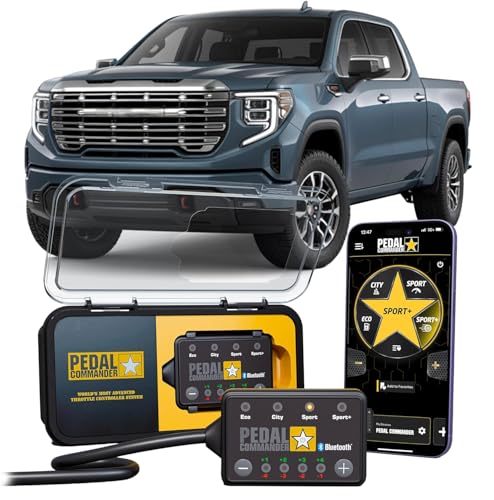
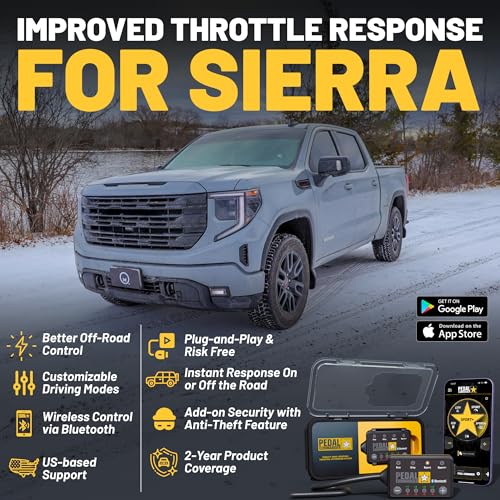
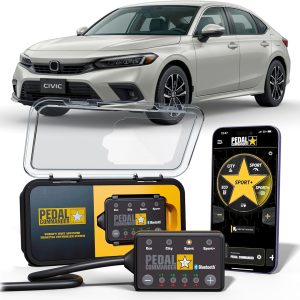
It connects at the accelerator-pedal harness, offers four driving modes, provides 36 sensitivity settings, and can be adjusted through a wireless mobile app. The installation is reversible and does not require a conventional ECU tune.
It does not add horsepower.
It does not increase towing capacity.
It does not make a loaded half-ton truck suddenly forget that physics exists.
What it can do is make the Sierra respond more quickly when the driver presses the accelerator, which may improve the feel of highway merging, passing, towing, climbing grades, and everyday street driving.
$299.99
What Is the Pedal Commander?
The Pedal Commander is an inline electronic throttle response controller.
It installs between the Sierra’s accelerator-pedal sensor and the factory wiring harness. Once connected, the controller modifies the pedal signal according to the selected driving mode and sensitivity level.
The device changes:
- Accelerator sensitivity
- Partial-throttle response
- The relationship between pedal travel and throttle request
- The perceived delay between pressing the pedal and vehicle response
It does not directly change:
- Peak horsepower
- Peak torque
- Turbocharger boost
- Fuel delivery
- Ignition timing
- Transmission gear ratios
- Axle gearing
- Towing ratings
- Payload ratings
The truck may feel more responsive because a smaller accelerator movement can produce a stronger throttle request.
That is different from increasing actual engine output.
The Pedal Commander is a drivability modification, not a power adder.
GMC Sierra 1500 Compatibility
According to the supplied product information, this Pedal Commander application is designed for 2019–2026 GMC Sierra 1500 models, including popular trims such as:
- SLE
- SLT
- Elevation
- Denali
- AT4
- AT4X
- Denali Ultimate
The supplied compatibility information includes Sierra 1500 models equipped with:
- 2.7-liter turbocharged gasoline engine
- 3.0-liter Duramax diesel
- 5.3-liter V8
- 6.2-liter V8
Because engine availability, electronic connectors, trim packages, and calibration details can vary by model year, owners should verify the exact Pedal Commander part number before ordering.
Fitment should be confirmed using the truck’s:
- Model year
- Engine
- Trim
- Accelerator-pedal connector
- Drivetrain
- Market configuration
A Sierra Elevation with the 2.7-liter turbo and a Denali Ultimate with the 6.2-liter V8 may share a grille large enough to have its own ZIP code, but their powertrain configurations are not identical.
Why Does the GMC Sierra Have Throttle Lag?
The Sierra 1500 uses electronic throttle control.
When the driver presses the accelerator, the pedal sends a signal to the engine-control system. The truck then determines how quickly to open the throttle or request torque from the engine.
The factory calibration must account for:
- Smoothness
- Emissions
- Fuel economy
- Traction
- Transmission behavior
- Towing stability
- Engine protection
- Passenger comfort
- Driveline durability
Those priorities can create a softer pedal response than some drivers prefer.
The delay may feel especially noticeable during:
- Highway merging
- Passing with a trailer
- Pulling away with a load
- Climbing steep grades
- Accelerating with larger tires
- Driving a lifted truck
- Stop-and-go traffic
- Low-rpm diesel operation
You press the pedal.
The Sierra receives the request.
It evaluates the transmission, load, traction, trailer, grade, temperature, and probably the emotional condition of the rear differential.
Then it responds.
The Pedal Commander is designed to reduce that perceived hesitation by changing accelerator sensitivity.
Four Driving Modes
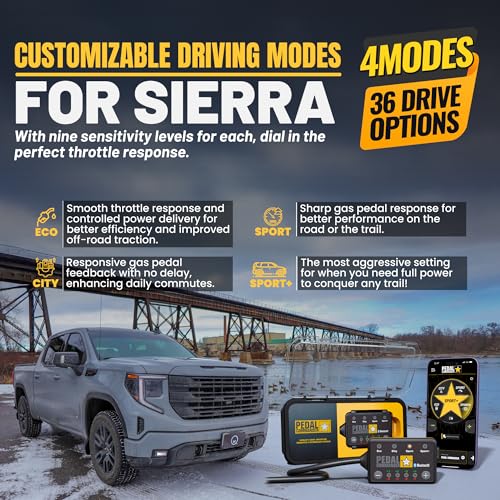
The Pedal Commander offers four main driving modes:
- Eco
- City
- Sport
- Sport+
Each mode changes how aggressively the Sierra responds to pedal movement.
Eco Mode
Eco mode reduces throttle sensitivity.
It may be useful for:
- Long highway drives
- Stop-and-go traffic
- Wet or slippery roads
- Snow
- Light-duty commuting
- Towing situations where smooth control matters
- Drivers trying to reduce abrupt acceleration
Eco mode does not physically reduce the engine’s maximum output.
Instead, it requires more pedal movement to request the same throttle response.
This can make it easier to accelerate smoothly and may help drivers avoid unnecessary throttle inputs.
Does Eco Mode Improve Fuel Economy?
Eco mode may encourage smoother accelerator use, which can support more efficient driving habits.
It does not guarantee better fuel economy.
Actual mileage still depends on:
- Engine choice
- Vehicle weight
- Trailer weight
- Tire size
- Road grade
- Wind
- Driving speed
- Traffic
- Driver behavior
A softer pedal can help.
It cannot convince a 6.2-liter V8 towing into a headwind that fuel is optional.
City Mode
City mode provides a moderate increase in accelerator response.
It is designed for everyday driving situations such as:
- Urban traffic
- Commuting
- Parking lots
- Stop-and-go driving
- Highway merging
- General street use
For many Sierra owners, City mode may provide the best daily-driving balance.
The accelerator feels more alert without becoming difficult to control at low speeds.
This can be especially useful on trucks that feel slightly lazy from a stop or after the installation of larger wheels and tires.
Sport Mode
Sport mode delivers a stronger increase in throttle sensitivity.
It may improve the driving feel during:
- Highway passing
- Merging with traffic
- Climbing grades
- Driving with a load
- Spirited street driving
- Open-road acceleration
- Off-road driving where quicker response is useful
Sport mode makes the truck react more aggressively to smaller pedal inputs.
It does not create additional torque, but it can make the available torque feel easier to access.
For many drivers, Sport mode may be the most noticeable upgrade without the extreme sensitivity of Sport+.
Sport+ Mode
Sport+ provides the most aggressive accelerator response.
Small pedal movements can create a much stronger throttle request, making the truck react quickly during acceleration.
This mode may appeal to owners who want:
- Maximum pedal sensitivity
- Immediate response
- Quicker access to full throttle
- Aggressive highway acceleration
- A dramatic change from the stock pedal feel
Sport+ should be used carefully, especially:
- While towing
- In rain or snow
- On loose dirt
- In heavy traffic
- On lifted trucks
- With oversized tires
- In high-torque diesel applications
- On powerful 6.2-liter V8 models
Maximum sensitivity is not automatically maximum usefulness.
A full-size truck towing a trailer does not need the accelerator to behave like a light switch.
36 Adjustable Throttle Settings
The Pedal Commander offers nine sensitivity levels within each of its four driving modes.
That creates a total of 36 available settings.
This allows owners to fine-tune throttle response rather than choosing only between factory response and maximum aggression.
Possible examples include:
- Eco -3 for snow or slippery roads
- Eco +1 for smoother towing
- City -1 for daily commuting
- City +3 for a truck with larger tires
- Sport -2 for highway driving
- Sport +2 for stronger passing response
- Sport+ at a low setting before trying maximum sensitivity
The best setting depends on:
- Engine
- Tire size
- Truck weight
- Trailer weight
- Road conditions
- Terrain
- Driver preference
- Weather
- Transmission behavior
A setting that feels ideal on a 2.7-liter turbo work truck may feel unnecessarily aggressive on a 6.2-liter Denali.
The ability to adjust gradually is one of the product’s most useful features.
Wireless App Control
The Pedal Commander can be adjusted through a compatible smartphone app.
Depending on the controller version and available software features, the app may allow the driver to:
- Change driving modes
- Adjust sensitivity
- View the current setting
- Save preferred configurations
- Control the device without reaching near the footwell
Wireless app control can be particularly convenient in a truck because the physical module may be mounted low near the accelerator pedal.
Drivers should make changes while parked.
The app is useful.
Experimenting with Sport+ while towing a trailer up an on-ramp is not the time to become a software tester.
Pedal Commander for the 2.7-Liter Turbo Sierra
The 2.7-liter turbocharged engine is designed to provide strong low-rpm torque and everyday usability.
A throttle controller may make these models feel:
- More immediate from a stop
- More responsive in traffic
- Quicker during highway merging
- Less hesitant during passing
- More alert when carrying a load
The Pedal Commander does not increase turbocharger boost or engine output.
It changes how quickly the driver requests the torque already available.
This may be especially noticeable during partial-throttle driving, where most trucks spend the majority of their time.
Pedal Commander for the 3.0-Liter Duramax Diesel
The 3.0-liter Duramax diesel provides strong low-rpm torque and is commonly chosen for towing, highway driving, and fuel-efficiency priorities.
A throttle controller may make the diesel Sierra feel:
- More responsive when pulling away
- More immediate during highway passing
- Less delayed while climbing grades
- Sharper when towing
- More alert at partial throttle
Because diesel torque arrives low in the rpm range, owners should increase sensitivity gradually.
An overly aggressive setting can make smooth power application more difficult, particularly when:
- Towing
- Driving on loose surfaces
- Maneuvering at low speed
- Operating in wet weather
City or a moderate Sport setting may offer a better balance than maximum Sport+.
The Duramax already has torque.
It does not need encouragement delivered with a hammer.
Pedal Commander for the 5.3-Liter V8
The 5.3-liter V8 is one of the Sierra 1500’s most familiar engine choices.
A Pedal Commander may make the 5.3-liter truck feel:
- More responsive in everyday traffic
- Quicker during highway merges
- Stronger during passing
- Less soft at low pedal inputs
- More immediate when carrying cargo
The controller does not add V8 horsepower or torque.
It changes the pedal curve so the engine responds more aggressively to smaller accelerator movements.
For owners who like the engine but dislike the stock pedal calibration, this may provide a noticeable improvement without a conventional tune.
Pedal Commander for the 6.2-Liter V8
The 6.2-liter V8 already provides substantial horsepower and torque.
On these trucks, the Pedal Commander can make the engine feel even more immediate during partial-throttle driving.
Potential benefits include:
- Faster-feeling response
- Stronger highway passing feel
- More immediate acceleration
- Adjustable pedal sensitivity
- A sharper street-driving character
However, aggressive settings should be approached carefully.
The 6.2-liter engine does not need much help overwhelming rear-tire traction, especially in two-wheel-drive configurations or poor weather.
A moderate City or Sport setting may be more useful than maximum Sport+.
The goal is sharper response.
Not turning every fuel stop into an explanation for why the rear tires are wearing unevenly.
Pedal Commander for Towing
The Sierra 1500 is frequently used to tow:
- Utility trailers
- Campers
- Boats
- Car trailers
- Equipment trailers
- Work trailers
A sharper accelerator response may make the truck feel more confident during:
- Highway merging
- Passing slower traffic
- Pulling away from a stop
- Climbing grades
- Maintaining speed under load
However, the Pedal Commander does not increase the truck’s official towing capacity.
It does not change:
- Frame strength
- Braking capacity
- Cooling capacity
- Axle ratings
- Gross combined weight rating
- Hitch rating
- Payload capacity
It only changes pedal response.
Best Mode for Towing
For many drivers, City or a moderate Sport setting may provide the best balance.
Sport+ may be too sensitive when towing because abrupt throttle requests can cause:
- Harsh acceleration
- Unnecessary transmission shifting
- Trailer movement
- Reduced traction
- Increased fuel consumption
- Less comfortable load control
Smooth power delivery is usually more valuable than maximum pedal sensitivity.
Your trailer does not care how sporty the throttle feels.
It cares whether you keep it stable.
Pedal Commander for Hauling
A loaded bed can make the Sierra feel slower to respond, particularly when carrying:
- Construction materials
- Tools
- Landscaping supplies
- Camping equipment
- Spare parts
- Work gear
The Pedal Commander cannot reduce the load or increase engine output.
It can make the truck feel more responsive by requesting throttle more aggressively.
This may be useful when:
- Entering traffic
- Climbing hills
- Passing
- Driving with a full bed
- Operating a heavily accessorized work truck
A moderate setting is usually more practical than maximum sensitivity.
The goal is controlled response, not making the cargo discover weight transfer.
Pedal Commander With Lift Kits and Larger Tires
Lift kits and oversized tires are common Sierra modifications.
They can improve:
- Ground clearance
- Off-road capability
- Tire clearance
- Approach angles
- Appearance
They can also increase vehicle weight, aerodynamic drag, and rotational mass.
Larger tires may effectively change the truck’s gearing, making acceleration feel softer.
The Pedal Commander can improve perceived response, but it does not mechanically correct the effects of oversized tires.
It cannot change:
- Axle gearing
- Tire weight
- Tire diameter
- Aerodynamic drag
- Vehicle mass
- Transmission ratios
For trucks with significantly larger tires, proper axle gearing may still be the correct mechanical solution.
The Pedal Commander can make the pedal feel sharper.
It cannot negotiate with gear ratios.
Pedal Commander for Off-Road Driving
The adjustable modes can be useful off road because different terrain requires different throttle behavior.
Loose Dirt
A moderate City or Sport setting may provide quicker response without excessive wheelspin.
Mud
Too much sensitivity can create unnecessary tire spin. The ideal setting depends on momentum, tire grip, and terrain.
Sand
A stronger response may help maintain momentum, but smooth control remains important.
Rocks and Technical Terrain
Eco mode may make low-speed power easier to manage.
A softened pedal can help reduce:
- Sudden wheelspin
- Abrupt weight transfer
- Lurching
- Unwanted throttle spikes
Snow and Ice
Eco mode may make it easier to apply power gradually.
The Pedal Commander does not improve traction.
It only changes how easy it is to manage the available traction.
Plug-and-Play Installation
The supplied product information states that the Pedal Commander can be installed in approximately 15 minutes.
It connects between the accelerator-pedal sensor and the factory wiring harness.
A typical installation process includes:
- Park the Sierra securely.
- Turn off the engine.
- Keep the key or key fob away from the truck.
- Allow the electrical system to power down.
- Locate the accelerator-pedal connector.
- Disconnect the factory harness.
- Connect the Pedal Commander inline.
- Mount the module securely.
- Route all wiring away from the pedals.
- Pair the device with the mobile app.
- Select a conservative initial setting.
- Test operation before normal driving.
The installation does not normally require:
- Wire cutting
- Soldering
- ECU flashing
- Drilling
- Engine modifications
- Permanent interior changes
All wiring must be secured away from:
- Accelerator-pedal movement
- Brake-pedal travel
- Driver footwear
- Steering components
- Parking-brake components
A loose wire near the pedals is not an acceptable final installation.
It is a safety problem.
Does the Pedal Commander Leave an ECU Footprint?
The supplied product description states that the controller leaves no ECU footprint and maintains the factory settings.
The Pedal Commander does not perform a conventional ECU software flash. It operates through the accelerator-pedal circuit rather than rewriting the truck’s engine-control calibration.
That makes it different from a tuner that may change:
- Fuel maps
- Ignition timing
- Torque management
- Transmission operation
- Boost control
- Rev limits
- Internal throttle mapping
The controller is also designed to be removable.
However, owners should not interpret “no ECU footprint” as an unconditional warranty guarantee.
Warranty decisions may depend on:
- The failed component
- Whether the accessory contributed to the issue
- Dealer inspection
- Manufacturer policy
- Applicable consumer-protection laws
The safest description is that the Pedal Commander is reversible and does not perform a conventional ECU reflash.
Works With Intakes, Exhausts, and Modified Builds
The supplied product information states that the controller can be used with stock and modified Sierra builds, including trucks equipped with:
- Cold air intakes
- Performance air filters
- Cat-back exhaust systems
- Performance mufflers
- Lift kits
- Larger wheels and tires
- Off-road accessories
These modifications perform different jobs.
An intake or exhaust may change airflow and sound.
A lift kit changes suspension height and tire clearance.
The Pedal Commander changes accelerator sensitivity.
It does not increase the horsepower produced by those modifications, but it may make the engine and exhaust respond more immediately during acceleration.
It does not create more V8 sound.
It helps you request the sound sooner.
Pedal Commander Versus an ECU Tune
A throttle response controller and an ECU tune are not the same modification.
Pedal Commander
The Pedal Commander changes:
- Pedal sensitivity
- Partial-throttle response
- Perceived throttle delay
It generally does not change:
- Fuel delivery
- Ignition timing
- Peak horsepower
- Peak torque
- Transmission calibration
- Turbo boost
- Rev limits
ECU Tune
A proper ECU tune may change:
- Fuel maps
- Ignition timing
- Torque management
- Transmission shift behavior
- Cooling-fan settings
- Turbocharger control
- Throttle mapping
- Rev limits
A tune may produce actual horsepower and torque gains when properly calibrated.
The Pedal Commander is primarily a reversible drivability modification.
It is intended for owners who want a different pedal feel without rewriting engine-management software.
Does the Pedal Commander Add Horsepower?
No.
The Pedal Commander does not increase:
- Horsepower
- Torque
- Turbocharger boost
- Fuel delivery
- Engine displacement
- Towing capacity
- Payload capacity
- Axle strength
- Transmission capacity
It changes accelerator sensitivity.
The truck may feel quicker because a smaller pedal movement requests more throttle.
At full throttle, however, the engine still has the same maximum output.
That means claims about guaranteed faster acceleration should be treated carefully.
Performance still depends on:
- Engine output
- Vehicle weight
- Trailer weight
- Tire grip
- Transmission behavior
- Road grade
- Weather
- Driver input
The Pedal Commander can change the response.
It cannot remove the trailer.
Advantages
- Sharper accelerator response
- Four driving modes
- 36 sensitivity settings
- Wireless app control
- Plug-and-play installation
- Reversible design
- No conventional ECU flash
- Compatible with multiple Sierra engines when properly matched
- Useful for towing, hauling, commuting, and off-road driving
- Can improve perceived response with larger tires
- Works with many common intake, exhaust, and suspension modifications
Disadvantages
- Does not add horsepower
- Does not increase torque
- Does not increase towing or payload ratings
- Sport+ may be too sensitive while towing
- Does not correct improper axle gearing
- Aggressive settings may reduce smooth low-speed control
- Exact model-year and engine fitment must be confirmed
- It does not replace an ECU or transmission tune
- Some drivers may prefer the factory pedal calibration
Is the Pedal Commander Worth It for a GMC Sierra 1500?
The Pedal Commander makes the most sense for a Sierra owner who:
- Dislikes the factory accelerator response
- Wants sharper highway merging
- Regularly tows or hauls
- Runs larger tires or a lift kit
- Wants adjustable response for different driving conditions
- Prefers a reversible modification
- Does not want an ECU flash
- Values drivability more than dyno numbers
It makes less sense for an owner expecting:
- Additional horsepower
- More torque
- Increased towing capacity
- Increased payload capacity
- Guaranteed fuel-economy gains
- A substitute for regearing
- A replacement for engine tuning
- Guaranteed faster zero-to-60 times
The Pedal Commander is best viewed as a throttle-response and drivability upgrade.
It changes how quickly the Sierra responds to accelerator movement.
It does not change what the engine or chassis can safely handle.
Final Thoughts
The GMC Sierra 1500 is designed to handle many different jobs.
It can be a daily driver, luxury truck, tow vehicle, work rig, off-road build, or some combination of all five.
The Pedal Commander adds another layer of adjustability by allowing the driver to tailor accelerator response to the situation.
Eco mode can soften the pedal for slippery roads or smooth towing. City mode can improve daily drivability. Sport can sharpen highway passing and grade climbing, while Sport+ offers the most aggressive response.
The 36 available settings make it possible to fine-tune the system rather than choosing between stock and maximum sensitivity.
It will not add horsepower.
It will not increase towing capacity.
It will not correct gearing on a truck running tires large enough to require their own loading dock.
What it can do is make the Sierra feel more immediate without a conventional ECU tune or permanent modification.
For owners frustrated by a soft factory pedal, that may be enough to make a capable truck feel more connected to the driver.
Frequently Asked Questions
Does the Pedal Commander add horsepower to a GMC Sierra 1500?
No. It changes accelerator-pedal sensitivity but does not increase peak horsepower or torque.
Which GMC Sierra 1500 models are compatible?
According to the supplied product information, it fits compatible 2019–2026 Sierra 1500 models including SLE, SLT, Elevation, Denali, AT4, AT4X, and Denali Ultimate trims.
Does it work with the 2.7-liter turbo engine?
The supplied compatibility information includes the 2.7-liter turbocharged engine. Exact part-number fitment should still be verified.
Is it compatible with the 3.0-liter Duramax?
The product listing includes compatible 3.0-liter Duramax diesel models. Owners should verify their exact model year and configuration.
Does it work with the 5.3-liter V8?
Yes, according to the supplied product information, provided the correct application is selected.
Can it be used with the 6.2-liter V8?
The supplied listing includes 6.2-liter V8 applications. Owners should increase sensitivity gradually because of the engine’s available torque.
Is the Pedal Commander useful for towing?
It can make the accelerator feel more responsive, especially during merging and grade climbing. It does not increase the truck’s towing capacity.
Does it help with larger tires?
It may improve perceived throttle response, but it does not correct the gearing changes caused by oversized tires.
How many settings does it have?
The controller offers four driving modes and nine sensitivity levels per mode, creating 36 settings.
Does installation require tools?
The supplied product information describes a fast plug-and-play installation without special tools. Access may vary by truck configuration.
Does it require an ECU tune?
No. It connects at the accelerator-pedal harness and does not perform a conventional ECU reflash.
Can it be removed?
Yes. The plug-and-play installation is designed to be reversible.
Specification: Pedal Commander for 2019–2026 GMC Sierra 1500: Sharper Throttle Response for Towing, Hauling, and Daily Driving
|
User Reviews
Be the first to review “Pedal Commander for 2019–2026 GMC Sierra 1500: Sharper Throttle Response for Towing, Hauling, and Daily Driving”
You must be logged in to post a review.




There are no reviews yet.