
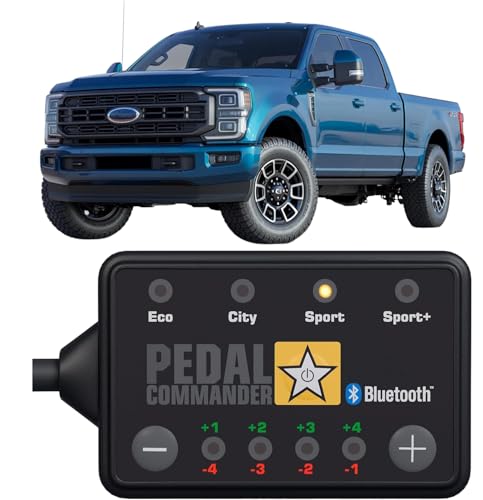



Pedal Commander for 2011–2026 Ford F-250 Super Duty: Better Throttle Response for Towing, Hauling, and Work
The Ford F-250 Super Duty is not purchased because someone occasionally needs to carry a bag of mulch.
It is built for fifth-wheel campers, gooseneck trailers, construction equipment, service bodies, truck campers, livestock trailers, snowplows, oversized tires, and the kind of workloads that quickly expose the difference between a heavy-duty truck and a half-ton wearing an especially confident grille.
Even with substantial gas and diesel engine options, however, some F-250 owners dislike the softened response of the factory electronic accelerator.
Press the pedal while pulling into traffic, climbing a grade, or merging with a trailer, and the truck may feel like it takes a moment to interpret the request before delivering its available power.
The Pedal Commander throttle response controller for the 2011–2026 Ford F-250 Super Duty is designed to change that pedal behavior.
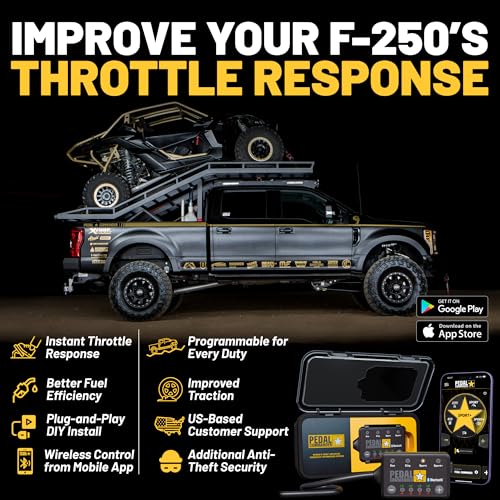
It connects to the accelerator-pedal sensor, offers four driving modes and 36 sensitivity settings, supports wireless app control, and includes an optional subscription-based Anti-Theft feature. Installation is designed to be plug-and-play and reversible without a conventional ECU reflash. Pedal Commander currently lists specific F-250 applications spanning the third-, fourth-, and fifth-generation Super Duty platforms.
It does not add horsepower.
It does not increase torque.
It does not raise the truck’s towing or payload rating.
What it can do is make the F-250 feel more responsive while towing, hauling, commuting, working off road, or operating with larger tires and heavy accessories.
$299.99
What Is the Pedal Commander?
The Pedal Commander is an inline electronic throttle response controller.
Modern F-250 trucks use an electronic accelerator rather than a traditional cable connecting the pedal directly to the engine. The accelerator-pedal sensor sends a signal to the truck’s control system, which then determines how much torque to request.
The Pedal Commander installs between that pedal sensor and the factory harness.
It modifies the relationship between pedal travel and the electronic throttle request based on the selected mode and sensitivity level.
The controller changes:
- Accelerator sensitivity
- Partial-throttle response
- The amount of pedal travel needed to request acceleration
- The perceived delay after pressing the pedal
- How progressive or aggressive the accelerator feels
It does not directly change:
- Peak horsepower
- Peak torque
- Turbocharger boost
- Diesel injection calibration
- Gasoline fuel mapping
- Ignition timing
- Transmission gear ratios
- Axle ratios
- Exhaust-brake performance
- Towing capacity
- Payload capacity
The truck may feel stronger because less pedal movement can request more of the engine’s available output.
That is not the same as producing more power.
The difference matters, particularly when a product is being installed on a truck that may already produce more than 1,000 pound-feet of torque.
Ford F-250 Super Duty Compatibility
The supplied listing identifies compatibility with 2011–2026 Ford F-250 Super Duty trucks, including trims such as:
- XL
- XLT
- Lariat
- King Ranch
- Platinum
- Limited
The listed engines include:
- 6.2-liter gasoline V8
- 7.3-liter gasoline V8
- 6.7-liter Power Stroke turbodiesel V8
That compatibility covers many—but not every—F-250 engine offered across this long model-year range.
Important Generation Clarification
The supplied listing divides the trucks into:
- Third generation: 2011–2016
- Fourth generation: 2017–2026
Pedal Commander’s current Super Duty material instead divides the newer trucks into:
- Third generation: 2011–2016
- Fourth generation: 2017–2022
- Fifth generation: 2023 and newer
That distinction is important because the 2023 redesign introduced significant changes to the Super Duty platform, electronics, engine lineup, and interior architecture.
Important Engine Clarification
The supplied description omits the 6.8-liter gasoline V8 offered in current Super Duty trucks.
Ford’s 2026 F-250 powertrain lineup includes:
- 6.8-liter gasoline V8
- 7.3-liter gasoline V8
- 6.7-liter Power Stroke turbodiesel V8
- High-output 6.7-liter Power Stroke turbodiesel V8
Ford lists the current engines at up to 500 horsepower and 1,200 pound-feet of torque with the high-output Power Stroke.
The 6.2-liter gasoline V8 applies to earlier trucks and should not be interpreted as an engine offered throughout the entire 2011–2026 period.
Owners should verify the correct Pedal Commander part number using the truck’s:
- Exact model year
- Engine
- Trim
- Accelerator-pedal connector
- Cab and bed configuration
- Drivetrain
- Pickup or chassis-cab designation
- Market specification
A 2011 XL work truck and a 2026 Limited may both be called F-250s, but nearly fifteen years of electronics separate them.
Order by verified fitment—not by the confidence generated by a blue oval and a large grille.
Why Does the Ford F-250 Have Throttle Lag?
The F-250 uses electronic throttle control.
When the accelerator is pressed, the truck’s control modules interpret the input before commanding engine torque. The system may consider:
- Pedal position
- Engine speed
- Transmission gear
- Vehicle speed
- Trailer load
- Traction-control activity
- Engine temperature
- Emissions strategy
- Turbocharger operating conditions
- Driveline protection
- Stability-control intervention
This allows Ford to manage acceleration smoothly and protect the powertrain, particularly when thousands of pounds may be connected to the hitch.
The result can be a pedal that feels less direct than some drivers prefer.
That softness may become more noticeable when the truck is:
- Towing a large trailer
- Carrying a heavy payload
- Equipped with a service body
- Pulling away on a grade
- Merging into highway traffic
- Running oversized tires
- Lifted
- Carrying a slide-in camper
- Equipped with heavy bumpers or work equipment
You press the pedal.
The F-250 checks the engine, transmission, traction, load, trailer, exhaust temperature, and whether the fifth wheel behind it has its own ZIP code.
Then it accelerates.
The Pedal Commander is intended to reduce that perceived hesitation by changing accelerator sensitivity.
Four Pedal Commander Driving Modes
The product description refers to Eco, “Town,” Sport, and Sport+.
Pedal Commander’s official mode name is City, not Town.
The four available modes are:
- Eco
- City
- Sport
- Sport+
Each mode has nine adjustment levels, creating 36 total throttle-response settings.
Eco Mode
Eco mode reduces accelerator sensitivity.
More pedal travel is required to request the same throttle response, producing smoother and more gradual acceleration.
Eco mode may be useful for:
- Backing a trailer
- Hitching a fifth wheel
- Snow and ice
- Wet pavement
- Technical off-road driving
- Stop-and-go traffic
- Crowded worksites
- Long-distance cruising
- Drivers who prefer progressive response
Eco mode does not reduce the engine’s maximum output.
It changes how quickly that output is requested.
Can Eco Mode Improve Fuel Economy?
Eco mode may encourage smoother acceleration and reduce unnecessary throttle inputs.
That could help some drivers use less fuel, but it does not guarantee a mileage improvement.
Fuel consumption still depends on:
- Engine
- Trailer weight
- Payload
- Tire size
- Axle ratio
- Vehicle speed
- Road grade
- Wind
- Idle time
- Driver behavior
Eco mode can soften the accelerator.
It cannot make a Power Stroke pulling a tall fifth-wheel camper stop noticing aerodynamic drag.
City Mode
City mode provides a moderate increase in accelerator sensitivity.
It is well suited to:
- Daily commuting
- Stop-and-go traffic
- Worksite travel
- Unloaded driving
- Highway entry
- General street use
- Trucks carrying permanent equipment
For many F-250 owners, City mode may offer the most practical everyday setting.
It can make the truck feel more responsive without creating the abrupt behavior associated with aggressive Sport+ settings.
City mode may be particularly useful on trucks carrying:
- Toolboxes
- Service bodies
- Auxiliary fuel tanks
- Welding equipment
- Snowplows
- Bed-mounted compressors
- Recovery equipment
- Heavy replacement bumpers
The Pedal Commander cannot remove any of that weight.
It can make the accelerator feel less reluctant to move it.
Sport Mode
Sport mode provides a stronger increase in accelerator sensitivity.
It may improve the driving feel during:
- Highway merging
- Passing
- Pulling onto fast roads
- Grade climbing
- Unloaded driving
- Moderate towing
- Open dirt-road travel
Sport mode requests more throttle from a smaller amount of pedal movement.
It does not increase horsepower or torque, but it can make the engine’s existing output feel easier to access.
For many F-250 owners, a mild or moderate Sport setting may deliver the most noticeable improvement without making the truck difficult to control at low speed.
Sport+ Mode
Sport+ provides the most aggressive accelerator response.
Small pedal inputs can produce a much stronger torque request, making the truck react quickly when the driver presses the accelerator.
Sport+ may appeal to drivers wanting:
- Maximum pedal sensitivity
- Immediate unloaded response
- Faster access to wide-open throttle
- A dramatic change from the stock pedal feel
- Aggressive highway acceleration
The supplied listing suggests Sport+ is ideal for towing.
That is not necessarily true.
Sport+ does not add towing power. It makes the accelerator more sensitive, which may actually make smooth trailer control more difficult.
Maximum sensitivity can contribute to:
- Abrupt acceleration
- Trailer surging
- Additional transmission shifting
- Cargo movement
- Reduced traction
- More difficult low-speed maneuvering
- Increased fuel use
Sport+ should be approached carefully in a truck equipped with a 6.7-liter Power Stroke, particularly while towing or driving on wet pavement.
The diesel already makes enough torque to rearrange the contents of a trailer.
It does not need every pedal movement translated into an emergency announcement.
What Do the 36 Settings Mean?
Each of the four modes offers nine adjustment levels.
That allows the driver to fine-tune the pedal rather than choosing only between stock response and maximum aggression.
Possible starting points might include:
- Eco -4 for snow
- Eco -2 for trailer maneuvering
- City -1 for commuting
- City +2 for a loaded work truck
- Sport -2 for highway travel
- Sport +1 for unloaded driving
- Sport+ at a low level before attempting maximum sensitivity
The best setting depends on:
- Engine
- Truck weight
- Trailer weight
- Payload
- Tire size
- Axle ratio
- Road surface
- Weather
- Driver preference
A setting that feels appropriate in an unloaded 6.2-liter regular-cab truck may be far too aggressive in a high-output Power Stroke pulling a loaded gooseneck.
The useful setting is the one that remains predictable.
It is not necessarily the setting with the greatest number of plus signs.
Wireless App Control
The Pedal Commander can be managed through its compatible smartphone app.
Depending on the hardware and current app features, drivers may be able to:
- Change modes
- Adjust sensitivity
- View the current setting
- Save preferred configurations
- Activate Anti-Theft mode
- Control the module without reaching toward the footwell
Pedal Commander describes its mobile app as a way to access settings and additional features after the inline controller has been installed.
Settings should be adjusted while parked.
Using an app to tailor accelerator response is convenient.
Selecting Sport+ while merging with a 14,000-pound trailer is an unnecessarily creative way to test both the technology and the driver’s insurance coverage.
Pedal Commander Anti-Theft Mode
Pedal Commander’s subscription-based Anti-Theft feature is designed to disable normal accelerator response when activated through the app.
The company currently advertises:
- A 14-day free trial
- $0.99 per month
- $9.99 per year
The feature restricts the accelerator signal, making the truck more difficult to drive away under its own power.
Anti-Theft may be useful when the F-250 is parked at:
- Construction sites
- Hotels
- Trailheads
- Equipment yards
- Parking lots
- Remote jobsites
- Campgrounds
- Long-term storage locations
It should be treated as an additional theft deterrent—not a complete vehicle-security system.
It does not replace:
- Ford’s factory immobilizer
- Secure key storage
- An alarm
- GPS tracking
- Steering-wheel locks
- Physical parking barriers
- Tool and equipment security
Locking the pedal signal can help prevent someone from driving the truck normally.
It cannot prevent every theft method, including towing or sophisticated electronic attacks.
Pedal Commander for the 6.2-Liter Gas V8
The 6.2-liter gasoline V8 was used extensively in earlier 2011–2022 Super Duty trucks.
A compatible Pedal Commander may make a 6.2-liter F-250 feel:
- More responsive from a stop
- Sharper during highway merging
- Less hesitant under load
- More immediate during passing
- More alert when climbing grades
The controller does not add horsepower or torque.
It changes how quickly the driver requests the output already available.
That may be particularly noticeable in a gasoline-powered heavy-duty truck because the engine generally needs more rpm than the Power Stroke diesel to produce its strongest output.
A moderate City or Sport setting may make the truck feel more eager without changing the factory engine calibration.
Pedal Commander for the 7.3-Liter Gas V8
Ford’s 7.3-liter gasoline V8—commonly called the Godzilla V8—provides substantial naturally aspirated displacement without the complexity of a diesel turbocharger or high-pressure diesel fuel system.
Ford currently lists the 7.3-liter gas V8 at 430 horsepower and 485 pound-feet of torque in the 2026 Super Duty lineup.
A Pedal Commander may make the 7.3-liter F-250 feel:
- More immediate at partial throttle
- Sharper when entering traffic
- More responsive while towing
- Less softened during grade climbing
- More alert during unloaded driving
The controller does not increase the engine’s 430-horsepower rating.
It makes the driver access the available power sooner in the accelerator’s travel.
Because the 7.3-liter engine already produces strong response, sensitivity should be increased gradually.
The engine has 445 cubic inches.
It is not waiting for emotional encouragement—only a clearer request from the pedal.
Pedal Commander for the 6.8-Liter Gas V8
The current Super Duty lineup also includes a 6.8-liter gasoline V8, even though the supplied listing does not mention it.
Ford lists the 2026 6.8-liter V8 at:
- 405 horsepower
- 445 pound-feet of torque
On a correctly matched truck, a Pedal Commander may improve the feel of:
- Daily acceleration
- Highway merging
- Worksite travel
- Moderate towing
- Loaded driving
- Grade climbing
It does not increase horsepower, torque, or towing capacity.
Because 6.8-liter compatibility depends on the specific controller application and newer electronic architecture, owners should verify the exact part number before purchasing.
Pedal Commander for the 6.7-Liter Power Stroke Diesel
Ford introduced the 6.7-liter Power Stroke in the 2011 Super Duty. The engine has evolved through multiple generations and output levels since then.
Current 2026 versions include:
- Standard-output 6.7-liter Power Stroke
- High-output 6.7-liter Power Stroke
Ford lists current output as high as:
- 500 horsepower
- 1,200 pound-feet of torque
A Pedal Commander may make a Power Stroke F-250 feel:
- More responsive when pulling away
- Sharper during highway passing
- Less delayed when climbing grades
- More immediate while towing
- More alert during unloaded driving
It does not increase:
- Diesel injection quantity
- Turbocharger boost
- Horsepower
- Torque
- Exhaust-brake strength
- Towing capacity
Because the Power Stroke already produces enormous low-rpm torque, owners should begin with a conservative setting.
City mode or a mild Sport setting may provide a useful improvement without making the accelerator overly abrupt.
Maximum Sport+ on a high-output Power Stroke is not automatically “better.”
Sometimes it is simply a faster way to remind every unsecured object in the cab that inertia exists.
Pedal Commander for Towing
F-250 owners commonly tow:
- Fifth-wheel campers
- Gooseneck trailers
- Equipment trailers
- Horse trailers
- Boats
- Car haulers
- Enclosed cargo trailers
- Construction machinery
A sharper accelerator response may improve the truck’s driving feel during:
- Highway merging
- Passing
- Pulling away from a stop
- Climbing grades
- Rejoining traffic
- Maintaining momentum
The Pedal Commander does not increase the F-250’s tow rating.
It does not change:
- Gross combined weight rating
- Gross vehicle weight rating
- Hitch capacity
- Axle ratings
- Tire ratings
- Brake capacity
- Cooling capacity
- Transmission capability
- Frame strength
Ford’s towing limits vary significantly by engine, axle ratio, cab, drivetrain, bed length, hitch type, and vehicle configuration. Those official limits remain unchanged after installing a throttle controller.
Best Pedal Commander Setting for Towing
For many drivers, City or a moderate Sport setting may offer the best balance.
Sport+ can be unnecessarily sensitive when towing because it may produce:
- Abrupt starts
- Trailer surging
- Harsh load transfer
- Additional transmission downshifts
- Reduced traction
- Less precise backing
- Higher fuel use
Smooth, predictable acceleration is usually more useful than maximum pedal response.
A fifth-wheel camper does not care whether the accelerator feels sporty.
It cares whether the driver avoids rearranging the kitchen every time the light turns green.
Pedal Commander for Hauling and Work Trucks
An F-250 may carry substantial permanent or temporary weight from:
- Service bodies
- Slide-in campers
- Toolboxes
- Construction materials
- Welding equipment
- Auxiliary fuel tanks
- Snowplows
- Compressors
- Recovery gear
- Landscaping equipment
That added weight can make the truck feel slower to react.
The Pedal Commander cannot reduce the weight or increase the payload rating.
It may make the accelerator feel more responsive by requesting greater throttle with less pedal travel.
This can improve perceived response during:
- Worksite travel
- Highway entry
- Hill climbing
- Passing
- Driving with a loaded bed
- Operating a permanently equipped service truck
Fleet operators should avoid excessively aggressive settings in shared vehicles.
Different drivers may react differently to a highly sensitive accelerator, particularly while maneuvering in crowded yards or around equipment.
A mild City setting may be more useful for a shared work truck than maximum Sport+.
A company truck should improve productivity.
It should not become an involuntary employee reaction-time assessment.
Pedal Commander With a Truck Camper
Slide-in campers can place substantial weight in the bed and increase both the truck’s center of gravity and aerodynamic drag.
A Pedal Commander may make the F-250 feel more responsive during:
- Highway merging
- Grade climbing
- Passing
- Pulling away from intersections
- Traveling at elevation
It does not change:
- Payload capacity
- Rear-axle rating
- Tire load ratings
- Center of gravity
- Camper weight
- Aerodynamic drag
Owners must continue to follow the truck’s payload, axle, tire, and camper-loading limits.
A sharper pedal cannot make a 3,000-pound camper weigh less.
Physics remains stubbornly resistant to smartphone apps.
Pedal Commander for Lifted F-250 Trucks
Lift kits and larger tires are common Super Duty modifications.
They can improve:
- Ground clearance
- Tire clearance
- Off-road capability
- Approach and departure angles
- Appearance
They can also increase:
- Rotational mass
- Unsprung weight
- Aerodynamic drag
- Effective gearing
- Overall vehicle weight
A lifted F-250 with larger tires may feel less responsive than a stock truck.
The Pedal Commander may improve perceived pedal response, but it cannot mechanically correct the effects of oversized tires.
It does not change:
- Axle ratios
- Tire diameter
- Tire weight
- Transmission gearing
- Vehicle mass
- Aerodynamic drag
If the truck is genuinely undergeared, axle regearing may remain the proper solution.
The controller can sharpen the pedal.
It cannot persuade a 40-inch tire that it is still the factory size.
Pedal Commander for Off-Road Use
Different terrain benefits from different accelerator characteristics.
Rocks and Technical Terrain
Eco mode may provide better low-speed control.
A softer pedal can help reduce:
- Sudden wheelspin
- Lurching
- Abrupt weight transfer
- Unwanted throttle spikes
Dirt Roads
City or a mild Sport setting may improve response while keeping the truck manageable.
Mud
Excessive sensitivity can cause unnecessary wheelspin.
A moderate setting may provide better control.
Sand
A stronger response may help maintain momentum, but abrupt pedal inputs can still dig the tires deeper.
Snow and Ice
Eco mode may make torque easier to apply gradually.
The Pedal Commander does not create traction.
It changes how the driver manages the traction already available.
Plug-and-Play Installation
Pedal Commander describes installation as a simple inline process using the factory accelerator-pedal connector.
The company’s basic procedure consists of:
- Turn off the truck and move the key fob away.
- Disconnect the factory pedal harness.
- Connect the Pedal Commander harness.
- Secure the cables and controller.
- Download and pair the mobile app.
A more complete installation process should include:
- Park the F-250 securely.
- Turn off the engine.
- Keep the key or key fob away from the truck.
- Allow the electrical system to power down.
- Locate the accelerator-pedal connector.
- Release the factory connector without pulling on the wires.
- Install the Pedal Commander inline.
- Confirm that both connections are fully seated.
- Secure the controller and excess wiring.
- Keep all cables away from pedal movement.
- Pair the module with the app.
- Begin with a conservative setting.
- Test the accelerator before normal driving.
Installation generally does not require:
- Wire cutting
- Soldering
- Drilling
- ECU flashing
- OBD-II port use
- Permanent dashboard changes
All wiring must be kept away from:
- Accelerator-pedal travel
- Brake-pedal movement
- Parking-brake components
- Steering components
- Driver footwear
A loose cable near the pedals is not merely an untidy installation.
It is a safety problem.
Does the Pedal Commander Alter the ECU?
The Pedal Commander does not perform a conventional ECU reflash.
It operates through the accelerator-pedal signal instead of rewriting the truck’s engine-control programming.
It does not normally alter:
- Fuel maps
- Ignition timing
- Diesel injection tables
- Turbocharger calibration
- Emissions systems
- Transmission software
- Engine-protection strategies
- Rev limits
Pedal Commander states that its controller does not use the OBD-II port or leave ECU flags.
However, claims such as “leaves no diagnostic codes” should not be interpreted as an absolute guarantee that a fault can never occur.
A diagnostic code could potentially result from:
- An improperly seated connector
- Installation before the truck has powered down
- Damaged wiring
- Corrosion
- An incompatible unit
- Hardware failure
- Incorrect removal
The accurate description is that the Pedal Commander does not perform a conventional ECU flash and is designed to be removable.
Does Pedal Commander Preserve the Factory Warranty?
Pedal Commander states that its controller does not void the manufacturer’s warranty because it does not reprogram the ECU or occupy the OBD-II port.
Real warranty decisions are more nuanced than a universal marketing statement.
A dealer or manufacturer may consider:
- Which component failed
- Whether the controller contributed to the failure
- Installation quality
- Diagnostic results
- Other modifications
- Applicable consumer-protection laws
The reversible installation and lack of an ECU flash may reduce some concerns compared with a conventional engine tune.
That does not guarantee approval of every future warranty claim or preserve “dealer service eligibility” under every circumstance.
The responsible claim is that the device does not rewrite the factory ECU calibration.
Does the Pedal Commander Add Horsepower?
No.
The Pedal Commander does not increase:
- Horsepower
- Torque
- Turbo boost
- Fuel delivery
- Engine displacement
- Airflow capacity
- Towing capacity
- Payload capacity
- Transmission strength
- Axle capacity
It changes accelerator sensitivity.
The truck may feel faster because less pedal movement requests more throttle.
At full throttle, however, the engine still has the same maximum output.
This is why Pedal Commander should be described as a throttle-response modification rather than a power adder.
It changes how quickly the driver asks for power.
It does not create more of it.
Will It Make the F-250 Accelerate Faster?
A more aggressive pedal map may help the driver request full throttle sooner.
That does not guarantee a measurable reduction in acceleration times.
Actual acceleration still depends on:
- Engine output
- Truck weight
- Trailer weight
- Payload
- Tire size
- Tire grip
- Axle ratio
- Transmission behavior
- Road grade
- Weather
- Driver input
Most owners are likely to notice the greatest difference during partial-throttle operation.
That is where the altered pedal curve can make a heavy truck feel considerably more immediate.
Pedal Commander Versus a Diesel or Gas Engine Tune
A throttle controller and an engine tune perform different jobs.
Pedal Commander
The Pedal Commander changes:
- Accelerator sensitivity
- Partial-throttle response
- Perceived pedal delay
It generally does not change:
- Fuel delivery
- Ignition timing
- Diesel injection calibration
- Turbocharger boost
- Peak horsepower
- Peak torque
- Transmission programming
Engine Tune
A properly developed tune may change:
- Fuel mapping
- Ignition timing
- Diesel injection parameters
- Turbocharger control
- Torque management
- Transmission behavior
- Throttle mapping
- Cooling-system operation
A tune may produce measurable horsepower and torque gains.
The Pedal Commander is primarily a reversible drivability modification for owners who want a different accelerator feel without rewriting factory engine software.
Advantages
- Sharper accelerator response
- Four driving modes
- 36 sensitivity settings
- Wireless smartphone app control
- Subscription-based Anti-Theft feature
- Plug-and-play installation
- No conventional ECU flash
- Does not require the OBD-II port
- Fully reversible
- Useful for towing and hauling
- Adjustable for worksite conditions
- May improve perceived response with larger tires
- Compatible with several gas and diesel configurations when correctly matched
Disadvantages
- Does not add horsepower
- Does not increase torque
- Does not raise towing capacity
- Does not increase payload capacity
- Sport+ may be too sensitive while towing
- Aggressive settings can reduce low-speed precision
- Does not correct axle gearing
- Does not reduce truck-camper weight or drag
- Anti-Theft requires a subscription
- Exact year and engine fitment must be verified
- The supplied listing omits the newer 6.8-liter engine
- Warranty approval cannot be universally guaranteed
- It does not replace a diesel, gasoline, or transmission tune
Is the Pedal Commander Worth It for a Ford F-250?
The Pedal Commander may be worth considering for an F-250 owner who:
- Dislikes the stock accelerator response
- Regularly tows or hauls
- Operates a loaded work truck
- Wants more immediate highway merging
- Uses a truck camper
- Runs larger tires
- Has installed a lift kit
- Wants adjustable response for different conditions
- Prefers a reversible modification
- Does not want an ECU tune
- Values drivability more than dyno numbers
It makes less sense for someone expecting:
- Additional horsepower
- More torque
- Increased towing capacity
- Increased payload capacity
- Guaranteed fuel savings
- A substitute for axle regearing
- A replacement for engine tuning
- Guaranteed quicker acceleration
The Pedal Commander is best understood as a throttle-response and drivability upgrade.
It changes how quickly the F-250 reacts to the accelerator.
It does not alter the mechanical capability of the engine, transmission, brakes, chassis, hitch, or axles.
Final Thoughts
The Ford F-250 Super Duty is built for work that exposes weak equipment quickly.
It tows large trailers, carries heavy payloads, supports commercial bodies, travels to remote jobsites, and occasionally serves as a family vehicle despite requiring roughly the same parking strategy as a municipal bus.
The Pedal Commander does not make the truck more powerful.
It changes how the available power is requested.
Eco mode can soften the pedal for trailer maneuvering, snow, or technical terrain. City mode may improve everyday response. Sport can sharpen highway merging and passing, while Sport+ delivers the most aggressive accelerator mapping.
The 36 settings give owners room to tailor the response to their engine, trailer, tires, payload, and driving conditions.
It will not add horsepower.
It will not increase the tow rating.
It will not make a Power Stroke pulling a fifth wheel forget that weight, wind resistance, and gravity remain active.
What it can do is make the F-250 react more immediately without a conventional ECU tune or permanent wiring modification.
For owners frustrated by the factory pedal calibration, that may be enough to make a capable truck feel considerably more responsive.
Specification: Pedal Commander for 2011–2026 Ford F-250 Super Duty: Better Throttle Response for Towing, Hauling, and Work
|
User Reviews
Be the first to review “Pedal Commander for 2011–2026 Ford F-250 Super Duty: Better Throttle Response for Towing, Hauling, and Work”
You must be logged in to post a review.





There are no reviews yet.