



Pedal Commander for 2008–2024 Dodge Challenger: Sharper Throttle Response Without an ECU Tune
The Dodge Challenger was never designed to be subtle.
It is wide.
It is heavy.
It offers engines that range from sensible V6 power to V8 configurations that seem personally offended by rear tires.
It also uses an electronic throttle-by-wire system, which means the relationship between your right foot and the engine is managed by software rather than a traditional mechanical cable.
That can create a softened or delayed accelerator feel, particularly during partial-throttle driving.
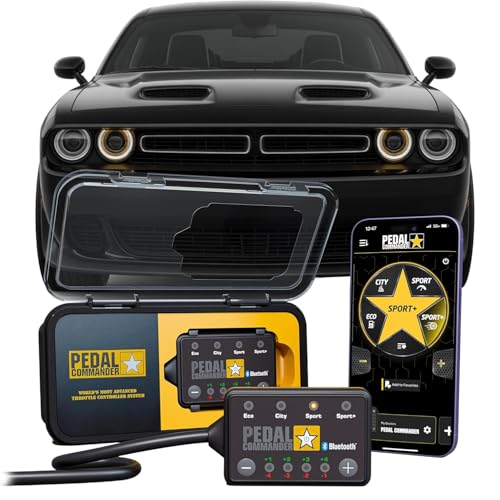
The Pedal Commander throttle response controller for the 2008–2024 Dodge Challenger is designed to change that behavior.
It plugs into the accelerator-pedal harness, offers four driving modes, provides adjustable sensitivity, and can be controlled through a smartphone app.
It does not add horsepower.
It does not increase engine displacement.
It does not transform an SXT into a Scat Pack because you selected Sport+ and turned the radio down.
What it can do is make the Challenger respond more aggressively when you press the accelerator.
For owners who want a sharper pedal without flashing the ECU, that may be exactly the point.
$299.99
What Is the Pedal Commander?
The Pedal Commander is an inline electronic throttle response controller.
It installs between the Challenger’s accelerator-pedal sensor and the factory wiring harness. Once connected, the controller modifies the pedal signal according to the selected mode and sensitivity level.
Modern electronic throttle systems do not directly connect the accelerator pedal to the throttle body. Instead, the pedal sends an electronic request to the vehicle’s control system.
The factory calibration determines how quickly that request becomes throttle opening.
The Pedal Commander changes that response curve.
Depending on the selected setting, the Challenger can feel:
- More responsive from a stop
- More immediate during highway passing
- Less hesitant during rolling acceleration
- Sharper during spirited driving
- Easier to tailor for relaxed or aggressive use
The engine’s maximum output remains unchanged.
The difference is how quickly the driver requests that output through pedal movement.
Compatible Dodge Challenger Models
According to the supplied product information, this Pedal Commander application is compatible with 2008–2024 Dodge Challenger models, including popular trims such as:
- SXT
- R/T
- Scat Pack
- SRT
The listing identifies compatibility with common Challenger engine families including:
- 3.6-liter V6
- 5.7-liter HEMI V8
- 6.4-liter HEMI V8
Trim names, engine combinations, transmissions, and electronic systems vary considerably across the Challenger’s long production run.
Owners should therefore confirm the correct product part number for their exact:
- Model year
- Trim
- Engine
- Pedal connector
- Transmission configuration
A 2008 Challenger SRT8 and a 2024 Challenger SXT may share the same basic nameplate, but that does not mean every electronic accessory should be ordered with the confidence of someone buying floor mats.
Why Does the Challenger Have Throttle Lag?
The Dodge Challenger uses electronic throttle control.
When the driver presses the accelerator, the pedal sends a signal to the vehicle’s control system. The computer then decides how quickly to open the throttle.
Manufacturers calibrate throttle response to balance:
- Smoothness
- Fuel economy
- Emissions
- Traction management
- Drivability
- Passenger comfort
- Transmission behavior
That factory calibration can make the accelerator feel less direct than some drivers expect from a performance coupe.
You press the pedal.
The Challenger receives the request.
It considers the available torque.
It checks whether the rear tires have updated their wills.
Then the throttle responds.
The Pedal Commander is designed to reduce that perceived hesitation by increasing or decreasing pedal sensitivity.
Four Driving Modes
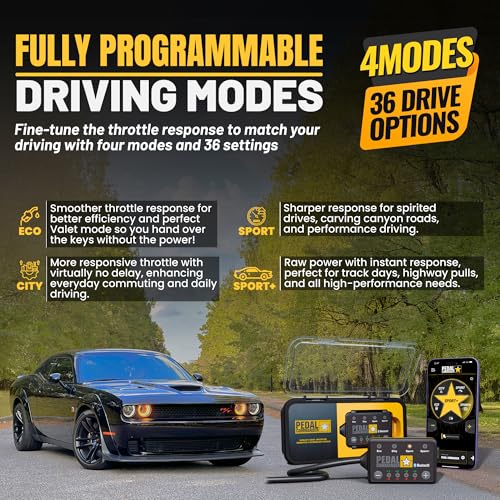
The Pedal Commander offers four primary driving modes:
- Eco
- City
- Sport
- Sport+
Each mode changes the relationship between accelerator movement and throttle request.
Eco Mode
Eco mode reduces pedal sensitivity.
This can be useful for:
- Daily commuting
- Wet-weather driving
- Heavy traffic
- Long highway trips
- Drivers who want smoother acceleration
Eco mode does not reduce the engine’s actual horsepower.
Instead, it requires more pedal movement to request the same throttle response.
This may help encourage smoother driving habits and can make a powerful Challenger easier to manage in low-traction conditions.
It also provides a temporary break from treating every on-ramp like a qualifying session.
City Mode
City mode offers a moderate response increase.
It is intended for normal street driving and may be useful for:
- Urban traffic
- Stop-and-go commuting
- Everyday errands
- Highway merging
- Owners who want sharper response without excessive sensitivity
For many drivers, City mode may provide the best daily balance.
The accelerator feels more awake without turning every small ankle movement into a dramatic event.
Sport Mode
Sport mode provides a stronger increase in throttle sensitivity.
It can make the Challenger feel more immediate during:
- Highway passing
- Rolling acceleration
- Back-road driving
- Spirited street use
- Corner exits
- Manual-transmission rev matching
The engine does not produce more power, but it may feel easier to access because smaller pedal inputs create a stronger throttle request.
Sport mode may be the most useful setting for drivers who want a noticeable improvement without the extreme sensitivity of Sport+.
Sport+ Mode
Sport+ offers the most aggressive response.
Small accelerator movements can produce a much larger throttle request, making the Challenger react quickly during partial-throttle acceleration.
This mode may appeal to drivers who want:
- Maximum pedal sensitivity
- Aggressive straight-line response
- Immediate highway acceleration
- A more dramatic driving experience
- Faster access to wide-open throttle
Sport+ should be used carefully, particularly in:
- Rain
- Snow
- Heavy traffic
- Parking lots
- High-powered V8 models
- Cars with worn or low-grip tires
The most sensitive setting is not automatically the quickest setting.
A 6.4-liter HEMI does not need much persuasion to convert traction into noise.
Does the Pedal Commander Make the Challenger Faster?
This is where marketing language and mechanical reality need to be separated.
It Can Make the Challenger Feel Faster
Because the throttle responds more aggressively, the vehicle may feel:
- Quicker from partial throttle
- More responsive during passing
- Less delayed when leaving a stop
- More eager during highway pulls
- More dramatic during normal driving
A driver may reach a larger throttle opening sooner with less pedal travel.
That can make acceleration feel stronger.
It Does Not Add Horsepower or Torque
The Pedal Commander does not increase:
- Engine displacement
- Airflow capacity
- Fuel delivery
- Ignition timing
- Maximum horsepower
- Maximum torque
- Supercharger boost on applicable models
- Transmission gear ratios
At full throttle, the engine still has the same peak output it had before installation.
Claims about guaranteed faster zero-to-60 times should therefore be treated carefully.
A more aggressive pedal curve may help a driver request full throttle sooner, but acceleration also depends on:
- Tire grip
- Road surface
- Launch technique
- Transmission behavior
- Vehicle weight
- Engine output
- Weather
- Traction-control intervention
The Pedal Commander changes pedal mapping.
It does not suspend the laws of physics, even if Sport+ makes them feel temporarily negotiable.
Pedal Commander on the Challenger SXT
The Challenger SXT is powered by a V6 and is often used as a daily driver.
A throttle response controller may make the SXT feel:
- More alert in traffic
- More responsive when merging
- Quicker during passing
- Less soft at partial throttle
- More engaging without major modifications
It will not create the low-end torque or exhaust sound of a HEMI V8.
It can, however, change how quickly the available V6 power responds to pedal input.
For owners who do not want an ECU tune or major engine modifications, the Pedal Commander offers a reversible way to alter the driving feel.
Pedal Commander on the Challenger R/T
The Challenger R/T uses the 5.7-liter HEMI V8.
These models already offer strong low-speed torque, but the factory pedal calibration can still feel softer than some owners prefer.
The Pedal Commander may make the R/T feel more immediate during:
- Street driving
- Highway passing
- Rolling acceleration
- Manual-transmission shifts
- Normal partial-throttle operation
The controller does not add HEMI power.
It simply changes how eagerly the pedal requests it.
That distinction may sound minor on paper, but it can be noticeable during everyday driving where the engine rarely operates at full throttle.
Pedal Commander on the Challenger Scat Pack
The Scat Pack’s 6.4-liter HEMI already provides substantial power and torque.
A sharper throttle curve can make that output feel even more immediate.
This may appeal to owners who want:
- Faster partial-throttle response
- Stronger highway passing feel
- More aggressive street behavior
- Adjustable response without an ECU flash
However, aggressive settings should be approached carefully.
The Scat Pack already has enough torque to make traction a negotiation rather than a guarantee.
Drivers should begin with a lower City or Sport setting and increase sensitivity gradually.
Pedal Commander on SRT Models
SRT-branded Challenger models were built around higher-performance engines, chassis tuning, brakes, and cooling systems.
On these cars, throttle control can be as important as throttle aggression.
A more responsive pedal may improve the sense of immediacy, but an overly sensitive setting can make smooth power application more difficult.
This matters during:
- Corner exits
- Wet-road driving
- Track use
- High-speed transitions
- Low-speed parking
- Cars running high-performance tires near their traction limits
The most aggressive setting may feel exciting.
That does not mean it is the most effective setting.
Smoothness still matters, even when the hood has enough vents to qualify as commercial ventilation equipment.
Smartphone App Control
The Pedal Commander can be adjusted through a mobile app.
Depending on the specific controller version and current app support, users may be able to:
- Change driving modes
- Adjust sensitivity
- View the selected setting
- Configure the controller from the driver’s seat
- Store preferred response settings
App control adds convenience because the physical controller is usually mounted near the driver’s footwell.
Instead of reaching under the dashboard every time you want to change modes, you can make adjustments through your phone.
Drivers should only change settings when it is safe to do so.
The correct time to explore a performance app is while parked—not while discovering how quickly a Scat Pack closes the gap to the car ahead.
Plug-and-Play Installation
The Pedal Commander is designed to install at the accelerator-pedal connector.
It does not normally require:
- Cutting wires
- Soldering
- ECU flashing
- Engine disassembly
- Drilling
- Permanent interior changes
A typical installation process includes:
- Turn the Challenger off.
- Keep the key or key fob away from the vehicle.
- Allow the electrical system to power down.
- Locate the accelerator-pedal connector.
- Disconnect the factory pedal harness.
- Connect the Pedal Commander inline.
- Secure the module and wiring.
- Pair the controller with the mobile app.
- Select a conservative initial setting.
- Test the system carefully before normal driving.
Installation is commonly described as a relatively quick project, but connector access may vary by year and trim.
The wiring must be secured away from:
- The accelerator pedal
- Brake pedal
- Clutch pedal
- Steering components
- Driver foot movement
A loose wire near the pedals is not a performance feature.
It is a problem that should be corrected before the vehicle moves.
Does It Leave a Footprint on the ECU?
The supplied product information states that the Pedal Commander leaves no footprint on the ECU.
The controller does not perform a conventional engine-computer software flash. Instead, it modifies the pedal signal through an inline connection.
That means it is fundamentally different from a tuner that changes:
- Fuel maps
- Ignition timing
- Torque management
- Transmission calibration
- Rev limits
- Throttle programming inside the ECU
The unit is also physically removable.
However, owners should not interpret “no footprint” as a universal warranty guarantee.
Warranty decisions can depend on:
- The failed component
- The cause of the failure
- Dealer inspection
- Manufacturer policy
- Whether the modification contributed to the issue
- Applicable consumer-protection laws
The safest description is that the Pedal Commander is reversible and does not perform a conventional ECU reflash.
Works With Intakes and Exhaust Systems
The supplied product description says the Pedal Commander can operate alongside common intake and exhaust upgrades.
That includes modifications such as:
- Cold air intakes
- Performance air filters
- Cat-back exhaust systems
- Axle-back exhaust systems
- Headers
- Mid-pipes
- Suspension upgrades
- Wheels and tires
These modifications serve different purposes.
An intake or exhaust may alter airflow and sound.
The Pedal Commander changes accelerator sensitivity.
It does not make those parts produce more power than they otherwise would, but sharper pedal response may make the engine and exhaust feel more immediate during acceleration.
In simpler terms, it does not create more roar.
It may help you request the roar sooner.
Pedal Commander Versus an ECU Tune
A throttle controller and an ECU tune are not the same thing.
Pedal Commander
The Pedal Commander changes:
- Pedal sensitivity
- Throttle-request response
- Partial-throttle feel
It generally does not change:
- Fueling
- Ignition timing
- Peak horsepower
- Peak torque
- Transmission calibration
- Rev limits
ECU Tune
An ECU tune may change:
- Fuel maps
- Ignition timing
- Torque management
- Transmission behavior
- Throttle mapping
- Cooling-fan operation
- Rev limits
- Forced-induction settings
A tune can potentially increase actual engine output.
The Pedal Commander cannot.
The throttle controller is better suited to owners who want a reversible response change without rewriting engine software.
Advantages
- Sharper accelerator response
- Four driving modes
- Adjustable sensitivity
- Smartphone app control
- Plug-and-play installation
- Fully removable design
- No conventional ECU flash
- Compatible with V6 and V8 Challenger trims when properly matched
- Works alongside many intake and exhaust upgrades
- Useful for commuting, highway driving, and spirited street use
Disadvantages
- Does not add horsepower
- Does not increase torque
- Sport+ may feel excessively sensitive
- Cannot overcome poor tires or limited traction
- Does not replace an ECU or transmission tune
- Exact fitment should be confirmed carefully
- Some drivers may prefer the factory throttle calibration
- Aggressive settings may make smooth low-speed driving more difficult
Is the Pedal Commander Worth It for a Dodge Challenger?
The Pedal Commander makes sense for a Challenger owner who:
- Dislikes the factory pedal response
- Wants sharper partial-throttle acceleration
- Prefers a reversible modification
- Does not want to flash the ECU
- Wants multiple response modes
- Uses the car for commuting and spirited driving
- Values responsiveness more than dyno numbers
It makes less sense for an owner expecting:
- Additional horsepower
- Additional torque
- Guaranteed quicker zero-to-60 times
- A substitute for engine tuning
- A mechanical throttle conversion
- Major performance gains at full throttle
The product is best understood as a driver-response upgrade.
It changes how the Challenger reacts to your foot.
It does not change the engine’s maximum capability.
Final Thoughts
The Dodge Challenger spent more than a decade proving that the traditional American muscle car still had an audience.
It offered V6 practicality, HEMI V8 power, retro styling, rear-wheel drive, and enough trim combinations to make ordering one feel like building a character in a racing game.
The Pedal Commander does not add power to that formula.
It focuses on one specific area: throttle response.
With Eco, City, Sport, and Sport+ modes, owners can adjust the Challenger for relaxed cruising, normal commuting, spirited driving, or aggressive pedal response. The plug-and-play design also makes it appealing to drivers who want a noticeable change without a conventional ECU tune.
It will not turn an SXT into an R/T.
It will not turn an R/T into a Scat Pack.
It will not turn a Scat Pack into something with an insurance premium visible from space.
What it can do is make the car respond more immediately when the accelerator is pressed.
For some Challenger owners, that may be the simplest way to make a familiar muscle car feel awake again.
Frequently Asked Questions
Does the Pedal Commander add horsepower to a Dodge Challenger?
No. It changes accelerator-pedal sensitivity but does not increase the engine’s peak horsepower or torque.
Which Dodge Challenger models are compatible?
According to the supplied product information, the controller fits 2008–2024 Challenger models, including SXT, R/T, Scat Pack, and SRT trims. Exact fitment should be confirmed before ordering.
Does it work with the Challenger SXT?
The product is listed for compatible V6-powered Challenger models, including the SXT. It can sharpen throttle response but will not increase engine output.
Does it work with the Challenger R/T?
Yes, according to the supplied application information. The controller changes pedal response on compatible 5.7-liter HEMI models.
Can it be used on a Challenger Scat Pack?
The product listing includes Scat Pack applications. Owners should begin with a lower sensitivity setting because the 6.4-liter HEMI already produces substantial torque.
Does the Pedal Commander require an ECU tune?
No. It connects at the accelerator-pedal harness and does not perform a conventional ECU software flash.
Can the Pedal Commander improve zero-to-60 times?
It does not add power. A more aggressive pedal response may help a driver request full throttle sooner, but quicker acceleration times are not guaranteed.
Does it work with a cold air intake or exhaust?
The supplied product description says it can operate alongside common intake and exhaust modifications. Each upgrade performs a different function.
Can the Pedal Commander be removed?
Yes. The inline installation is designed to be reversible.
Is Sport+ the best mode for every Challenger?
No. Sport+ provides maximum sensitivity, but City or Sport may offer better control for daily driving, wet conditions, or high-powered V8 models.
Specification: Pedal Commander for 2008–2024 Dodge Challenger: Sharper Throttle Response Without an ECU Tune
|
User Reviews
Be the first to review “Pedal Commander for 2008–2024 Dodge Challenger: Sharper Throttle Response Without an ECU Tune”
You must be logged in to post a review.





There are no reviews yet.