


Pedal Commander for 2007–2018 Dodge Ram 1500: Throttle Response, HEMI Performance, Towing, and Off-Road Use
The 2007–2018 Dodge Ram and Ram 1500 lineup covers two generations, two brand names, several transmissions, and enough engine combinations to make a broad online fitment description dangerously optimistic.
These trucks served as basic work vehicles, family haulers, tow rigs, lifted off-road builds, luxury commuters, and mobile storage units for ratchet straps that were never where anyone remembered leaving them.
Many also share a familiar complaint: softened electronic throttle response.
Instead of using a mechanical throttle cable, compatible Ram 1500 models use an electronic accelerator pedal. Pressing the pedal sends a signal to the powertrain-control system, which calculates how much throttle or engine torque to request.
That factory calibration must balance smooth acceleration, emissions, traction, transmission behavior, fuel economy, and driveline protection. As a result, the pedal can feel slower or less direct than some drivers prefer.
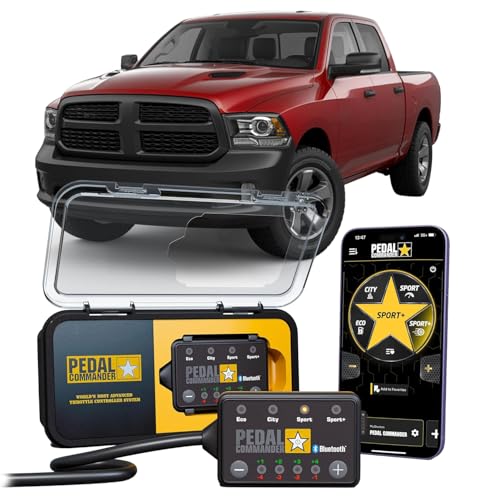
The Pedal Commander for the 2007–2018 Dodge Ram 1500 is designed to change that relationship.
It installs at the accelerator-pedal sensor and offers four response modes with nine adjustment levels each, creating 36 settings. Current Pedal Commander systems also support wireless app control and an optional subscription-based Anti-Theft feature.
It does not add horsepower.
It does not increase torque.
It does not restore power lost to larger tires, armor, or overland equipment.
It does not increase towing or payload capacity.
What it can do is make a correctly matched Ram 1500 feel more responsive during commuting, highway merging, passing, towing, hauling, and off-road driving.
Before buying one, however, shoppers need to understand that the supplied engine list combines genuine Ram 1500 applications with engines that belong primarily to heavy-duty Ram trucks.
That distinction is more important than the marketing copy makes it sound.
$299.99
Important Compatibility Warning
The supplied product listing claims compatibility with 2007–2018 Ram trucks using:
- 3.0-liter engines
- 3.6-liter engines
- 5.7-liter engines
- 6.4-liter engines
- 6.7-liter engines
That list should not be interpreted as an accurate North American Ram 1500 engine history.
For a 2007–2018 Ram 1500, the commonly relevant engines include:
- 3.7-liter gasoline V6
- 4.7-liter gasoline V8
- 3.6-liter Pentastar gasoline V6
- 5.7-liter HEMI V8
- 3.0-liter EcoDiesel V6
The listing omits the 3.7-liter and 4.7-liter engines, despite both being legitimate Ram 1500 powerplants during parts of the covered period.
At the same time, it includes the 6.4-liter HEMI and 6.7-liter Cummins, which are associated primarily with Ram 2500 and Ram 3500 heavy-duty trucks, not the regular Ram 1500 covered by this title.
Ram’s official 2018 towing documentation lists the half-ton Ram 1500 with the 3.6-liter V6, 5.7-liter HEMI V8, and 3.0-liter EcoDiesel—not a 6.4-liter HEMI or 6.7-liter Cummins.
The statement “not compatible with 2011–2014 HO” also appears more relevant to a heavy-duty Cummins application than to a normal Ram 1500 listing. A high-output 6.7-liter Cummins was not a conventional 2007–2018 Ram 1500 engine option.
The most likely explanation is that the marketplace copy blends fitment information from multiple Ram truck products.
Therefore:
Confirm the controller by exact year, engine, model, and pedal connector before ordering. Do not assume that every engine named in the listing belongs in a Ram 1500.
Dodge Ram Versus Ram 1500 Naming
The covered years also cross an important branding change.
Earlier trucks were sold as the Dodge Ram 1500. Ram later became a separate truck brand, so newer vehicles were officially sold as the Ram 1500 rather than the Dodge Ram 1500.
Owners and parts sellers still use both names interchangeably, which is understandable.
Google certainly does.
For search and fitment purposes, relevant terms include:
- Dodge Ram 1500
- Ram 1500
- Dodge 1500
- Ram truck
- Third-generation Dodge Ram
- Fourth-generation Ram 1500
The badge wording changed.
The need to verify an electronic part before connecting it to the accelerator did not.
What Is the Pedal Commander?
The Pedal Commander is an inline electronic throttle-response controller.
It connects between the accelerator-pedal position sensor and the factory wiring harness. The controller then modifies the pedal signal based on the selected mode and sensitivity level.
It changes:
- Accelerator sensitivity
- Partial-throttle response
- The pedal travel needed to request acceleration
- The perceived hesitation after pressing the pedal
- How gradual or aggressive the accelerator feels
It does not directly change:
- Peak horsepower
- Peak torque
- Fuel maps
- Ignition timing
- Diesel injection quantity
- Turbocharger boost
- Transmission ratios
- Axle ratios
- Tow ratings
- Payload limits
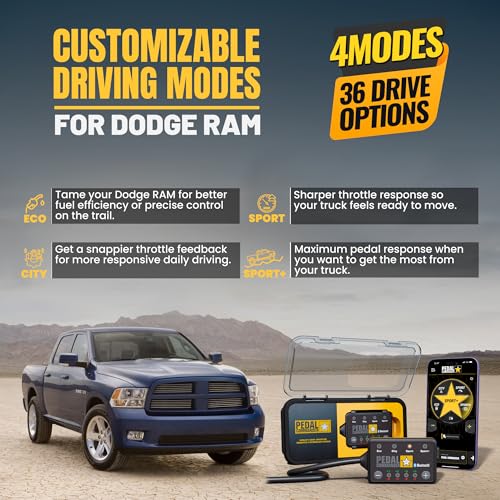
Pedal Commander describes its system as using four programmable modes—Eco, City, Sport, and Sport+—with nine sensitivity levels in each mode. That produces 36 available response settings.
A truck may feel quicker because less pedal travel requests more throttle.
That is not the same as making more power.
Why Does a Ram 1500 Have Throttle Lag?
The electronic accelerator does not directly open the throttle body like an old cable system.
Instead, the truck interprets the driver’s input while considering factors such as:
- Engine speed
- Transmission gear
- Vehicle speed
- Requested torque
- Traction-control activity
- Stability-control intervention
- Engine temperature
- Emissions operation
- Driveline protection
- Vehicle load
Factory calibration has to work for many situations, from an empty two-wheel-drive regular cab to a four-wheel-drive crew cab towing a trailer through poor weather.
That broad compromise can create a softer initial response.
The delay may feel more noticeable when the truck is:
- Pulling a trailer
- Carrying payload
- Running larger tires
- Equipped with heavier wheels
- Lifted
- Carrying bumpers, winches, or skid plates
- Loaded with overland equipment
- Climbing a grade
- Entering fast-moving traffic
You press the pedal.
The Ram checks the engine, transmission, traction, load, and whether the contents of the bed were secured with actual straps or just reassuring eye contact.
Then it accelerates.
The Pedal Commander changes the pedal curve so the truck can respond more strongly to a smaller input.
Four Pedal Commander Driving Modes
The four modes are:
- Eco
- City
- Sport
- Sport+
Each mode contains nine adjustment levels, resulting in 36 combinations.
Eco Mode
Eco mode softens accelerator response.
It requires more pedal movement to request the same level of acceleration, creating a more progressive pedal.
Eco mode may be useful for:
- Snow and ice
- Rain
- Trailer backing
- Hitching a trailer
- Technical trails
- Crowded worksites
- Stop-and-go traffic
- Relaxed highway travel
Eco does not reduce the engine’s maximum available output.
It simply makes the power easier to apply gradually.
Can Eco Mode Save Fuel?
It may help some drivers accelerate more smoothly, which can support better driving habits.
It does not guarantee improved fuel economy.
Mileage still depends on:
- Engine
- Speed
- Payload
- Trailer weight
- Tire size
- Lift height
- Aerodynamic drag
- Road grade
- Wind
- Driver behavior
Eco can make the pedal calmer.
It cannot make a lifted HEMI truck carrying a rooftop tent stop displacing enough air to influence local weather.
City Mode
City mode provides a moderate increase in accelerator sensitivity.
It is usually the most practical starting point for:
- Daily commuting
- Urban traffic
- Highway merging
- General street use
- Light towing
- Work trucks
- Trucks carrying permanent equipment
City mode can make the Ram feel more alert without becoming excessively abrupt.
This may be especially useful on trucks equipped with:
- Toolboxes
- Bed caps
- Steel bumpers
- Winches
- Service equipment
- Recovery gear
- Larger all-terrain tires
The controller does not remove any of that weight.
It changes how quickly the truck reacts while moving it.
Sport Mode
Sport mode delivers a more noticeable increase in pedal sensitivity.
It may improve the driving feel during:
- Highway merging
- Passing
- Grade climbing
- Unloaded driving
- Moderate towing
- Faster dirt-road travel
- Driving with heavier tires
Sport mode makes the existing output feel more accessible during partial-throttle driving.
It does not add horsepower or torque.
For many 5.7-liter HEMI owners, a mild or moderate Sport setting may provide the strongest useful improvement without making the pedal difficult to control.
Sport+ Mode
Sport+ provides the most aggressive throttle response.
A relatively small pedal movement can request a much stronger response, making the truck feel dramatically sharper.
Sport+ may appeal to drivers wanting:
- Maximum pedal sensitivity
- Aggressive unloaded response
- Faster access to full throttle
- A substantial change from stock
- Sharper highway acceleration feel
Sport+ should be used carefully when:
- Towing
- Driving in rain or snow
- Traveling on gravel
- Carrying unsecured cargo
- Operating off road
- Driving a two-wheel-drive truck with an empty bed
- Using a high-output V8
Sport+ does not create more power.
It asks for the available power more aggressively.
A HEMI Ram already possesses enough torque to move the contents of the center console into a different postal district.
Maximum sensitivity is not automatically the most useful setting.
Understanding the 36 Settings
The nine levels within each mode let the driver fine-tune response.
Possible starting points include:
- Eco -4 for ice or snow
- Eco -2 for trailer maneuvering
- City -1 for normal commuting
- City +2 for a truck carrying permanent equipment
- Sport -2 for highway travel
- Sport +1 for unloaded driving
- A low Sport+ level before trying maximum sensitivity
The best setting depends on:
- Engine
- Transmission
- Tire size
- Vehicle weight
- Trailer weight
- Payload
- Terrain
- Weather
- Driver preference
A setting that feels appropriate in a 3.6-liter V6 may feel excessive in a lightly loaded HEMI truck.
The best setting is the one that remains smooth and predictable.
Not the one that produces the most dramatic first trip around the block.
Wireless App Control
Supported Pedal Commander units can be managed through the company’s smartphone app.
Depending on the hardware version and current app functions, drivers may be able to:
- Change modes
- Adjust sensitivity
- View the active setting
- Access Anti-Theft
- Control the unit without reaching under the dashboard
The app is convenient, particularly when the physical module is mounted near the lower dash or pedal area.
Settings should be adjusted while parked.
Using a phone to select a response mode while entering a freeway is an elegant way to defeat the safety benefit the driver was supposedly trying to obtain.
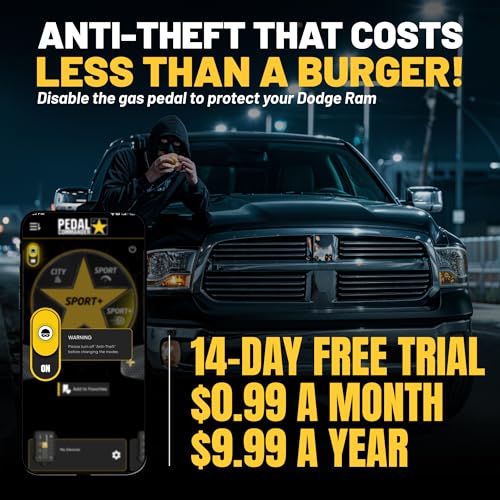
Pedal Commander Anti-Theft
Pedal Commander’s optional Anti-Theft service is designed to disable normal accelerator response when activated through the app.
This may be useful when the truck is parked at:
- Worksites
- Trailheads
- Hotels
- Parking garages
- Remote camping areas
- Equipment yards
- Long-term storage locations
The feature should be treated as an additional security layer—not complete theft prevention.
It does not replace:
- The factory immobilizer
- An alarm
- Secure key storage
- GPS tracking
- Steering-wheel locks
- Physical barriers
- Secure parking
Disabling the accelerator can make it harder to drive the truck away normally.
It cannot prevent towing, key theft, physical entry, or every electronic attack.
Owners should also confirm current Anti-Theft pricing and subscription terms before purchasing, since app features and service plans can change.
Pedal Commander for the 3.7-Liter V6
The supplied engine list does not mention the 3.7-liter gasoline V6, even though it was offered in earlier Ram 1500 trucks.
On a compatible application, the Pedal Commander may make a 3.7-liter Ram feel:
- More responsive from a stop
- Sharper in city traffic
- Less hesitant while merging
- More immediate at partial throttle
- More alert with a light load
It will not give the 3.7-liter the power of a HEMI.
It simply changes how quickly the driver requests the output already available.
Because this engine is omitted from the marketplace description, owners should verify whether the exact controller part number supports it.
Pedal Commander for the 4.7-Liter V8
The 4.7-liter gasoline V8 was another legitimate Ram 1500 engine omitted from the supplied compatibility list.
A compatible throttle controller may improve the perceived response during:
- Everyday driving
- Highway merging
- Passing
- Light towing
- Driving with larger tires
The controller does not increase 4.7-liter horsepower or torque.
It may make the truck feel more eager because the pedal requests stronger acceleration sooner.
Exact year and connector compatibility should be verified before ordering.
Pedal Commander for the 3.6-Liter Pentastar V6
The 3.6-liter Pentastar became the regular V6 choice in later fourth-generation Ram 1500 trucks.
Ram’s official 2018 towing chart identifies the 3.6-liter V6 as one of the available half-ton engines.
A Pedal Commander may make a 3.6-liter Ram feel:
- Quicker to respond from a stop
- More alert in city traffic
- Less delayed during highway entry
- More immediate with passengers or cargo
- Sharper during moderate grade climbing
It does not add horsepower or torque.
The V6 still has to move the same truck, cargo, tires, and accessories.
The driver simply reaches the available response earlier in the pedal’s travel.
Pedal Commander for the 5.7-Liter HEMI V8
The 5.7-liter HEMI is the engine most commonly associated with this generation of Ram 1500.
Ram’s official 2018 documentation confirms the 5.7-liter HEMI as a major half-ton powertrain.
A Pedal Commander may make a HEMI Ram feel:
- More immediate at partial throttle
- Sharper during passing
- More responsive when merging
- Less softened while towing
- More aggressive during unloaded driving
The controller does not increase HEMI output.
It changes accelerator sensitivity.
Because the 5.7-liter already delivers substantial torque, owners should raise sensitivity gradually.
City or a mild Sport setting may offer a stronger everyday improvement than maximum Sport+.
The HEMI does not need motivational coaching.
It may simply benefit from the accelerator sending a less diplomatic request.
Pedal Commander for the 3.0-Liter EcoDiesel
The 3.0-liter EcoDiesel became available in later fourth-generation Ram 1500 trucks.
Official Ram towing documents for applicable 2016 and 2018 trucks identify the 3.0-liter diesel alongside the 3.6-liter V6 and 5.7-liter HEMI.
A compatible Pedal Commander may make the EcoDiesel feel:
- More responsive while pulling away
- Sharper during highway passing
- Less delayed while climbing a grade
- More immediate during towing
- More alert in everyday traffic
It does not increase:
- Turbo boost
- Diesel fuel delivery
- Horsepower
- Torque
- Exhaust-brake capability
- Towing capacity
EcoDiesel owners should verify the exact model year because the engine was not available throughout the entire 2007–2018 period.
A throttle controller should also never be mistaken for a solution to engine, emissions-system, turbocharger, transmission, or maintenance problems.
What About the 6.4-Liter HEMI?
The supplied listing includes a 6.4-liter engine.
That is a major reason shoppers should verify the product instead of relying on the marketplace title.
The 6.4-liter HEMI is chiefly associated with Ram heavy-duty trucks such as the 2500 and 3500, not the conventional 2007–2018 Ram 1500 covered by this article.
Pedal Commander maintains separate heavy-duty Ram applications, and its Ram 2500 materials specifically discuss HEMI and Cummins compatibility.
An owner with a 6.4-liter Ram should shop by the exact heavy-duty model:
- Ram 2500
- Ram 3500
- Exact model year
- Exact pedal connector
- Exact controller part number
Do not order a Ram 1500 unit merely because a marketplace bullet point includes “6.4L.”
What About the 6.7-Liter Cummins?
The 6.7-liter Cummins is not a normal 2007–2018 Ram 1500 engine.
It belongs to Ram heavy-duty pickups and chassis-cab applications.
Pedal Commander’s official Ram 2500 and Ram 3500 pages discuss dedicated Cummins-compatible products.
Therefore, a truck with a 6.7-liter Cummins should not be treated as a Ram 1500 application.
The listing’s “2011–2014 HO” exclusion also appears likely to relate to one of these heavy-duty diesel applications.
Owners of Cummins trucks should use a controller specifically verified for their:
- Ram 2500 or 3500
- Model year
- Standard- or high-output engine
- Transmission
- Pedal connector
Combining half-ton and heavy-duty fitment information in one product description is not helpful.
It is the automotive-parts equivalent of labeling every socket in a toolbox “probably close enough.”
Pedal Commander for Towing
A Ram 1500 may tow:
- Travel trailers
- Boats
- Utility trailers
- Car trailers
- Landscaping trailers
- Enclosed cargo trailers
- Off-road campers
A sharper accelerator may improve the feel of:
- Highway merging
- Pulling away from a stop
- Climbing grades
- Rejoining traffic
- Passing
- Maintaining momentum
It does not increase the truck’s tow rating.
The official towing limit remains determined by factors such as:
- Engine
- Transmission
- Axle ratio
- Cab configuration
- Bed length
- Drivetrain
- Equipment
- Payload
- Hitch type
Ram’s official 2018 towing chart shows substantial capacity differences among configurations, even when the trucks share the same engine.
Best Pedal Commander Setting for Towing
City or a moderate Sport setting may provide the most useful balance.
Sport+ can make the pedal too sensitive, causing:
- Abrupt starts
- Trailer surging
- Excessive downshifting
- Cargo movement
- Reduced traction
- Difficult low-speed maneuvering
- Higher fuel use
Smooth acceleration is normally more valuable than maximum response.
The trailer does not care how sporty the accelerator feels.
It cares whether the contents arrive in approximately the same arrangement in which they departed.
Pedal Commander for Hauling
Payload can make a Ram 1500 feel less responsive because the engine must accelerate additional mass.
Common loads include:
- Tools
- Construction materials
- Firewood
- Landscaping supplies
- Camping equipment
- Spare parts
- Motorcycles
- Work gear
The Pedal Commander cannot reduce the load or increase payload capacity.
It may make the pedal feel more immediate during:
- City driving
- Highway entry
- Hill climbing
- Pulling away from stops
- Passing with a loaded bed
A moderate setting is normally preferable to maximum sensitivity.
The goal is controlled movement.
Not discovering which pieces of cargo were secured through optimism alone.
Lifted Ram 1500 Trucks and Larger Tires
Lift kits and oversized tires can improve:
- Ground clearance
- Tire clearance
- Off-road capability
- Approach angles
- Appearance
They can also increase:
- Rotational mass
- Unsprung weight
- Aerodynamic drag
- Effective gearing
- Overall vehicle weight
A Pedal Commander may make a modified truck feel more responsive.
It cannot mechanically correct the effects of larger tires.
It does not change:
- Axle ratios
- Tire diameter
- Tire weight
- Vehicle mass
- Transmission gearing
- Aerodynamic drag
If the truck is genuinely undergeared, differential regearing may still be the correct solution.
The Pedal Commander can alter the pedal curve.
It cannot persuade a 37-inch mud tire that it is still a factory all-season.
Bumpers, Winches, Armor, and Overland Gear
The supplied listing says the controller works alongside modifications such as:
- Steel bumpers
- Rock sliders
- Skid plates
- Winches
- Roof racks
- Rooftop tents
- Overland equipment
Those components do not normally prevent a throttle controller from operating, assuming the truck itself has the correct compatible pedal system.
However, the Pedal Commander does not compensate mechanically for their weight or drag.
It cannot:
- Remove added mass
- Improve aerodynamics
- Restore lost horsepower
- Raise payload capacity
- Strengthen the suspension
- Correct an overloaded axle
It can make the truck feel more responsive by requesting throttle sooner.
The distinction is important because a heavily equipped truck may need actual mechanical changes, including:
- Appropriate springs or dampers
- Correct axle gearing
- Better brakes
- Proper tire load ratings
- Reduced cargo
- Careful payload calculations
A more sensitive pedal is useful.
It is not a suspension system, weight-loss program, or exemption from the door-jamb payload label.
Pedal Commander for Off-Road Driving
Different surfaces benefit from different pedal behavior.
Rocks and Technical Trails
Eco mode may provide better low-speed precision.
A softer pedal can help reduce:
- Wheelspin
- Lurching
- Abrupt weight transfer
- Unwanted throttle spikes
Dirt Roads
City or a mild Sport setting may sharpen response without making the truck difficult to control.
Mud
Excessive sensitivity may create unnecessary wheelspin.
A moderate setting can be more useful than Sport+.
Sand
Sharper response may help maintain momentum, but abrupt inputs can still dig the tires deeper.
Snow and Ice
Eco mode may make torque easier to apply gradually.
The controller does not increase traction.
It changes how quickly the driver requests the torque sent toward the tires.
Plug-and-Play Installation
The Pedal Commander connects inline at the accelerator-pedal sensor.
A typical installation involves:
- Park the truck securely.
- Turn off the engine.
- Remove the key or move the key fob away.
- Allow the electrical system to power down.
- Locate the pedal-position-sensor connector.
- Disconnect the factory harness.
- Connect the Pedal Commander inline.
- Confirm that both connectors are fully seated.
- Secure the module and wiring.
- Keep the harness clear of pedal movement.
- Pair the unit with the app.
- Begin with a conservative setting.
- Test the accelerator before normal driving.
Installation normally does not require:
- Cutting wires
- Soldering
- Drilling
- ECU flashing
- Permanent interior changes
- Using the OBD-II port
The supplied listing estimates approximately 15 minutes.
Actual time depends on access, connector location, driver size, lighting, and whether the last person under the dashboard believed wire ties were an optional concept.
All wiring must remain clear of:
- Accelerator travel
- Brake-pedal movement
- Parking-brake hardware
- Steering components
- Driver footwear
A loose controller harness in the pedal area is a safety problem, not a cosmetic issue.
Does It Alter the ECU?
The Pedal Commander does not perform a conventional ECU reflash.
It works through the pedal signal rather than rewriting:
- Fuel maps
- Ignition tables
- Diesel injection calibration
- Turbocharger programming
- Transmission software
- Emissions controls
- Rev limits
- Engine-protection strategies
When removed, the factory pedal harness can be reconnected.
That makes the installation reversible.
However, claims that it can never leave a diagnostic code or electronic trace should be treated carefully.
A fault could potentially be triggered by:
- Installing the controller before the truck powers down
- An incompletely seated connector
- Damaged wiring
- Corrosion
- Incorrect fitment
- A defective component
- Improper removal
The accurate claim is that it does not perform a conventional software tune.
That is different from promising that no electronic accessory could ever cause a fault under any circumstance.
Does It Preserve the Factory Warranty?
The lack of an ECU reflash may make the Pedal Commander less intrusive than conventional engine tuning.
It does not guarantee that every warranty claim will be approved automatically.
A manufacturer or dealer may consider:
- Which component failed
- Whether the controller contributed
- Installation quality
- Diagnostic findings
- Other modifications
- Applicable warranty law
The responsible description is:
- The controller is removable.
- It does not rewrite factory engine software.
- It operates through the accelerator-pedal circuit.
That is not the same as an unconditional lifetime promise about every dealer decision.
Does Pedal Commander Add Horsepower?
No.
It does not increase:
- Horsepower
- Torque
- Turbo boost
- Fuel delivery
- Airflow
- Engine displacement
- Towing capacity
- Payload capacity
- Axle strength
- Transmission capacity
The truck may feel faster because the pedal reaches a stronger throttle request sooner.
At wide-open throttle, the engine still produces the same maximum output.
Pedal Commander is therefore a throttle-response controller, not a conventional power adder.
Will It Make a Ram 1500 Faster?
It may help the driver request full throttle more quickly.
That does not guarantee a meaningful improvement in measured acceleration.
Actual performance still depends on:
- Engine output
- Transmission
- Truck weight
- Tire size
- Axle ratio
- Traction
- Payload
- Trailer weight
- Road grade
- Weather
The greatest difference is normally felt during partial-throttle driving.
That is where changing the pedal map can make a truck feel dramatically more immediate without changing its actual peak power.
Pedal Commander Versus an ECU Tune
A Pedal Commander and an ECU tune perform different jobs.
Pedal Commander
It changes:
- Pedal sensitivity
- Partial-throttle response
- Perceived accelerator delay
It generally does not change:
- Fuel delivery
- Ignition timing
- Turbocharger boost
- Peak horsepower
- Peak torque
- Transmission programming
ECU Tune
A properly developed tune may alter:
- Fuel mapping
- Ignition timing
- Torque management
- Turbocharger control
- Transmission shift behavior
- Throttle mapping
- Rev limits
- Cooling-fan settings
A tune may produce measurable horsepower and torque gains.
The Pedal Commander is for owners who want adjustable accelerator feel without rewriting the truck’s factory powertrain software.
Advantages
- Sharper accelerator response
- Eco, City, Sport, and Sport+ modes
- 36 total settings
- Wireless app control
- Optional Anti-Theft service
- Reversible installation
- No conventional ECU flash
- No wire cutting
- Does not require the OBD-II port
- Useful for commuting and highway passing
- Adjustable for towing and hauling
- Can soften response for slippery conditions
- May improve perceived response with larger tires
- Useful across several engines when correctly matched
Disadvantages
- Does not add horsepower
- Does not increase torque
- Does not raise towing capacity
- Does not increase payload capacity
- Does not correct axle gearing
- Sport+ may be too aggressive while towing
- Aggressive modes may reduce trail precision
- Anti-Theft may require a subscription
- Exact fitment must be verified
- The supplied engine list is misleading
- The 6.4-liter and 6.7-liter claims appear to involve HD trucks
- Legitimate 3.7-liter and 4.7-liter engines are omitted
- The “2011–2014 HO” exclusion requires clarification
- Warranty coverage cannot be universally guaranteed
Is Pedal Commander Worth It for a 2007–2018 Ram 1500?
It may be worth considering for an owner who:
- Dislikes the factory pedal response
- Wants more immediate highway merging
- Regularly tows or hauls
- Drives a lifted truck
- Uses larger tires
- Carries permanent work equipment
- Wants adjustable response for different conditions
- Prefers a reversible modification
- Does not want an ECU tune
- Values drivability more than dyno numbers
It makes less sense for someone expecting:
- Additional horsepower
- More torque
- Increased towing capacity
- Increased payload capacity
- Guaranteed fuel savings
- A cure for incorrect axle gearing
- A replacement for engine tuning
- A solution to mechanical or emissions-system problems
The Pedal Commander changes how quickly the truck responds to the accelerator.
It does not change the mechanical limits of the engine, transmission, brakes, chassis, tires, axles, or hitch.
Final Verdict
The 2007–2018 Dodge Ram and Ram 1500 lineup includes some of the most recognizable modern American pickups.
These trucks could be powered by a basic V6, a 4.7-liter V8, the familiar 5.7-liter HEMI, or the later 3.0-liter EcoDiesel. They could also be configured for work, luxury, towing, off-road use, or a combination of all four.
The Pedal Commander does not add power to any of them.
It changes how the driver accesses the power already available.
Eco can soften response for snow, trailer backing, or technical terrain. City can make daily driving more alert. Sport can sharpen passing and merging, while Sport+ provides the most aggressive pedal map.
Its 36 settings allow the response to be adjusted for different engines, loads, tires, and driving conditions.
The most important issue is fitment.
The supplied listing appears to blend Ram 1500 and heavy-duty Ram applications. A 6.4-liter HEMI or 6.7-liter Cummins owner should not assume this Ram 1500 product is correct, while owners of legitimate 3.7-liter and 4.7-liter half-ton trucks should not assume they are excluded merely because the listing forgot their engines.
Verify the exact part number first.
Once correctly matched, the Pedal Commander may make an older Ram feel considerably more responsive without a conventional ECU tune or permanent wiring changes.
It will not add horsepower.
It will not increase the tow rating.
It will not make a lifted HEMI truck carrying armor, camping equipment, a winch, and oversized tires forget that weight and rotational mass remain real.
But it may make the accelerator stop taking every request under advisement.
Frequently Asked Questions
Does Pedal Commander add horsepower to a Ram 1500?
No. It changes accelerator sensitivity but does not increase peak horsepower or torque.
Is Pedal Commander compatible with 2007–2018 Ram 1500 trucks?
The supplied listing claims that range, but exact compatibility must be verified by year, engine, model, and pedal connector.
Does it work with the 5.7-liter HEMI?
The supplied listing includes compatible 5.7-liter applications. The HEMI was also an official engine in the 2018 Ram 1500 lineup.
Does it work with the 3.6-liter Pentastar?
The listing includes compatible 3.6-liter applications. The engine applies only to later years within the full 2007–2018 range.
Does it work with the 3.0-liter EcoDiesel?
The listing includes applicable 3.0-liter engines. Ram’s official towing documents confirm the EcoDiesel in later fourth-generation Ram 1500 trucks.
Does it work with the 3.7-liter V6?
The marketplace description omits the 3.7-liter even though it was used in earlier Ram 1500 trucks. Verify the exact Pedal Commander part number before purchasing.
Does it work with the 4.7-liter V8?
The product description also omits the 4.7-liter. Exact controller compatibility should be checked by model year and connector.
Was the 6.4-liter HEMI offered in the regular Ram 1500?
The 6.4-liter is primarily a Ram heavy-duty engine. Owners of 6.4-liter trucks should shop for the correct Ram 2500 or 3500 application rather than assuming a Ram 1500 controller fits.
Was the 6.7-liter Cummins offered in the Ram 1500?
No conventional North American 2007–2018 Ram 1500 used the 6.7-liter Cummins. Pedal Commander offers separate heavy-duty Ram applications for Cummins trucks.
What does “not compatible with 2011–2014 HO” mean?
The listing does not provide enough detail to establish this clearly. It most likely relates to a heavy-duty high-output diesel application rather than the normal Ram 1500. Confirm directly using the product part number.
Is Pedal Commander useful for towing?
It can make the pedal feel more immediate during merging and grade climbing. It does not increase the truck’s official towing capacity.
Which mode is best for towing?
City or a moderate Sport setting is generally a better starting point than maximum Sport+.
Can Pedal Commander help with larger tires?
It may improve perceived response, but it cannot correct the effective gearing and added rotational weight caused by oversized tires.
Does it compensate for bumpers and overland gear?
It may make the accelerator feel more responsive, but it cannot eliminate added weight, aerodynamic drag, or payload use.
Does Pedal Commander alter the ECU?
It does not perform a conventional ECU software flash. It operates through the pedal-position-sensor circuit.
Can it trigger a diagnostic code?
It is designed to operate without faults when correctly matched and installed, but an incompatible unit, poor connection, damaged harness, or improper installation could potentially trigger a pedal-related code.
Can it be removed?
Yes. The inline installation is designed to be reversible.
Specification: Pedal Commander for 2007–2018 Dodge Ram 1500: Throttle Response, HEMI Performance, Towing, and Off-Road Use
|
User Reviews
Be the first to review “Pedal Commander for 2007–2018 Dodge Ram 1500: Throttle Response, HEMI Performance, Towing, and Off-Road Use”
You must be logged in to post a review.





There are no reviews yet.