
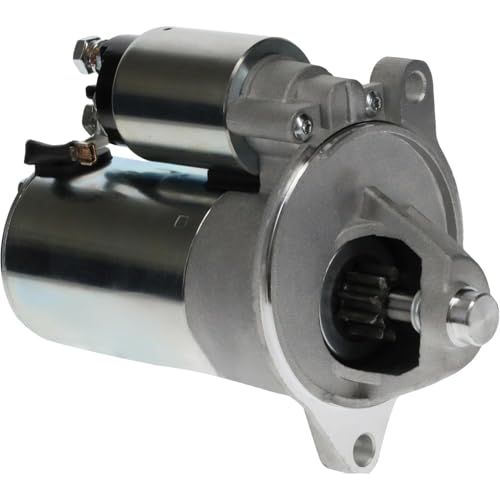


OEG Parts CW PMGR Starter for Ford, Lincoln and Mercury Applications
The OEG Parts replacement starter is a new 12-volt, clockwise-rotation permanent-magnet gear-reduction unit designed for select Ford, Lincoln and Mercury automotive and marine applications. Its compact PMGR construction provides greater exhaust-header clearance than many older direct-drive starters and may provide more consistent cranking when exposed to underhood heat.
Despite the product title emphasizing Ford 5.0-liter and 5.8-liter V8 engines, the supplied interchange also includes certain 3.8-liter V6, 3.9-liter V6, 4.2-liter V6 and 4.9-liter inline-six applications. Buyers must match the original part number, mounting flange, electrical connections, pinion position and flywheel or flexplate configuration before ordering.
Starter Specifications
| Specification | Listed value |
|---|---|
| Condition | New |
| Voltage | 12 volts |
| Starter type | PMGR |
| Rated output | 1.4 kW |
| Rotation | Clockwise |
| Pinion teeth | 10 |
| Quantity | One starter |
| Mounting hardware | Not included |
| Country of origin | China |
Rotation must be interpreted according to the starter manufacturer’s viewing convention. Do not confirm fitment from “CW” alone.
$59.95
Supplied Vehicle Applications
The listing provides the following examples:
| Make and model | Trim | Engine | Years |
|---|---|---|---|
| Ford F-150 | XL | 4.9L inline-six | 1992–1996 |
| Ford F-150 | XLT | 4.9L inline-six | 1993–1996 |
| Ford F-150 | XL | 5.0L V8 | 1992–1996 |
| Ford F-150 | XLT | 5.0L V8 | 1993–1996 |
| Ford F-150 | Base | 4.2L V6 | 1997–1998 |
| Ford Mustang | Base | 3.8L V6 | 1997–2004 |
| Ford Mustang | Base | 3.9L V6 | 2004 |
These are only the applications specifically identified in the supplied copy. The broader title suggests additional Ford, Lincoln, Mercury and marine uses, but those vehicles should not be published as confirmed without a complete application catalog.
Engine-Family Coverage
Potential applications may involve select versions of:
- Ford 3.8-liter Essex V6
- Ford 3.9-liter Essex V6
- Ford 4.2-liter Essex V6
- Ford 4.9-liter inline-six
- Ford 5.0-liter 302 V8
- Ford 5.8-liter 351 V8
- Marine-converted Ford 302 engines
- Marine-converted Ford 351 engines
Engine displacement alone does not confirm starter compatibility. Ford used different bellhousings, transmissions, flywheels, flexplates, electrical systems and starter arrangements across these engine families.
A starter advertised as fitting “Ford 302” should not automatically be applied to every 302 built since humanity discovered the small-block Ford.
Replacement Part Numbers
This unit is marketed as a replacement or interchange for the following numbers:
- 1-03205
- 103205
- 103268
- 1-03268
- 323508
- 323-508
- 3268N
- 3361114
- 336-1114
- 3361114A
- 336-1114A
- 3361809
- 336-1809
- 3371036
- 337-1036
- 3854190
- 38541900
- 3854190-0
- 3C2411000AA
- 3C24-11000-AA
- 3C24AA
- 3C24-AA
- 3C2Z11002AA
- 3C2Z-11002-AA
- 3C2Z11002AARM
- 3C2Z-11002-AARM
- 41014023
- 410-14023
- 41014023R
- 410-14023R
- 41014046
- 410-14046
- 987811
- E9SF11000AA
- E9SF-11000-AA
- E9SF11000BA
- E9SF-11000-BA
- E9SFAA
- E9SF-AA
- E9SFBA
- E9SF-BA
- E9SZ11002A
- E9SZ-11002-A
- E9SZ11002B
- E9SZ-11002-B
- E9SZ11002BRM
- E9SZ-11002-BRM
- F7SU11000A1B
- F7SU-11000-A1B
- F7SU11000AA
- F7SU-11000-AA
- F7SU11000AB
- F7SU-11000-AB
- F7SUA1B
- F7SU-A1B
- F7SUAA
- F7SU-AA
- F7SUAB
- F7SU-AB
- F7SZ11002AA
- F7SZ-11002-AA
- F7SZ11002AARM
- F7SZ-11002-AARM
- SFD0001
- SFD0066
Hyphens, suffixes and remanufactured-designation letters can identify catalog variations rather than separate physical designs. Match the complete number whenever possible.
Confirm More Than the Interchange Number
Before ordering, compare the replacement starter with the original unit for:
- Mounting flange shape
- Bolt-hole spacing
- Starter nose length
- Pinion tooth count
- Pinion resting position
- Clockwise rotation
- Electrical-terminal locations
- Solenoid arrangement
- Overall case diameter
- Header and exhaust clearance
- Flywheel or flexplate compatibility
- Manual or automatic transmission
A matching engine displacement and similar-looking housing do not provide enough information for a reliable starter replacement.
PMGR Starter Design
PMGR means permanent-magnet gear reduction. Instead of relying on a large direct-drive motor, a PMGR starter uses permanent magnets and internal reduction gearing to multiply cranking torque.
Potential benefits include:
- Smaller starter housing
- Reduced component weight
- Greater exhaust-header clearance
- Efficient cranking performance
- Lower current demand under some operating conditions
- Improved packaging around custom exhaust systems
The compact design can be especially useful on modified Ford V8 applications where long-tube headers leave limited space around the starter.
Header Clearance
The smaller PMGR housing may provide additional clearance around:
- Long-tube headers
- Aftermarket exhaust manifolds
- Custom exhaust routing
- Bellhousing braces
- Transmission cooling lines
- Modified chassis components
Clearance must still be measured before installation. Header designs differ, and the position of the starter terminals can be just as important as housing diameter.
Maintain enough clearance to prevent:
- Heat damage to the solenoid
- Melted battery cables
- Damaged trigger wiring
- Terminal contact with the exhaust
- Starter heat soak
- Electrical shorts
Use an appropriate heat shield or starter blanket when exhaust proximity remains excessive.
Hot-Start Performance
The listing states that the PMGR design reduces hot-start problems. Its compact housing and internal gear reduction may help, particularly when replacing a large starter located close to exhaust components.
However, a new starter cannot correct every hot-start complaint. Other causes include:
- Weak battery
- Undersized battery cables
- Corroded cable terminals
- Poor engine ground
- Excessive ignition timing
- High engine compression
- Exhaust heat soak
- Worn flywheel teeth
- Defective starter relay
- Voltage drop in the trigger circuit
A voltage-drop test should be performed before condemning the starter. Otherwise, the new part may inherit the old electrical problem with impressive efficiency.
Integrated and Remote Solenoid Arrangements
Many older Ford systems use a fender-mounted starter relay, often casually called a solenoid. A PMGR starter may also contain an attached solenoid.
Depending on the original wiring and replacement design, installation may require:
- Retaining the fender-mounted relay
- Moving the main starter cable
- Adding or relocating a trigger wire
- Installing a manufacturer-approved jumper
- Protecting the new terminal arrangement from exhaust heat
Do not improvise the conversion wiring. Follow the diagram supplied with the replacement starter or the applicable Ford service information.
Incorrect wiring may cause:
- Starter run-on
- Solenoid chatter
- No-crank operation
- Burned wiring
- Damaged flywheel teeth
- Battery drain
- Electrical fire
Mustang Application Notes
The supplied fitment confirms certain base Mustangs:
- 1997–2004 Mustang with 3.8-liter V6
- 2004 Mustang with 3.9-liter V6
Do not automatically list the starter for:
- Mustang GT
- Mustang Cobra
- Mustang Mach 1
- Mustang Bullitt
- 5.0-liter Fox-body Mustang
- Engine-swapped Mustang
- Manual-transmission applications not named in the catalog
Some of those models may use a related starter, but the supplied vehicle table does not establish fitment.
F-150 Application Notes
The supplied listing includes select:
- 1992–1996 F-150 4.9-liter
- 1992–1996 F-150 5.0-liter
- 1997–1998 F-150 4.2-liter
Fitment can vary with:
- Model year
- Engine
- Transmission
- Two- or four-wheel drive
- Gross vehicle weight package
- Original starter number
- Production date
- Wiring configuration
Confirm the VIN, engine code and original starter number before ordering.
The NHTSA VIN decoder can help identify basic vehicle information, although the installed starter and transmission should still be inspected directly.
Lincoln and Mercury Applications
The title advertises Ford, Lincoln and Mercury compatibility, but no specific Lincoln or Mercury models are identified in the supplied fitment excerpt.
Do not populate vehicle applications based only on the 5.0-liter or 5.8-liter engine family. Possible vehicles may differ in:
- Starter indexing
- Oil-pan clearance
- Exhaust routing
- Transmission type
- Flywheel or flexplate
- Electrical connections
Publish specific Lincoln and Mercury models only after matching them through the complete OEG application guide.
Marine Application Warning
The title also identifies marine applications. Marine starter motors may require ignition-protected construction to reduce the risk of igniting fuel vapor in an enclosed engine compartment.
Before installing this starter in a boat, confirm that it is explicitly:
- Rated for marine service
- Ignition protected
- Approved for the specific engine
- Compatible with the flywheel
- Compatible with the electrical system
- Suitable for the engine-compartment environment
Do not use automotive fitment as evidence of marine approval. A starter that bolts to a 351 on land is not automatically appropriate below deck, where fuel vapor can make casual substitutions spectacularly bad.
Installation Preparation
Before removing the old starter:
- Record the original part number.
- Verify battery voltage and condition.
- Perform positive- and negative-cable voltage-drop tests.
- Photograph the original wire positions.
- Confirm the replacement pinion tooth count.
- Compare both mounting flanges.
- Inspect the flywheel or flexplate teeth.
- Check exhaust and header clearance.
- Obtain the correct mounting hardware if needed.
The product does not include mounting hardware. Reuse existing bolts only if they are correct, clean and undamaged.
Installation Overview
A typical installation includes:
- Disconnecting the negative battery cable.
- Raising and securely supporting the vehicle if required.
- Labeling the starter wiring.
- Removing the electrical connections.
- Supporting the original starter.
- Removing the starter mounting bolts.
- Comparing the old and new starters.
- Inspecting accessible flywheel or flexplate teeth.
- Installing the new starter.
- Torquing the mounting bolts correctly.
- Connecting the cables according to the wiring diagram.
- Routing cables away from the exhaust.
- Reconnecting the battery.
- Testing starter engagement and disengagement.
Never work on the starter circuit with the battery connected. The main starter cable is normally unfused and capable of delivering enough current to turn a misplaced wrench into modern art.
Installation Checks
After installation, verify:
- Strong, consistent cranking
- Correct pinion engagement
- Immediate starter disengagement
- No grinding or clicking
- No contact with headers
- Secure cable routing
- No overheated terminals
- Normal charging-system voltage
- No abnormal current draw
A grinding noise may indicate incorrect engagement depth, mismatched components or damaged ring-gear teeth. Stop testing until the cause is identified.
No-Crank Diagnosis
A no-crank condition is not automatically a failed starter. Inspect:
- Battery state of charge
- Battery terminals
- Positive battery cable
- Engine and chassis grounds
- Starter relay
- Ignition switch
- Neutral-safety switch
- Clutch-interlock switch
- Trigger-wire voltage
- Ford Passive Anti-Theft System where equipped
Ford’s SecuriLock or PATS system can inhibit starting on equipped vehicles when the key is not recognized. Replacing the starter will not repair an immobilizer fault.
Frequently Asked Questions
What are the starter specifications?
The starter is rated at 12 volts and 1.4 kW, with clockwise rotation and a 10-tooth pinion.
Is this a new or remanufactured starter?
The supplied specifications identify it as new.
Does it fit every Ford 302 or 351?
No. Engine displacement alone cannot confirm fitment. Match the original part number, transmission, mounting flange, electrical terminals and flywheel configuration.
Does it fit a 1997–2004 Mustang?
The supplied fitment identifies base Mustangs with the 3.8-liter V6 for 1997–2004 and the 3.9-liter V6 for 2004. Other trims require separate confirmation.
Does it fit the Mustang GT or Cobra?
Those applications are not confirmed by the supplied vehicle list.
Why is a PMGR starter smaller?
It uses permanent magnets and internal reduction gearing to produce cranking torque from a more compact motor assembly.
Can it help with hot-start problems?
The compact gear-reduction design may improve header clearance and hot cranking, but battery, cable, ground, timing and heat-management problems must also be checked.
Is mounting hardware included?
No. The listing states that mounting hardware is not included.
Can it be used in a boat?
Only if OEG explicitly confirms ignition-protected marine approval for the specific engine and application.
Is a fender-mounted relay still required?
That depends on the original Ford wiring and the replacement starter’s solenoid arrangement. Follow the supplied conversion or installation diagram.
Final Verdict
This OEG Parts PMGR starter offers compact dimensions, a 1.4-kW rating and a 10-tooth pinion for compatible Ford-family applications. Its smaller housing may be particularly useful where headers crowd a traditional direct-drive starter.
The supplied listing is broader than its title suggests, covering selected V6, inline-six and V8 vehicles along with claimed marine applications. Buyers should prioritize the original starter number and physical configuration over engine displacement alone. Marine use requires explicit ignition-protection confirmation, while older Ford installations may require careful attention to the remote-relay wiring.
Visit My Pro Street for additional starting-system diagnostics, Ford repair guides and replacement-part reviews.
Specification: OEG Parts CW PMGR Starter for Ford, Lincoln and Mercury Applications
|
User Reviews
Be the first to review “OEG Parts CW PMGR Starter for Ford, Lincoln and Mercury Applications”
You must be logged in to post a review.



There are no reviews yet.