


100W x 4 Plus 315W at 4 Ohms
At 4 ohms, the NDA11005 delivers 100 watts RMS to each of its four main channels while supplying 315 watts RMS to the subwoofer channel.
That’s a useful configuration for many conventional aftermarket audio systems.
A set of compatible 4-ohm component speakers can receive substantially more power than a typical factory radio provides, while the dedicated fifth channel powers a modest subwoofer system.
This provides a balanced upgrade without requiring multiple amplifiers.
150W x 4 Plus 500W at 2 Ohms
With compatible 2-ohm loads, output increases to 150 watts RMS x 4 plus 500 watts RMS x 1.
That gives the NDA11005 enough power for substantially more aggressive speaker and subwoofer combinations.
At this level, speaker impedance and RMS power handling become especially important.
Match components according to continuous RMS ratings rather than simply comparing whichever enormous peak-power number has the most zeros.
Peak wattage sells boxes. RMS ratings build systems.
Bridged 300-Watt Channel Capability
The NDA11005 can also be configured for 300 watts RMS x 2 in bridged operation, while retaining up to 500 watts RMS for the subwoofer channel under the specified configuration.
Bridging pairs of channels combines their output for applications requiring greater power to fewer speakers.
This can be useful for specialized systems involving:
- High-power component sets
- Custom front stages
- Large midbass drivers
- Two-channel plus subwoofer configurations
Always verify speaker impedance requirements before operating an amplifier in bridged mode.
Efficient Class D Architecture
The NVX NDA11005 uses Class D amplifier technology.
Class D amplification is particularly useful in a five-channel amplifier because efficiency helps reduce both physical size and heat generation.
Compared with less efficient amplifier architectures, Class D designs can provide:
- High output from a smaller chassis
- Reduced heat production
- Lower current demand for equivalent output
- Easier installation
- Greater mounting flexibility
That efficiency is one reason NVX can package more than 1,000 watts RMS of rated output into such a small enclosure.
Compact 10.15-Inch Amplifier Chassis
The NDA11005 measures approximately:
10.15 inches long
4.42 inches wide
1.73 inches high
Those dimensions make it unusually compact for a five-channel amplifier with this level of rated output.
Potential mounting locations may include:
- Beneath a seat
- Behind interior trim
- Inside a custom amplifier rack
- In compact trunk installations
- Behind rear seating
- Within truck audio enclosures
Always allow enough room around the amplifier for wiring, adjustments and ventilation.
Compact does not mean “wrap it in carpet and forget heat exists.”
Variable High-Pass Filter
The NDA11005 provides an adjustable high-pass filter from 40 Hz to 400 Hz.
A high-pass filter prevents frequencies below the selected crossover point from reaching the connected speakers.
This is particularly useful for door speakers and component systems that aren’t designed to reproduce deep bass.
Correct HPF adjustment can:
- Reduce speaker excursion
- Improve midrange clarity
- Reduce distortion
- Increase usable output
- Improve integration with a subwoofer
A typical system should be tuned according to the capabilities of the actual speakers rather than blindly copying somebody else’s crossover settings.
Adjustable Subsonic Filter
The amplifier also incorporates an adjustable 10–55 Hz subsonic filter.
A subsonic filter limits extremely low frequencies reaching the subwoofer.
This can be particularly useful with ported subwoofer enclosures, where frequencies substantially below the enclosure’s tuning frequency can cause excessive cone excursion without producing useful acoustic output.
Our guide comparing sealed versus ported subwoofer sound can help explain why enclosure design should be considered when choosing crossover and subsonic-filter settings.
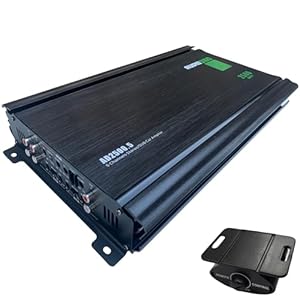
Wired Remote Bass Knob
The NDA11005 includes a wired remote bass-level control.
Mounting the remote near the driver’s position allows subwoofer output to be adjusted without accessing the amplifier itself.
This is useful because bass requirements vary considerably between:
- Music genres
- Recording quality
- Listening volume
- Vehicle speed
- Different source material
The remote control makes small adjustments much easier once the primary gain and crossover settings have been established.
It should be treated as a convenient level adjustment rather than a replacement for properly setting amplifier gain.
High-Level Speaker Inputs
The NVX NDA11005 includes speaker-level high-level inputs, making it easier to integrate into vehicles retaining the factory radio.
Factory head units often don’t provide conventional RCA preamp outputs.
High-level inputs allow the amplifier to accept an appropriate amplified speaker-level signal instead.
This can reduce the need for a separate basic line-output converter in compatible installations.
Modern factory systems can still vary considerably, especially when factory amplifiers, active crossovers or data-controlled audio systems are involved.
Verify the vehicle’s audio architecture before cutting into anything.
Signal-Sensing Automatic Turn-On
The NDA11005 also supports signal-sensing remote turn-on.
This feature can allow the amplifier to recognize an incoming audio signal and turn on automatically rather than relying exclusively on a conventional remote turn-on wire.
That’s especially helpful when integrating the amplifier with an OEM head unit.
Many newer factory radios don’t provide the simple blue remote wire installers enjoyed in the old days, because apparently wires that simply did one job were becoming far too convenient.
Four-Way Protection Circuitry
NVX equips the NDA11005 with four-way amplifier protection circuitry.
Protection covers conditions including:
- Thermal overload
- Electrical overload
- Speaker short circuits
- DC offset
These safeguards help protect the amplifier and connected equipment if an abnormal operating condition occurs.
Protection circuitry is still a last line of defense.
Correct speaker impedance, power wiring, grounding, ventilation and gain settings remain essential for reliable operation.
Thermal Protection
High amplifier temperatures can occur because of restricted airflow, excessive load, electrical problems or incorrect tuning.
Thermal protection helps prevent amplifier damage when internal temperatures exceed safe limits.
If the amplifier repeatedly enters protection, investigate the cause rather than treating protection mode as a mildly annoying feature.
Common causes of excessive amplifier heat include:
- Low speaker impedance
- Restricted ventilation
- Excessive gain
- Clipping
- Poor grounds
- Low supply voltage
- Undersized wiring
Our guide explaining why car amplifiers overheat covers these problems and the diagnostic steps used to isolate them.
Speaker Short-Circuit Protection
Speaker wires can become damaged or shorted during installation.
Potential trouble spots include:
- Seat tracks
- Sharp sheet metal
- Door jambs
- Trim mounting points
- Improperly insulated terminals
The NDA11005’s speaker-short protection provides an additional safeguard when a fault occurs.
Still, route wiring carefully and protect cables anywhere they pass through metal.
DC Offset Protection
DC offset protection helps safeguard the amplifier and speakers against abnormal DC voltage appearing where an audio signal should be present.
Excessive DC reaching a speaker can cause overheating and potentially damage the voice coil.
The amplifier’s protection circuitry monitors for this type of abnormal condition as part of its overall safety system.
4 AWG Amplifier Wiring Recommended
NVX specifies a 4 AWG amplifier wiring kit for proper installation of the NDA11005.
Power wiring is not the place to get creative with whatever cable was hiding behind the workbench.
A proper installation should include:
- 4 AWG power cable
- Appropriate ground cable
- Correct main fuse
- Quality fuse holder
- Properly crimped terminals
- Suitable speaker wire
- Quality signal wiring
- Secure battery connection
The main power fuse should be positioned close to the battery to protect the power cable in the event of a short circuit.
Grounding Is Just as Important as Power Wiring
The amplifier’s ground connection is equally important.
A poor ground can cause:
- Voltage loss
- Amplifier shutdown
- Noise
- Reduced output
- Excessive heat
- Protection-mode activation
Keep the ground cable appropriately sized and as short as practical.
The connection point should provide low electrical resistance to the vehicle’s chassis.
Check Voltage at the Amplifier
A powerful five-channel amplifier can expose weaknesses in a vehicle’s electrical system.
If voltage drops substantially during heavy bass passages, check:
- Battery condition
- Alternator output
- Power wiring
- Ground connections
- Fuse connections
- Battery terminals
Voltage should be measured at the amplifier under load when troubleshooting supply problems.
Our automotive voltage-drop testing guide explains how testing a circuit while current is flowing can expose resistance that won’t necessarily appear during a simple continuity check.
Proper Gain Setup Is Essential
Amplifier gain controls should be used to match the amplifier input sensitivity to the source signal.
They aren’t volume controls.
Excessive gain can cause clipping, distortion and unnecessary heat.
It can also damage speakers even when the amplifier and speakers appear reasonably matched on paper.
Establish clean source output first, then configure gain and crossover settings methodically.
Match RMS Power Instead of Peak Ratings
The NDA11005 is advertised at 2,200 watts peak, but the more useful specification for system design is its 1,100-watt RMS capability.
RMS output describes continuous power much more meaningfully for speaker matching.
When choosing speakers and subwoofers, compare:
- Amplifier RMS output
- Speaker RMS handling
- Subwoofer RMS handling
- Speaker impedance
- Final subwoofer impedance
Don’t match equipment using peak ratings alone.
Otherwise you end up comparing numbers created by marketing departments rather than building an audio system.
Great Choice for a Single-Amplifier System
The NDA11005 is particularly attractive for enthusiasts who want to run an entire system from one amplifier.
A practical configuration might include:
- Two front component speakers
- Two rear coaxial speakers
- One subwoofer
- One five-channel amplifier
This keeps the installation compact while still providing independent amplification for the main speakers and bass system.
For a daily driver, that balance between output, simplicity and installation space can be more useful than building a complex multi-amplifier rack.
Key Features
- NVX NDA11005
- Five-channel Class D amplifier
- 2,200 watts peak power
- Up to 1,100 watts RMS
- 100W x 4 + 315W x 1 at 4 ohms
- 150W x 4 + 500W x 1 at 2 ohms
- 300W x 2 + 500W x 1 bridged configuration
- Variable 40–400 Hz high-pass filter
- Variable 10–55 Hz subsonic filter
- Wired remote bass-level control
- High-level speaker inputs
- Signal-sensing automatic turn-on
- Thermal protection
- Overload protection
- Speaker-short protection
- DC offset protection
- Compact Class D architecture
- 10.15 x 4.42 x 1.73-inch chassis
- Recommended 4 AWG amplifier wiring
- Suitable for factory and aftermarket audio integration
- Designed to power speakers and a subwoofer from one amplifier
Compact Full-System Power from the NVX NDA11005
The NVX NDA11005 Class D 5-Channel Amplifier offers an impressive combination of power, compact dimensions and installation flexibility.
At 4 ohms, it provides 100 watts RMS to four full-range channels plus 315 watts RMS to the subwoofer. With compatible 2-ohm loads, output climbs to 150 watts RMS x 4 plus 500 watts RMS x 1, giving enthusiasts enough power to build a serious complete audio system around a single amplifier.
Its compact Class D architecture is backed by adjustable crossover controls, a useful subsonic filter, remote bass control and four-way protection circuitry. High-level inputs and signal-sensing turn-on also make the NDA11005 particularly useful when adding aftermarket amplification while retaining a compatible factory stereo.
For anyone trying to power four speakers and a subwoofer without turning the trunk into NASA Mission Control, the NDA11005 provides a compelling single-amplifier solution.








There are no reviews yet.