
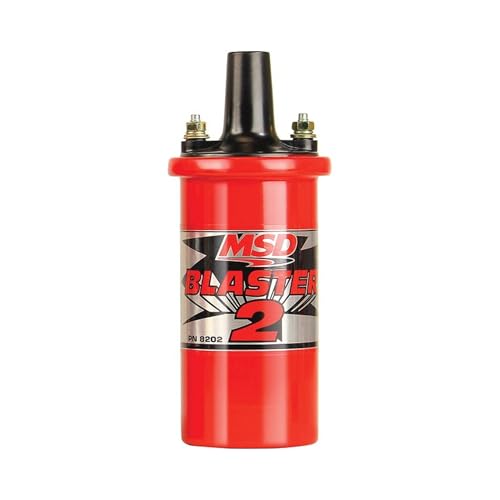

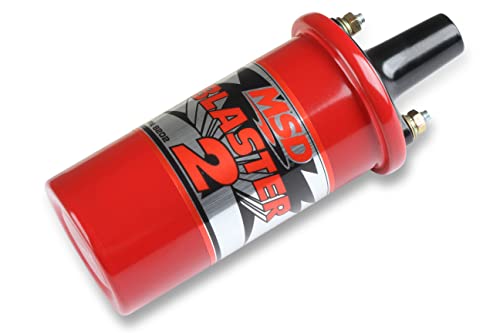
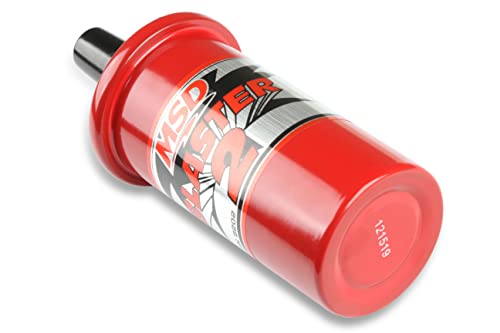

What Vehicles Does the MSD 8202 Fit?
This is the important difference between the MSD 8202 and a modern replacement coil pack:
There is no fixed year/make/model fitment list.
MSD officially categorizes the 8202 as a universal-fit performance coil designed for an MSD ignition box and compatible conventional distributor-style ignition systems.
Potential applications include compatible:
- Classic Chevrolet muscle cars
- Ford Mustangs and classic Ford V8s
- Mopar muscle cars
- Hot rods
- Street rods
- Carbureted performance cars
- Distributor-equipped trucks
- Restomods
- Race cars
- Custom engine swaps
Compatibility depends on the ignition system—not simply whether the vehicle has a Chevy, Ford or Mopar badge.
Do NOT list it like this:
1965–1995 Chevrolet/Ford/Dodge
That’s too broad and could produce incorrect fitment.
For ProStreetOnline, categorize the MSD 8202 as:
Universal Performance Ignition Coil – Conventional Canister/Distributor Ignition
That’s considerably safer and more accurate.
Designed for MSD 6-Series Ignition
The MSD 8202 is particularly well suited to an MSD 6-Series ignition control.
MSD’s compatibility documentation lists the Blaster 2 8202 as compatible with MSD 5-Series, MSD 6-Series, 7AL-2/7AL-3 and Digital-7 ignition systems.
With an MSD 6- or 7-Series capacitive-discharge ignition, the ignition control itself supplies the coil. MSD’s installation instructions specify the orange ignition-control wire to coil positive (+) and the small black wire to coil negative (-).
That makes the Blaster 2 a natural companion for classic performance builds already running an MSD ignition box.
Can You Use the MSD 8202 Without an MSD Ignition Box?
Yes, in certain compatible applications.
MSD states that the Blaster 2 can work with appropriate electronic and conventional points ignition systems.
But there’s an important catch.
Points Ignition Requires a Ballast Resistor
When the 8202 is installed with a stock points-style distributor, MSD requires a 0.8-ohm ballast resistor or appropriate resistance wiring in the positive coil circuit.
MSD specifically warns that failing to use the required resistor with a points ignition can result in component failure or injury.
The MSD 8202 itself does not include the ballast resistor.
If you’re building a points-equipped car and want a Blaster 2 package supplied with the resistor, MSD offers other configurations such as the red 8203 Blaster 2 Kit.
45,000 Volts of Maximum Output
MSD rates the Blaster 2 series at up to 45,000 volts.
More voltage capacity doesn’t mean the ignition system continuously fires the spark plug with 45,000 volts.
The actual voltage required depends on factors including:
- Spark-plug gap
- Cylinder pressure
- Compression ratio
- Air/fuel mixture
- Engine load
- Plug condition
- Ignition-system configuration
The benefit of a capable performance coil is having sufficient voltage available when operating conditions demand it.
That’s a considerably more useful explanation than writing “45,000 VOLTS = 45,000 HORSEPOWER” and waiting for the Internet to correct us.
Why the 100:1 Turns Ratio Matters
An ignition coil is fundamentally a transformer.
It uses primary and secondary windings to step relatively low electrical-system voltage up to the much higher voltage required to fire a spark plug.
MSD uses special windings in the Blaster 2 to increase voltage potential. The manufacturer specifies a 100:1 winding ratio for this coil family.
Combined with relatively low primary resistance, the design is intended to provide strong ignition output for compatible performance systems.
Oil-Filled Canister Construction
The 8202 uses a traditional oil-filled metal canister.
The oil helps cool and insulate the coil’s internal windings.
MSD recommends mounting the 8202 upright, with the high-voltage tower pointing upward.
That’s important.
The 8202 should not be treated like MSD’s epoxy-potted high-vibration coil, which can tolerate different mounting orientations.
For a normal Blaster 2 installation:
Mount it vertically whenever possible.
Signs Your Existing Ignition Coil May Be Failing
A failing conventional ignition coil can produce:
- Hard starting
- Rough idle
- Engine misfire
- Hesitation
- Loss of power
- Stalling
- Poor acceleration
- Reduced fuel economy
- Weak spark
- No-start condition
Before replacing the coil simply because the engine runs badly, read Pro Street’s live 7 Bad Ignition Coil Symptoms You Should Never Ignore guide.
The same rule applies here as with modern coil-on-plug systems:
Diagnose first. Replace second.
Don’t Forget the Spark Plugs
A performance ignition coil cannot compensate indefinitely for worn or incorrectly selected spark plugs.
Spark-plug condition influences the voltage necessary to bridge the electrode gap.
Factors include:
- Plug gap
- Electrode wear
- Heat range
- Compression
- Cylinder pressure
- Engine modifications
Pro Street’s live How to Pick Spark Plugs for Your Build guide explains heat range, plug construction and selecting plugs for modified engines.
That’s particularly relevant for the type of classic and modified vehicles likely to use an MSD ignition system.
Check the Distributor and Coil Wire Too
The MSD 8202 is designed around a conventional high-voltage coil-wire arrangement.
That means the rest of the ignition system still matters.
Inspect:
- Distributor cap
- Distributor rotor
- Coil wire
- Spark-plug wires
- Electrical grounds
- Coil terminals
- Ignition-module wiring
- Battery voltage
A 45,000-volt-capable coil connected through a distributor cap that looks like it survived the Carter administration isn’t exactly a performance ignition system.
CARB Legal for Street Use
The MSD 8202 carries CARB Executive Order D-40-37.
MSD currently lists the part as legal for sale and use on emissions-controlled vehicles when installed according to the manufacturer’s approved application guidance.
For California customers, that’s an important distinction compared with performance ignition components marketed strictly for racing use.
Always install emissions-related components according to the manufacturer’s current application guidance.
Who Should Buy the MSD 8202 Blaster 2?
The MSD 8202 makes the most sense for enthusiasts running a compatible:
- MSD 5-Series ignition
- MSD 6-Series ignition
- MSD 7-Series ignition
- Electronic distributor ignition
- Conventional points ignition with the required ballast resistance
It’s particularly appropriate for classic performance vehicles and custom builds retaining a single external canister-style ignition coil.
It is not a direct replacement for modern coil-on-plug or coil-near-plug systems such as late-model LS, Coyote, EcoBoost or similar engines.
Is the MSD 8202 Blaster 2 Worth It?
For a compatible distributor-style performance ignition system, the MSD 8202 Blaster 2 remains a straightforward and proven upgrade.
You get a recognizable oil-filled canister design, up to 45,000 volts of output capability, a 100:1 winding ratio and compatibility with popular MSD ignition controls.
More importantly, it’s built specifically to work as part of a performance ignition system rather than pretending to be a universal miracle box.
Pair it with the correct ignition control, distributor, plug wires and spark plugs and you’ve got a properly matched ignition system.
Which is considerably more effective than buying every red component in the catalog and assuming the colors communicate with each other.
Shop performance ignition and engine components through Pro Street Online.







There are no reviews yet.