
100-Amp Rating
Moroso rates the switch at:
100 amps
That rating matters.
A battery disconnect is a current-carrying electrical component, so it needs to be appropriate for the electrical load in the intended application.
Don’t assume every battery disconnect is suitable for every starting or racing electrical system simply because the terminals physically connect.
High-compression engines, high-torque starters and heavily modified electrical systems can have substantial current demands.
Match the disconnect to the actual electrical requirements of the vehicle.
Compatible With 12-Volt Systems
The 74104 can be used with compatible 12-volt DC systems.
That’s the electrical architecture used by the overwhelming majority of modern and classic passenger vehicles.
Potential applications include appropriately configured:
- Muscle cars
- Classic cars
- Project vehicles
- Hot rods
- Pro Street cars
- Race cars
- Stored vehicles
The side-post battery requirement remains critical.
Also Rated for 24-Volt DC
Moroso also rates the 74104 for 24-volt DC use.
That broadens its potential application beyond conventional 12-volt automotive systems.
Again, voltage compatibility doesn’t override the 100-amp current rating.
Both specifications need to match the intended application.
Useful for Stored Vehicles
One of the most practical uses for a manual battery disconnect is a vehicle that spends long periods parked.
Older cars and modified vehicles can develop small parasitic electrical loads from components such as:
- Stereo memory
- Alarm systems
- Relays
- Aftermarket electronics
- Gauges
- Control modules
- Wiring faults
Disconnecting the battery prevents current from flowing through the disconnected circuit while the vehicle is stored.
That can help prevent an otherwise healthy battery from being slowly discharged by vehicle-side parasitic loads.
It Doesn’t Fix a Parasitic Draw
There’s an important distinction.
A battery disconnect can prevent a parasitic draw from draining the battery while the vehicle is disconnected.
It doesn’t repair the electrical fault responsible for that draw.
If a vehicle repeatedly kills batteries while parked, diagnose the problem.
Common causes include:
- Glove-box lights
- Trunk lights
- Relays stuck on
- Stereo amplifiers
- Aftermarket alarms
- Improperly wired accessories
- Control modules that don’t enter sleep mode
- Alternator diode problems
The disconnect can be useful while the vehicle is stored, but it shouldn’t become a permanent substitute for electrical diagnosis.
Helpful During Vehicle Storage
For seasonal and occasional-use cars, the 74104 makes battery isolation quick.
Instead of:
- Finding a wrench.
- Loosening a battery terminal.
- Removing the cable.
- Preventing the cable from touching the terminal.
- Reinstalling everything before driving.
you can use the manual disconnect.
That’s particularly convenient on:
- Weekend cars
- Project cars
- Stored muscle cars
- Hot rods
- Track cars
- Show cars
A disconnect can also make certain maintenance procedures more convenient.
Useful During Electrical Work
Many automotive electrical procedures begin with:
Disconnect the battery.
That’s because an energized automotive electrical system can create problems when working around:
- Starter wiring
- Alternator wiring
- Fuse panels
- Engine harnesses
- Stereo installations
- ECU wiring
- Metal tools near positive terminals
The Moroso disconnect provides a convenient isolation point.
However, always verify that the circuit is actually de-energized before beginning electrical work.
Don’t assume that turning a knob replaces proper electrical safety procedures.
Protecting the Alternator and Voltage Regulator During Charging
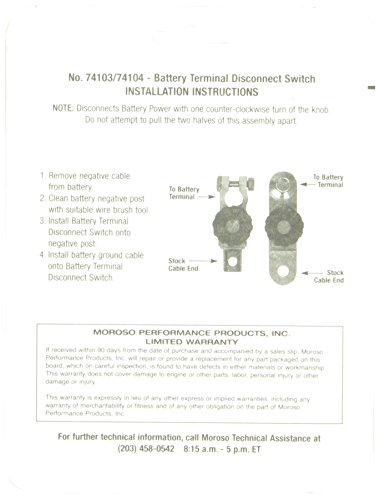
Moroso specifically states that one turn of the disconnect can help protect the solid-state voltage regulator and alternator when charging the battery.
This allows the battery to be isolated from the vehicle electrical system before connecting certain external charging equipment.
That can be useful on older vehicles and racing electrical systems where the owner wants to charge the battery independently from the rest of the vehicle.
Always follow the battery charger’s instructions.
Modern electronically controlled vehicles can have additional requirements regarding battery charging, battery monitoring and power disconnection.
A Simple Theft Deterrent
Moroso also describes the 74104 as a theft deterrent.
Disconnecting the battery can prevent the vehicle’s normal electrical system from operating until the connection is restored.
That may inconvenience someone attempting to start the vehicle without realizing a disconnect is installed.
But it is important to describe this accurately.
The Moroso 74104 is not a dedicated anti-theft system.
It doesn’t replace:
- Alarm systems
- Immobilizers
- Steering locks
- Secure storage
- GPS recovery systems
Think of battery isolation as another obstacle rather than an impenetrable security system.
Battery Disconnect vs Battery Isolator
These terms are sometimes used interchangeably online, but they can describe different devices.
Manual Battery Disconnect
The Moroso 74104 belongs in this category.
A person manually opens or closes the battery connection.
Automatic Battery Isolator
An isolator may use relays, solenoids, diodes or electronic controls to manage multiple batteries or automatically control charging circuits.
The Moroso 74104 isn’t that type of device.
It’s intentionally simple.
Battery Disconnect vs Kill Switch
Another important distinction is between the Moroso 74104 and a racing master electrical cutoff switch.
A motorsports master cutoff may need to shut down the engine and isolate electrical power according to the requirements of a particular racing sanctioning body.
Depending on vehicle wiring, simply disconnecting a battery while the engine is running may not immediately shut off the engine because the alternator can continue supplying electrical power.
The Moroso 74104 should therefore not automatically be marketed as an NHRA/IHRA master kill switch.
Use an appropriately rated and properly wired racing master disconnect when competition rules require one.
Don’t Disconnect a Running Alternator Carelessly
A battery is part of the vehicle’s electrical system.
Disconnecting it while an alternator is charging can cause undesirable voltage behavior depending on the charging system.
That means the old backyard test of:
“Pull the battery cable while it’s running and see if the engine dies.”
is not a recommended charging-system diagnostic method.
On vehicles with electronic components, voltage transients can potentially damage sensitive equipment.
Use a multimeter and proper diagnostic procedures instead.
Battery Disconnects and ECU Memory
Disconnecting the battery can erase or reset certain vehicle information.
Depending on the vehicle, that may include:
- Clock settings
- Radio presets
- ECU adaptive values
- Transmission adaptations
- Window initialization
- Sunroof initialization
- Diagnostic readiness monitors
Modern vehicles may have additional procedures following battery disconnection.
This is one reason the Moroso 74104 makes the most sense on compatible classic, racing and project-car electrical systems rather than being blindly installed on every modern vehicle.
Battery Registration on Modern Cars
Some newer vehicles use intelligent battery monitoring and battery-energy-management systems.
Those vehicles may require battery registration or coding when the battery is replaced.
A manual disconnect doesn’t eliminate those requirements.
If the vehicle uses a battery monitoring sensor or intelligent charging strategy, follow the manufacturer’s battery service procedures.
Side-Post Connections Need to Be Tight
Battery connections carry substantial current.
A loose side-post connection can create:
- Voltage drop
- Starting problems
- Heat
- Intermittent electrical failures
- Charging issues
The disconnect and battery cable connections should therefore be clean and properly tightened.
Do not overtighten a side-post battery terminal.
The threaded insert is part of the battery, and damaging it can turn a ten-minute accessory installation into shopping for another battery.
Check for Voltage Drop
After installing any battery disconnect, verify the electrical connection.
A voltage-drop test while the circuit is under load can reveal excessive resistance.
If the disconnect or connections develop abnormal resistance, symptoms may include:
- Slow cranking
- Clicking starter
- Dim lights
- Charging problems
- Hot terminals
A battery disconnect should behave like a very low-resistance connection when switched on.
Keep Connections Clean
Battery terminals are exposed to an unfriendly environment.
Corrosion can increase electrical resistance.
Inspect the disconnect periodically for:
- Corrosion
- Loose hardware
- Heat damage
- Mechanical damage
- Contamination
Clean connections are especially important in starting circuits because of the relatively high current involved.
Great for Classic Cars
Classic vehicles are strong candidates for a simple manual disconnect.
Many have:
- Minimal electronic memory requirements
- Long storage periods
- Modified electrical systems
- Occasional parasitic drains
A quick disconnect makes it easy to isolate the battery between drives.
Side-post compatibility still needs to be confirmed.
Useful for Project Cars
Project cars can spend weeks or months between starts while wiring and mechanical work continues.
A battery disconnect makes it easier to isolate power whenever the vehicle isn’t being worked on.
That’s particularly useful during:
- Engine swaps
- Stereo installation
- ECU wiring
- Gauge installation
- Starter replacement
- Alternator work
- Fuse-box modifications
You still need proper fusing and circuit protection.
The disconnect doesn’t replace them.
Useful for Pro Street and Race Builds
Race and Pro Street vehicles often have highly modified electrical systems.
A manual battery disconnect can be useful during storage and maintenance.
However, competition vehicles may also require a dedicated master cutoff meeting specific sanctioning-body rules.
If the car is being built for organized competition, check the current rules for:
- Switch location
- External accessibility
- Alternator shutdown
- Switch labeling
- Current capacity
- Wiring arrangement
A convenient battery-terminal disconnect and a regulation racing master switch are not necessarily the same component.
Not Truly Vehicle-Specific
The Moroso 74104 should not be classified as conventional year/make/model fitment.
The key compatibility factors are:
Battery Terminal Type: Side post
System Voltage: 12 or 24V DC
Current Requirement: Within the appropriate rating and application
For ecommerce purposes, I would classify it as:
Fitment Type: Universal / battery-terminal specific
That’s more useful than attempting to populate a vehicle-fitment table.
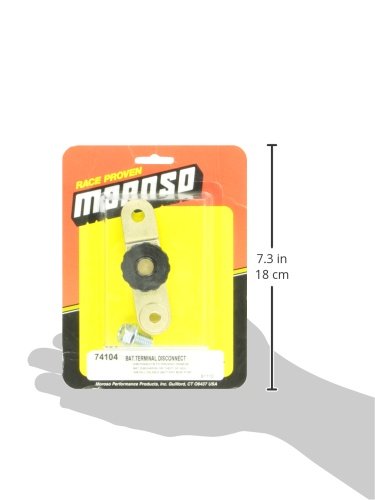
Moroso 74104 Specifications
Part Number: 74104
Product: Battery Disconnect Switch
Battery Connection: Side post
Operation: Manual knob
Voltage: 12V or 24V DC
Rated Current: 100 amps
Application: Battery isolation, charging/service convenience and supplemental theft deterrence
Fitment: Universal / side-post battery specific
Who Should Buy the Moroso 74104?
The Moroso 74104 is a practical option for vehicles with compatible side-post batteries that benefit from easy manual battery isolation.
Good candidates include:
- Classic cars
- Muscle cars
- Hot rods
- Project cars
- Pro Street cars
- Stored vehicles
- Show cars
- Appropriate race vehicles
- Vehicles undergoing frequent electrical work
It is especially useful when the battery needs to be disconnected regularly and physically removing the cable every time is inconvenient.
Who Should Look for Something Else?
Choose a different product if you specifically need:
- Top-post battery compatibility
- Remote cable operation
- High-current racing master cutoff
- Sanctioning-body-compliant external kill switch
- Automatic dual-battery isolation
- Electronic low-voltage protection
Those are different jobs requiring different hardware.
Final Verdict
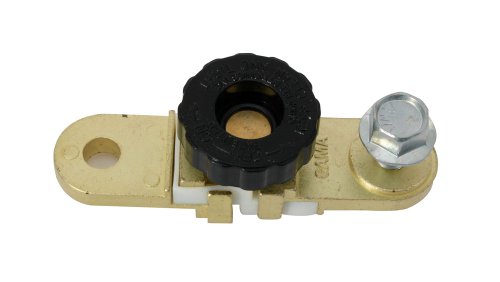
The Moroso 74104 Side-Post Battery Disconnect is a simple solution to a simple problem: sometimes you want the battery electrically disconnected without removing the battery cable.
Turn the knob and the connection is opened.
Moroso rates the switch at 100 amps for 12- or 24-volt DC systems, and specifically positions it for battery isolation during charging as well as an additional theft deterrent during storage.
For classics, race cars and projects using compatible side-post batteries, that simplicity is the main attraction.
Just don’t confuse it with a sophisticated racing master cutoff, battery-management module or magic cure for parasitic draw.
Sometimes a switch is allowed to just be a switch.






There are no reviews yet.