
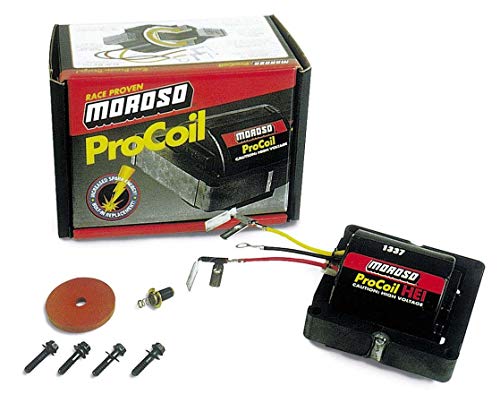
More Spark Energy Than a Stock HEI Coil
Moroso’s goal with the 72355 is straightforward: increase the amount of usable spark energy available from the HEI system.
According to Moroso, the ProCoil combines:
- Low-oxygen magnet wire
- High-conductivity winding material
- High-silicon core material
- Non-porous epoxy impregnation
- High-current capability
- Extended spark duration
Moroso says the resulting increase in spark energy can contribute to easier starting, smoother idle, improved acceleration and better high-RPM ignition performance.
That’s especially useful when the engine has moved beyond its original factory configuration.
Addressing the Stock HEI High-RPM Limitation
One of Moroso’s primary claims for the ProCoil is improved ignition performance beyond the approximate 6,000-rpm limitation associated with stock HEI systems.
As engine speed increases, the ignition system has progressively less time to charge the coil between firing events. An ignition system that performs perfectly well during cruising can therefore begin struggling when engine speed climbs.
The result can feel like:
- High-RPM breakup
- Misfiring under load
- Loss of power at higher engine speeds
- Inconsistent acceleration
- Difficulty maintaining a clean spark with modified engines
A higher-output coil can be part of the solution when the existing coil is the limiting component.
But it isn’t a magic cure for every engine that breaks up at 5,500 rpm.
Don’t Diagnose Every Misfire as a Bad Coil
Before replacing ignition components, verify the rest of the system.
A failing ignition module, worn distributor cap, damaged rotor, excessive plug gap, poor plug wires, inadequate voltage supply or incorrect ignition timing can produce symptoms that look remarkably similar to a weak coil.
Our Best Ignition Control Modules for Street Builds guide explains why the ignition module and coil need to be treated as parts of the same system, particularly on distributor-equipped GM HEI applications.
Throwing a high-output coil at a failing ignition module doesn’t repair the module.
It just gives the new coil a front-row seat to the problem.
A Strong Match for Carbureted Small-Block and Big-Block Chevys
The Moroso 72355 makes particular sense on traditional Chevrolet street and strip combinations still using a large-cap HEI distributor.
Typical builds can include:
- Small-block Chevrolet V8s
- Big-block Chevrolet V8s
- Carbureted muscle cars
- Street/strip Camaros
- Novas and Chevelles
- C10 and other classic GM trucks
- Hot rods
- Pro Street builds
- Drag-racing combinations
Modified engines with increased compression, larger camshafts, higher operating RPM or forced induction can place additional demands on the ignition system.
If you’re planning a boosted carbureted combination, ignition health should be established before increasing cylinder pressure. That’s one reason our Complete Turbo Build Guide puts ignition-system condition alongside compression, leak-down testing, oil pressure and cooling-system health before the turbocharger ever goes on the engine.
Boost has an impressive ability to discover ignition weaknesses you didn’t know you had.
Usually at wide-open throttle.
Coil-in-Cap HEI Design
The traditional large-cap GM HEI distributor places the ignition coil inside the distributor cap rather than mounting a conventional canister-style coil elsewhere in the engine compartment.
That packaging reduces external ignition wiring and gives the classic HEI distributor its distinctive large-cap appearance.
It also means you need to identify which GM ignition system you’re actually working with before ordering replacement components.
GM’s later ignition systems aren’t all interchangeable simply because someone calls them “HEI.” Our guide to GM LT1 ignition distributors illustrates this problem particularly well: different distributor designs can use internal or external ignition coils, different cap sizes and different electrical connections.
If your GM uses an external ignition coil, don’t assume the Moroso 72355 is the correct part based solely on the model year.
Bolt-In Replacement
For compatible GM HEI distributors, the Moroso 72355 is intended as a bolt-in replacement rather than a universal external coil requiring a fabricated mounting bracket.
The coil installs into the HEI distributor cap in the factory-style location.
That makes the 72355 particularly attractive to builders who want additional ignition capability without abandoning the simple integrated HEI architecture.
There is no need to find room for a giant external ignition box just because the engine has a camshaft and occasionally sees the exciting side of the tachometer.
Works With Moroso DuraFire HEI Distributors
The 72355 isn’t only an upgrade for compatible factory-style HEI distributors.
Moroso specifically identifies the 72355 ProCoil as a replacement component for its DuraFire GM HEI distributor. The company’s DuraFire distributor combines the ProCoil with a high-output ignition module, HEI cap and rotor and adjustable mechanical advance components.
That gives builders two potential approaches.
If the existing distributor is in good condition, upgrading the coil may be all that’s required.
If the distributor itself is worn, damaged or unsuitable for the engine combination, replacing or rebuilding the complete distributor may make more sense than installing a performance coil into a tired housing.
Inspect the Distributor While You’re There
Replacing an HEI coil is a good opportunity to inspect the rest of the distributor.
Look closely at:
Distributor cap — Check for carbon tracking, cracks, burned terminals and corrosion.
Rotor — Inspect the contact surfaces for excessive wear or burning.
Center contact and brush — Make sure the electrical connection between the coil and rotor is clean and intact.
Ignition module — Inspect the connections and mounting condition.
Mechanical advance — On applicable distributors, make sure the weights and advance mechanism move freely.
Vacuum advance — Check operation where the application uses one.
Distributor shaft — Excessive radial play can create unstable timing.
Spark plug wires — Damaged, high-resistance or poorly terminated wires can waste the additional ignition energy you’re trying to create.
The ignition system is a chain. Improving one component can’t compensate indefinitely for worn components elsewhere.
Spark Plug Gap Still Matters
Installing a higher-output coil doesn’t mean the spark plug gap should automatically be opened as far as possible.
Spark plug gap needs to match the complete engine combination.
A naturally aspirated street engine may tolerate a wider gap than a boosted engine producing considerably greater cylinder pressure. Increased cylinder pressure makes it harder for the spark to jump the plug gap, which is why forced-induction engines frequently require tighter gaps than comparable naturally aspirated combinations.
If the engine starts misfiring under heavy load after increasing boost, ignition coil output and plug gap should both be part of the diagnosis.
Don’t keep opening the gap because the new coil came in a box with the word “performance” printed on it.
Physics remains stubbornly unimpressed by packaging.
Moroso 72355 ProCoil Features
- Moroso part number 72355
- ProCoil HEI ignition coil
- Designed for compatible 1975–1993 GM HEI applications
- Coil-in-cap configuration
- Bolt-in replacement design
- Increased spark-energy design
- Extended spark duration
- Low-oxygen magnet wire
- High-conductivity winding material
- High-silicon core material
- Non-porous epoxy impregnation
- Designed for improved high-RPM ignition performance
- Suitable for performance street and racing applications
- Replacement ProCoil for compatible Moroso GM DuraFire HEI distributors
Who Should Buy the Moroso 72355?
The Moroso 72355 is a strong option for someone who already has a compatible GM HEI distributor and wants to improve ignition performance without completely redesigning the ignition system.
It makes particular sense for:
- Restored or modified GM muscle cars
- Carbureted Chevrolet V8s
- Small-block and big-block street builds
- Higher-RPM naturally aspirated engines
- Street/strip vehicles
- Drag cars
- Hot rods
- Pro Street builds
- Existing Moroso DuraFire HEI distributors requiring a replacement coil
For a completely stock engine that rarely approaches the upper RPM range, the benefits may be less dramatic. For a modified engine that regularly works the factory ignition harder, the upgraded coil becomes considerably easier to justify.
Verify Your Distributor Before Ordering
The most important fitment check isn’t simply whether your car says Chevrolet, Pontiac, Buick, Oldsmobile or GMC on the grille.
Identify the distributor.
Verify that the engine uses the compatible coil-in-cap GM HEI configuration before ordering the Moroso 72355.
Engine swaps make this particularly important. A 1970 Chevelle could easily contain a later HEI-equipped small-block, while a vehicle originally manufactured during the HEI era might now have an aftermarket distributor, LS swap or completely different ignition system.
Buy the coil for the ignition system that’s actually in the car—not necessarily the ignition system that left Detroit with it.
Final Verdict
The Moroso 72355 ProCoil HEI Ignition Coil provides a straightforward performance upgrade for compatible 1975–1993 GM HEI ignition systems.
Moroso combines high-conductivity magnet wire, a high-silicon core and epoxy construction to increase current capability and spark duration, with particular emphasis on improving the high-RPM performance limitations associated with stock HEI components.
For a classic GM street machine or race car already using a healthy HEI distributor, it’s an appealing bolt-in upgrade because it improves a critical ignition component without requiring an entirely different ignition architecture.
Just diagnose the system before replacing parts.
Because “it breaks up at 6,000 rpm” is useful diagnostic information.
“It needs a bigger coil because my buddy said so” is considerably less useful.



There are no reviews yet.