
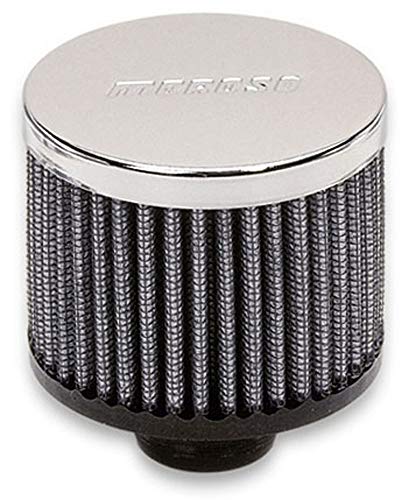
Designed for Moroso 1.22-Inch Valve Cover Openings
Moroso specifically describes the 68817 as being for:
Moroso covers with 1.22-inch punched holes
That specification should be prominent on the Pro Street Online listing.
Before ordering, verify:
- Valve-cover breather-hole diameter
- Grommet configuration
- Available vertical clearance
- Engine crankcase-ventilation design
- Emissions requirements
- Whether the engine requires an open or closed ventilation system
Do not assume every push-in valve-cover breather uses the same opening.
Why an Engine Needs Crankcase Ventilation
Every piston engine produces some amount of blow-by.
During combustion, a small amount of combustion gas can pass the piston rings and enter the crankcase.
That gas can contain:
- Combustion byproducts
- Fuel vapor
- Moisture
- Oil mist
Without adequate ventilation, pressure can accumulate inside the crankcase.
Excessive crankcase pressure can contribute to:
- Oil leaks
- Oil pushed past seals
- Dipstick movement
- Oil mist around breathers
- Increased oil consumption
- Turbocharger oil-drain problems
- Gasket leakage
Your How to Check Your PCV Valve guide explains the basic relationship between blow-by, crankcase gases and positive crankcase ventilation.
The 68817 addresses the same fundamental need—allowing the crankcase to breathe—but does so as an open filtered breather rather than a conventional closed PCV valve.
Filtered Crankcase Ventilation
Leaving a valve-cover opening completely exposed would allow crankcase vapor to escape.
It could also allow dirt and airborne debris to enter the engine.
That’s not a particularly appealing trade.
Moroso describes the 68817 as providing protection against dirt and airborne debris while maintaining airflow.
The filter therefore serves two basic purposes:
Allow crankcase ventilation
while
Helping prevent outside debris from entering through the valve-cover opening
This is particularly useful on purpose-built engines where an atmosphere-vented crankcase system is appropriate.
Cleanable and Reusable
The Moroso 68817 isn’t intended to be thrown away every time the filter becomes dirty.
Moroso specifies that the breather is:
Cleanable and reusable
It should be periodically inspected for:
- Oil saturation
- Dirt
- Debris
- Physical damage
- Restriction
A heavily contaminated breather can reduce airflow.
And restricting crankcase ventilation defeats the reason the breather exists in the first place.
Oil the Filter Before Use
Moroso specifically instructs owners to:
Oil the breather before use.
That detail should be included on the product page because installing the filter dry isn’t the manufacturer’s recommended preparation.
Follow Moroso’s current service recommendations when cleaning and re-oiling the filter.
Don’t drown it in oil.
The objective is to prepare the filter media—not create a miniature oil reservoir on top of the valve cover.
Non-Hooded Design
The 68817 uses Moroso’s:
Non-hooded design
This leaves the filter element exposed around its perimeter rather than placing a partial metal hood over it.
Moroso offers both hooded and non-hooded configurations depending on the application.
The non-hooded design is particularly straightforward where there is adequate clearance and no need for a protective hood around the filter.
Push-In Installation
The 68817 uses a push-in design rather than clamping onto a welded breather stack.
That distinction matters when ordering.
Moroso offers both:
Push-in breathers
and
Clamp-on breathers
The 68817 belongs to the push-in family.
It is intended for compatible Moroso valve covers with the appropriate punched breather opening.
Push-In vs Clamp-On Breathers
Don’t choose between the two styles based on appearance.
Choose according to the valve cover.
Moroso 68817
Push-in
Non-hooded
For 1.22-inch punched holes
Moroso 68815
Clamp-on
Non-hooded
For valve covers with welded-in breather stacks
Moroso lists the 68815 with a 1-3/8-inch inside-diameter clamp-on connection.
These products perform a similar ventilation function but attach to the valve cover differently.
Moroso 68813 Half-Hood Alternative
If the engine requires the same push-in mounting concept but a hooded configuration is preferred, Moroso offers:
68813 — Half-Hood Push-In Filtered Breather
Like the 68817, the 68813 is designed for Moroso valve covers with 1.22-inch punched holes.
That makes it a logical alternative rather than an unrelated accessory.
Choose based on:
- Engine-bay clearance
- Oil-control needs
- Valve-cover configuration
- Desired filter protection
- Appearance
Add a Breather Baffle Where Appropriate
One of the most useful cross-sells for the 68817 is the:
Moroso 68790 Valve Cover Breather Baffle
Moroso specifically lists the 68790 for use with the 68817.
The baffle mounts inside the valve cover beneath the breather opening and is designed to reduce the amount of liquid oil reaching the breather.
This distinction matters.
A breather needs access to crankcase vapor.
It doesn’t need to be continuously blasted with oil from the valvetrain.
Why Breather Baffling Matters
Inside a running engine, the valvetrain can throw substantial amounts of oil around the valve-cover area.
Without adequate baffling, oil can reach the breather media.
Possible symptoms include:
- Saturated breather
- Oil mist around the engine bay
- Oil dripping from the breather
- Increased oil consumption
- Smoke or odor
- Mess around the valve cover
A properly designed baffle helps separate the breather opening from direct oil splash while still allowing crankcase vapor to reach it.
Moroso manufactures the 68790 specifically for this purpose.
Moroso 68790 Baffle Compatibility
Moroso lists the 68790 baffle for use with several of its valve-cover breathers, including:
- 68740
- 68741
- 68781
- 68810
- 68813
- 68817
Moroso constructs the baffle from 14-gauge 6061-T6 aluminum and supplies the required mounting fasteners.
One important limitation:
Moroso states that the 68790 cannot be used on engines equipped with stud girdles.
Check the engine configuration before adding it to the order.
Open Breather vs PCV System
A filtered valve-cover breather and a PCV valve are not the same thing.
A conventional positive crankcase ventilation system uses intake vacuum to draw crankcase vapors into the engine’s intake system.
An open breather allows gases to vent through filtered media to atmosphere.
Your How to Check Your PCV Valve article explains how a conventional PCV system uses engine vacuum to evacuate crankcase gases.
The correct strategy depends on the engine.
Do not assume replacing a factory PCV connection with an open breather is automatically an upgrade.
Street Cars Need Special Consideration
Many street vehicles use a closed crankcase-ventilation system as part of their emissions controls and engine-management strategy.
Changing that system can affect:
- Emissions compliance
- Fuel trims
- Idle quality
- Oil control
- Intake airflow
- Crankcase pressure
- Inspection legality
Your How to Customize Your Engine Bay article discusses this exact problem: replacing factory PCV routing with a simple breather can vent oily crankcase vapor directly into the engine bay and may violate emissions requirements.
The Moroso 68817 should therefore be selected because it fits the engine’s intended ventilation strategy, not simply because a little filter on the valve cover looks like a race-car part.
Not Legal for Pollution-Controlled Vehicles
Moroso explicitly states:
Not legal for sale or use on pollution-controlled vehicles.
That warning should remain visible on the Pro Street Online listing.
This is especially important because the 68817 vents crankcase vapor differently from many factory closed-PCV systems.
It is primarily suited to appropriate:
- Race engines
- Competition vehicles
- Non-emissions-controlled applications
- Purpose-built performance engines
Always follow applicable federal, state and local regulations.
Naturally Aspirated Race Engines
On an appropriate naturally aspirated race engine, filtered valve-cover breathers can provide a simple method of allowing crankcase gases to escape.
The required ventilation capacity depends on:
- Engine displacement
- RPM
- Ring seal
- Piston design
- Cylinder condition
- Engine load
- Blow-by volume
A mild engine and a large-displacement high-RPM race engine do not necessarily need the same crankcase-ventilation strategy.
Boosted Engines Need More Thought
Turbocharged and supercharged engines can place greater demands on crankcase ventilation.
Boost does not automatically mean a 68817 is wrong.
But it does mean the ventilation system needs to be engineered rather than guessed.
Your How to Check Engine Health Before Adding Boost guide explains why crankcase ventilation should be inspected before increasing cylinder pressure.
Restricted breather hoses, undersized vents, excessive blow-by and incorrect catch-can plumbing can contribute to crankcase-pressure problems on a boosted engine.
A Bigger Breather Doesn’t Fix Worn Piston Rings
If the engine produces excessive blow-by because of worn rings or cylinder damage, adding more breathers may reduce pressure symptoms.
It does not repair the engine.
Possible excessive-blow-by symptoms include:
- Heavy vapor from the breather
- Oil pushed from the breather
- Dipstick pushed upward
- Multiple oil leaks
- High crankcase pressure
- Excessive oil consumption
- Blue exhaust smoke
Your Blue Smoke From Exhaust Diagnosis Guide explains how worn piston rings, cylinder damage and crankcase-ventilation faults can overlap diagnostically.
Measure and diagnose the engine rather than treating the breather as a cure for poor ring seal.
Crankcase Pressure Can Cause Oil Leaks
A properly functioning seal has to contain oil.
It should not have to act as the pressure-relief valve for the entire crankcase.
If crankcase ventilation becomes restricted, pressure can force oil through otherwise serviceable:
- Valve-cover gaskets
- Front crankshaft seals
- Rear main seals
- Camshaft seals
- Dipstick tubes
- Other engine seals
Your Why Is My Car Leaking Oil? guide includes excessive crankcase pressure and PCV faults among the causes worth checking when an engine develops multiple oil leaks.
Replacing the gasket without correcting the pressure problem can simply move the leak somewhere else.
Breather vs Catch Can
A simple filtered breather and a catch can solve related but different problems.
Filtered Breather
Allows crankcase vapor to vent through filter media.
Catch Can
Routes crankcase vapor through a separate container intended to separate and collect oil mist.
Air/Oil Separator
Uses internal separation media or baffling to remove oil from crankcase vapor, usually as part of a more controlled ventilation system.
Your 8 Best Oil Catch Cans for Cleaner Boost guide covers catch-can and oil-separator systems for performance applications.
For engines producing significant oil mist, a properly designed remote breather tank or separator may be more appropriate than relying exclusively on a small valve-cover filter.
Moroso Breather Tanks for More Advanced Systems
For race engines requiring remote ventilation, Moroso offers products such as its aluminum breather tanks.
That includes products like the Moroso 85465 vacuum-pump breather tank and 85469 dual -12AN breather tank.
Those systems allow crankcase vapor to be routed away from the valve cover through larger hoses into a remote tank.
The 68817 is the simpler solution:
Push it into the compatible valve-cover opening and vent directly through the filtered element.
Which strategy is correct depends on the engine.
Turbo Oil Leaks Can Be Related to Crankcase Pressure
Crankcase ventilation becomes especially important on turbocharged engines because a turbo’s oil drain generally relies on gravity and favorable crankcase pressure.
Excessive crankcase pressure can interfere with oil draining from the turbocharger.
Your Why Is My Turbo Leaking Oil If the Seals Are Still Good? article covers restricted breathers, clogged PCV systems, undersized vents and excessive blow-by as possible contributors.
A breather is therefore part of an overall system.
It should be sized and configured according to what the engine actually needs.
Inspect Breather Clearance
Before installation, check clearance around the breather.
Pay attention to:
- Hood
- Air cleaner
- Throttle linkage
- Fuel lines
- Ignition wiring
- Coil packs
- Intake manifold
- Firewall
- Brake booster
- Other valve-cover hardware
Remember that the engine moves under torque.
A breather that barely clears the hood with the engine off may discover considerably less clearance the first time the throttle opens.
Keep It Away From Exhaust Heat
Avoid placing an open breather directly against:
- Headers
- Exhaust manifolds
- Turbocharger turbine housings
- Downpipes
Oil mist and high exhaust temperatures are not desirable neighbors.
If the breather becomes saturated and drips oil, correct the oil-control or crankcase-pressure problem rather than accepting it as normal.
One Breather Per Package
Moroso supplies:
Quantity: 1
per package.
If your valve-cover configuration requires two breathers, order two 68817 units.
This should be stated clearly in the listing so customers don’t assume the product includes a pair.
Service the Breather Regularly
Inspect the filter as part of normal race-car maintenance.
Clean it when contaminated and re-oil it according to Moroso’s instructions.
Also inspect for:
- Torn filter media
- Damaged mounting area
- Hardened grommet
- Loose fit
- Excessive oil saturation
- Unusual crankcase vapor
A breather suddenly becoming much oilier than usual can be a diagnostic clue rather than simply a cleaning problem.
Package Information
Your distributor data lists:
Package Height: 2.032 cm / approximately 0.80 inch
Package Length: 24.13 cm / approximately 9.50 inches
Package Width: 17.272 cm / approximately 6.80 inches
Package Weight: 0.4 kg / approximately 0.88 lb
These are shipping/package dimensions, not the installed dimensions of the breather.
They should remain separated from the actual fitment specification:
1.22-inch valve-cover punched hole
Country of Origin
Your distributor feed lists:
Country of Origin: China
I would retain this as distributor-supplied country-of-origin data unless your current Moroso inventory documentation or packaging identifies otherwise.
Do not convert it to USA simply because Moroso is a U.S.-based manufacturer.
Moroso 68817 Specifications
Part Number: 68817
Product: Filtered Valve Cover Breather
Style: Non-hooded
Mounting: Push-in
Valve Cover Compatibility: Moroso valve covers with 1.22-inch punched breather holes
Filter: Cleanable and reusable
Filter Preparation: Oil before use
Quantity: One per package
Fitment: Universal / valve-cover specific
Application: Appropriate racing and non-pollution-controlled crankcase-ventilation systems
Emissions: Not legal for sale or use on pollution-controlled vehicles
Package Height: Approximately 0.80 inch, distributor data
Package Length: Approximately 9.50 inches, distributor data
Package Width: Approximately 6.80 inches, distributor data
Package Weight: Approximately 0.88 lb, distributor data
Country of Origin: China, according to supplied distributor data
Who Should Buy the Moroso 68817?
The Moroso 68817 is a good choice for a builder who needs:
- Push-in valve-cover breather
- Non-hooded breather
- Filtered crankcase vent
- Breather for a compatible Moroso valve cover
- 1.22-inch punched-hole compatibility
- Serviceable race-engine breather
- Compact direct-to-valve-cover ventilation
It is particularly well suited to purpose-built racing and performance engines where an atmosphere-vented filtered breather is appropriate.
Who Should Not Buy It?
Do not buy the 68817 simply because your engine has a valve cover.
It isn’t the right choice when:
- The valve-cover hole is incompatible
- The cover uses a welded breather stack
- The engine requires a closed PCV system
- The application requires a remote catch tank
- Emissions regulations prohibit open crankcase ventilation
- A specialized vacuum-pump system is being used
- The engine has excessive blow-by that needs diagnosis
Select the crankcase-ventilation strategy first.
Then choose the hardware.
Final Verdict
The Moroso 68817 Non-Hooded Push-In Valve Cover Breather provides a simple, serviceable crankcase-ventilation solution for compatible Moroso valve covers with 1.22-inch punched breather holes.
Its push-in mounting makes installation straightforward, while the cleanable filtered element helps keep dirt and airborne debris from entering the engine without unnecessarily restricting airflow.
Moroso also offers compatible breather baffling and alternative half-hooded or clamp-on designs, making it easy to build the ventilation arrangement around the actual valve cover.
Just don’t mistake a breather for an engine repair.
If the engine is pushing enough oil through the filter to lubricate the underside of the hood, the solution probably isn’t ordering a second filter.




There are no reviews yet.