
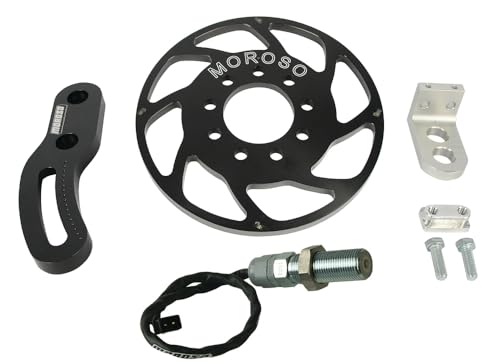
Flying-Magnet Trigger Wheel
Moroso equips the 60008 with a flying-magnet-style trigger wheel.
Magnets are incorporated into the rotating trigger wheel, while the stationary sensor detects their passage.
As the crankshaft rotates, the trigger wheel provides a repeatable position signal to the ignition controller.
This approach is commonly used in racing ignition systems because it provides a direct crankshaft reference without relying on the distributor’s internal pickup to determine firing timing.
Billet Aluminum Trigger Wheel
The Moroso Ultra Series trigger wheel is manufactured from billet aluminum.
That helps keep rotating mass relatively low while providing a rigid, accurately machined component.
Moroso also applies a black anodized finish to the trigger wheel and arm.
The result is a purpose-built racing component rather than a generic steel wheel adapted to the front of the engine.
Passenger-Side BBC Configuration
The Moroso 60008 positions its crank-trigger hardware on the passenger side of the Big Block Chevy.
This is important when planning front-engine accessories.
Moroso also offers the 60012 Ultra Series BBC crank trigger, which uses a driver-side configuration.
That gives builders another option when packaging conflicts exist around:
- Dry-sump drives
- Vacuum pumps
- Alternators
- Water-pump drives
- Motor plates
- Supercharger drives
- Chassis components
Don’t choose between the 60008 and 60012 solely because both say Big Block Chevy.
Choose the side that works with the rest of the engine’s front-drive system.
Fits 8-Inch-or-Smaller BBC Damper Cases
Moroso specifies the 60008 for compatible 8.0-inch-or-smaller harmonic damper cases.
That includes compatible dampers from manufacturers and designs such as:
- OEM
- ATI
- Fluidampr
- Fischer
- JEGS
- Other BBC dampers meeting the required dimensions
But diameter isn’t the only measurement that matters.
4.749-Inch Mounting Register Is Critical
Moroso specifies a 4.749-inch mounting register for the 60008.
That is one of the most important fitment dimensions on this product.
The crank-trigger wheel needs to register accurately and concentrically with the crankshaft/damper assembly.
Before ordering, verify:
Engine: Big Block Chevrolet
Damper Case Diameter: 8.0 inches or smaller
Mounting Register: 4.749 inches
Trigger Location: Passenger/right side
If those specifications don’t match the engine, don’t assume that “Big Block Chevy” alone guarantees fitment.
Compact Ultra Series Adjuster Arm
Moroso designed the Ultra Series with a compact adjuster arm.
The smaller arrangement provides additional clearance around crowded racing engines.
Moroso specifically notes improved compatibility with:
- Two-piece oil pans
- Engine containment devices
- Racing diapers
That’s an important detail on a dedicated race car.
The area around the front of a Big Block Chevy can become surprisingly crowded once the engine has a motor plate, external oil pump, vacuum pump, alternator drive, containment system and crank trigger all competing for real estate.
Sensor Block Designed for Additional Clearance
Moroso also redesigned the sensor mounting block so it doesn’t protrude unnecessarily from the rear of the adjustment arm.
That helps prevent interference with the oil pan or engine-containment equipment.
It’s a relatively small engineering detail that matters much more during an actual race-car installation than it does in a product photo.
Two Sensor Locations
Moroso provides two sensor mounting locations for applications that aren’t using a motor plate.
That gives the installer additional flexibility when positioning the crank-trigger sensor around the engine’s front accessories.
Packaging flexibility is particularly valuable on BBC combinations because there is no single universal racing accessory layout.
Compatible With Popular Ignition Boxes
Moroso equips the crank-trigger sensor with a common connector intended to simplify connection to popular racing ignition boxes.
The exact ignition-controller configuration should still be verified before installation.
A crank trigger doesn’t operate the ignition coils by itself.
It provides a position signal to a compatible ignition controller.
A typical system looks like:
CRANK TRIGGER → IGNITION CONTROLLER → IGNITION COIL → DISTRIBUTOR → SPARK PLUG
The distributor remains responsible for routing spark to the appropriate cylinder unless the engine uses a completely different ignition architecture.
The Distributor Still Has a Job
Installing a crank trigger doesn’t necessarily eliminate the distributor on a traditional Big Block Chevy.
In a common racing arrangement, the crank trigger tells the ignition controller when to fire.
The distributor tells the spark which cylinder gets it.
That distinction matters.
Once the crank trigger controls timing, the distributor needs to be correctly phased so the rotor remains aligned with the appropriate cap terminal when the ignition fires.
Distributor Phasing Matters
Rotor phasing becomes particularly important when using:
- Crank triggers
- Large timing changes
- Boost retard
- Nitrous retard
- Programmable ignition controllers
If the rotor isn’t properly aligned with the distributor terminal when the ignition fires, spark can attempt to jump to the wrong terminal or across an excessive gap.
Potential symptoms include:
- Misfires
- Crossfire
- High-RPM breakup
- Erratic ignition
- Burned distributor terminals
A perfectly accurate crank trigger can’t compensate for a badly phased distributor.
Both parts of the system need to be correct.
Start by Establishing True TDC
Before setting up the crank trigger, establish true top dead center on cylinder No. 1.
Don’t simply assume that the existing harmonic-balancer mark is perfect.
A proper engine-building procedure normally uses a piston stop or equivalent accurate method to determine TDC.
The concept is straightforward:
- Rotate the crankshaft toward TDC until the piston contacts the stop.
- Record the crankshaft position.
- Rotate the crankshaft in the opposite direction until the piston contacts the stop again.
- Record that position.
- Determine the midpoint between the two readings.
That midpoint is true TDC.
Once true TDC is known, the crank-trigger system can be accurately referenced.
Why True TDC Matters
Every ignition-timing value is measured relative to top dead center.
If your TDC reference is three degrees wrong, then every timing number that follows is also three degrees wrong.
That includes:
- Base timing
- Total timing
- Launch timing
- Nitrous retard
- Boost retard
- Timing curves
This is why accurate engine timing starts with establishing the crankshaft’s actual physical position.
Check Timing With a Timing Light
After the crank trigger is installed and configured, verify ignition timing with a timing light according to the ignition-controller manufacturer’s procedure.
Don’t assume that because the trigger wheel looks correctly aligned, the commanded and actual ignition timing are identical.
Verify them.
A high-performance ignition system may involve:
- Crank-trigger offset
- Ignition-box configuration
- Timing retard
- Launch control
- RPM-based timing
- Boost-based timing
- Nitrous timing retard
The timing light remains an important sanity check between what the system has been told to do and what the engine is actually doing.
Crank Triggers and High-RPM Big Block Chevy Engines
High-RPM racing is where direct crankshaft triggering becomes particularly attractive.
As engine speed rises, the time available between ignition events becomes extremely short.
A more stable crankshaft-position signal helps the ignition controller maintain consistent spark timing.
That’s valuable on combinations such as:
- Drag-race BBC engines
- High-compression naturally aspirated BBCs
- Large-displacement strokers
- Supercharged BBC engines
- Nitrous combinations
- Alcohol racing engines
The crank trigger isn’t adding horsepower by itself.
It’s improving the accuracy and consistency of the ignition reference that allows the engine combination to be tuned properly.
Crank Triggers and Nitrous
Nitrous engines often require ignition timing to be retarded when the nitrous system activates.
A compatible programmable ignition controller can use the crank-trigger signal as its primary position reference while applying the required retard strategy.
The amount of timing removed depends on the actual engine combination.
Factors include:
- Nitrous horsepower
- Compression ratio
- Fuel
- Combustion chamber
- Spark plug
- Cylinder pressure
- Engine speed
There is no universal “safe nitrous timing” number.
The crank trigger provides accurate position information.
It doesn’t decide what timing the engine wants.
Crank Triggers and Supercharged BBC Engines
The same principle applies to supercharged Big Block Chevy combinations.
Boost substantially increases cylinder pressure.
Accurate ignition control becomes increasingly important as power rises.
A crank-trigger system can provide the ignition controller with a stable position reference while the ignition strategy handles any required timing changes.
Packaging becomes another concern on supercharged engines, which is why Moroso’s compact Ultra Series arm can be valuable around complex front-drive systems.
Crank Trigger vs Distributor Trigger
A traditional distributor-triggered ignition determines spark timing from a pickup inside the distributor.
A crank-trigger ignition references crankshaft position directly.
Distributor Trigger
Crank → timing set → camshaft → distributor → ignition
Advantages:
- Simpler
- Fewer external components
- Appropriate for many street engines
Crank Trigger
Crank → trigger wheel → sensor → ignition controller
Advantages:
- Direct crankshaft reference
- Reduced influence from distributor-drive movement
- Well suited to high-RPM racing
- Useful with sophisticated timing-control strategies
A mild street BBC doesn’t automatically need a crank trigger.
A dedicated high-RPM racing engine may benefit considerably more.
Crank Trigger vs Modern LS Reluctor Wheel
Modern GM LS engines use a conceptually similar idea from the factory: determine crankshaft position directly rather than relying on a conventional distributor.
Our LS1 Specs guide explains how the Gen III LS1 replaced the traditional distributor with coil-near-plug ignition and electronic crankshaft-position sensing.
The LS1 uses a 24X crankshaft reluctor system, allowing the PCM to continuously determine crankshaft position and control ignition electronically.
The Moroso 60008 and an LS1 reluctor aren’t interchangeable systems.
But the engineering principle is related:
Accurate crankshaft position allows accurate ignition control.
LS Engines Took Crank Position Control Much Further
Later Gen IV LS engines increased crankshaft resolution further.
Our Ultimate GM LS Engine Guide explains the evolution from Gen III to later LS architectures, including the move toward newer crank and cam position systems.
For example, the My Pro Street LS3 specifications explain the later 58X crank reluctor and 4X cam-position system, which gives the ECU highly detailed crankshaft and camshaft position information.
A racing BBC with an external crank trigger and a modern LS engine therefore arrive at the same fundamental requirement through very different hardware:
The ignition system needs to know precisely where the crankshaft is.
LS1 24X vs LS3 58X
This also helps explain one of the important differences between generations of LS engines.
The Gen III LS1 uses a 24X reluctor.
Later engines such as the LS3 use 58X crankshaft position sensing.
The LS1 bore and machining guide also identifies the LS1’s 24X reluctor as part of the Gen III architecture.
This is useful context for enthusiasts moving between traditional BBC racing engines and modern LS swaps.
Crank position isn’t just an EFI issue.
It’s fundamental to accurate ignition timing on any engine.
Match the Ignition Controller to the Engine
The crank trigger is only one part of a complete ignition system.
Our Best Ignition Control Modules for Street Builds guide explains why ignition architecture should be the first consideration when selecting a controller.
A distributor-equipped carbureted Big Block Chevy has completely different ignition requirements from an LS engine using individual coils and ECU-controlled dwell.
For a racing BBC using the Moroso 60008, select an ignition controller specifically capable of accepting the appropriate crank-trigger input.
Don’t select an ignition box solely because its marketing material contains a large horsepower number.
Moroso 60008 vs Moroso 60012
Moroso offers two Ultra Series Big Block Chevy configurations worth distinguishing.
Moroso 60008
- Big Block Chevy
- Ultra Series
- Passenger/right-side configuration
- 4.749-inch damper mounting register
- Compatible 8-inch-or-smaller damper cases
Moroso 60012
- Big Block Chevy
- Ultra Series
- Driver-side configuration
The side of the engine is an important purchasing decision because racing engines frequently have multiple accessories occupying the same front-drive area.
Map out the entire accessory system before ordering.
Replacement Crank Trigger Sensor Available
Moroso supports the Ultra Series system with replacement sensors.
The company lists the 60055 replacement crank-trigger transducer for the magnet-in-wheel style system.
Moroso also offers its 60060 non-magnetic sensor with Weather Pack connector kit as an available sensor option for compatible crank-trigger systems.
That means a sensor failure doesn’t require purchasing another complete trigger kit.
Replacement Trigger Wheel Available
Moroso also lists the 60017 crank-trigger wheel among its replacement components.
Again, that’s useful on a race engine.
Serviceable systems are preferable when components experience years of vibration, maintenance and engine changes.
Includes Installation Hardware
Moroso states that the 60008 includes the necessary installation hardware.
That makes it a complete crank-trigger kit rather than just a wheel and pickup.
The kit’s main functional components include:
- Flying-magnet trigger wheel
- Crank-trigger sensor
- Adjustable sensor arm
- Sensor mounting block
- Timing reference hardware
- Mounting hardware
Always follow Moroso’s current installation instructions and the instructions supplied with the ignition controller.
Thread Locker Matters on Race Engines
Crank-trigger components live in an environment filled with vibration.
Moroso’s Ultra Series crank-trigger instructions for related applications specify using an appropriate thread-locking compound on mounting hardware.
That’s sensible practice for a racing ignition reference.
A sensor bracket that moves changes timing.
Even a small amount of unwanted movement can undermine the precision that justified installing a crank trigger in the first place.
Verify Sensor Air Gap
Crank-trigger sensor clearance needs to be set according to Moroso’s instructions and the specific sensor configuration.
The sensor should not contact the rotating trigger wheel.
At the same time, excessive distance can weaken the trigger signal.
After installation:
- Rotate the engine manually
- Check trigger-wheel runout
- Verify clearance throughout rotation
- Tighten the sensor securely
- Recheck clearance
Never assume the wheel is perfectly concentric simply because the engine turns freely.
Measure it.
Route Sensor Wiring Carefully
Crank-trigger wiring carries an important timing signal.
Keep the wiring:
- Away from headers
- Away from spark-plug wires where practical
- Away from ignition coils
- Away from alternator wiring
- Away from moving belts
- Protected from abrasion
Electrical noise can create trigger problems.
The sensor signal is telling the ignition system when to fire the engine.
It’s not a wire you want casually zip-tied to every high-current component it encounters on the way to the ignition box.
Not a Vehicle-Specific Part
The supplied marketplace data describes the Moroso 60008 as vehicle specific.
That’s misleading.
Compatibility is determined primarily by:
- Big Block Chevy engine architecture
- Harmonic damper diameter
- 4.749-inch mounting register
- Passenger-side accessory clearance
- Ignition-controller compatibility
- Front-engine hardware
For ecommerce purposes, I would classify it as:
Fitment Type: Application-specific
Engine: Big Block Chevrolet
Damper: 8.0-inch or smaller compatible case
Register: 4.749 inches
Mounting Side: Passenger/right
That’s considerably more useful than trying to associate a racing crank trigger with a particular Camaro or Chevelle model year.
Moroso 60008 Specifications
Part Number: 60008
Product: Ultra Series Crank Trigger Kit
Engine: Big Block Chevrolet
Trigger Style: Flying magnet
Mounting Side: Passenger/right side
Damper Case Diameter: 8.0 inches or smaller
Damper Register: 4.749 inches
Compatible Damper Types: OEM-style, ATI, Fluidampr, Fischer, JEGS and other compatible BBC dampers meeting Moroso dimensions
Trigger Wheel Material: Billet aluminum
Adjuster Arm Material: Billet aluminum
Finish: Black anodized
Sensor Locations: Two positions for non-motor-plate applications
Hardware: Included
Fitment: Application-specific
Country of Origin: United States
Package Height: 31.242 cm
Package Length: 8.89 cm
Package Width: 30.48 cm
Listed Package Weight: Approximately 1.52 kg / 3.35 lb
Who Should Buy the Moroso 60008?
The Moroso 60008 is designed for serious Big Block Chevy combinations that can benefit from direct crankshaft-referenced ignition timing.
Strong applications include:
- Drag-race BBC engines
- High-RPM Big Block Chevys
- High-compression race engines
- 454 performance builds
- 496 strokers
- 540 BBC engines
- 572-style racing combinations
- Nitrous BBC builds
- Supercharged Big Blocks
- Race engines using programmable ignition boxes
A mild street engine with a properly functioning distributor doesn’t automatically need a crank trigger.
This is a precision racing ignition component for combinations where timing accuracy and repeatability justify the additional hardware.
Final Verdict
The Moroso 60008 Ultra Series Crank Trigger Kit provides a direct crankshaft-position reference for racing Big Block Chevy ignition systems.
Its flying-magnet trigger wheel, billet aluminum construction, compact adjustment arm and passenger-side mounting arrangement are designed around serious BBC installations where accurate, repeatable ignition timing matters.
Just as importantly, Moroso has engineered the Ultra Series around real race-car packaging concerns, including two-piece oil pans, containment devices and crowded front accessory systems.
Verify the critical dimensions before ordering:
Big Block Chevy.
8-inch-or-smaller damper case.
4.749-inch mounting register.
Passenger-side installation.
Then establish true TDC, install the trigger correctly, phase the distributor and verify actual timing with a light.
Because the entire reason for installing a crank trigger is knowing exactly when the engine fires.
Guessing afterward would somewhat defeat the exercise.



There are no reviews yet.