
Why Pull Vacuum in the Crankcase?
Moroso identifies several potential benefits to a properly designed racing vacuum-pump system.
The company states that crankcase vacuum can allow an engine builder to use lower-tension compression and oil-control rings, which can reduce frictional horsepower losses.
Moroso also cites potential reductions in:
- Blow-by
- Intake-charge contamination
- Frictional losses
The important phrase is properly designed.
Simply bolting a large vacuum pump onto an engine doesn’t automatically create horsepower.
The engine’s ring package, oiling system, vacuum level, pump speed and crankcase sealing all need to work together.
Why Low-Tension Piston Rings Matter
Piston rings create friction against the cylinder wall.
Reducing ring tension can reduce some of that friction.
But the ring still needs enough pressure against the cylinder wall to maintain effective sealing and oil control.
Crankcase vacuum can help support a racing ring package designed around lower tension.
This is why external vacuum pumps are commonly associated with purpose-built racing engines rather than ordinary production engines.
The engine needs to be built with the vacuum system in mind.
4-Vane Design
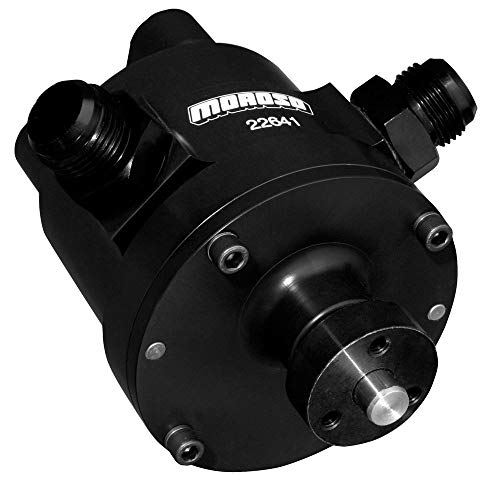
The Moroso 22641 uses four internal vanes.
As the rotor turns, the vanes move through the pump housing and create changing chamber volumes that draw gases out of the engine.
Moroso specifically states that its 4-vane design can achieve greater vacuum sooner than its comparable 3-vane pump.
That makes the 22641 attractive for racing combinations that need more vacuum capacity than Moroso’s Original Design 3-vane 22640.
Moroso 22641 vs 22640
Moroso offers both Original Design configurations.
Moroso 22640
Design: 3 vane
A suitable option for racing combinations requiring less vacuum-pump capacity.
Moroso 22641
Design: 4 vane
Moroso says the additional vane allows the pump to achieve greater vacuum sooner than the comparable 3-vane version.
The correct choice isn’t automatically the pump with the larger number of vanes.
The engine builder should determine how much crankcase vacuum the combination actually requires.
Billet Aluminum Construction
Moroso manufactures the 22641 around a billet aluminum design.
Billet construction gives the pump a rigid housing while keeping the assembly relatively compact.
That’s valuable because a mechanical vacuum pump usually lives at the front of an already crowded race engine.
The pump needs to coexist with components such as:
- Alternator
- Water pump
- Dry-sump pump
- Vacuum-pump drive
- Crank trigger
- Supercharger drive
- Motor plate
Front accessory packaging can become complicated quickly on a purpose-built race engine.
Durable Vane Material
Moroso uses purpose-selected vane material intended to improve efficiency and wear characteristics.
That’s important because the vanes are active internal components.
They operate continuously whenever the pump is being driven.
Moroso also designed the Original Design pump to be serviceable rather than disposable.
Rebuildable Design
The Moroso 22641 can be rebuilt.
Moroso offers the 22646 4-Vane Vacuum Pump Vane Kit, which includes:
- Vanes
- Bearing
- Seals
Moroso also offers the 97179 update/rebuild kit for the 22641.
That more comprehensive kit includes the internal components necessary to rebuild current-style pumps and can update certain older Original Design pumps to the later internal configuration.
For a racing component, serviceability is a significant advantage.
A pump that has accumulated multiple seasons of racing doesn’t necessarily need to be thrown away when its wear components reach the end of their service life.
-12AN Vacuum Plumbing
Moroso supports the 22641 with -12AN crankcase-vacuum plumbing.
Large-diameter vacuum plumbing is important because the pump is trying to move a significant volume of crankcase gas.
The system should avoid unnecessary restrictions.
A typical installation may use:
VALVE COVER / CRANKCASE OUTLET → -12AN HOSE → VACUUM PUMP → BREATHER TANK
Use hose and fittings appropriate for crankcase-vapor and racing-oil environments.
Keep the Vacuum Line Efficient
The suction side of the system should be routed as efficiently as possible.
Avoid:
- Collapsed hose
- Sharp bends
- Undersized fittings
- Excessive adapters
- Poorly designed valve-cover fittings
A powerful vacuum pump connected through restrictive plumbing isn’t operating at its full potential.
It’s the crankcase equivalent of breathing through a coffee stirrer.
Use a Breather Tank
The vacuum pump doesn’t just move clean air.
Crankcase gases can contain:
- Oil mist
- Fuel vapor
- Moisture
- Combustion byproducts
A proper racing installation therefore needs a suitable discharge system.
Moroso’s application information pairs the 22641 with crankcase breather tanks such as the 85465.
The breather tank gives oil vapor and other contaminants somewhere to collect instead of simply discharging them throughout the engine compartment.
Useful With a Dedicated Catch/Breather Tank
For more specialized race applications, Moroso also offers larger remote breather tanks.
A system can therefore be configured around:
ENGINE → VACUUM PUMP → CATCH/BREATHER TANK
The tank should be inspected and drained as part of normal race-car maintenance.
How quickly it collects fluid can also provide useful information about engine condition.
A sudden increase in collected oil or blow-by deserves investigation.
Wet-Sump Compatibility
The Moroso 22641 can be incorporated into a wet-sump racing oil system.
In a wet-sump engine, oil remains stored in the engine’s oil pan.
The vacuum pump operates independently of the engine oil pump, evacuating gases from the crankcase while the conventional oil pump continues supplying pressurized lubrication.
This can be useful on:
- Drag-race engines
- Circle-track engines
- High-RPM naturally aspirated combinations
- Nitrous engines
- Other competition engines
The engine still needs proper internal oil control.
A vacuum pump doesn’t compensate for a poorly designed oil pan or inadequate oil pickup.
Dry-Sump Compatibility
The 22641 can also be used in suitable dry-sump racing systems.
Dry-sump systems already use external scavenge stages to remove oil and air from the crankcase, so vacuum requirements need to be evaluated as part of the complete oiling-system design.
Moroso lists dedicated drive hardware for combinations incorporating dry-sump and vacuum-pump systems.
The key point is that the 22641 isn’t exclusively a wet-sump or dry-sump product.
It can be incorporated into either type of racing engine when the overall system is engineered appropriately.
Vacuum Regulation Is Important
More crankcase vacuum isn’t automatically better.
A racing vacuum system should have a target vacuum level appropriate for the engine.
Excessive vacuum can create lubrication and sealing problems depending on the engine design.
Moroso offers several vacuum-control components, including:
- 22633 pump-mounted vacuum regulator
- 22636 3/8-inch NPT vacuum relief valve
- 22637 3/4″-16 vacuum relief valve
These components allow the system to regulate maximum crankcase vacuum rather than simply pulling whatever the pump can produce.
Monitor Actual Crankcase Vacuum
A vacuum gauge is extremely useful when setting up the system.
Without a gauge, you’re guessing.
The actual crankcase vacuum depends on several factors:
- Engine displacement
- Ring package
- Blow-by
- Pump speed
- Engine RPM
- Hose restriction
- Vacuum leaks
- Relief-valve setting
Measure the actual system under operating conditions.
The engine builder can then adjust pump speed and regulation according to the combination.
Pump Speed Matters
The 22641 is mechanically driven, so pump RPM is determined by the drive ratio between the crankshaft and vacuum-pump pulleys.
Changing pulley size changes pump speed.
That changes vacuum-pump output.
This means pulley selection isn’t purely a packaging decision.
It’s part of the system calibration.
Follow Moroso’s current instructions for allowable pump speed and drive ratios rather than assuming that spinning the pump faster is automatically better.
Vacuum Pump Pulley Options
Moroso offers several pulley and drive components for its racing vacuum pumps.
These allow the builder to configure the pump drive according to the engine and desired pump speed.
Moroso’s application charts include components such as its 64885 vacuum-pump V-belt pulley and other application-specific drive components.
The correct hardware depends on the engine family and accessory arrangement.
Mounting Bracket Is Not Included
This is an important purchasing detail.
The Moroso 22641 does not include its mounting bracket.
Moroso offers several brackets depending on engine family.
Examples include:
- 63909 — Big Block Ford
- 63910 — SBC/BBC and engines using a motor plate
- 63911 — Small Block Ford
- 63912 — Big Block Chrysler
- 63917 — motor-plate/SBC/BBC applications
- 63922 — GM LS, driver-side cylinder head
- 63923 — GM LS, passenger-side cylinder head
Always verify the exact current bracket requirements for the engine before ordering.
Compatible With Small Block Chevy
Moroso provides hardware for installing the Original Design 22641 on Small Block Chevy racing engines.
The 63910 bracket, for example, is designed to mount the 22640 and 22641 Original Design pumps to compatible SBC/BBC cylinder-head locations or engines using a front motor plate.
This makes the pump adaptable across a wide range of racing combinations.
Compatible With Big Block Chevy
Big Block Chevy racers can also use the 22641 with the appropriate Moroso bracket and drive hardware.
BBC applications are particularly common in:
- Drag racing
- Pro Street
- Bracket racing
- High-displacement naturally aspirated engines
- Nitrous combinations
Again, the pump isn’t a BBC-specific component.
The mounting and drive hardware adapt it to the engine.
GM LS Vacuum Pump Applications
Moroso also supports the 22641 on GM LS-series engines using application-specific mounting hardware.
Moroso lists:
63922 — GM LS driver-side cylinder-head bracket
63923 — GM LS passenger-side cylinder-head bracket
That makes the 22641 relevant to high-output LS racing combinations where a purpose-built external crankcase vacuum system is part of the engine package.
This is very different from the factory LS PCV system.
Racing Vacuum Pump vs PCV System
A PCV system and a belt-driven racing vacuum pump both deal with crankcase gases, but they do it very differently.
Factory-Style PCV
Uses engine intake vacuum to draw crankcase gases into the intake tract for combustion.
It is primarily part of the engine’s crankcase ventilation and emissions strategy.
Racing Vacuum Pump
Uses a mechanically driven external pump to actively create controlled crankcase vacuum.
It is designed around competition engine requirements and can support specialized low-tension ring packages.
The Moroso 22641 belongs firmly in the second category.
External Vacuum Pumps and LS Engines
A production LS engine already has an engineered crankcase-ventilation system.
Installing an external racing vacuum pump changes how crankcase pressure is managed.
That means an LS race engine using the 22641 should be configured around the external pump rather than simply connecting it alongside the factory PCV system and hoping both systems cooperate.
For broader LS engine architecture, see the Pro Street LS1 Specs guide and Ultimate GM LS Engine Guide.
Those guides provide useful background for understanding the LS platform before changing its crankcase-ventilation strategy.
Ring Seal Still Starts With Engine Condition
A vacuum pump isn’t a cure for damaged piston rings or excessive cylinder wear.
If an engine suddenly develops major blow-by, diagnose the mechanical problem.
That may involve:
- Compression testing
- Leak-down testing
- Inspecting spark plugs
- Monitoring crankcase pressure
- Inspecting cylinder walls
- Checking ring condition
An external pump can improve crankcase control in an engine designed to use one.
It cannot magically turn worn rings into new rings.
Vacuum Pumps and Oil Leaks
One useful effect of controlled crankcase vacuum is reducing the positive pressure trying to force oil past engine seals and gaskets.
That can help keep a properly built racing engine cleaner.
But if the engine requires extreme vacuum just to stop oil pouring from every gasket, fix the leaks.
Performance parts work best when they aren’t being asked to perform an exorcism.
Check Crankshaft Seals
An engine designed to operate under crankcase vacuum needs appropriate sealing.
Air entering through:
- Front crank seal
- Rear main seal
- Valve covers
- Dipstick tube
- Fuel-pump opening
- Distributor area
- Oil-pan gasket
reduces the pump’s ability to maintain vacuum.
When troubleshooting low vacuum, don’t immediately blame the pump.
Check the engine for uncontrolled air leaks first.
Valve Cover Plumbing Matters
The crankcase evacuation connection is commonly placed in a valve cover or another suitable crankcase location.
The fitting needs to allow sufficient airflow without continuously feeding liquid oil into the vacuum pump.
Internal baffling can be important.
If the pickup point is positioned directly in heavy oil splash, the pump may transfer excessive oil into the breather tank.
Proper placement separates crankcase vapor from bulk oil as effectively as possible.
4.150-Inch Pump Body
Moroso specifies the 22641 with a 4.150-inch outside body diameter.
That’s an important packaging dimension when planning the front accessory system.
Before ordering brackets and pulleys, check clearance around:
- Cylinder head
- Valve cover
- Water pump
- Alternator
- Radiator
- Motor plate
- Belt drive
Race engines have an impressive ability to run out of space precisely where the next accessory needs to go.
5.900-Inch Pump Depth
Moroso lists the distance from the back of the pump to the pulley mounting flange at 5.900 inches.
Use that measurement when planning forward clearance.
This is especially important on cars with limited space between the front accessory drive and radiator.
Moroso 22641 Specifications
Part Number: 22641
Product: Original Design 4-Vane Vacuum Pump
Application: Racing crankcase vacuum system
Pump Design: 4 vane
Housing: Billet aluminum
Body Diameter: 4.150 inches
Back of Pump to Pulley Mounting Flange: 5.900 inches
Vacuum Plumbing: -12AN system components available
Oiling-System Compatibility: Wet-sump or dry-sump racing applications when properly configured
Mounting Bracket: Not included
Serviceable: Yes
Replacement Vane Kit: Moroso 22646
Internal Update/Rebuild Kit: Moroso 97179
Replacement -12AN Fittings: Moroso 97641
Fitment: Universal/application-specific using appropriate mounting and drive hardware
Country of Origin: USA
Not Vehicle-Specific
Don’t classify the Moroso 22641 as a vehicle-specific component.
It’s a racing engine component that can be adapted to numerous engine families with the appropriate bracket and drive system.
Compatibility depends on:
- Engine family
- Mounting bracket
- Drive system
- Available accessory clearance
- Vacuum requirements
- Crankcase plumbing
- Engine ring package
For ecommerce purposes, use:
Fitment Type: Universal / application-specific
Application: Racing engine crankcase vacuum
Pump Type: Mechanical 4-vane
Plumbing: -12AN
That will be far more useful than trying to tell customers it fits a specific Camaro, Mustang or Challenger.
Who Should Buy the Moroso 22641?
The Moroso 22641 is intended for purpose-built performance engines that can benefit from controlled external crankcase vacuum.
Strong applications include:
- Drag-race engines
- Pro Street builds
- High-RPM naturally aspirated engines
- Nitrous combinations
- High-compression racing engines
- Wet-sump race engines
- Dry-sump racing systems
- Small Block Chevy race engines
- Big Block Chevy race engines
- Ford racing engines
- Chrysler race engines
- High-output LS race engines
It’s less appropriate for an otherwise stock street engine still using its factory PCV and emissions system.
This is racing hardware.
Final Verdict
The Moroso 22641 Original Design 4-Vane Vacuum Pump is a serious crankcase-pressure-control component for engines built around external vacuum.
Moroso’s billet aluminum 4-vane design is intended to produce greater vacuum sooner than its comparable 3-vane Original Design pump, while replaceable vanes, seals, bearings and internal components make the pump serviceable over the long term.
Its universal nature also makes it adaptable to numerous engine families through Moroso’s extensive bracket and drive catalog.
But the vacuum pump should be treated as part of an engineered system.
Select the correct bracket.
Choose the appropriate drive ratio.
Use properly sized -12AN plumbing.
Install a breather/catch tank.
Regulate the vacuum.
Then measure what the engine is actually seeing.
Because when the goal is controlled crankcase vacuum, “maximum suck” isn’t technically a tuning specification.










There are no reviews yet.