
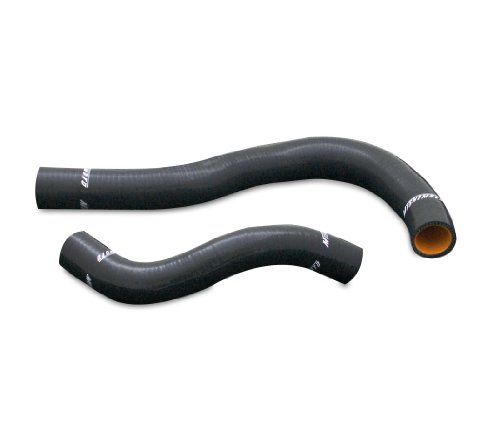
Reinforced Silicone Construction
The hoses combine high-grade silicone with heat-resistant embedded fibers. Mishimoto rates them for coolant temperatures up to 330°F and improved pressure tolerance compared with aging factory rubber hoses.
Product benefits include:
- High-grade reinforced silicone construction
- Heat-resistant embedded fibers
- Maximum temperature rating of 330°F
- Factory-style molded routing
- Improved pressure tolerance
- Black OEM-inspired finish
- Suitable for factory and aluminum radiators
- Mishimoto Lifetime Warranty
Some reseller descriptions call this a “five-layer” kit, while Mishimoto’s current description uses different construction language. To avoid turning product copy into archaeological speculation, the safest description is reinforced high-grade silicone with heat-resistant embedded fibers.
Upper and Lower Radiator Hoses Included
The MMHOSE-RSX-02BK kit includes:
- One upper radiator hose
- One lower radiator hose
- Worm-gear hose clamps
These are the two main radiator hoses. The kit does not replace every heater, bypass, throttle-body or expansion-tank hose in the RSX cooling system.
Factory-Style Fit
Each hose is molded to follow the original RSX routing between the K20 engine and radiator. No custom splicing should be required on an unmodified 2002–2006 RSX cooling system.
Before installation, inspect:
- Radiator inlet and outlet necks
- Thermostat-housing connection
- Engine coolant outlet
- Clamp sealing surfaces
- Cooling-fan clearance
- Nearby wiring and brackets
- Evidence of oil contamination
Oil contamination can soften and swell coolant hoses. If the old hose is oily, repair the leak before installing the new kit. Silicone is durable, but it is not an absolution for ignored maintenance.
When Should RSX Radiator Hoses Be Replaced?
Replace the hoses when you find:
- Cracks near either connection
- Soft or swollen sections
- Coolant stains around the clamps
- A hose that collapses during cooldown
- Abrasion from surrounding components
- Hardened material that no longer flexes
- A recurring coolant smell
- Unexplained coolant loss
- Temperature fluctuations or overheating
If the source is not obvious, follow our guide on how to find a coolant leak. Pressure testing is particularly useful for small leaks that only appear after the engine warms up.
Installation Overview
Never open the radiator cap while the engine is hot. Let the engine cool completely before beginning.
A typical installation involves:
- Raise and support the vehicle safely if lower access is required.
- Drain the coolant into a suitable container.
- Photograph the original hose routing.
- Remove the factory clamps.
- Carefully free the original hoses from their connections.
- Clean and inspect each sealing surface.
- Compare the replacement hoses with the originals.
- Install each hose without twisting or stretching it.
- Position the clamps behind the raised beads.
- Refill with Honda-compatible coolant.
- Bleed air from the cooling system.
- Confirm radiator-fan operation.
- Inspect every connection at operating temperature.
- Recheck the coolant level after the engine cools.
Use our cooling-system flush guide if the coolant is old, contaminated or mixed with an unknown formula.
Inspect the Rest of the RSX Cooling System
Replacing the hoses is a good opportunity to inspect the:
- Radiator
- Pressure cap
- Thermostat
- Water pump
- Cooling fans
- Fan relays
- Coolant reservoir
- Heater hoses
- Coolant temperature sensor
Our complete car cooling-system guide explains how these components work together.
If the RSX already runs hot, use these diagnostic resources before ordering parts with the traditional “it looked guilty” method:
- Why a car overheats while driving
- Bad thermostat versus bad water pump
- Seven signs of a failing radiator
- Acura RSX high-idle causes
- Car overheating while the heater blows cold
- When to stop driving an overheating car
Product Specifications
| Specification | Details |
|---|---|
| Brand | Mishimoto |
| Manufacturer part number | MMHOSE-RSX-02BK |
| Product type | Silicone radiator hose kit |
| Color | Black |
| Material | Reinforced silicone |
| Inside diameter | 1.18 inches |
| Outside diameter | 1.54 inches |
| Maximum temperature | 330°F |
| Upper radiator hose | Included |
| Lower radiator hose | Included |
| Hose clamps | Included |
| Fitment | 2002–2006 Acura RSX |
| Compatible trims | Base and Type-S |
| Warranty | Mishimoto Lifetime Warranty |
Frequently Asked Questions
What year Acura RSX does MMHOSE-RSX-02BK fit?
It fits every 2002–2006 Acura RSX, including Base and Type-S models.
Does it fit the RSX Type-S?
Yes. It fits 2002–2004 K20A2 and 2005–2006 K20Z1 Type-S applications.
Does it fit the base RSX?
Yes. It fits the 2002–2006 Base model with the K20A3 engine.
Are the upper and lower hoses included?
Yes. The kit includes both primary radiator hoses and hose clamps.
Does it fit an aftermarket aluminum radiator?
It is designed around factory connection locations and is compatible with many direct-fit aluminum radiators. Verify the neck diameter and placement when using a custom or universal radiator.
Will it fit a K-swapped Civic?
No. Mishimoto offers the separate MMHOSE-HON-K20BK for 1992–2000 Civic K-swaps using a compatible K-swap radiator.
Will silicone hoses reduce coolant temperature?
They provide better heat and pressure tolerance, but they do not function as a radiator or lower the thermostat’s operating point. Their primary benefit is durability and reliable coolant containment.
Can new hoses fix an overheating RSX?
Only when damaged, leaking or collapsing hoses caused the problem. A clogged radiator, failed fan, defective thermostat, weak water pump, trapped air or engine problem requires separate diagnosis.





There are no reviews yet.