

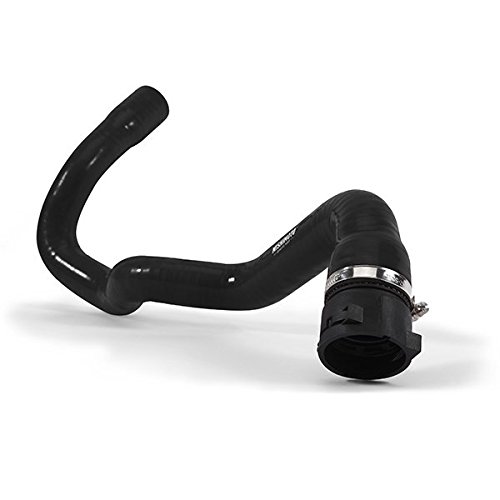
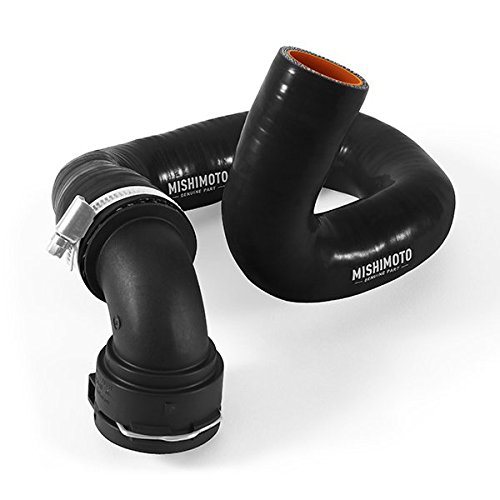
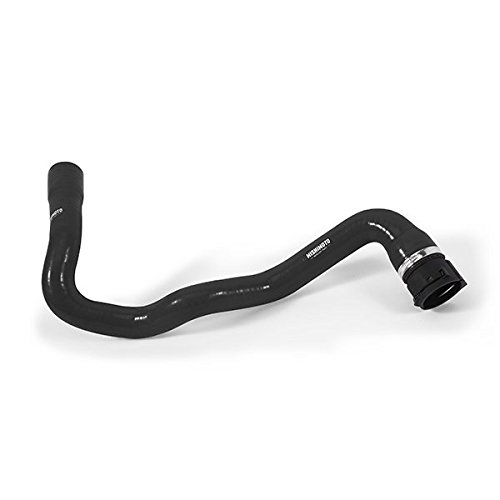

Five-Layer Silicone Construction
Each hose is manufactured from five layers of silicone reinforced with heat-resistant fibers. This construction provides greater resistance to heat, pressure, swelling, and age-related deterioration than the original rubber hoses.
That makes the kit suitable for stock Focus STs as well as modified cars used for autocross, track days, or aggressive street driving.
Benefits include:
- Five-layer reinforced silicone construction
- Improved heat and pressure tolerance
- Resistance to cracking and age-related hardening
- Preformed factory-style routing
- Black finish for a clean OEM-inspired appearance
- Direct replacement for the primary radiator hoses
- Mishimoto Lifetime Warranty
Factory-Style Quick-Disconnect Fittings
The MMHOSE-FOST-13BK includes pre-attached stock-style quick-disconnect fittings and new O-rings. These fittings allow the hoses to connect to the original cooling-system ports without transferring worn connectors from the factory hoses.
New O-rings are especially important. Reusing flattened or damaged seals is an excellent way to perform the same repair twice.
Inspect each retaining clip and connector before installation. A fitting should lock completely into place and resist being pulled free by hand.
What’s Included?
The package contains:
- One silicone upper radiator hose
- One silicone lower radiator hose
- Pre-attached quick-disconnect fittings
- New connector O-rings
- Two worm-gear clamps
This kit replaces the main upper and lower radiator hoses. It does not replace every heater, turbocharger, expansion-tank, oil-cooler, or bypass hose in the Focus ST cooling system.
When Should Focus ST Radiator Hoses Be Replaced?
Inspect or replace the hoses if you notice:
- Coolant residue around a quick connector
- Cracks, splits, or surface deterioration
- A soft or swollen section
- Coolant odor after driving
- Recurring loss from the expansion tank
- A hose rubbing against another component
- Temperature fluctuations
- Steam or visible coolant spray
- A connector that no longer locks securely
If you’re still locating the source, follow our guide on how to find a coolant leak. Dried coolant residue around the connectors can reveal a pressure-dependent leak even when the driveway remains suspiciously spotless.
Installation Overview
Work only when the engine is completely cold. The Focus ST cooling system operates under pressure, and opening a hot expansion tank is a poor method of discovering how fast coolant can move.
A typical installation involves:
- Allow the engine to cool completely.
- Remove the expansion-tank cap.
- Drain enough coolant to lower the level beneath the hose connections.
- Photograph the original hose routing.
- Release the factory quick-connect fittings.
- Remove the original clamps and hoses.
- Clean and inspect each coolant connection.
- Lubricate new O-rings with clean, compatible coolant.
- Push each connector into place until fully locked.
- Position the worm-gear clamps behind the raised fitting beads.
- Confirm that neither hose is twisted or contacting a belt, fan, or sharp edge.
- Refill with Ford-approved coolant.
- Bleed the system according to the factory procedure.
- Bring the engine to operating temperature and inspect for leaks.
- Recheck the coolant level after the engine cools.
Use our cooling-system flush guide if the existing coolant is old, contaminated, mixed with an incompatible type, or generally looks like something recovered from a neglected aquarium.
Inspect the Entire Cooling System
New radiator hoses will correct leaking or deteriorated hoses, but they cannot repair another cooling-system failure. While the coolant is drained, inspect:
- Expansion tank and pressure cap
- Radiator seams and end tanks
- Thermostat housing
- Water pump
- Cooling fan and fan controls
- Heater and bypass hoses
- Turbocharger coolant connections
- Coolant temperature sensor
- Oil-cooler connections
Our complete car cooling-system guide explains how these components work together. If the engine is already running hot, review why a car overheats while driving before blaming the most visible hose.
Additional diagnostic resources include:
- Bad thermostat versus bad water pump
- Seven signs of a failing radiator
- Car overheating while the heater blows cold
- Can radiator stop-leak cause damage?
- When should you stop driving your car?
Product Specifications
| Specification | Details |
|---|---|
| Brand | Mishimoto |
| Manufacturer part number | MMHOSE-FOST-13BK |
| Product | Silicone radiator hose kit |
| Color | Black |
| Material | Reinforced silicone |
| Construction | Five-layer |
| Fitment | 2013–2018 Ford Focus ST |
| Engine | 2.0L EcoBoost turbocharged I4 |
| Upper radiator hose | Included |
| Lower radiator hose | Included |
| Quick-disconnect fittings | Pre-attached |
| New O-rings | Included |
| Worm-gear clamps | Two included |
| Warranty | Mishimoto Lifetime Warranty |
| Installation style | Direct replacement |
Frequently Asked Questions
What year Focus ST does MMHOSE-FOST-13BK fit?
It fits the 2013–2018 Ford Focus ST with the turbocharged 2.0L EcoBoost engine.
Does it fit a 2019 Ford Focus?
No. The North American Focus ST was offered through the 2018 model year, and Mishimoto specifies this kit for 2013–2018 applications.
Does it fit the Ford Focus RS?
No. The Focus RS uses a different 2.3L EcoBoost engine and cooling-system configuration.
Are the quick-connect fittings included?
Yes. Both hoses have pre-attached stock-style quick-disconnect fittings, and new O-rings are included.
Does the kit include upper and lower hoses?
Yes. It includes the upper and lower primary radiator hoses.
Are hose clamps included?
Yes. Two worm-gear clamps are supplied.
Will these hoses increase horsepower?
No. Radiator hoses do not create measurable horsepower. They provide a more durable coolant path and help support reliable cooling under demanding conditions. Sometimes the honest answer lacks fireworks.
Will this kit stop an overheating problem?
Only if the overheating is caused by a leaking, restricted, or collapsing radiator hose. A defective thermostat, water pump, radiator, fan, pressure cap, head gasket, or trapped air must be diagnosed separately.







There are no reviews yet.