

Acura Integra Fitment
The springs are also advertised for:
- 2023 Acura Integra Base
- 2023 Acura Integra A-Spec
- 2024 Acura Integra Base
- 2024 Acura Integra A-Spec
- 2025 Acura Integra Base
- 2025 Acura Integra A-Spec
Not Confirmed for Integra Type S
The Acura Integra Type S is not listed. It uses wider bodywork, different suspension tuning and performance-specific chassis components.
Do not list this kit as compatible with:
- 2024–2025 Acura Integra Type S
- Integra models with adaptive dampers unless confirmed
- Earlier 1986–2001 Acura Integra models
Acura notes that certain Integra configurations use an available Adaptive Damper System, making trim-level verification particularly important. Acura Integra product information
Models Requiring Additional Verification
Fitment should be confirmed separately for:
- 2016–2021 tenth-generation Civic
- 2022–2024 eleventh-generation Civic
- Civic Si
- Civic Touring
- Civic Sport Touring
- Civic models with adaptive dampers
- Acura Integra equipped with adaptive dampers
- Canadian and other non-U.S. trims
- Vehicles with previously modified suspension
The kit should not automatically be listed for:
- Honda Civic Type R
- Acura Integra Type S
- Honda Insight
- Civic Hybrid
- Civic Coupe after 2020
- Civic Si for 2016 or 2021
- Vehicles already equipped with coilovers
Lowered Street Stance
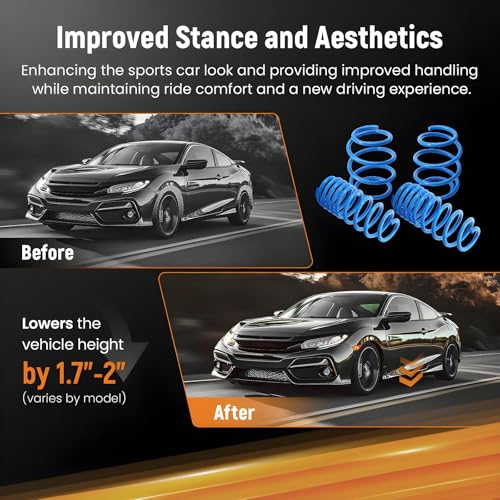
The springs reduce the space between the tires and fenders, giving the Civic or Integra a lower and more planted appearance.
The supplied product information does not specify the exact front or rear lowering amount. Do not advertise a precise drop until the spring SKU is matched with the manufacturer’s application chart.
Actual ride-height reduction can vary based on:
- Civic or Integra chassis
- Sedan, Coupe or Hatchback body
- Engine and transmission
- Vehicle trim
- Factory suspension package
- Damper condition
- Existing spring wear
- Added vehicle weight
- Normal settling after installation
Measure factory ride height from the wheel-hub center to the fender opening before installation. Repeat the measurement after installation and once the springs have settled.
Handling and Stability
Lowering the vehicle’s center of gravity can reduce body movement and improve the way the chassis responds during cornering.
Potential benefits include:
- Reduced body roll
- More immediate steering response
- Less brake dive
- More controlled acceleration squat
- Improved highway stability
- Cleaner wheel-to-fender fitment
- More responsive street handling
The springs do not create tire grip on their own. Alignment, tire quality, damper control and suspension condition remain responsible for keeping the vehicle predictable.
Drivers who want adjustable height or damping should compare fixed springs with the choices covered in the My Pro Street daily-driver coilover guide.
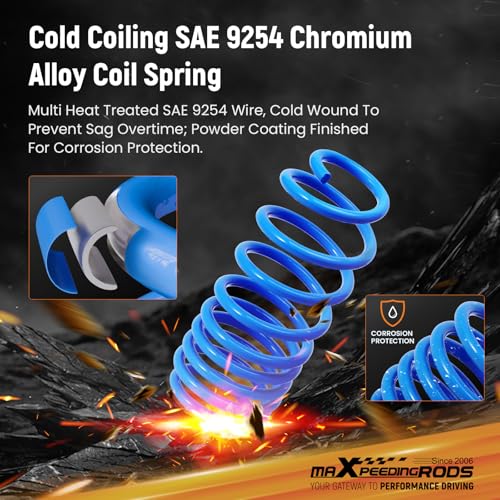
SAE 9254 Cold-Wound Steel
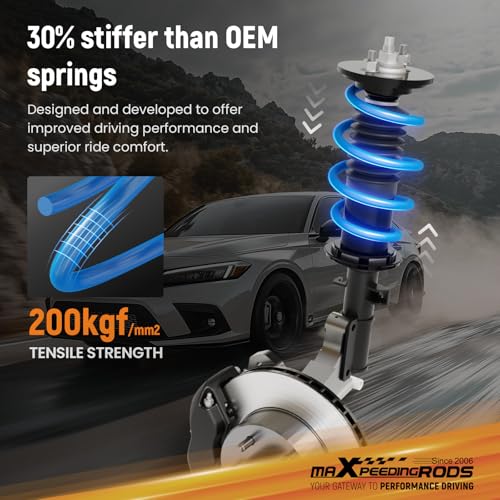
These lowering springs are constructed from SAE 9254 cold-wound steel. This silicon-chromium alloy is selected for components exposed to high cyclic loads and repeated compression.
The construction is intended to provide:
- Consistent spring geometry
- Stable compression characteristics
- Resistance to fatigue
- Long-term structural durability
- Predictable suspension response
An anti-corrosion coating helps protect the steel from:
- Moisture
- Road salt
- Dirt and road debris
- Temperature changes
- Common automotive chemicals
Additional manufacturer information is available through maXpeedingrods.
Tested for Durability
According to the supplied product specifications, the springs undergo:
- 200,000-cycle fatigue testing
- 720-hour salt-spray testing
Fatigue testing evaluates durability under repeated compression. Salt-spray testing evaluates the protective coating’s resistance to accelerated corrosion.
Real-world service life will still depend on road conditions, climate, vehicle loading and installation quality.
Factory and Aftermarket Shock Compatibility
These springs are advertised as compatible with OEM-style and suitable aftermarket shocks. That does not mean every original damper will perform properly at the new ride height.
Lowering springs reposition the shock farther into its normal travel. Depending on the final drop, this may cause:
- Reduced compression travel
- Increased bump-stop contact
- Premature damper wear
- Excessive bouncing
- Poor rebound control
- Harsh impact response
- Tire cupping
The My Pro Street lowering-spring and shock-wear guide explains why spring height and damper travel must be considered together.
If the existing shocks are old, leaking or poorly controlled, replace them during installation. New springs have a remarkable ability to expose old dampers immediately.
Adaptive Damper Warning
Some Civic Touring, Civic Type R and Acura Integra configurations use electronically controlled or adaptive dampers.
Lowering springs may physically install over these units, but compatibility must be confirmed because the reduced ride height can affect:
- Damper operating range
- Suspension travel
- Electronic damping behavior
- Warning-light operation
- Ride quality
- Warranty coverage
Do not disable or bypass an adaptive suspension system without using properly engineered components.
Suspension Inspection
Before installation, inspect:
- Front struts
- Rear shocks
- Upper strut mounts
- Rear shock mounts
- Spring pads and isolators
- Bump stops
- Control-arm bushings
- Ball joints
- Tie-rod ends
- Sway-bar links
- Wheel bearings
- Brake hoses
- ABS wiring
Browse the My Pro Street How-To library for additional Honda and Acura repair guidance.
Wheel and Tire Clearance
Lowering changes the available space between the tires, fenders and suspension components. Clearance should be checked throughout the complete steering and suspension range.
Inspect:
- Tire-to-fender clearance
- Tire-to-strut clearance
- Wheel offset
- Wheel width
- Tire diameter
- Full steering lock
- Full suspension compression
- Brake-hose routing
- ABS-wire clearance
- Underbody clearance
Wheel spacers and aggressive offsets increase the chance of rubbing. A setup that clears while parked can still contact the fenders during braking or cornering.
Installation Requirements
Although the springs use factory-style mounting locations, installation requires suspension disassembly and safe spring-compression equipment.
A typical installation includes:
- Confirming chassis and trim compatibility.
- Measuring the original ride height.
- Raising and safely supporting the vehicle.
- Removing the front strut assemblies.
- Compressing and removing the factory springs.
- Inspecting mounts, boots and bump stops.
- Installing the new front springs correctly.
- Removing and replacing the rear springs.
- Confirming proper seating and orientation.
- Checking brake-hose and ABS-wire clearance.
- Torquing suspension hardware correctly.
- Performing a four-wheel alignment.
Professional installation is recommended. “Direct bolt-on” describes the mounting arrangement—not the difficulty level or the amount of energy stored in a compressed coil spring.
Alignment Is Required
A four-wheel alignment should be completed after installation and rechecked if the ride height changes as the springs settle.
The technician should inspect:
- Front toe
- Rear toe
- Front camber
- Rear camber
- Caster comparison
- Steering-wheel centering
- Thrust angle
Incorrect toe can wear tires rapidly even when the vehicle drives straight. Additional camber or toe components may be required if the lowered geometry falls outside the factory adjustment range.
The NHTSA tire-safety guide provides additional information about tire inspection and abnormal wear.
Package Contents
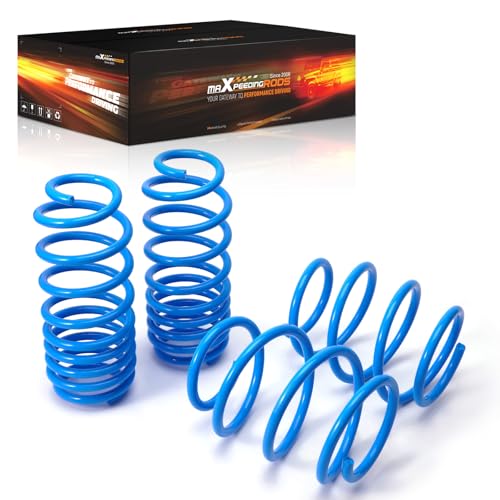
The package is expected to include:
- Two front lowering springs
- Two rear lowering springs
The following are not listed as included:
- Shocks or struts
- Upper mounts
- Bump stops
- Camber arms
- Toe links
- Spring compressors
- Alignment service
- Electronic damper bypass modules
Confirm the exact package contents before ordering.
Frequently Asked Questions
What years does this kit fit?
It is advertised for 2016–2024 Honda Civic models and 2023–2025 Acura Integra Base and A-Spec models. Exact chassis and trim compatibility must be confirmed.
Does it fit both tenth- and eleventh-generation Civics?
The supplied listing claims that it does, but the range spans two different Civic generations. Verify the exact spring SKU before ordering.
Does it fit a 2021 Civic Coupe?
No. Honda discontinued the Civic Coupe after the 2020 model year.
Does it fit a 2021 Civic Si?
No U.S.-market 2021 Civic Si was offered. The tenth-generation Si ended with 2020 and returned on the new chassis for 2022.
Does it fit the Civic Type R?
Type R compatibility is not listed and should not be assumed.
Does it fit the Acura Integra Type S?
No confirmed Type S compatibility is provided. The listing names Base and A-Spec models only.
Will it work with factory shocks?
The springs are advertised for factory-style dampers, but compatibility and damper life depend on the actual lowering amount and suspension condition.
Is an alignment required?
Yes. A professional four-wheel alignment is required after installation.
Final Verdict
These maXpeedingrods lowering springs are marketed as a broad application for late-model Honda Civic and Acura Integra platforms. The SAE 9254 construction, corrosion-resistant coating and advertised durability testing make the kit appealing for a budget-conscious street build.
The fitment range needs careful verification because it combines two Civic generations, three body styles and a separate Acura platform. Confirm the exact SKU, lowering amount, adaptive-damper compatibility and chassis code before ordering.
Visit My Pro Street for more Honda suspension guides, installation articles and performance-part reviews.





There are no reviews yet.