
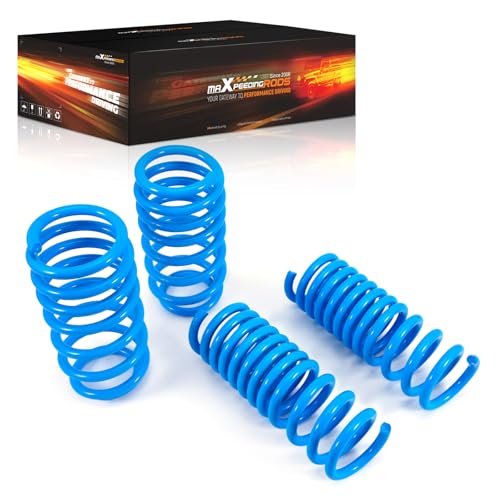
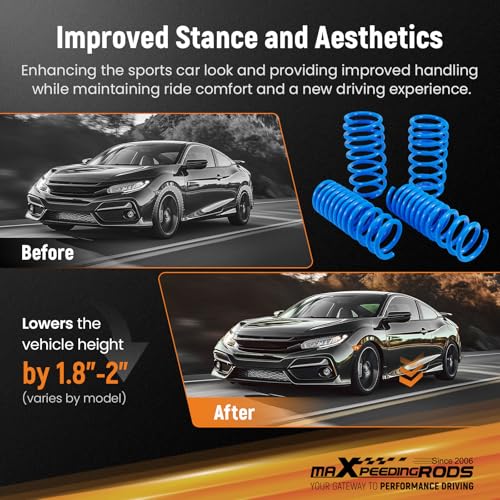
maXpeedingrods Lowering Springs for 2011–2023 Dodge Charger and Chrysler 300 RWD
The maXpeedingrods lowering spring kit is designed for select rear-wheel-drive Dodge Charger and Chrysler 300 models produced from 2011 through 2023. Constructed from SAE 9254 cold-wound steel, these springs reduce the vehicle’s center of gravity for a lower stance, less body roll and more responsive handling.
The specified rates are 224 lb/in in front and 280 lb/in in the rear, creating a rear-biased setup appropriate for the Charger and 300 platform’s suspension layout. Exact compatibility must be confirmed by trim, engine, factory suspension package and axle-load rating.
Advertised Vehicle Fitment
| Years | Make | Model | Drivetrain |
|---|---|---|---|
| 2011–2023 | Dodge | Charger | RWD |
| 2011–2023 | Chrysler | 300 | RWD |
These springs are only advertised for rear-wheel-drive vehicles.
Not Compatible With AWD Models
Do not install this kit on:
- Dodge Charger AWD
- Chrysler 300 AWD
- Vehicles converted between AWD and RWD
- Models with unidentified suspension modifications
All-wheel-drive versions carry additional front drivetrain components and use different suspension loading. Installing RWD springs can result in incorrect ride height, inadequate travel or poor handling.
The NHTSA VIN decoder can help identify basic vehicle information, but the suspension option codes and installed components should also be inspected directly.
$129.99
Performance Models Require Verification
The stated 2011–2023 range includes numerous performance variants with different engines, curb weights, suspension packages and dampers.
Obtain explicit manufacturer confirmation before ordering for:
- Charger R/T
- Charger Daytona
- Charger Scat Pack
- Charger SRT 392
- Charger SRT Hellcat
- Charger Hellcat Redeye
- Charger Widebody
- Charger Pursuit
- Chrysler 300S
- Chrysler 300C
- Chrysler 300 SRT
- Models with adaptive damping
- Models with self-leveling rear shocks
The fact that a Hellcat is rear-wheel drive does not automatically mean it should use the same springs as a V6 rental-spec Charger. Seven hundred horsepower deserves at least one extra fitment check.
Spring Rates
The supplied spring rates are:
| Position | Metric rate | Imperial rate |
|---|---|---|
| Front | 4 kg/mm | 224 lb/in |
| Rear | 5 kg/mm | 280 lb/in |
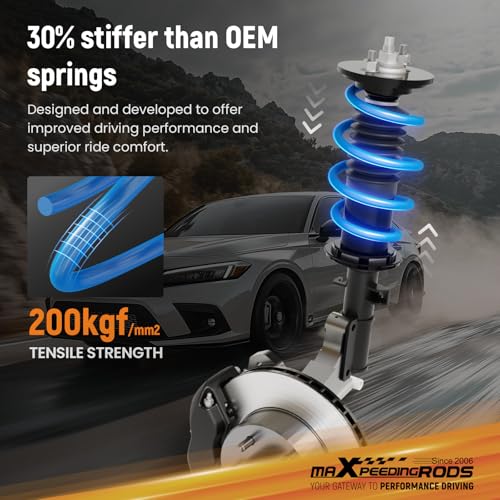
Spring rate describes how much force is required to compress a spring by a specified distance. The higher rear rate helps control the platform’s rear suspension movement and vehicle weight.
The way these rates feel will vary based on:
- V6 or V8 engine
- Vehicle trim and curb weight
- Factory damper package
- Wheel and tire configuration
- Added audio equipment
- Passenger and cargo loading
A spring rate that feels controlled on a standard V6 model may behave differently under a heavier V8 or supercharged application.
Lowering Amount
The supplied information does not specify an exact front or rear drop. Do not publish a lowering measurement until it is confirmed through the manufacturer’s application chart for the exact part number.
Finished ride height can vary because of:
- Engine weight
- Charger versus Chrysler 300 body configuration
- Factory performance suspension
- Original spring wear
- Shock condition
- Vehicle accessories
- Wheel and tire dimensions
- Normal spring settling
Measure the original ride height from the wheel-hub center to the fender opening before installation. Repeat the measurements afterward so the actual change can be documented accurately.
Improved Street Stance
Lowering springs reduce the visible wheel gap and give the large-body Charger or 300 a more planted profile.
Potential appearance and handling benefits include:
- Reduced factory wheel gap
- Lower center of gravity
- Reduced body roll
- Quicker steering transitions
- Less brake dive
- More controlled acceleration squat
- Cleaner wheel-to-fender fitment
- More settled highway behavior
Lowering springs cannot compensate for worn dampers, old bushings or poor tire quality. They are one part of a complete suspension system.
For more information about selecting a balanced street setup, read the My Pro Street daily-driver suspension guide.
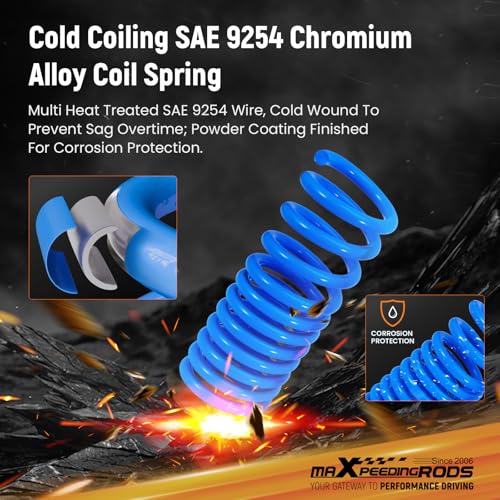
SAE 9254 Cold-Wound Steel
These springs are manufactured from SAE 9254 cold-wound steel. This silicon-chromium alloy is commonly selected for suspension components exposed to high cyclic loads.
The construction is intended to provide:
- Consistent coil dimensions
- Resistance to fatigue
- Stable spring response
- Long-term structural durability
- Predictable ride-height control
An anti-corrosion coating helps protect the springs against:
- Moisture
- Road salt
- Dirt and road grime
- Common automotive chemicals
- Temperature changes
Additional manufacturer information is available through maXpeedingrods.
Durability Testing
According to the supplied specifications, the springs undergo:
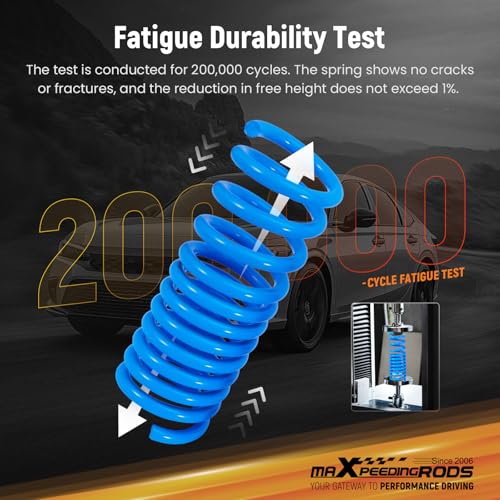
- 200,000-cycle fatigue testing
- 720-hour salt-spray testing
Fatigue testing evaluates repeated compression durability, while salt-spray testing evaluates the protective coating’s resistance to accelerated corrosion.
These tests support the product’s stated durability, but service life will still depend on installation quality, vehicle weight, road conditions and coating maintenance.
Factory and Aftermarket Shock Compatibility
The springs are advertised for use with OEM-style and appropriate aftermarket shocks. Physical compatibility, however, does not guarantee ideal damping.
A lowering spring changes the shock’s resting position and reduces available compression travel. Worn or mismatched dampers may cause:
- Excessive bouncing
- Poor rebound control
- Premature shock wear
- Frequent bump-stop contact
- Harsh impacts
- Tire cupping
- Unstable high-speed behavior
The My Pro Street lowering-spring and shock-wear guide explains how spring height and damper travel affect one another.
Lowering-compatible dampers are recommended if the original shocks are old, leaking or unable to control the new rates.
Adaptive and Self-Leveling Suspension Warning
Certain Charger and Chrysler 300 trims use adaptive dampers or load-leveling rear shocks. These systems require application-specific springs.
Installing ordinary lowering springs on an incompatible electronic or self-leveling system may cause:
- Incorrect ride height
- Warning messages
- Poor damping
- Reduced suspension travel
- Rear height inconsistencies
- Premature component wear
Confirm the factory damper type before ordering. Do not remove or bypass electronic suspension equipment without properly engineered replacement components.
Suspension Inspection
Before installation, inspect:
- Front shocks and upper mounts
- Rear shocks and mounts
- Front tension-strut bushings
- Lower control-arm bushings
- Ball joints
- Tie-rod ends
- Rear suspension links
- Sway-bar links
- Spring isolators
- Bump stops
- Wheel bearings
- Brake hoses
- ABS wiring
The oldest vehicles covered by this kit are now well over a decade old. New springs will not repair loose bushings, leaking shocks or worn steering components.
Browse the My Pro Street How-To library for additional suspension and repair information.
Wheel and Tire Clearance
Lowering changes the relationship between the wheels, tires, fenders and suspension components.
Check clearance at:
- Full steering lock
- Full suspension compression
- Front fender liners
- Rear fender openings
- Front shock bodies
- Rear suspension links
- Brake hoses
- Inner wheel wells
- Exhaust components
Widebody models, aggressive offsets and wheel spacers require additional care. A tire can clear while parked and still rub during hard cornering or when carrying passengers.
Installation Requirements
Although these springs install in factory-style mounting locations, professional installation is recommended.
A proper installation should include:
- Confirming RWD configuration and suspension type.
- Measuring the original ride height.
- Raising and safely supporting the vehicle.
- Removing the original springs.
- Inspecting mounts, isolators and bump stops.
- Checking shock condition and available travel.
- Installing the new springs in the correct orientation.
- Confirming each spring is fully seated.
- Inspecting brake-hose and ABS-wire clearance.
- Checking wheel and tire clearance.
- Torquing suspension hardware correctly.
- Performing a four-wheel alignment.
Suspension fasteners passing through bonded rubber bushings should be tightened according to the appropriate service procedure. Tightening them while the suspension hangs can preload the bushings at normal ride height.
Alignment Is Required
A professional four-wheel alignment should be completed after installation and repeated if spring settling changes the ride height.
The alignment should include:
- Front toe
- Rear toe
- Front camber
- Rear camber
- Caster comparison
- Thrust angle
- Steering-wheel centering
Incorrect toe can rapidly wear expensive tires even if the vehicle drives straight. Adjustable suspension links may be required if the lowered geometry falls outside the factory adjustment range.
The NHTSA tire-safety guide provides additional information about tire inspection and abnormal tread wear.
Package Contents
The package is expected to contain:
- Two front lowering springs
- Two rear lowering springs
The following are not listed as included:
- Front or rear shocks
- Upper mounts
- Spring isolators
- Bump stops
- Adjustable control arms
- Camber links
- Electronic damper modules
- Installation tools
Confirm the exact package contents and part number before ordering.
Frequently Asked Questions
What vehicles do these springs fit?
They are advertised for 2011–2023 Dodge Charger and Chrysler 300 models with rear-wheel drive.
Do they fit AWD models?
No. The supplied fitment is strictly for RWD vehicles.
Do they fit the Charger Hellcat or Scat Pack?
Do not assume compatibility. Performance trims use different vehicle weights and suspension packages and require exact manufacturer confirmation.
Do they fit a Chrysler 300C?
Compatibility depends on the engine and factory suspension configuration. Verify the exact part number against the vehicle’s trim and option codes.
What are the spring rates?
The front rate is 4 kg/mm or 224 lb/in. The rear rate is 5 kg/mm or 280 lb/in.
How much do they lower the vehicle?
No exact lowering measurement was supplied. Confirm the drop through the manufacturer’s application information before publishing a specific number.
Can factory shocks be retained?
The springs are advertised for OEM-style dampers, but worn shocks or adaptive units may not be suitable. Inspect the dampers and confirm compatibility first.
Is an alignment required?
Yes. Perform a professional four-wheel alignment after installation.
Final Verdict
These maXpeedingrods lowering springs offer a fixed-height suspension upgrade for select RWD Dodge Charger and Chrysler 300 models. Their SAE 9254 construction and specified 224/280 lb-in spring rates are intended to reduce body movement while creating a cleaner street stance.
The broad model-year range requires careful trim verification. Confirm engine, drivetrain, adaptive-damper equipment and axle-load compatibility—especially on SRT, Scat Pack, Hellcat, Widebody and Pursuit models.
Visit My Pro Street for more suspension guides, product reviews and installation advice.
Specification: maXpeedingrods Lowering Springs for 2011–2023 Dodge Charger and Chrysler 300 RWD
|
User Reviews
Be the first to review “maXpeedingrods Lowering Springs for 2011–2023 Dodge Charger and Chrysler 300 RWD”
You must be logged in to post a review.



There are no reviews yet.