


Turbocharger Specifications
| Specification | Details |
|---|---|
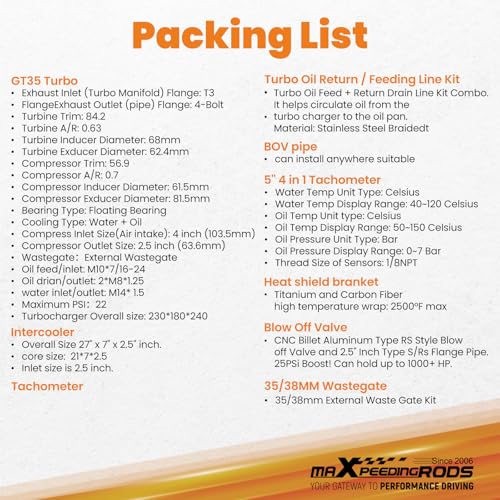
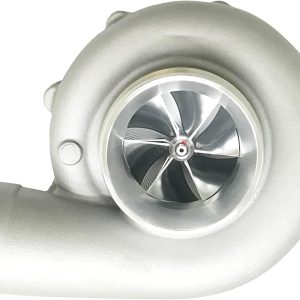
| Turbo style | GT35/GT3582 |
| Engine range | Custom 2.5L–6.0L applications |
| Bearing design | Floating/journal bearing |
| Cooling | Oil and water |
| Turbine inlet | T3 four-bolt flange |
| Turbine outlet | Three-inch four-bolt flange |
| Compressor inducer | 61.5 mm |
| Compressor exducer | 81.5 mm |
| Compressor trim | 57 |
| Compressor housing A/R | 0.70 |
| Turbine inducer | 68 mm |
| Turbine exducer | 62.4 mm |
| Turbine trim | 84 |
| Turbine housing A/R | 0.63 |
| Oil-feed fitting | M10 / 7/16-24 |
| Oil-return mounting threads | M8 × 1.25 |
| Water fittings | M14 × 1.5 |
GT35 Compressor and Turbine Sizing
The 61.5 mm compressor inducer and 0.70 A/R housing provide airflow for higher-output street and competition engines. The 0.63 A/R turbine housing is intended to balance response with exhaust-flow capacity.
Actual performance depends on:
- Engine displacement
- Engine speed
- Compression ratio
- Exhaust-manifold design
- Boost target
- Fuel type
- Camshaft specifications
- Exhaust restriction
- Vehicle weight and gearing
A turbo that works well on a high-rpm 3.0L engine may behave very differently on a larger, lower-rpm application.
Garrett recommends matching a turbo using target horsepower, displacement, pressure ratio and airflow rather than choosing by engine size alone. Garrett Motion
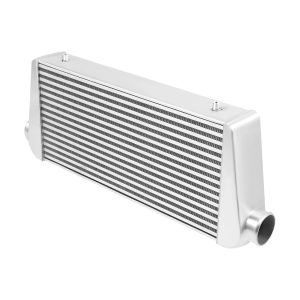
27 × 7 × 2.5-Inch Intercooler
The included front-mount intercooler is approximately:
- Overall size: 27 × 7 × 2.5 inches
- Core size: 21 × 7 × 2.5 inches
- Inlet and outlet: 2.5 inches
The intercooler reduces compressed-air temperature before the air enters the engine. Lower intake temperature can improve air density, reduce knock tendency and provide more consistent power.
Before purchase, measure:
- Available bumper width
- Crash-beam clearance
- Radiator airflow
- Air-conditioning condenser clearance
- Charge-pipe routing
- Hood-latch and bumper-support locations
Cutting, drilling or bracket fabrication may be required.
Package Contents
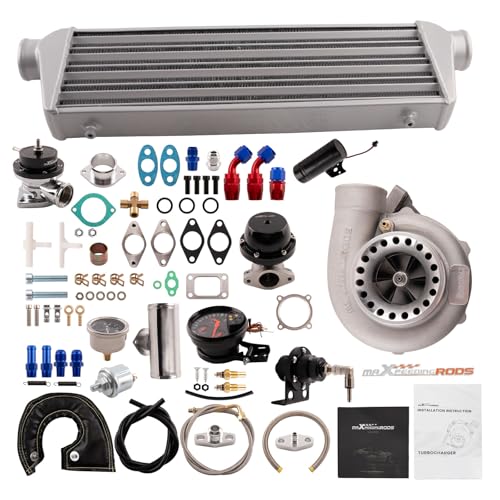
Depending on the selected package and the components shown in the primary product image, the kit may include:
- GT35/GT3582-style turbocharger
- 27-inch front-mount intercooler
- Oil-feed line
- Oil-return line
- External wastegate
- Blow-off valve
- Blow-off-valve adapter pipe
- Turbo heat blanket
- Monitoring gauge or tachometer components
Confirm the included parts before ordering. Universal kits frequently require additional couplers, clamps, fittings and hardware once the engine bay begins expressing its opinions.
Components Still Required
This kit does not complete a turbo conversion by itself. Most installations also need:
- Engine-specific T3 turbo manifold
- Wastegate dump tube
- Custom three-inch downpipe
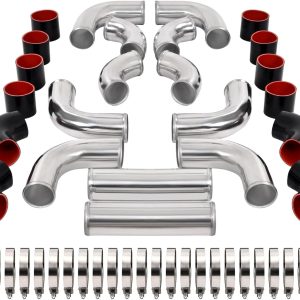
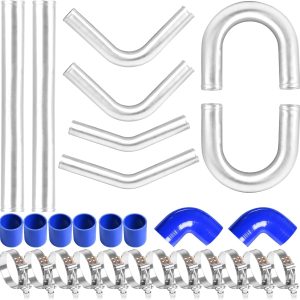
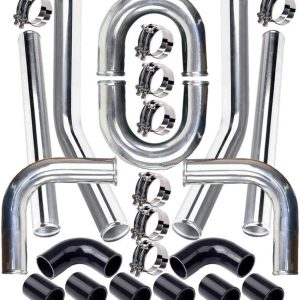
- Intercooler charge piping
- Silicone couplers
- T-bolt clamps
- Air intake and filter
- Oil-pan return fitting
- Coolant hoses and fittings
- Larger fuel injectors
- Higher-capacity fuel pump
- Boost-control system
- Wideband oxygen sensor
- MAP or boost-pressure sensor
- ECU calibration
- Exhaust-system modifications
- Heat shielding
External Wastegate Requirements
The turbocharger housing does not provide universal internal-wastegate control, so a compatible external wastegate and manifold port are required.
Wastegate selection should account for:
- Engine displacement
- Exhaust flow
- Minimum boost target
- Manifold pressure
- Wastegate port placement
- Spring pressure
- Dump-tube routing
A poorly positioned or undersized wastegate may cause boost creep or overboost.
Oil-Feed and Return Installation
The included oil-line hardware must be adapted to the engine.
The oil return must:
- Flow continuously downhill
- Enter the oil pan above the normal oil level
- Avoid tight bends and kinks
- Remain clear of exhaust heat
- Have sufficient internal diameter
- Avoid crankcase-pressure restrictions
Garrett recommends approximately a -4AN feed for many journal-bearing turbo systems, but oil pressure must be measured and matched to the requirements of this exact turbocharger. Garrett Motion
Water-Cooling Requirements
The turbocharger uses M14 × 1.5 coolant ports. Both coolant connections should be used unless the manufacturer specifically states otherwise.
Proper routing helps control bearing-housing temperature and reduce oil coking after shutdown. Coolant lines should avoid trapped air, sharp bends and direct contact with hot exhaust components.
Garrett notes that water cooling continues drawing heat away from the center housing after shutdown through thermal siphoning. Garrett Motion
Realistic Power Expectations
The product should not be assigned a guaranteed horsepower increase without a published compressor map and complete engine specification.
Actual output depends on:
- Compressor airflow
- Boost pressure
- Engine volumetric efficiency
- Fuel type
- Injector size
- Fuel-pump capacity
- Intercooler efficiency
- Ignition timing
- Exhaust backpressure
- ECU calibration
The turbocharger may support a substantial power increase on a properly built combination, but the engine’s internal components determine how much power it can survive.
Check Engine Health Before Adding Boost
Before installation, perform:
- Compression testing
- Cylinder leak-down testing
- Oil-pressure testing
- Cooling-system inspection
- Fuel-pressure testing
- Ignition-system inspection
- Crankcase-ventilation inspection
- Timing-system inspection
Review Pro Street’s engine-health checklist for turbo builds before installing the kit.
A larger turbo does not repair weak piston rings. It simply delivers the final diagnosis with more enthusiasm.
Installation and Initial Startup
Professional fabrication and dyno tuning are strongly recommended.
Before startup:
- Verify that the turbo wheels rotate freely.
- Clean every oil line and charge pipe.
- Install the oil return above the oil level.
- Connect and bleed the coolant circuit.
- Prime the turbo with clean engine oil.
- Crank the engine without starting until oil pressure develops.
- Pressure-test the intercooler and charge piping.
- Verify wastegate plumbing and spring pressure.
- Confirm sufficient fuel pressure.
- Begin tuning at minimum boost.
- Monitor air/fuel ratio, boost and oil pressure.
- Recheck every fitting after the first heat cycle.
Emissions Notice
This kit modifies the factory intake, exhaust, fuel and engine-management systems. No CARB Executive Order number is supplied.
Verify applicable emissions and vehicle-modification laws before installation. In regulated areas, this kit may be limited to off-road or competition use.



There are no reviews yet.