

What Is a Group 34 Battery?
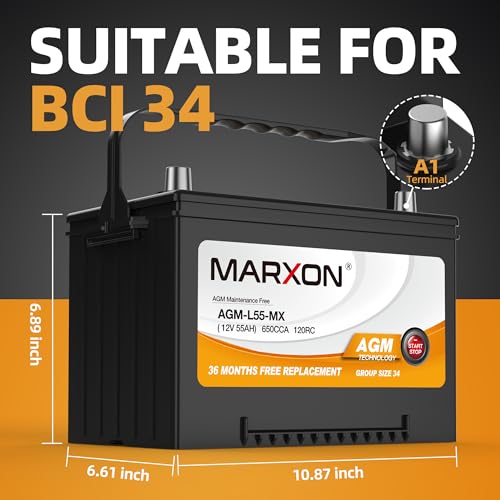
BCI Group 34 describes a common automotive battery case size used in a wide variety of cars, trucks, SUVs and performance applications.
The MARXON Group 34 measures:
10.87 inches long
6.61 inches wide
6.89 inches tall
Those dimensions matter just as much as the Group 34 label.
Different vehicle battery trays, cables and hold-down systems can vary significantly.
Before purchasing, compare the MARXON battery directly with the battery currently installed in the vehicle.
650 Cold Cranking Amps
The MARXON Group 34 provides:
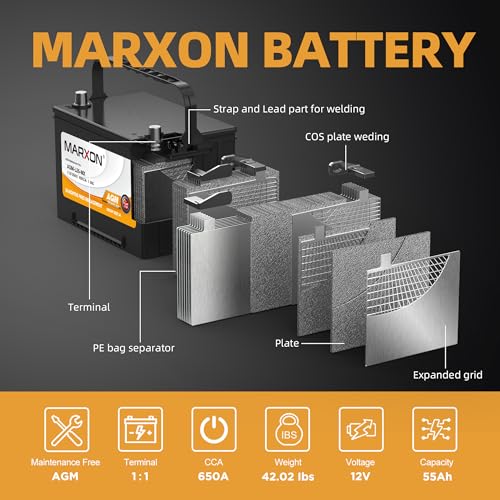
650 CCA
Cold Cranking Amps measure how much current the battery can deliver under standardized cold-weather conditions while maintaining sufficient voltage.
Starting requirements increase when:
- Temperature drops
- Engine oil becomes thicker
- Battery performance decreases with age
- Starter demand increases
A 650CCA rating can provide reliable starting performance for many compatible Group 34 applications.
However, don’t select a battery by CCA alone.
Always meet or exceed the minimum specification required by the vehicle manufacturer.
55Ah Battery Capacity
The MARXON Group 34 is rated at:
55 amp-hours
Battery capacity represents how much electrical energy the battery can supply over time.
That becomes increasingly important in vehicles containing:
- Security systems
- Infotainment equipment
- Keyless-entry receivers
- Electronic control modules
- Heated accessories
- Dash cameras
- Start-stop systems
A modern vehicle can continue consuming electrical power long after the ignition has been switched off.
AGM Technology
AGM stands for:
Absorbent Glass Mat
Instead of allowing liquid electrolyte to move freely inside the battery case, AGM construction holds the electrolyte within fiberglass separators between the plates.
Potential advantages include:
- Strong starting output
- Improved cycling capability
- Better charge acceptance
- Improved vibration resistance
- Spill-resistant construction
- Maintenance-free operation
These characteristics make AGM batteries particularly attractive for modern vehicles with larger electrical loads.
Designed for Start-Stop Applications
MARXON markets this Group 34 AGM battery for compatible vehicles equipped with:
automatic start-stop technology
Start-stop vehicles can restart the engine repeatedly during a single trip.
When the engine shuts down at a traffic light, the battery may continue powering:
- Climate-control electronics
- Lights
- Infotainment
- Safety systems
- Vehicle computers
The battery then needs to supply enough current to restart the engine and recover charge afterward.
That creates much more cycling demand than a traditional starting system.
Does a Start-Stop Battery Really Save 10% Fuel?
MARXON’s product marketing states that start-stop operation may save approximately:
10% in fuel
and reduce CO₂ emissions by approximately:
20%
Those numbers should not be treated as guaranteed battery performance.
The battery itself does not reduce fuel consumption.
Instead, an AGM battery helps support the vehicle’s existing start-stop system.
Actual fuel savings depend on factors including:
- Vehicle design
- Traffic conditions
- Length of idle periods
- Climate-control demand
- Driving style
- Engine calibration
- How frequently the start-stop system activates
The correct claim is:
The MARXON battery is designed to support compatible start-stop systems that may reduce unnecessary engine idling.
That’s much more defensible than promising every driver a fixed 10% reduction in fuel costs.
If the Vehicle Came With AGM, Stay With AGM
If your vehicle was originally equipped with an AGM battery, replacing it with another properly specified AGM battery is generally the correct approach.
AGM-equipped vehicles may depend on:
- Improved cycling capability
- Higher charge acceptance
- Automatic start-stop
- Intelligent alternator control
- Battery-management systems
Replacing AGM with a conventional flooded battery can reduce battery life or affect start-stop operation.
Always follow the vehicle manufacturer’s battery specification.
Battery Registration May Be Required
Some modern vehicles require the replacement battery to be registered or coded after installation.
The vehicle may track:
- Battery age
- Capacity
- Chemistry
- State of charge
- Charging history
Our What Is Battery Registration, and Does Your Car Need It? guide explains why.
Registration tells certain vehicle charging systems that a new battery has been installed so charging behavior can be adjusted accordingly.
Manufacturer Claims 40% Faster Charging
MARXON advertises this battery as having charging times up to:
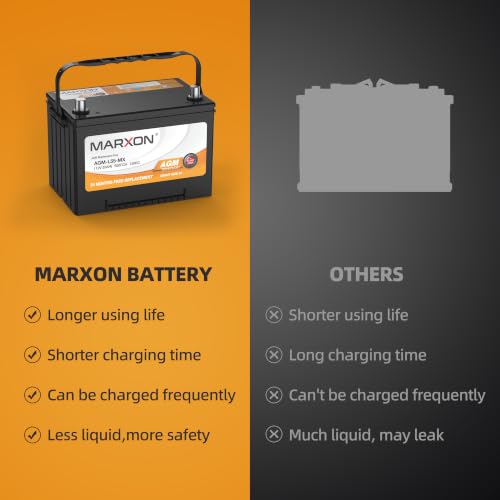
40% faster than conventional SLA batteries
because of improved charge acceptance and internal materials.
I would treat that as a:
manufacturer performance claim
rather than a universal charging-time guarantee.
Actual charging speed depends on:
- Alternator output
- Charging voltage
- Battery temperature
- State of charge
- Electrical load
- External charger output
Better charge acceptance can help a battery recover more effectively after repeated start-stop cycles, but the charging system still determines how much power is actually available.
A Better Battery Doesn’t Fix a Weak Alternator
Battery capacity and charging-system output are two different things.
If alternator output is insufficient, even a new AGM battery will eventually discharge.
Potential charging-system problems include:
- Weak alternator
- Failed voltage regulator
- Charging-cable resistance
- Poor ground
- Main charging fuse failure
- Battery-current sensor fault
If your battery warning lamp stays illuminated, use our Why Is My Battery Light On? diagnostic guide before assuming the battery itself is bad.
Maintenance-Free Design
The MARXON Group 34 uses sealed AGM construction.
Under normal operation, there is no need to routinely:
- Add distilled water
- Open battery caps
- Check electrolyte level
You should still inspect:
- Battery terminals
- Cables
- Grounds
- Hold-down hardware
- Charging voltage
Maintenance-free does not mean inspection-free.
Corrosion-Resistant Internal Alloy
MARXON states that the battery uses a proprietary alloy intended to improve:
- Corrosion resistance
- Leakage resistance
- Battery durability
These characteristics can contribute to longer service life when combined with correct charging and installation.
As with other performance claims, actual lifespan depends heavily on vehicle use and charging-system health.
Leak-Resistant AGM Construction
AGM construction holds electrolyte within internal glass mats instead of allowing it to move freely inside the case.
This helps reduce the likelihood of electrolyte leakage compared with a traditional serviceable flooded battery.
That’s particularly useful for vehicles where the battery is mounted:
- Under the hood
- In a trunk
- Beneath a seat
- Under a cargo floor
Always maintain factory battery venting when the vehicle requires it.
Improved Vibration Resistance
AGM batteries generally provide better resistance to vibration than traditional flooded designs.
That can make them useful in:
- Performance cars
- Trucks
- SUVs
- Vehicles driven on rough roads
- Stiffly sprung vehicles
The battery still needs to be properly secured.
A battery bouncing around the engine bay eventually turns every design advantage into a durability experiment.
Not a Dedicated Deep-Cycle Battery
The MARXON Group 34 AGM offers better cycling capability than a basic flooded starting battery.
That does not make it a dedicated deep-cycle battery.
Its primary job remains:
starting an automotive engine
For applications involving repeated deep discharge such as:
- Solar storage
- RV house systems
- Marine house banks
- Large engine-off inverters
use a battery specifically engineered for deep-cycle service.
Battery Light On?
A battery warning lamp that remains illuminated while the engine is running normally indicates a charging-system fault.
Potential causes include:
- Alternator failure
- Voltage regulator fault
- Broken drive belt
- Charging cable damage
- Poor engine ground
- Blown main fuse
Our Why Is My Battery Light On? guide explains how to isolate the problem.
Installing another battery without fixing the charging problem simply starts the countdown again.
Check the Main Fuse or Fusible Link
High-current alternator circuits frequently contain:
- Fusible links
- Mega fuses
- Strip fuses
- Battery-mounted fuse blocks
If one opens, alternator output may never reach the battery.
Our What Is a Fusible Link? Fusible Link vs. Fuse Explained article explains how these protective devices work.
Rapid Clicking When Starting
Rapid starter clicking often means battery voltage is collapsing when the starter attempts to operate.
Possible causes include:
- Weak battery
- Discharged battery
- Loose battery terminal
- Corroded cable
- Poor ground
- Starter fault
- Charging-system failure
Our Rapid Clicking When Starting a Car guide covers the proper diagnostic process.
Car Has Power but Won’t Start
Interior electronics require much less current than a starter motor.
A vehicle can still have:
- Dash lights
- Radio
- Headlights
- Door locks
while being unable to crank.
Our Car Has Power but Won’t Start diagnostic guide explains how to separate battery, starter, wiring and control-system faults.
Diagnose Before Buying a Battery
Before replacing a battery, test:
- Resting voltage
- Cranking voltage
- Charging voltage
- Cable voltage drop
- Parasitic current draw
Our Diagnose the Car Before Replacing Parts guide explains why basic electrical testing should come first.
The parts cannon remains exceptionally fast.
Accuracy is where it gets a little shaky.
MARXON Group 34 and Car Audio
A 55Ah AGM battery can support moderate aftermarket electrical equipment in a properly designed charging system.
Our Car Audio System Guide explains how battery capacity works together with:
- Alternator output
- Amplifier demand
- Power wiring
- Grounds
- Circuit protection
Remember:
Installing an AGM battery does not increase alternator amperage.
If a large audio system continuously demands more current than the alternator produces, the battery will eventually discharge.
Check Fitment Before Ordering
The MARXON battery measures:
10.87 × 6.61 × 6.89 inches
Before purchase, compare those dimensions with your original battery.
Check:
- Battery tray
- Hold-down
- Terminal location
- Cable reach
- Hood clearance
- Venting requirements
A battery can have the correct voltage and CCA and still be physically wrong for the vehicle.
Don’t Assume Every Group 34 Is Identical
Nominal BCI group size is an important fitment reference, but you should still compare the exact battery construction.
Possible differences include:
- Terminal orientation
- Terminal style
- Case details
- Hold-down design
- Overall height
Use the original battery and vehicle application data as the final fitment reference.
3-Year Replacement Coverage
MARXON advertises:
3 years of replacement coverage
and states that it maintains U.S.-based support and warehouse operations.
Before purchase, review the current warranty policy for:
- Proof-of-purchase requirements
- Replacement procedure
- Shipping responsibility
- Commercial-use exclusions
- Improper installation
- Incorrect charging
Warranty duration is useful.
Warranty terms are what actually determine coverage.
Who Should Buy the MARXON Group 34 AGM?
This battery is best suited to compatible vehicles requiring approximately:
BCI Group 34 dimensions
12V AGM chemistry
55Ah capacity
and:
650 CCA
It can be particularly useful for:
- Compatible start-stop vehicles
- Daily drivers
- SUVs
- Trucks
- Performance vehicles
- Vehicles with moderate electrical accessory loads
Why Buy the MARXON Group 34 AGM Battery?
Key features include:
- BCI Group 34
- 12V AGM technology
- 55Ah capacity
- 650 Cold Cranking Amps
- Start-stop compatibility
- Maintenance-free construction
- Improved charge acceptance
- Manufacturer-claimed faster recharge performance
- Corrosion-resistant internal alloy
- Leak-resistant AGM construction
- Improved vibration resistance
- 3-year advertised replacement coverage
For vehicles that require a compatible Group 34 AGM starting battery, the MARXON offers a practical balance of starting performance, modern AGM technology and improved cycling capability.
Specifications at a Glance
Brand: MARXON
Model: M-34
BCI Group: 34
Battery Type: AGM Automotive Starting Battery
Voltage: 12V
Capacity: 55Ah
Cold Cranking Amps: 650 CCA
Length: 10.87 inches
Width: 6.61 inches
Height: 6.89 inches
Weight: Approximately 42 lb
Terminal Type: A1
Primary Application: Automotive starting / compatible start-stop vehicles
Maintenance: Maintenance-free
Warranty: 3 years, according to MARXON
Always verify exact year, make, model, engine, battery dimensions, terminal arrangement, CCA requirements and AGM compatibility before ordering.








There are no reviews yet.