

What Is a Group 24F Battery?
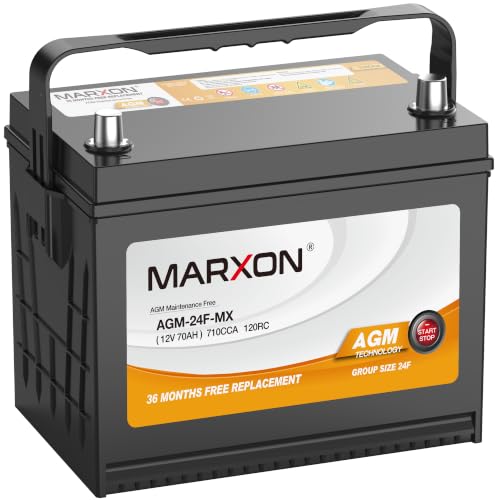
The 24F designation refers primarily to the battery’s physical dimensions and terminal arrangement.
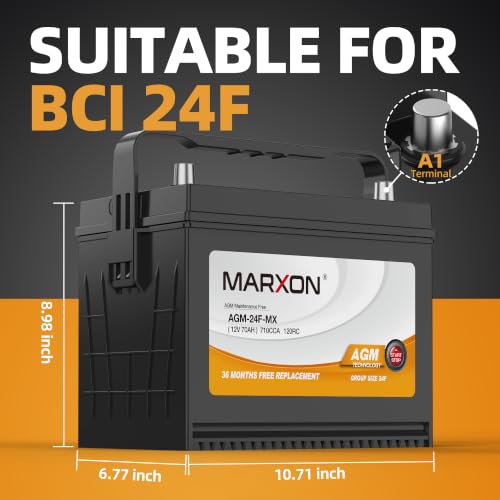
This battery measures approximately:
10.7 inches long
6.77 inches wide
8.98 inches tall
The advertised terminal arrangement is:
Negative: left
Positive: right
Group 24F batteries are commonly found in a variety of Asian-brand cars, SUVs and crossovers, but group size alone should never be treated as universal vehicle fitment.
Always verify the exact year, make, model and engine.
Group 24 vs. Group 24F
The F matters.
Group 24 and Group 24F batteries can be similar in overall size while using different terminal arrangements.
Installing the wrong polarity can leave battery cables:
- Too short
- Stretched
- Crossed over the battery
- Routed near moving components
- Positioned dangerously close to grounded metal
Compare the positive and negative terminal locations before buying.
Don’t discover what the “F” means while holding a 45-pound battery over the engine bay.
710 Cold Cranking Amps
The MARXON Group 24F battery is rated at:
710 CCA
Cold Cranking Amps measure how much current the battery can supply under standardized cold-weather conditions while maintaining sufficient voltage.
Cold starting places significant stress on a battery because:
- Battery output falls as temperature drops
- Engine oil becomes thicker
- Starter-motor demand increases
A 710CCA rating provides substantial cranking capability for compatible applications.
Always meet or exceed the vehicle manufacturer’s minimum CCA requirement.
70Ah Capacity
The battery provides:
70 amp-hours
Capacity matters because modern vehicles depend on their batteries for far more than simply operating the starter.
Even with the engine off, a vehicle may continue supplying power to:
- Security systems
- Keyless-entry receivers
- Body-control modules
- Telematics
- Infotainment memory
- Driver-assistance systems
- Computers
- Start-stop controls
A 70Ah battery provides useful electrical reserve for vehicles designed around this capacity range.
120-Minute Reserve Capacity
The MARXON Group 24F is rated at:
120 minutes of reserve capacity
Reserve capacity is a standardized measure of how long a fully charged battery can supply a 25-amp load before voltage reaches the specified cutoff.
That becomes especially useful if the charging system fails while driving.
A battery with useful reserve capacity may temporarily continue powering:
- Engine-management electronics
- Fuel systems
- Lighting
- Instrumentation
- Safety systems
But reserve capacity is not an excuse to keep driving indefinitely with a failed alternator.
Designed for Start-Stop Vehicles
MARXON markets this Group 24F AGM battery for compatible vehicles equipped with automatic start-stop systems.
Start-stop operation is demanding because the starter may operate repeatedly during a single drive.
While the engine is stopped, the battery may also continue supporting:
- Climate-control electronics
- Infotainment
- Lighting
- Computers
- Safety modules
This creates a combination of starting and cycling loads that conventional flooded starter batteries may not handle as well.
AGM batteries are commonly used for these higher-demand applications.
Start-Stop Can Reduce Fuel Consumption—But the Battery Doesn’t Create the Savings
Automatic start-stop technology can reduce fuel consumed while the vehicle would otherwise sit idling.
How much fuel is actually saved depends on:
- Vehicle
- Engine
- Traffic
- Climate-control use
- Trip length
- Driving environment
- How frequently the engine stops
The battery’s job is to support the system reliably.
It should not be marketed as independently guaranteeing a specific percentage of fuel or emissions savings.
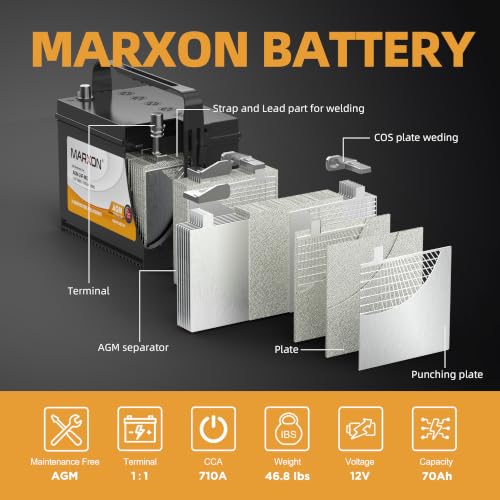
AGM Technology Explained
AGM stands for:
Absorbent Glass Mat
In an AGM battery, the electrolyte is absorbed into fiberglass separators instead of freely moving around the battery case.
Advantages can include:
- Better vibration resistance
- Strong starting capability
- Good charge acceptance
- Improved cycling performance
- Spill-resistant construction
- Maintenance-free operation
These characteristics make AGM batteries particularly useful in modern vehicles with substantial electrical demand.
Faster Charge Acceptance
MARXON advertises improved charging acceptance compared with conventional sealed lead-acid batteries.
Better charge acceptance is useful in vehicles with start-stop systems because the battery may need to recover energy quickly between repeated engine starts.
However, I would treat the advertised “40% faster charging” figure as a manufacturer claim rather than a universal charging-time guarantee.
Actual recharge time depends on:
- Battery state of charge
- Alternator output
- Charging voltage
- Vehicle energy-management strategy
- Temperature
- Electrical loads
The alternator ultimately determines how much charging power is available.
AGM Does Not Mean Deep-Cycle Unlimited
AGM construction improves cycling performance, but this remains primarily an automotive starting and start-stop battery.
Repeatedly discharging it completely can still shorten battery life.
If your application involves extended engine-off use such as:
- Large inverters
- Camping equipment
- Extended car-audio operation
- Refrigeration
- House loads
a battery designed specifically for deep-cycle service may be more appropriate.
Maintenance-Free Design
The MARXON Group 24F is designed to operate without routine electrolyte maintenance.
There is normally no need to:
- Remove cell caps
- Add distilled water
- Check electrolyte level
You should still inspect the electrical system periodically.
Check:
- Terminals
- Cables
- Grounds
- Hold-down hardware
- Battery case
- Charging voltage
Maintenance-free batteries still depend on a healthy charging system.
Improved Leak Resistance
The seller states that the battery uses an alloy designed to improve:
- Corrosion resistance
- Leak resistance
Combined with AGM construction, this creates a more contained battery design than a traditional serviceable flooded battery.
However, always follow the vehicle manufacturer’s battery mounting and venting requirements.
Some vehicles route battery gases outside the passenger compartment or trunk.
Do not remove factory venting simply because the replacement battery is AGM.
Strong Vibration Resistance
AGM construction generally provides better internal support than conventional flooded designs.
That can be useful in:
- SUVs
- Trucks
- Rough-road vehicles
- Performance cars
- Vehicles with stiff suspension
Vibration is one of the conditions that can shorten battery life over time.
The battery should still be securely clamped into the factory tray.
A loose battery bouncing around the engine compartment defeats the entire point.
Check the Battery Dimensions Before Ordering
MARXON lists the case dimensions as:
10.7 × 6.77 × 8.98 inches
Compare those measurements directly with the original battery.
Check:
- Battery tray length
- Battery tray width
- Battery height
- Hold-down location
- Terminal position
- Hood clearance
A battery fitting between the fenders does not mean it fits the vehicle.
Verify Terminal Polarity
The advertised terminal arrangement is:
Left: Negative
Right: Positive
Compare this directly with the battery currently installed.
Battery cables should reach the terminals without being:
- Stretched
- Crossed
- Twisted
- Forced around brackets
Never reverse polarity.
Modern vehicle electronics are generally not enthusiastic about being connected backward.
Is 710 CCA Enough?
Use the original battery specification as your baseline.
If the vehicle requires 600 CCA, a correctly sized 710CCA replacement provides additional starting margin.
If the vehicle requires substantially more than 710 CCA, however, don’t select this battery solely because it physically fits.
The correct replacement battery should meet:
Group size + polarity + capacity + CCA + battery chemistry
All five matter.
Is 70Ah the Correct Capacity?
Modern vehicles may use battery-management systems calibrated around a specific battery capacity.
If the factory battery is approximately 70Ah, this battery may be appropriate when the remaining specifications match.
Installing a dramatically different capacity can sometimes affect:
- Charging behavior
- Start-stop operation
- Battery-monitoring calculations
- Energy-management strategy
Match the original specification whenever possible.
Battery Registration May Be Required
Some newer vehicles require the replacement battery to be registered with the battery-management system.
The vehicle may track:
- Battery age
- Capacity
- State of charge
- Charging history
- Battery chemistry
Our What Is Battery Registration, and Does Your Car Need It? guide explains when battery registration matters and why replacing a battery isn’t always finished when the terminals are tightened.
Depending on the vehicle, battery registration may require a scan tool.
Replace AGM With AGM
If your vehicle originally came with an AGM battery, replacing it with another correctly specified AGM battery is generally the safest approach.
Downgrading to a conventional flooded battery may affect:
- Start-stop operation
- Battery lifespan
- Charge acceptance
- Cycling durability
Always follow the manufacturer’s original battery specification.
Battery Light On? Don’t Automatically Replace the Battery
A dashboard battery warning usually indicates a charging-system problem rather than simply a bad battery.
Possible causes include:
- Alternator failure
- Voltage-regulator failure
- Broken belt
- Wiring fault
- Main fuse failure
- Fusible link failure
- Battery sensor problem
Our Why Is My Battery Light On? guide explains how to determine whether the battery, alternator or charging circuit is actually at fault.
A healthy new battery can keep the car running temporarily with a failed alternator.
Once it discharges, you’re right back where you started.
Check Main Charging Fuses
The high-current circuit between the alternator and battery is often protected by:
- Fusible links
- Mega fuses
- Strip fuses
- Battery-terminal fuse assemblies
If one opens, the alternator may be generating power that never reaches the battery.
Our What Is a Fusible Link? Fusible Link vs. Fuse Explained guide explains how these high-current protection devices work.
Never replace a fusible link with ordinary wire.
That modification mostly makes the wiring harness volunteer for fuse duty.
Rapid Clicking When Starting
Rapid starter clicking commonly occurs when available voltage collapses under load.
Possible causes include:
- Discharged battery
- Weak battery
- Loose battery terminal
- Corroded cable
- Bad engine ground
- Starter failure
- Charging problem
Our Rapid Clicking When Starting a Car guide walks through the diagnosis.
Testing voltage while cranking can reveal much more than simply measuring resting battery voltage.
Car Has Power but Won’t Start
Lights and electronics working does not prove the battery is capable of cranking the engine.
The starter can require hundreds of amps.
Dashboard electronics may require only a fraction of that.
If the car powers up but refuses to crank, read our Car Has Power but Won’t Start diagnostic guide.
Possible causes include:
- Battery
- Starter
- Starter relay
- Cable resistance
- Ground fault
- Ignition switch
- Immobilizer
Diagnose first.
Buy parts second.
AGM Battery for Car Audio
A 70Ah AGM battery can provide a solid electrical foundation for compatible vehicles with moderate aftermarket audio equipment.
However, battery capacity is only one part of a car-audio electrical system.
Large amplifiers may require upgraded:
- Alternator output
- Power cable
- Ground cable
- Circuit protection
Our Car Audio System Guide explains how batteries and alternators work together in high-current audio systems.
A larger battery can store more energy.
It does not magically make a 120-amp alternator produce 200 amps.
Low Self-Discharge and Vehicles That Sit
AGM batteries typically offer good storage characteristics compared with conventional flooded batteries.
That can be useful for:
- Weekend vehicles
- Secondary cars
- Seasonal vehicles
However, vehicle parasitic draw can still discharge an AGM battery over time.
Security systems, keyless-entry receivers and telematics may remain active even while the car is parked.
For vehicles that sit for weeks at a time, use an AGM-compatible battery maintainer when appropriate.
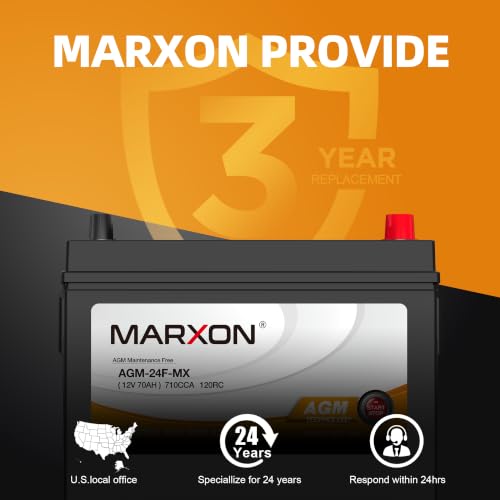
3-Year Warranty
MARXON advertises a:
3-year warranty
The seller also states that it maintains warehouse and support operations in California and Georgia.
Before purchase, verify the complete warranty terms, including:
- Free replacement period
- Prorated coverage
- Commercial-use exclusions
- Shipping responsibility
- Proof-of-purchase requirements
The length printed in the listing does not necessarily describe every warranty condition.
Who Should Buy the MARXON Group 24F AGM Battery?
This battery makes the most sense for a vehicle requiring:
BCI Group 24F
12V AGM technology
approximately 70Ah capacity
710CCA starting power
and:
left-negative/right-positive polarity
It may be particularly useful for compatible:
- Cars
- Crossovers
- SUVs
- Light trucks
- Start-stop vehicles
- Vehicles with substantial factory electronics
Exact vehicle fitment should still be confirmed before purchase.
Why Buy the MARXON Group 24F AGM Battery?
Key features include:
- BCI Group 24F sizing
- 12V AGM technology
- 70Ah capacity
- 710 CCA
- 120-minute reserve capacity
- Start-stop compatibility
- Maintenance-free design
- Improved charging acceptance
- Strong cold-start performance
- Leak-resistant construction
- Vibration-resistant AGM design
- Left-negative / right-positive terminals
- 3-year advertised warranty
For vehicles designed around a Group 24F AGM battery, the MARXON 12V 70Ah 710CCA AGM Battery offers a strong combination of starting power, reserve capacity and modern start-stop capability without requiring the maintenance of a traditional serviceable flooded battery.
Specifications at a Glance
Brand: MARXON
Battery Type: AGM Lead-Acid
BCI Group: 24F
Voltage: 12V
Capacity: 70Ah
Cold Cranking Amps: 710 CCA
Reserve Capacity: 120 minutes
Dimensions: 10.7 × 6.77 × 8.98 inches
Terminal Layout: Left Negative / Right Positive
Application: Starting / compatible start-stop vehicles
Maintenance: Maintenance-free
Warranty: 3 years, according to seller








There are no reviews yet.