
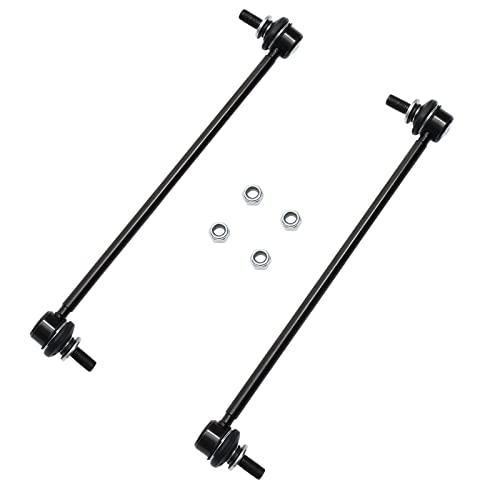

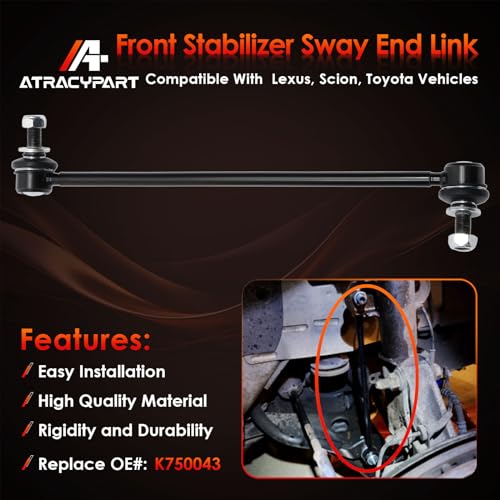

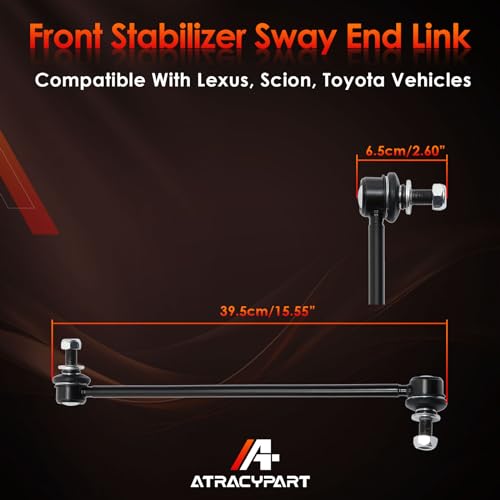
What Is Included?
The package contains:
- 2 × K750043 front sway bar end links
One link is installed on each side of the front suspension.
Replacing the links as a pair is often sensible on higher-mileage vehicles because both have experienced approximately the same mileage, road conditions and suspension cycles.
What Does a Front Sway Bar Link Do?
The sway bar link connects the stabilizer bar to the vehicle’s suspension.
During a turn, the outside suspension compresses while the inside suspension unloads. The end links transfer these forces into the sway bar, which twists and resists excessive body roll.
The system helps maintain:
- Predictable cornering
- Body-roll control
- Steering response
- Highway stability
- Transitional handling
The sway bar can’t do much if its connection to the suspension is loose, which is why seemingly insignificant end links can have a noticeable effect when they’re badly worn.
Symptoms of Bad Sway Bar Links
One of the most recognizable symptoms is a clunking or rattling noise over bumps.
Other symptoms can include:
- Clunking over rough roads
- Knocking over small bumps
- Rattling from the front suspension
- Increased body roll
- Loose handling
- Reduced steering confidence
- Visible play in the end-link joints
- Torn or deteriorated joint boots
Noise can become particularly noticeable while traveling slowly over uneven pavement.
Important Note About “Memory Steer”
Some product descriptions associate bad sway bar links with memory steer, where the steering doesn’t readily return toward center after a turn.
That’s generally not a classic sway bar end-link symptom.
Memory steer is more commonly associated with binding components such as:
- Strut mounts
- Strut bearings
- Ball joints
- Steering components
If the steering doesn’t naturally return toward center, diagnose the steering and suspension system rather than automatically replacing the sway bar links.
Can Bad Sway Bar Links Cause Tire Wear?
Not normally by themselves.
Sway bar links don’t directly establish wheel alignment.
Uneven tire wear should prompt inspection of:
- Toe
- Camber
- Ball joints
- Tie rods
- Control arm bushings
- Wheel bearings
- Tire pressure
Bad links can compromise handling, but replacing them isn’t a substitute for diagnosing an alignment problem.
K750043 Toyota RAV4 Fitment
One of the broadest applications is:
2006–2018 Toyota RAV4
This covers multiple RAV4 generations, so verifying the original component and suspension configuration before purchase remains important.
On an older RAV4, worn links can become particularly noticeable as a knocking sound over broken pavement.
Toyota Prius Fitment
K750043 is also listed for several Prius applications:
2010–2015 Toyota Prius
2012–2015 Toyota Prius Plug-In
2012–2018 Toyota Prius V
These are distinct Prius models, so don’t assume the same year range applies universally across every Prius variant.
Lexus CT200h Fitment
Compatible applications include:
2011–2017 Lexus CT200h
The CT200h shares considerable underlying architecture with Toyota’s hybrid platforms, making the K750043 applicable to these models as well.
Lexus HS250h Fitment
The links are listed for:
2010–2012 Lexus HS250h
This gives owners of the relatively uncommon HS another replacement option when servicing the front stabilizer system.
Lexus NX Fitment
Compatible NX applications include:
2015–2017 Lexus NX200t
2018–2019 Lexus NX300
2015–2019 Lexus NX300h
Note the model-name transition from NX200t to NX300 when cataloging the gasoline turbo application.
Scion tC Fitment
The K750043 fits:
2011–2016 Scion tC
This corresponds to the second-generation tC.
Scion xB Fitment
Fitment includes:
2008–2015 Scion xB
These second-generation xB models can develop suspension noises as mileage accumulates, making end-link inspection worthwhile when diagnosing front-end clunks.
Scion iM and Toyota Corolla iM
The links also fit:
2016 Scion iM
and:
2017 Toyota Corolla iM
Toyota transitioned the iM from the Scion brand to Toyota after discontinuing Scion.
Different badge, same basic car, because apparently parts catalogs weren’t complicated enough already.
Steel Construction
The K750043 links use steel connecting rods designed to handle the repeated forces transmitted between the suspension and sway bar.
The joint assemblies combine metal components with protective rubber boots intended to keep contaminants away from the moving joint surfaces.
Can New Sway Bar Links Improve Handling?
If the existing links are badly worn, yes.
Fresh links eliminate unwanted movement between the suspension and sway bar.
That can restore:
- More immediate sway-bar response
- Better body-roll control
- More predictable handling
- Reduced suspension noise
However, these are replacement links rather than a major performance modification.
They restore the connection; they don’t magically turn a Prius into a GR Corolla.
Installation
General installation involves:
- Park the vehicle on a level surface.
- Safely raise and support the front of the vehicle as required.
- Remove the front wheels if necessary for access.
- Locate the sway bar end links.
- Remove the upper and lower link fasteners.
- Remove the original link.
- Compare its dimensions with the K750043 replacement.
- Install the replacement link.
- Repeat on the opposite side.
- Torque all hardware to manufacturer specifications.
- Verify clearance through suspension movement.
- Road-test the vehicle.
- Reinspect the installation.
Corrosion can make removal considerably more difficult on older vehicles.
Does Replacing Sway Bar Links Require an Alignment?
Normally, no.
Sway bar links don’t directly adjust:
- Camber
- Caster
- Toe
An alignment isn’t generally required solely because the front end links were replaced.
What Else Should You Inspect?
If you’re diagnosing a front suspension clunk, inspect:
- Sway bar mounting bushings
- Ball joints
- Control arm bushings
- Tie-rod ends
- Struts
- Strut mounts
- Wheel bearings
Replacing sway bar links because “something up front makes noise” is technically diagnosis in the same way throwing darts is technically precision targeting.
Find the play first.
Complete K750043 Fitment
Toyota: 2006–2018 RAV4, 2010–2015 Prius, 2012–2015 Prius Plug-In, 2012–2018 Prius V, 2017 Corolla iM
Lexus: 2011–2017 CT200h, 2010–2012 HS250h, 2015–2017 NX200t, 2018–2019 NX300, 2015–2019 NX300h
Scion: 2016 iM, 2011–2016 tC, 2008–2015 xB
Always verify the original part, trim and suspension configuration before ordering.





There are no reviews yet.