
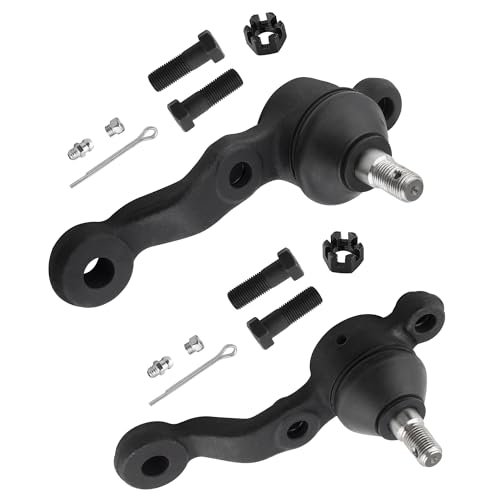
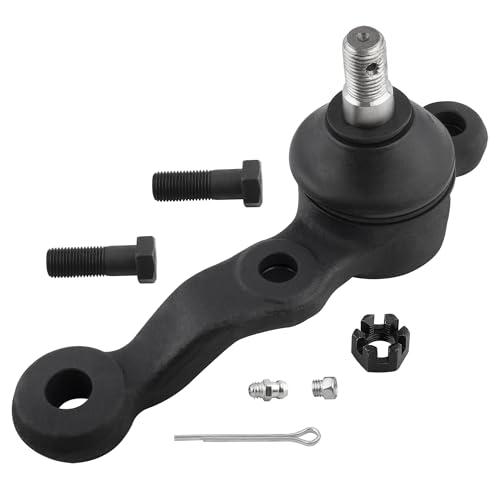
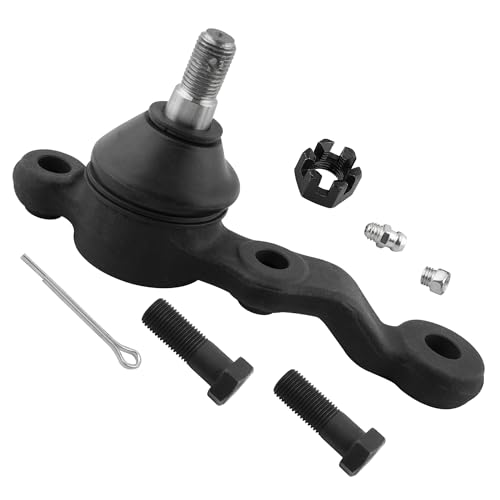
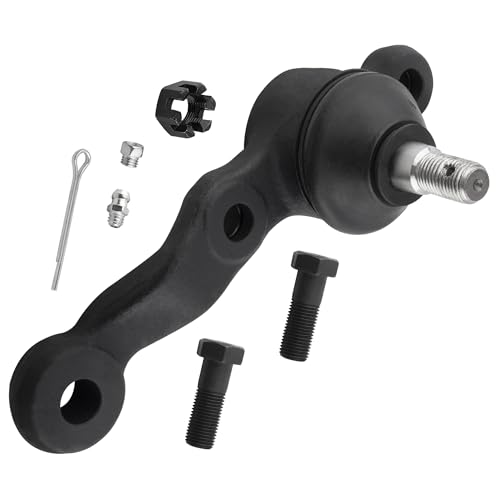
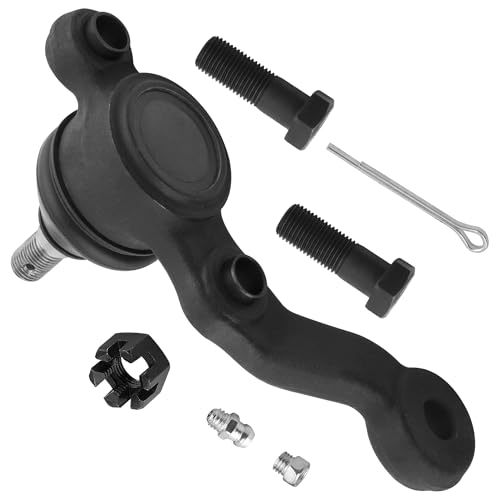
What Comes in the Package?
The kit includes:
- One K500066 front lower ball joint for the driver side
- One K500067 front lower ball joint for the passenger side
The parts are side-specific. Do not reverse them or assume both joints are interchangeable because they look similar in the box.
Product Specifications
| Specification | Detail |
|---|---|
| Product type | Front lower ball-joint set |
| Quantity | Two |
| Driver-side number | K500066 |
| Passenger-side number | K500067 |
| Position | Front lower |
| Vehicle | 2001–2005 Lexus IS300 |
| Body styles | Sedan and applicable SportCross |
| Installation type | Direct replacement |
| Material | High-strength steel construction |
| Warranty | Advertised five-year warranty |
Confirm current warranty conditions, exclusions and seller requirements before purchase.
What Does the Lower Ball Joint Do?
The lower ball joint connects the front suspension assembly to the steering knuckle. Its stud and socket must move through steering and suspension travel while keeping the wheel assembly securely positioned.
On the IS300, each joint deals with:
- Vehicle weight
- Steering movement
- Braking loads
- Cornering forces
- Pothole impacts
- Normal suspension travel
That is a busy job for a component most owners ignore until it begins making expensive noises.
The official Lexus suspension catalog confirms that the IS300 uses separate left- and right-side front lower ball-joint assemblies.
Symptoms of Bad IS300 Ball Joints
Common symptoms include:
- Clunking over bumps
- Popping while turning
- Wandering or vague steering
- Steering-wheel vibration
- Uneven front-tire wear
- Visible grease leakage
- Torn or cracked dust boots
- Excessive movement at the steering knuckle
- Difficulty maintaining alignment
Our guide to diagnosing a clunking noise while driving over bumps explains how ball-joint noise can overlap with worn control-arm bushings, sway-bar links and strut mounts.
A clicking or popping sound during low-speed steering can also indicate joint wear. Review the Pro Street guide to clicking noises while turning before treating every front-end noise as proof of a failed ball joint.
Why Replace Both Ball Joints Together?
The left and right joints operate under similar mileage and road conditions. If one is worn, the opposite side may not be far behind.
Replacing the pair offers several practical benefits:
- More consistent steering response
- Balanced suspension service
- Reduced repeated labor
- A better foundation for alignment
- Both dust boots and joints start with equal service time
- Easier inspection of the surrounding suspension
Replacing parts in pairs does not mean every component should be replaced blindly. Inspect first, diagnose second and order parts third. The parts cannon is entertaining until you receive the credit-card statement.
Construction and Durability
According to the supplied product information, these replacement joints use high-strength steel bodies and precision-machined components. The manufacturer states that they undergo fatigue, impact and wear testing.
The joints are marketed as OE-style replacements designed to restore normal articulation and suspension control. Their intended benefits include:
- Secure steering-knuckle attachment
- Controlled joint movement
- Resistance to suspension loads
- Direct vehicle-specific mounting
- Reduced looseness when replacing failed joints
- Corrosion-resistant treated components
A new ball joint can eliminate rattling or clunking only when the worn ball joint is actually causing the noise. It will not repair failed control-arm bushings, loose sway-bar links, worn shocks or a damaged wheel bearing.
Likewise, the claim that ball joints promote longer shock life should be treated cautiously. Correct suspension geometry helps the front end work properly, but new ball joints cannot restore an already worn shock absorber.
Inspect the Rest of the Front Suspension
A 2001–2005 IS300 is now more than two decades old. Before installing the new joints, inspect:
- Upper control arms and ball joints
- Lower control-arm bushings
- Tension or caster-arm bushings
- Inner and outer tie rods
- Sway-bar links
- Sway-bar bushings
- Wheel bearings
- Shocks and upper mounts
- Tires
- Steering-rack mounts
The Pro Street Energy Suspension guide explains how deteriorated bushings can allow unwanted movement that produces steering wander and inconsistent alignment.
If the steering wheel shakes, follow our steering-wheel vibration diagnosis before assuming the ball joints are solely responsible.
Installation Requirements
Replacing IS300 lower ball joints is an intermediate-to-advanced suspension repair. Typical tools include:
- Floor jack
- Properly rated jack stands
- Wheel chocks
- Metric socket set
- Breaker bar
- Torque wrench
- Ball-joint separator
- Pry bar
- Pliers
- Penetrating oil
- New cotter pins where required
Raise the vehicle only from approved lifting points and support it with jack stands. Never work beneath a car supported by a hydraulic jack alone. Pro Street’s guide to using an automotive jack safely covers the correct basic procedure.
Avoid damaging the steering-knuckle bore, ABS wiring and ball-joint stud threads. Compare the replacement joints with the removed parts before installation:
- Check the mounting-hole locations
- Compare the housing shape
- Verify the stud taper
- Confirm the thread size
- Match the left and right sides
- Inspect the dust boots for shipping damage
A pinched or torn boot allows dirt and water to enter the joint, dramatically shortening its usable life.
Torque Specifications
Ball-joint and lower-arm fasteners must be tightened to the correct factory specification. Do not reuse damaged locking hardware or cotter pins.
Use the complete Lexus IS300 and 2JZ-GE torque-specification guide as a supporting resource, then confirm the relevant suspension values through the Lexus service information for your specific model year.
A torque wrench is mandatory here. “One more pull on the breaker bar” is not a recognized unit of measurement.
Is an Alignment Required?
A wheel alignment is recommended after lower ball-joint replacement, especially if other suspension parts were removed or loosened during the repair.
An alignment check can identify:
- Incorrect toe
- Excessive camber
- Caster differences
- Worn control-arm bushings
- A bent suspension component
- An off-center steering wheel
Do not align the vehicle until every loose steering or suspension component has been repaired. Otherwise, the measurements can change as soon as the car returns to the road.
Frequently Asked Questions
What vehicles do K500066 and K500067 fit?
They fit the 2001–2005 Lexus IS300. This includes the sedan and applicable 2002–2005 SportCross wagon.
Which side is K500066?
K500066 is the front lower driver-side ball joint.
Which side is K500067?
K500067 is the front lower passenger-side ball joint.
Does this kit fit a 2001 Lexus IS300?
Yes. Unlike some larger steering and suspension kits with production-date restrictions, current K500066 and K500067 catalogs list the complete 2001–2005 IS300 range. VIN verification is still recommended.
Does it fit the IS300 SportCross?
Yes. The SportCross uses these front lower ball-joint applications for the 2002–2005 model years.
Will these fit a 2006 Lexus IS250?
No. The second-generation IS uses different suspension components.
Does this package include control arms?
No. It contains only the driver- and passenger-side front lower ball joints.
Will these ball joints stop a clunking noise?
They can eliminate the noise if worn lower ball joints are the confirmed cause. Control-arm bushings, sway-bar links, tie rods and shock mounts can produce similar symptoms.
Is professional installation recommended?
Yes. Incorrectly installed suspension components can create an unsafe driving condition. Use a qualified technician if you lack the proper lifting, separation and torque equipment.
Final Verdict
The K500066 and K500067 set provides both side-specific front lower ball joints required for a 2001–2005 Lexus IS300 suspension repair. It covers the sedan and SportCross, uses direct-replacement mounting and avoids ordering the two sides separately.
Diagnose the suspension before buying, inspect the surrounding arms and bushings, install the joints using the correct torque procedure and have the alignment checked afterward.







There are no reviews yet.