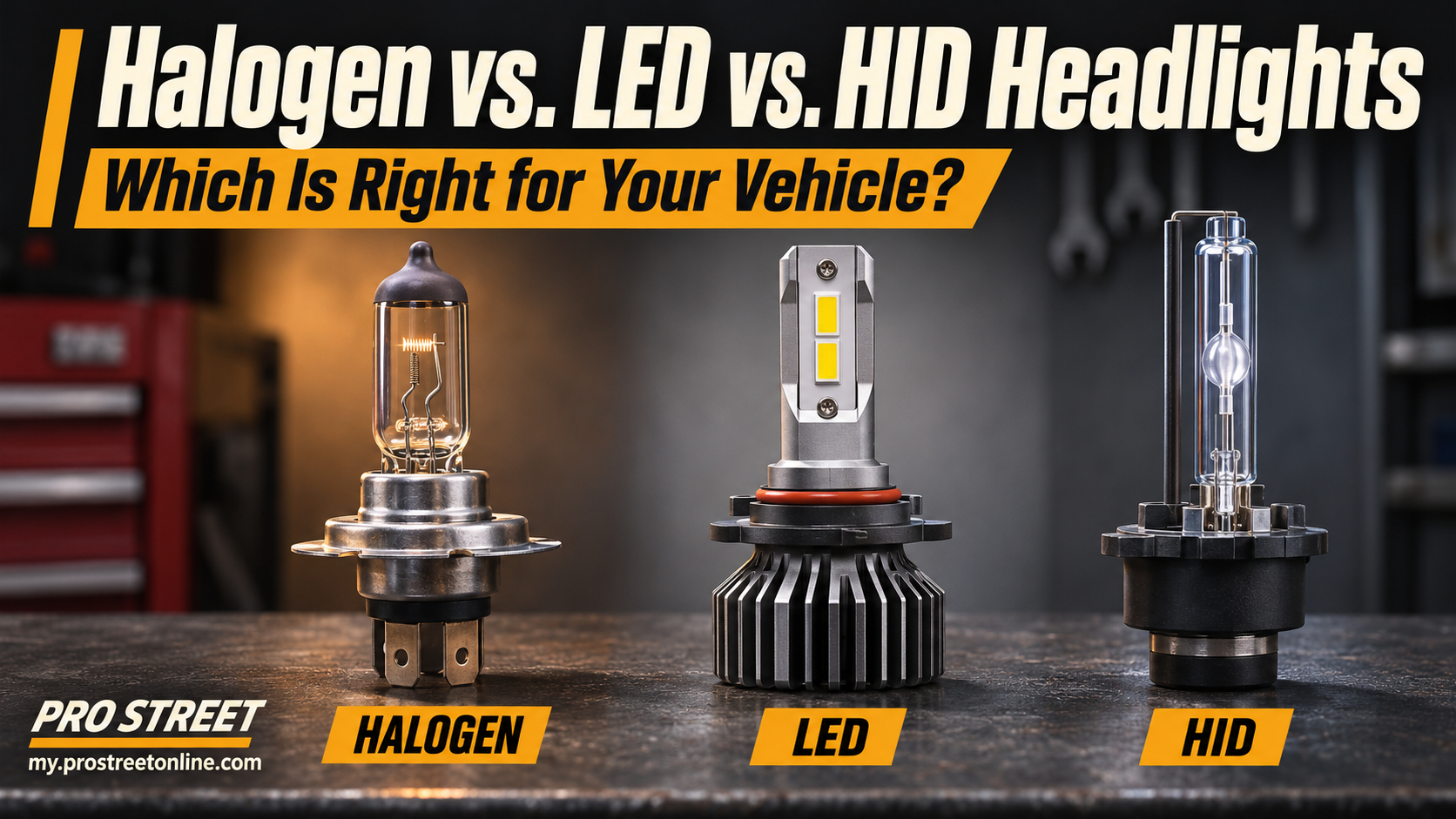
Shopping for new headlight bulbs used to be simple: you matched the number on the old bulb and bought a new one. Now you’re choosing between halogen, LED, and HID (xenon), each with its own color, brightness, lifespan, install requirements, and legal rules.
This guide walks through how each technology works, what it’s best at, where it falls short, and which ProStreet products fit each one, so you can buy the right bulb the first time.
The Quick Answer
- Want the simplest, street-legal, plug-and-play replacement? Go halogen.
- Want the brightest, whitest, longest-lasting light, and your vehicle uses sealed beams or 7″ / 5×7 headlights? A complete DOT-compliant LED headlight assembly is the best upgrade.
- Your vehicle came with factory HID headlights? Replace with HID bulbs that match your bulb code (D2S, D4S, and so on).
At a Glance
| Halogen | LED | HID (Xenon) | |
|---|---|---|---|
| Light color | Warm white (about 3000–4300K) | Cool white (about 5000–6500K) | White to cool white (about 4300–6000K) |
| Brightness | Standard to enhanced | High | High |
| Rated lifespan | About 500–1,600 hours | Up to 50,000+ hours (manufacturer rated) | About 3,000–5,000 hours |
| Warm-up | Instant | Instant | A few seconds |
| Install | Plug-and-play | Plug-and-play, but check rear clearance and CANbus | Plug-and-play in factory HID systems only |
| Street legal? | Yes (DOT bulbs) | Complete DOT assemblies: yes. LED bulbs in halogen housings: no | Yes, as factory replacements |
| Best for | OE replacement, bad weather, simplicity | Maximum brightness and long life | Vehicles with factory HID |
Halogen: The Reliable Standard
Halogen bulbs are what most vehicles leave the factory with. A tungsten filament glows inside a capsule filled with halogen gas, producing warm white light that works with every vehicle and every headlight housing.
Why choose halogen
- True plug-and-play: no decoders, no flicker, no bulb-out warnings, no clearance problems.
- Street legal: DOT-compliant halogen bulbs are the simplest way to pass inspection.
- Great in bad weather: warmer light scatters less in fog, rain, and snow than very white light.
- Affordable: easy to replace in pairs and keep spares on hand.
The trade-offs
- Shorter lifespan than LED or HID.
- Warmer, yellower light than modern LED or HID headlights.
- Gradual dimming over time. Replacing every 18 months or so keeps them at full strength.
Enhanced halogens are a middle ground. Bulbs with extra xenon gas in the fill burn brighter and whiter than standard halogens while staying DOT compliant. Blue-tinted versions give a whiter, 5000K-style look, though the coating trades away a little light output and lifespan.
ProStreet halogen picks
- Gentle King 9004 / HB1 Halogen: DOT compliant, OE-quality high/low beam, 1,300+ lumens (manufacturer rated), 3200K.
- SYLVANIA 9003 XtraVision: more down-road light than SYLVANIA Basic, with no change to housing or wiring.
- NEWBROWN 9006 / HB4 Halogen: 12V 51W, listed at 5000K, sold as a matched 2-pack.
- Bosch H8 Pure Light: OE-style fog light bulb with UV-Cut to help keep plastic lenses from yellowing.
- SYLVANIA H6024 XtraVision: a brighter, whiter 7″ round halogen sealed beam.
- Wagner H6054 Halogen Sealed Beam: the classic DOT/SAE 5×7 sealed beam for Jeeps, trucks, and more.
LED: Maximum Brightness and Lifespan
LED headlights use light-emitting diodes instead of a filament. They turn on instantly, produce crisp cool white light, use far less power, and are rated to last tens of thousands of hours.
LED comes in two very different forms, and the difference matters:
1. Complete LED headlight assemblies
These replace the entire headlight (lens, reflector, and light source) and are designed around LED light from the start. That means a proper beam pattern and a clean cutoff line. Some are DOT compliant, so they’re street legal.
They’re the best LED option for vehicles with sealed beam headlights: 7″ round (Jeep Wrangler JK, TJ, CJ, classic trucks) and 5×7 rectangular (Jeep Cherokee XJ, Wrangler YJ, older Ford, Chevy, GMC, and Dodge trucks and vans).
ProStreet picks
- ZIMABLUE 7″ Round LED Headlights (DOT): DOT compliant, 5,400 lm high beam (manufacturer rated), IP68 aluminum housing, fits the Jeep JK, TJ, LJ, and CJ.
- MAYELLO 5×7 LED Headlights: 4,500 lm high beam (manufacturer rated), sealed aluminum housing, fits the Jeep XJ, YJ, MJ, and more.
- IVBDQV 7″ Round Glass Headlights with LED H4 Bulbs: a classic glass lens that won’t yellow, with replaceable H4 bulbs.
2. LED replacement bulbs
These are LED bulbs shaped to fit a halogen socket (9006, 1156, 194, and so on). They’re bright and long-lasting, but they’re placed in a housing designed for a halogen filament.
- Headlights: LED bulbs in halogen headlight housings aren’t DOT-compliant for on-road use in the US. They’re best for off-road and show use.
- Small bulbs: LED reverse, interior, and license plate bulbs are popular, easy upgrades.
ProStreet picks
- AUTOONE 9006 / HB4 LED: 6500K cool white with a built-in cooling fan.
- LUYED 1156 LED Reverse Light: 6000K with a projector lens, ideal for brighter backup lights.
- AUXITO 194 LED: 6000K white for dome, map, trunk, and plate lights.
The trade-offs
- Rear clearance: fan-cooled bulbs are longer at the back, so check the space behind your headlight.
- CANbus warnings: some vehicles flicker or show a bulb-out warning, which a decoder or load resistor usually fixes.
- Hyper-flash: LED turn signals blink fast without a load resistor.
- Bad weather: cool white light can scatter more in heavy fog and snow.
HID (Xenon): The Factory Upgrade Path
HID (high-intensity discharge) headlights create light with an electric arc through xenon gas instead of a filament. They need a ballast to start and run, take a few seconds to reach full brightness, and produce intense white light.
The key rule: HID bulbs are for vehicles that came with factory HID headlights. Replace them with the exact bulb code on your old bulb (D1S, D2S, D3S, D4S, D2R, and so on). These codes aren’t interchangeable, because they differ in base, voltage, and housing type.
Why choose HID
- Bright, crisp light in factory projector headlights.
- Longer life than halogen, about 3,000–5,000 hours.
- Plug-and-play in factory HID systems with no error codes.
The trade-offs
- A few seconds of warm-up.
- Bulbs shift color as they age, so always replace in pairs.
- High-voltage systems call for care during installation.
- 6000K bulbs look whiter but produce slightly less total light than factory-color bulbs (about 4200–4300K).
ProStreet HID picks
- Philips D2S Authentic Xenon, 4200K: the factory-color choice for D2S systems.
- Torchbeam D2S HID, 6000K: OEM-spec replacement for 85122, 66240, and 66040, rated up to 5,000 hours.
- Marsauto D4S HID, 6000K: full brightness in about 5 seconds, replaces 66440 and 42402.
- SEALIGHT D4S HID, 6000K: German xenon gas, anti-UV quartz, IP68.
- Innovited D4S HID, 6000K: rated 3,500 hours, works in bi-xenon projectors.
Want instant-on instead? The Marsauto D4S / D4R LED replaces factory HID bulbs with LED. There’s no warm-up, and it’s rated up to 60,000 hours (manufacturer rated). It’s an off-road and show upgrade, since LED bulbs in HID housings aren’t DOT-compliant.
What About Color Temperature?
Color temperature, measured in Kelvin (K), describes how warm or cool the light looks:
- 3000–3500K: warm white, the classic halogen look. Best in fog and rain.
- 4200–4300K: bright warm white, the color of most factory HID headlights.
- 5000K: neutral daylight white.
- 6000–6500K: cool white with a crisp, modern look. It shows the best contrast on dry roads but scatters more in fog.
Higher K doesn’t mean brighter. It means whiter or bluer. If you drive in fog or snow a lot, warmer light is the safer choice.
How to Choose: 4 Questions
- What came on your vehicle? Check the bulb number on your old bulb or in your owner’s manual. Factory HID means buy HID. Halogen or sealed beam opens up all the options.
- Do you need it street legal? Stick with DOT halogen bulbs or DOT-compliant LED assemblies.
- What matters most? Simplicity and bad-weather performance point to halogen. Maximum brightness and lifespan point to LED. Restoring a factory HID system points to HID.
- Any fitment quirks? Check rear clearance for fan-cooled LEDs, CANbus warnings on newer vehicles, and adapters (for example, Jeep JK owners usually need an H13-to-H4 adapter for 7″ round H4 headlights).
Not sure what your vehicle uses? Check our Jeep Wrangler bulb size guide or read Sealed Beam vs LED Headlights for a deeper look at sealed beam upgrades.
Frequently Asked Questions
Can I put LED bulbs in my halogen headlights?
They’ll physically fit, but LED bulbs in halogen headlight housings aren’t DOT-compliant for on-road use in the US. For street-legal LED, choose a complete DOT-compliant LED headlight assembly.
Are HID headlights brighter than LED?
Both are far brighter than standard halogen. Quality LED assemblies and factory HID systems are comparable. The bigger differences are warm-up time (HID takes a few seconds, LED is instant) and lifespan (LED lasts much longer).
Can I use HID bulbs in a halogen headlight?
No. HID bulbs need a ballast and are designed for HID housings. Our HID bulbs are for factory HID systems only.
Why should I replace headlight bulbs in pairs?
All bulbs dim with age, and HID bulbs also shift color. Replacing both sides keeps brightness and color matched for safer, more even lighting.
Which is best for fog?
Warm halogen light (about 3000–4300K) scatters least in fog. For dedicated fog lights, OE-style bulbs like the Bosch H8 Pure Light perform best.
Need Help Choosing?
Browse all headlight bulbs, headlight assemblies, and LED kits, or contact the ProStreet team with your year, make, and model, and we’ll point you to the right halogen, LED, or HID option.