
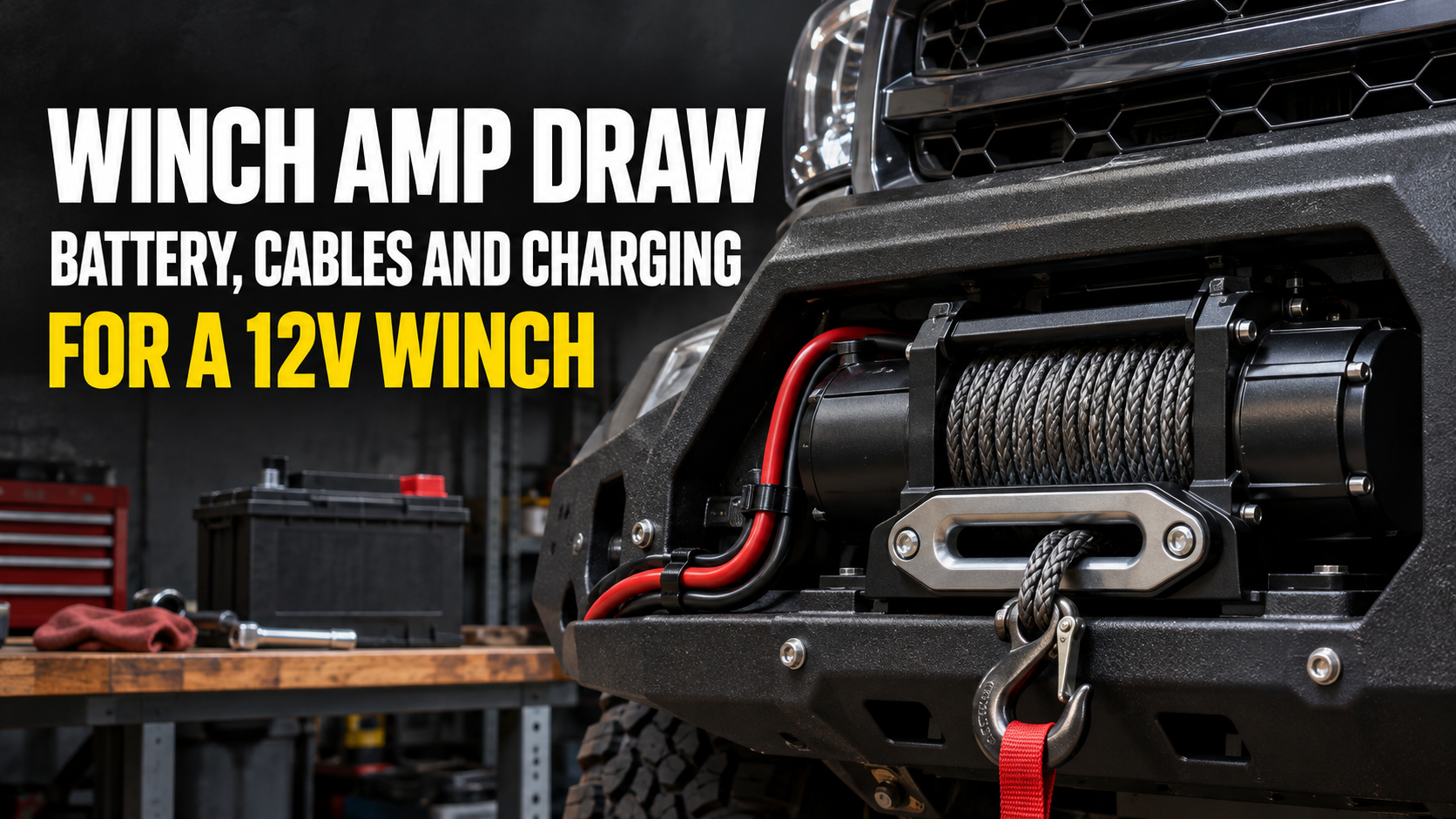
A 12,000 or 13,500 lb electric winch runs on the same 12-volt battery that starts your truck. Under a hard pull, it asks that battery, its cables and the alternator for more current than almost anything else you’ll bolt on. Winch amp draw is the number that tells you whether your electrical system is ready. Here’s what the makers of the winches in our store publish, and what to check on your truck before the first recovery.
If you’re still deciding how much winch you need, start with our sister site’s guide to choosing a truck winch. This post picks up once you’ve narrowed it down.
Winch amp draw at full load: what the makers publish
| Winch | Current at maximum line pull (12V) | Line speed at that pull | Battery the maker calls for | Source |
|---|---|---|---|---|
| OPENROAD Panther Series 3S 13,500 lb | 320 amps | 5.2 ft/min | 650 CCA | OPENROAD product page |
| Rough Country PRO12000S 12,000 lb | 360 amps (first layer) | 5.5 ft/min | 650 CCA minimum | Rough Country PRO9500/PRO12000 manual (see note) |
| VEVOR 13,500 lb | Not published on our listing | Not published | Not published | Store listing |
Note: the Rough Country manual we found covers the PRO12000 with steel cable. Our listing is the synthetic-rope PRO12000S, so confirm the figures with Rough Country for your model.
To put those numbers in perspective, 320 amps at 12 volts is roughly 3,800 watts of electrical demand, and that’s at the moment of hardest pull. If a listing doesn’t give a current figure, ask the seller before you buy. You can’t size the rest of the system without it.
Keep the engine running and give the motor breaks
Rough Country’s manual tells you to start the engine, select neutral and hold idle while winching, so the alternator helps carry the load and the battery isn’t run flat. Never winch with the transmission in gear or in park. The manual gives no fixed duty cycle. Instead, it says to stop and let the motor cool if it gets too hot, rest the winch periodically on long pulls, and never keep power applied if the motor stalls.
Cables, connections and factory wiring
A winch should be wired with the leads its maker supplies, not tapped into an existing accessory circuit:
- Rough Country: the manual lists 2-gauge, 72-inch battery leads, with the red lead to battery positive and the black lead from the motor to battery negative.
- OPENROAD: the product page lists 72-inch battery cables.
- Routing: keep the leads away from sharp edges and exhaust heat, and make sure the terminals are clean and tight. A loose terminal at 300-plus amps turns into heat.
Our sister site’s explainer on fusible links and fuses lists winches among the accessories that can overload factory wiring when they’re installed incorrectly. If your truck has factory inline fuses or fusible links between the battery and the rest of the system, check where the winch connects relative to them before you finalize the install.
Check the battery and alternator before the trail
A winch can only use what the battery and charging system can deliver. Before you rely on it, confirm the battery is fully charged and meets the cold cranking amps (CCA) rating the winch maker calls for. Then check that the alternator is charging properly at idle and under load. Our sister site’s walkthrough on testing alternator output with a multimeter covers the battery-at-rest, idle and loaded voltage checks, plus voltage-drop tests on the cables and grounds.
Less pull means less current
Current climbs with load, so anything that lowers the load on the winch also lowers the current it draws. Two ways the Rough Country manual describes:
- Pull from the inner layers. Rated pull falls as rope stacks up: the manual lists 12,000 lb on the first layer, 9,210 lb on the second, 8,030 lb on the third and 6,894 lb on the fourth. Spool out as much line as practical for a heavy pull, but always leave at least five wraps on the drum.
- Double the line with a snatch block. The manual says a snatch block doubles the winch’s pulling capacity and halves the line speed.
One thing to watch on listings: OPENROAD’s 13,500 lb figure appears in our listing as both the winch class and the rope’s breaking capacity. Rope breaking strength isn’t a working load or a line-pull rating. Check both numbers separately.