
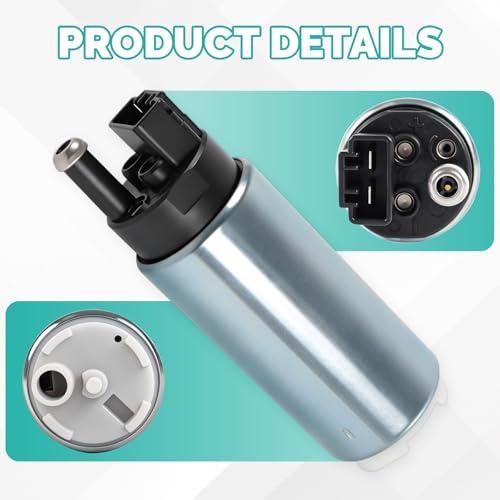
Can a 255LPH Fuel Pump Support 500–600 Horsepower?
The manufacturer/seller specification describes this pump as suitable for applications in approximately the 500–600 horsepower range, but that should be treated as a general application estimate rather than a guaranteed horsepower rating.
Actual supported horsepower depends on:
- Fuel type
- Base fuel pressure
- Boost pressure
- Pump voltage
- Injector capacity
- Fuel-line restriction
- Fuel filter condition
- Regulator configuration
- Brake-specific fuel consumption
- Naturally aspirated versus forced induction operation
Our fuel pump upgrade guide goes deeper into matching pump capacity to the actual combination instead of relying exclusively on an advertised horsepower number.
For performance builds, having fuel-system headroom is far better than discovering the pump’s limit during a wide-open-throttle pull. Engines tend to file complaints about inadequate fueling in unusually expensive ways.
Ideal for Turbo and Supercharged Applications
Forced induction is one of the most common reasons to move beyond an original fuel pump.
Increasing boost forces more air into the engine, requiring additional fuel to maintain the commanded air/fuel ratio. A higher-capacity pump can support the larger injectors and increased fuel demand associated with turbocharger and supercharger upgrades.
If you’re planning a boosted build, our turbocharger upgrade guide explains why the pump, injectors, wiring, fuel lines and regulator should be treated as supporting components of the complete power package.
Match the Pump With the Right Injectors
Installing a high-flow pump does not automatically increase horsepower. It simply gives the fuel system additional delivery capacity.
The injectors still have to provide enough fuel for the engine.
Larger turbos, increased boost, engine swaps and aggressive naturally aspirated combinations can eventually push factory injectors beyond their useful duty cycle. When that happens, pump capacity alone cannot solve the problem.
Read our guide to fuel injector upgrade benefits before choosing injectors for a higher-output combination.
Pump, injectors, regulator and ECU calibration should be selected as a system rather than as unrelated upgrades.
Return vs Returnless Fuel Systems
A 255LPH pump can be used in many different fuel-system layouts, but increasing pump capacity can affect how the system controls pressure.
Before installing a universal performance pump, determine whether your vehicle uses a traditional return-style system, mechanical returnless arrangement or electronically controlled returnless system.
Our returnless versus return fuel systems comparison explains how these systems regulate pressure and why high-flow pumps can require additional consideration for regulators, return lines and electronic pump controls.
This is particularly important on newer vehicles where the ECU or fuel-pump control module may vary pump voltage or speed.
What About E85?
A 255LPH pump should not automatically be considered E85 compatible simply because it is a high-flow performance pump.
The supplied specifications do not explicitly establish E85 compatibility for this particular pump.
If you’re converting a vehicle to ethanol, verify that the pump’s internal components, seals and materials are specifically rated for the intended ethanol concentration before installation.
Our How to Convert to E85 guide explains why the fuel pump is one of the major components that needs attention when switching from gasoline to ethanol.
E85 also requires greater fuel volume than gasoline. That means a 255LPH pump that provides comfortable headroom for a gasoline combination may have considerably less horsepower headroom when running ethanol.
For a complete conversion, also read our guide to upgrading fuel lines for E85.
Don’t Ignore Fuel-Pump Wiring
The advertised flow numbers are based on a specific electrical supply.
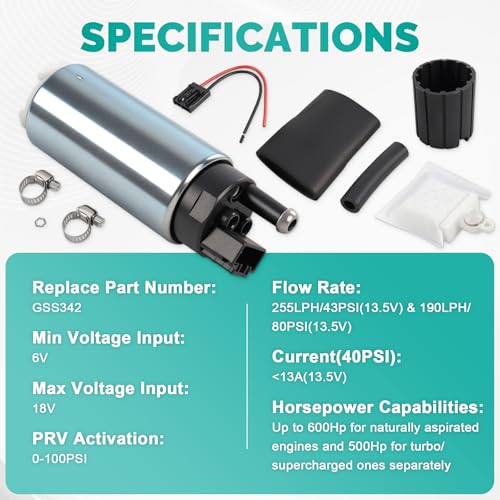
This pump is rated at 255LPH at 43 PSI with 13.5 volts, which makes voltage at the pump an important part of achieving its intended performance.
Old factory wiring, corroded connectors, weak grounds and undersized wiring can create voltage drop under load. The engine may therefore receive less fuel than expected even though the pump itself is technically large enough.
For modified vehicles, inspect the factory circuit and determine whether a dedicated relay and upgraded power and ground wiring are appropriate.
Measure voltage at the fuel pump under load whenever possible.
Universal Fitment
The GSS342 255LPH pump is a universal performance component, not a guaranteed direct-fit pump for every vehicle.
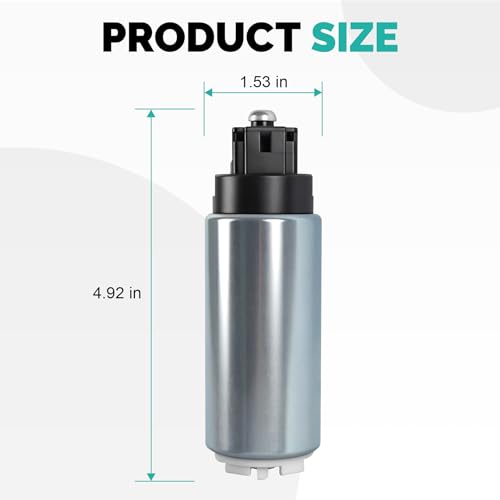
Before ordering, compare the pump dimensions, electrical connector, inlet arrangement, outlet configuration, fuel-pump hanger and strainer orientation against the original installation.
Some applications may require modification or adaptation.
Professional installation is recommended when changes to the fuel-pump hanger, wiring or fuel lines are necessary.
What’s Included?
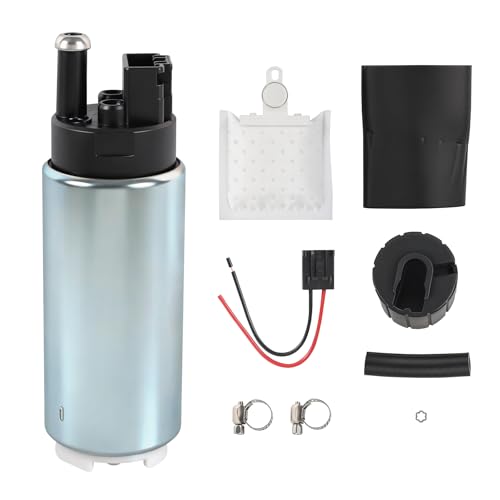
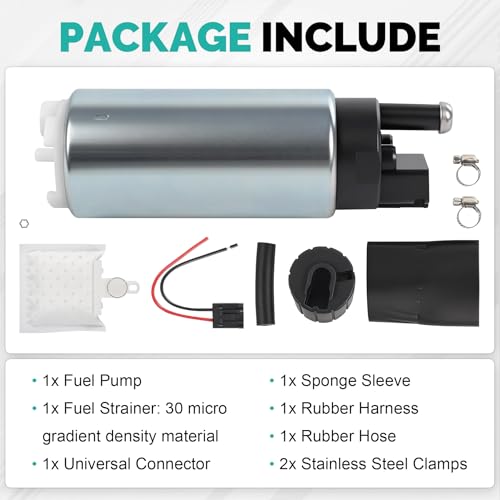
The GSS342 255LPH fuel-pump kit includes:
- 1 × 255LPH Electric Fuel Pump
- 1 × 30-micron gradient-density fuel strainer
- 1 × Universal electrical connector
- 1 × Sponge sleeve
- 1 × Rubber harness
- 1 × Rubber hose
- 2 × Stainless-steel clamps
This combination provides the basic hardware needed for adapting the pump to many compatible fuel-pump assemblies.
Why Upgrade to a GSS342 255LPH Fuel Pump?
For a modified street car or performance project that has outgrown its factory pump, a 255LPH high-pressure fuel pump provides a practical step up in fuel-delivery capacity without immediately moving into a massive race-oriented fuel system.
It’s particularly attractive for:
- Turbocharged street cars
- Supercharged applications
- Modified naturally aspirated engines
- Engine swaps
- Larger injector upgrades
- ECU-tuned vehicles
- Street/strip cars
- Track and racing applications
- Older performance vehicles needing a higher-capacity replacement pump
The key is matching the pump to the actual engine combination.
A fuel pump isn’t horsepower in a tube. Size the pump around your target power, pressure, fuel and injector requirements, then make sure the wiring and rest of the fuel system can actually support it.
Product Specifications
Part Number: GSS342
Product Type: High-Flow Electric Fuel Pump
Rated Flow: 255 LPH @ 43 PSI / 13.5V
High-Pressure Flow: Approximately 190 LPH @ 80 PSI / 13.5V
Minimum Voltage Input: 6V
Maximum Voltage Input: 18V
PRV Activation: Listed at 0–100 PSI
Fitment: Universal / application dependent
Fuel Strainer: 30-micron gradient-density material
Recommended Applications: Performance street, turbocharged, supercharged and racing vehicles
Important Fitment Note: Verify pump dimensions, fuel compatibility, electrical requirements, inlet/outlet configuration and vehicle-specific fitment before ordering. Universal fitment does not mean direct fit for every vehicle.






There are no reviews yet.